Short answer: the Yamaha VXL1-8, though neither ranks well in its class. Both are rated 2.6/5 for sound quality (#21 and #22 of 23 column and line array PA speakers), and the Yamaha VXL1-8 costs $444.99 against $807.99 for the Yamaha VXL1-16, so with nothing between them on sound quality, price settles it. Both are rated below 3.0/5 among the 23 column and line array PA speakers, so if sound quality matters, consider the JBL COL800 instead, ranked #11 at $577.

Why pick the Yamaha VXL1-16: The middle model of Yamaha’s VXL slim line arrays, with sixteen 1.5” full-range drivers in a 54mm wide column between the measured Yamaha VXL1-8 and Yamaha VXL1-24. The tradeoff: No independent measurements yet, so it can’t be compared with ranked PA speakers.
Why pick the Yamaha VXL1-8: A slim column speaker for commercial installations with eight 1.5” drivers in a line array. The tradeoff: Bass is very limited, so it needs a subwoofer, and the on-axis response is very uneven (2.37 average deviation).
Buy the Yamaha VXL1-8. Both are rated the same for sound quality, and it costs $363 less than the Yamaha VXL1-16.
Worth knowing: the Yamaha VXL1-16 has not been measured yet. Its rating is estimated from related models, with a likely range of 2.2 to 3.0, so treat this verdict as provisional.
Looking for alternatives? See the complete PA & Live Sound rankings.
Specifications Side By Side
| Yamaha VXL1-16 | Yamaha VXL1-8 | |
|---|---|---|
| Price | $807.99 each Passive | $444.99 each Passive |
| Ranked | #22 of 23 in Column and Line Array PA Speakers Estimated | #21 of 23 in Column and Line Array PA Speakers |
| Weight | 8.6 lbs (3.9 kg) | 4.6 lbs (2.1 kg) |
| Rigging | Wall mount bracket included | Wall mount bracket included |
| Maximum SPL | 116dB peak (manufacturer specified) | 111dB peak (manufacturer specified) |
| Passive | Yes | Yes |
| Configuration | Passive slim line array column | - |
| Drivers | 16x 1.5” full-range drivers | 8x 1.5” full-range drivers (line array) |
| Coverage | Switchable 20° or 30° vertical | - |
| Power Handling | 80W | - |
| XLR Input | No | - |
| Bluetooth | No | No |
| DSP | No (passive) | - |
| Amplifier Power | Passive speaker; requires external amplification | - |
| Spinorama Preference Score | - | -0.38 |
| Spinorama Preference Score with Perfect Sub | - | 4.48 |
| DIY Kit | - | No |
Related Speaker Comparisons
More worthwhile head-to-heads for Yamaha VXL1-8:
- JBL COL600 vs Yamaha VXL1-8
- JBL CBT 50LA-1 vs Yamaha VXL1-8
- JBL CBT 50LA-1 vs Yamaha VXL1-16
- JBL CBT 100LA-1 vs Yamaha VXL1-16
- JBL COL800 vs Coda Audio CoRay4
Prices on this page were last checked October 11, 2026 at 4:59 PM UTC. Product prices and availability are accurate as of that date/time and are subject to change; the price and availability shown on Amazon at the time of purchase will apply to the purchase of this product.
As an eBay Partner, we may be compensated if you make a purchase.
The Two Speakers In Full
 Yamaha VXL1-16: $807.99 each Passive Estimated Full Compass eBay
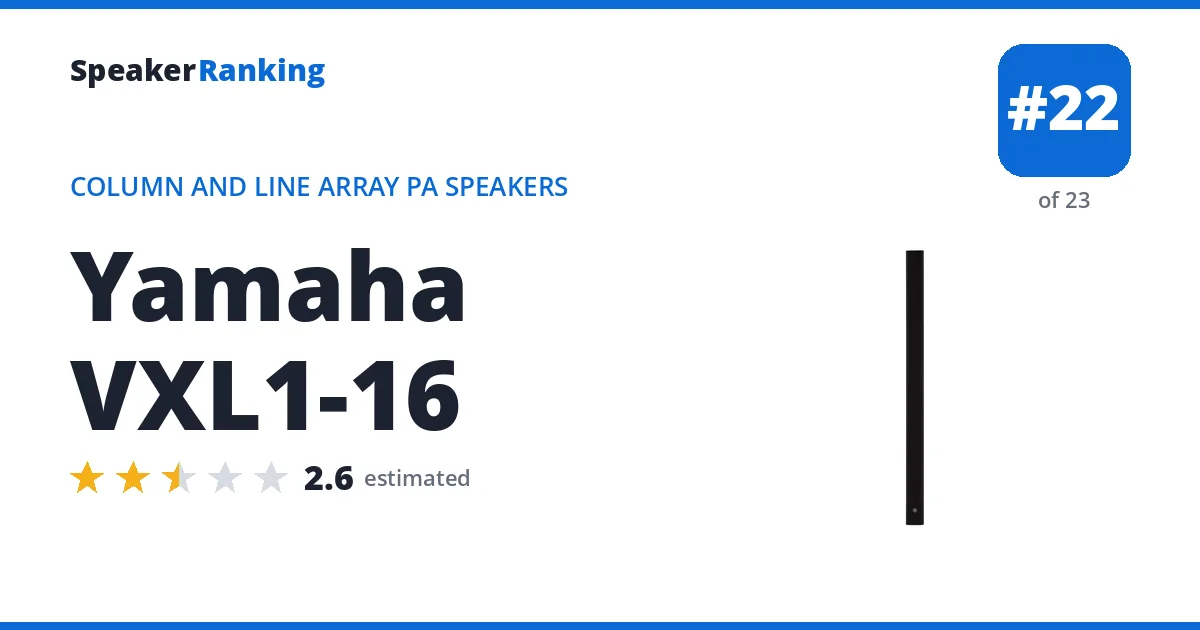
Same family: the Yamaha VXL1-8 (smaller model, ranked higher, rated 2.6/5) and the Yamaha VXL1-24 (larger model, ranked lower, rated 2.5/5).
Pros: The middle model of Yamaha’s VXL slim line arrays, with sixteen 1.5” full-range drivers in a 54mm wide column between the measured Yamaha VXL1-8 and Yamaha VXL1-24. A rear switch picks 20° or 30° vertical coverage, which helps speech intelligibility in reflective rooms.
Cons: No independent measurements yet, so it can’t be compared with ranked PA speakers. Small full-range drivers limit bass and output, so it is built for speech and background music, and it needs an external amplifier.
Full Yamaha VXL1-16 review and specifications →
| Released | Jun 2017 (9 years ago) |
|---|---|
| Amplifier Power | Passive speaker; requires external amplification |
| Bluetooth | No |
| Configuration | Passive slim line array column |
| Coverage | Switchable 20° or 30° vertical |
| DSP | No (passive) |
| Drivers | 16x 1.5” full-range drivers |
| Maximum SPL | 116dB peak (manufacturer specified) |
| Passive | Yes |
| Power Handling | 80W |
| Rigging | Wall mount bracket included |
| Weight | 8.6 lbs (3.9 kg) |
| XLR Input | No |
- Links
- Reviews, Comparisons and Sound Samples
- No independent measurement review is linked for this model; it is ranked from hands-on listening and comparison against similarly priced speakers.
- Head-to-Head Comparisons
 Yamaha VXL1-8: $444.99 each Passive Amazon eBay
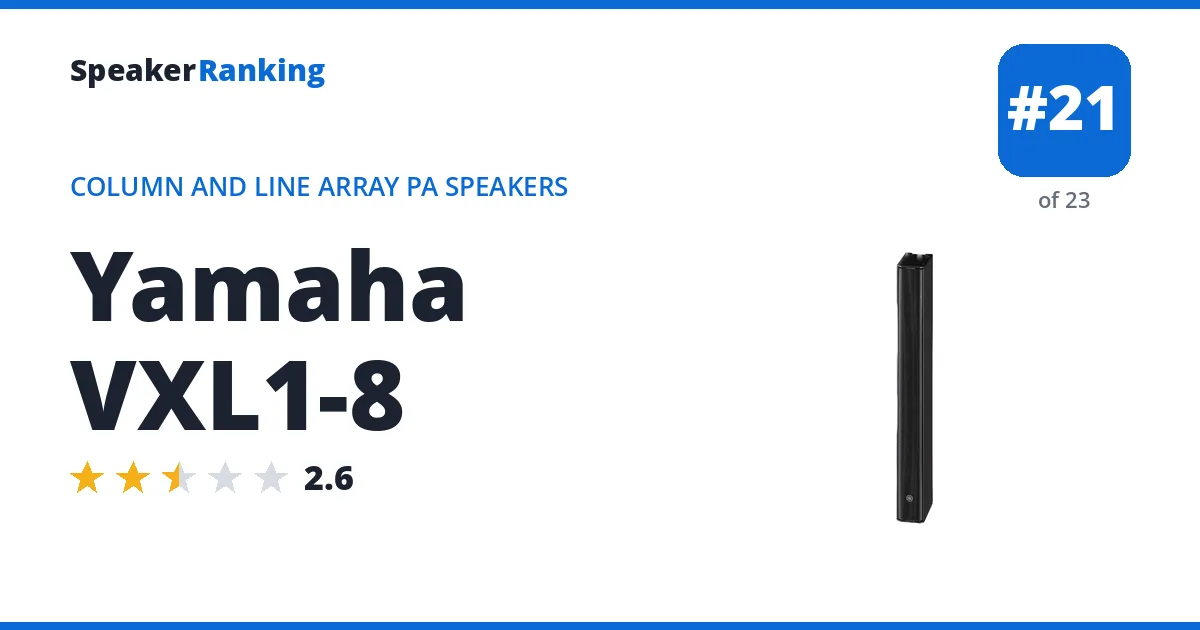
Same family: the Yamaha VXL1-16 (larger model, ranked lower, estimated 2.6/5) and the Yamaha VXL1-24 (larger model, ranked lower, rated 2.5/5).
Pros: A slim column speaker for commercial installations with eight 1.5” drivers in a line array. Yamaha’s measurements show a preference score of -0.38 that reaches 4.48 with an ideal subwoofer, with 0.69 listening window deviation.
Cons: Bass is very limited, so it needs a subwoofer, and the on-axis response is very uneven (2.37 average deviation). The data comes from Yamaha.
Full Yamaha VXL1-8 review and specifications →
| Released | Jun 2017 (9 years ago) |
|---|---|
| Bluetooth | No |
| DIY Kit | No |
| Drivers | 8x 1.5” full-range drivers (line array) |
| Maximum SPL | 111dB peak (manufacturer specified) |
| Passive | Yes |
| Rigging | Wall mount bracket included |
| Spinorama Preference Score | -0.38 |
| Spinorama Preference Score with Perfect Sub | 4.48 |
| Weight | 4.6 lbs (2.1 kg) |
- Reviews, Comparisons and Sound Samples
- Head-to-Head Comparisons