Short answer: the Warwick Acoustics Aperio on measured sound quality, the Stax SR-X9000 on price. The Warwick Acoustics Aperio ranks #74 of 216 over-ear headphones, rated 4.0/5, at $30,000. The Stax SR-X9000 ranks #101, rated 3.8/5, at $6,819.99, $23,180.01 cheaper.

What the Warwick Acoustics Aperio does well: In oratory1990’s measurement it scores 81 for preference, with low mids within 0.3 dB of target, so vocals and the body of instruments sound natural and unforced. The tradeoff: It is electrostatic and needs a dedicated electrostatic energizer, so it cannot be driven from a phone or a regular headphone amp.
Why pick the Stax SR-X9000: A preference score of 77, with the midrange from 200 Hz to 3 kHz staying within about 1.3 dB of target for natural, uncolored voices and instruments. The tradeoff: It needs a dedicated electrostatic energizer, and bass falls 6 dB below target by 56 Hz, about 9.5 dB short across the sub-bass, so the deepest notes are faint.
Buy the Warwick Acoustics Aperio if sound quality is the priority over the price, or the Stax SR-X9000 if the price is the priority over sound quality.
Still deciding? The full Headphones rankings cover every ranked option.
Specifications Side By Side
| Warwick Acoustics Aperio | Stax SR-X9000 | |
|---|---|---|
| Price | $30,000.00 | $6,819.99 |
| Ranked | #74 of 216 in Over-Ear Headphones | #101 of 216 in Over-Ear Headphones |
| Form Factor | Over-ear | Over-ear |
| Harman Preference Score | 81 (measured by oratory1990, via AutoEQ) | 77 (measured by oratory1990, via AutoEQ) |
| Deviation From Target | 2.24 dB standard deviation | 2.72 dB standard deviation |
| Tonal Tilt | -0.33 (negative is warmer, positive brighter) | +0.20 (negative is warmer, positive brighter) |
| Sub-bass Extension | Within 6 dB of target down to 20 Hz (-3.3 dB at 30 Hz) | Falls 6 dB below target at 56 Hz (-9.0 dB at 30 Hz) |
| Connection | Wired | Wired |
| Back | Open | Open |
| Driver Type | Electrostatic | Electrostatic |
| Drivers | 1 x balanced-drive electrostatic (3570 mm2 diaphragm area) | 1 x large round push-pull electrostatic |
| Weight | 0.9 lbs (405 g) | 1 lbs (432 g) |
| Frequency Response | 10Hz - 60kHz (Manufacturer specified) | 5Hz - 42kHz (Manufacturer specified) |
| Built-in Microphone | No | No |
| Sensitivity | - | 100 dB |
Related Headphone Comparisons
More worthwhile head-to-heads for Warwick Acoustics Aperio:
- HIFIMAN Shangri-La Jr vs Warwick Acoustics Aperio
- HIFIMAN Susvara Unveiled vs Warwick Acoustics Aperio
- HIFIMAN Shangri-La Jr vs Stax SR-X9000
- HIFIMAN Susvara Unveiled vs Stax SR-X9000
- HIFIMAN Susvara vs Stax SR-X9000
Prices on this page were last checked October 11, 2026 at 4:59 PM UTC. Product prices and availability are accurate as of that date/time and are subject to change; the price and availability shown on Amazon at the time of purchase will apply to the purchase of this product.
As an eBay Partner, we may be compensated if you make a purchase.
The Two Headphones In Full
 Warwick Acoustics Aperio: $30,000.00 Headphones.com eBay

Pros: In oratory1990’s measurement it scores 81 for preference, with low mids within 0.3 dB of target, so vocals and the body of instruments sound natural and unforced. Bass stays within about 1 dB of target from 60 to 200 Hz and reaches down to 20 Hz without falling more than 6 dB.
Cons: It is electrostatic and needs a dedicated electrostatic energizer, so it cannot be driven from a phone or a regular headphone amp. A deep 10.9 dB dip near 9.4 kHz and presence about 2.8 dB under target from 3 to 6 kHz leave cymbals and the leading edge of instruments sounding muted. The open back leaks sound and gives no isolation.
Full Warwick Acoustics Aperio review and specifications →
| Back | Open |
|---|---|
| Built-in Microphone | No |
| Connection | Wired |
| Deviation From Target | 2.24 dB standard deviation |
| Driver Type | Electrostatic |
| Drivers | 1 x balanced-drive electrostatic (3570 mm2 diaphragm area) |
| Form Factor | Over-ear |
| Frequency Response | 10Hz - 60kHz (Manufacturer specified) |
| Harman Preference Score | 81 (measured by oratory1990, via AutoEQ) |
| Sub-bass Extension | Within 6 dB of target down to 20 Hz (-3.3 dB at 30 Hz) |
| Tonal Tilt | -0.33 (negative is warmer, positive brighter) |
| Weight | 0.9 lbs (405 g) |
EQ preset to match the Harman target
Set a preamp of -4.2 dB, then add these filters in any parametric equalizer (Wavelet, Equalizer APO, Peace, or a player with parametric EQ). Calculated by AutoEQ from its measured frequency response.
| Filter | Frequency | Gain | Q |
|---|---|---|---|
| Low shelf | 105 Hz | +2.3 dB | 0.70 |
| Peak | 988 Hz | -3.5 dB | 1.45 |
| Peak | 1,899 Hz | +4.3 dB | 2.92 |
| Peak | 5,388 Hz | +2.3 dB | 1.14 |
| Peak | 165 Hz | -1.5 dB | 0.81 |
| High shelf | 10,000 Hz | -1.6 dB | 0.70 |
| Peak | 58 Hz | +2.8 dB | 5.78 |
| Peak | 72 Hz | -2.1 dB | 5.14 |
| Peak | 2,882 Hz | -1.3 dB | 4.75 |
| Peak | 487 Hz | +1.7 dB | 6.00 |
- Reviews, Comparisons and Sound Samples
- Head-to-Head Comparisons
 Stax SR-X9000: $6,819.99 Elusive Disc eBay
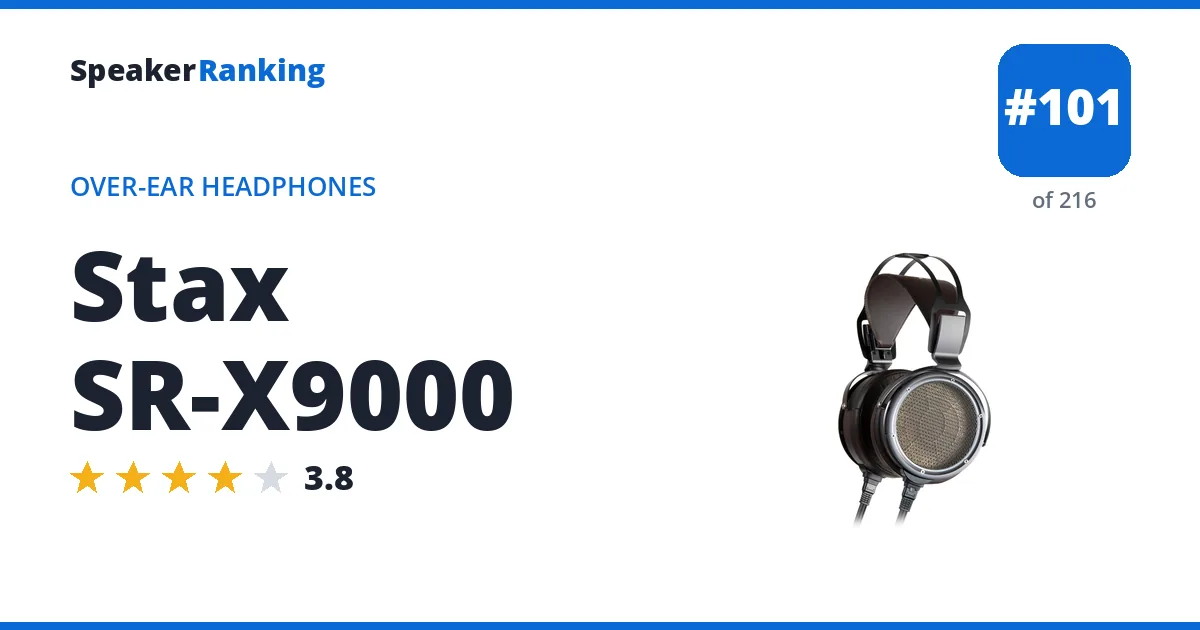
Pros: A preference score of 77, with the midrange from 200 Hz to 3 kHz staying within about 1.3 dB of target for natural, uncolored voices and instruments. Air above 10 kHz rises 1.7 dB, adding openness to the top end, and the neutral, slightly warm balance suits critical listening. It earns a higher rating than the Focal Utopia 2022.
Cons: It needs a dedicated electrostatic energizer, and bass falls 6 dB below target by 56 Hz, about 9.5 dB short across the sub-bass, so the deepest notes are faint. A 14.1 dB dip near 9.7 kHz dulls cymbals and detail. The Final Audio D8000 Pro Edition and Dan Clark Audio EXPANSE cost much less and rate higher.
Full Stax SR-X9000 review and specifications →
| Released | 2021 (5 years ago) |
|---|---|
| Back | Open |
| Built-in Microphone | No |
| Connection | Wired |
| Deviation From Target | 2.72 dB standard deviation |
| Driver Type | Electrostatic |
| Drivers | 1 x large round push-pull electrostatic |
| Form Factor | Over-ear |
| Frequency Response | 5Hz - 42kHz (Manufacturer specified) |
| Harman Preference Score | 77 (measured by oratory1990, via AutoEQ) |
| Sensitivity | 100 dB |
| Sub-bass Extension | Falls 6 dB below target at 56 Hz (-9.0 dB at 30 Hz) |
| Tonal Tilt | +0.20 (negative is warmer, positive brighter) |
| Weight | 1 lbs (432 g) |
EQ preset to match the Harman target
Set a preamp of -6.3 dB, then add these filters in any parametric equalizer (Wavelet, Equalizer APO, Peace, or a player with parametric EQ). Calculated by AutoEQ from its measured frequency response.
| Filter | Frequency | Gain | Q |
|---|---|---|---|
| Low shelf | 105 Hz | +5.7 dB | 0.70 |
| Peak | 1,081 Hz | -5.9 dB | 1.99 |
| Peak | 2,699 Hz | +2.5 dB | 1.47 |
| Peak | 201 Hz | -0.9 dB | 1.69 |
| Peak | 5,305 Hz | +2.1 dB | 6.00 |
| High shelf | 10,000 Hz | -4.2 dB | 0.70 |
| Peak | 7,973 Hz | +2.4 dB | 1.92 |
| Peak | 71 Hz | -1.7 dB | 3.73 |
| Peak | 6,342 Hz | -1.8 dB | 6.00 |
| Peak | 45 Hz | +1.0 dB | 4.46 |
- Reviews, Comparisons and Sound Samples
- Head-to-Head Comparisons