Short answer: the Stax SR-L300. It ranks #20 of 216 over-ear headphones by sound quality, rated 4.3/5, at $455. The Audio-Technica ATH-R70xa ranks #34, rated 4.2/5, at $379, $76 cheaper, which does not close the gap in sound quality.

What the Stax SR-L300 does well: An excellent preference score of 89 in crinacle’s measurement, among the closest tunings to the Harman target in its class. Watch for: As an electrostatic headphone it needs a dedicated Stax-compatible energizer to run at all, which adds real cost and a box on the desk.
Why pick the Audio-Technica ATH-R70xa: A preference score of 86 comes from a well balanced midrange, with upper mids within 0.1 dB of target and low mids only 0.8 dB under. The tradeoff: Sub-bass below 60 Hz is about 6.5 dB under target, so bass is clean but lacks rumble.
Buy the Stax SR-L300. It is rated higher for sound quality, and the $76 you would save on the Audio-Technica ATH-R70xa does not close the gap.
Want more options? Browse the full Headphones rankings.
Specifications Side By Side
| Stax SR-L300 | Audio-Technica ATH-R70xa | |
|---|---|---|
| Price | $455.00 | $379.00 |
| Ranked | #20 of 216 in Over-Ear Headphones | #34 of 216 in Over-Ear Headphones |
| Form Factor | Over-ear | Over-ear |
| Harman Preference Score | 89 (measured by crinacle, via AutoEQ) | 86 (measured by oratory1990, via AutoEQ) |
| Deviation From Target | 1.94 dB standard deviation | 2.11 dB standard deviation |
| Tonal Tilt | -0.03 (negative is warmer, positive brighter) | -0.12 (negative is warmer, positive brighter) |
| Connection | Wired | Wired |
| Back | Open | Open |
| Driver Type | Electrostatic | Dynamic |
| Drivers | 1 x oval push-pull electrostatic | 1 x 45mm dynamic |
| Sensitivity | 101 dB/100V rms | 97 dB/mW |
| Weight | 0.7 lbs (323 g) | 0.4 lbs (199 g) |
| Frequency Response | 7Hz - 41kHz (Manufacturer specified) | 5Hz - 40kHz (Manufacturer specified) |
| Built-in Microphone | No | - |
| Sub-bass Extension | - | Falls 6 dB below target at 30 Hz (-6.1 dB at 30 Hz) |
| Impedance | - | 470 ohms |
Related Headphone Comparisons
More top alternatives to Stax SR-L300:
- Edifier Stax Spirit S3 vs Stax SR-L300
- Stax SR-L300 vs Grado Hemp
- Audio-Technica ATH-R70xa vs Logitech G Astro A50 X
- Audio-Technica ATH-M70x vs Audio-Technica ATH-R70xa
- Audio-Technica ATH-R70xa vs Sennheiser HD 650
Prices on this page were last checked October 11, 2026 at 4:59 PM UTC. Product prices and availability are accurate as of that date/time and are subject to change; the price and availability shown on Amazon at the time of purchase will apply to the purchase of this product.
As an eBay Partner, we may be compensated if you make a purchase.
The Two Headphones In Full
 Stax SR-L300: $455.00 Audio46 eBay

Pros: An excellent preference score of 89 in crinacle’s measurement, among the closest tunings to the Harman target in its class. The open back push-pull electrostatic driver gives a wide, airy presentation, and at 323 g it is light for a full size headphone.
Cons: As an electrostatic headphone it needs a dedicated Stax-compatible energizer to run at all, which adds real cost and a box on the desk. The open back leaks sound and blocks no outside noise. The Beyerdynamic DT 900 Pro X shares the same rating for less money and plugs into ordinary gear.
Full Stax SR-L300 review and specifications →
| Released | 2016 (10 years ago) |
|---|---|
| Back | Open |
| Built-in Microphone | No |
| Connection | Wired |
| Deviation From Target | 1.94 dB standard deviation |
| Driver Type | Electrostatic |
| Drivers | 1 x oval push-pull electrostatic |
| Form Factor | Over-ear |
| Frequency Response | 7Hz - 41kHz (Manufacturer specified) |
| Harman Preference Score | 89 (measured by crinacle, via AutoEQ) |
| Sensitivity | 101 dB/100V rms |
| Tonal Tilt | -0.03 (negative is warmer, positive brighter) |
| Weight | 0.7 lbs (323 g) |
EQ preset to match the Harman target
Set a preamp of -6.5 dB, then add these filters in any parametric equalizer (Wavelet, Equalizer APO, Peace, or a player with parametric EQ). Calculated by AutoEQ from its measured frequency response.
| Filter | Frequency | Gain | Q |
|---|---|---|---|
| Low shelf | 105 Hz | +6.7 dB | 0.70 |
| Peak | 1,213 Hz | -2.9 dB | 1.92 |
| Peak | 82 Hz | -4.1 dB | 1.03 |
| Peak | 4,035 Hz | +3.7 dB | 5.20 |
| Peak | 2,474 Hz | +2.5 dB | 3.36 |
| High shelf | 10,000 Hz | -2.3 dB | 0.70 |
| Peak | 5,544 Hz | -3.1 dB | 5.36 |
| Peak | 225 Hz | -0.7 dB | 2.42 |
| Peak | 413 Hz | +0.2 dB | 1.37 |
| Peak | 42 Hz | +0.7 dB | 4.57 |
- Reviews, Comparisons and Sound Samples
- Head-to-Head Comparisons
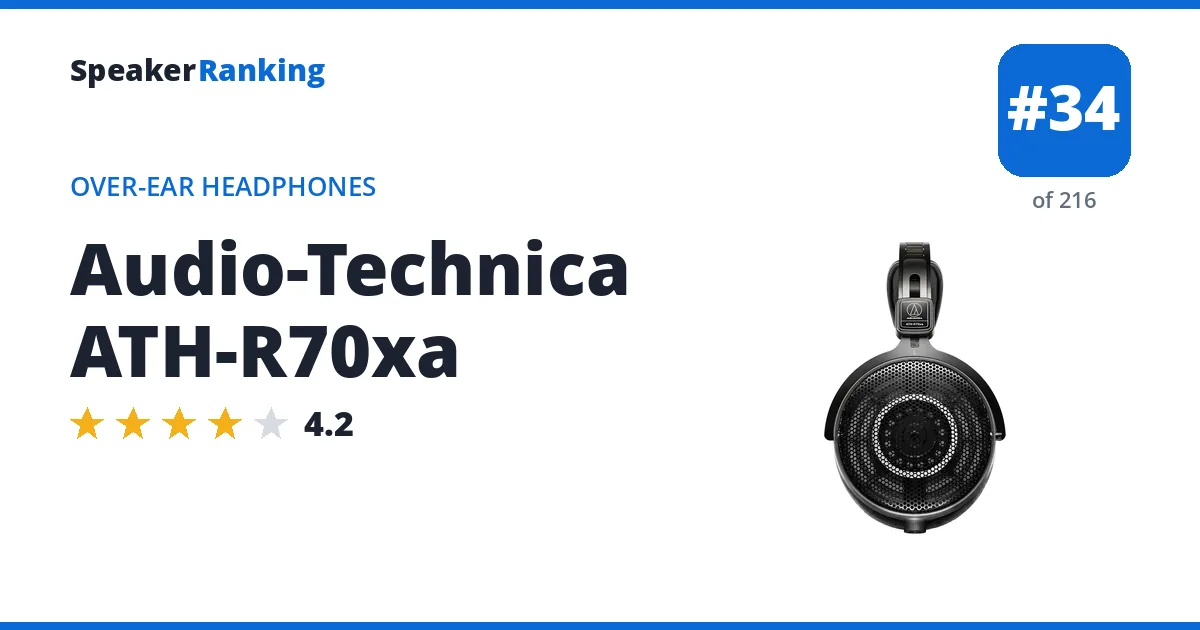
 Audio-Technica ATH-R70xa: $379.00 Amazon eBay
Older model: the Audio-Technica ATH-R70x (ranked lower, rated 4/5). See every Audio-Technica ATH-R70x generation.
Pros: A preference score of 86 comes from a well balanced midrange, with upper mids within 0.1 dB of target and low mids only 0.8 dB under. At 199 g it is a very light open-back design. The warm tilt and slightly relaxed top suit listeners who find bright headphones tiring.
Cons: Sub-bass below 60 Hz is about 6.5 dB under target, so bass is clean but lacks rumble. An 8.8 dB dip near 4.2 kHz and presence about 3.4 dB low pull some clarity out of vocals and instrument attack, making it sound recessed. The 470 ohm impedance means it needs a dedicated headphone amp, and the open back leaks sound. See headphone amps and DACs with enough power to drive it.
Full Audio-Technica ATH-R70xa review and specifications →
| Back | Open |
|---|---|
| Connection | Wired |
| Deviation From Target | 2.11 dB standard deviation |
| Driver Type | Dynamic |
| Drivers | 1 x 45mm dynamic |
| Form Factor | Over-ear |
| Frequency Response | 5Hz - 40kHz (Manufacturer specified) |
| Harman Preference Score | 86 (measured by oratory1990, via AutoEQ) |
| Impedance | 470 ohms |
| Sensitivity | 97 dB/mW |
| Sub-bass Extension | Falls 6 dB below target at 30 Hz (-6.1 dB at 30 Hz) |
| Tonal Tilt | -0.12 (negative is warmer, positive brighter) |
| Weight | 0.4 lbs (199 g) |
EQ preset to match the Harman target
Set a preamp of -6.4 dB, then add these filters in any parametric equalizer (Wavelet, Equalizer APO, Peace, or a player with parametric EQ). Calculated by AutoEQ from its measured frequency response.
| Filter | Frequency | Gain | Q |
|---|---|---|---|
| Low shelf | 105 Hz | +7.2 dB | 0.70 |
| Peak | 90 Hz | -4.2 dB | 0.50 |
| Peak | 4,752 Hz | +4.6 dB | 3.09 |
| Peak | 1,292 Hz | -1.7 dB | 1.42 |
| Peak | 365 Hz | +2.3 dB | 1.73 |
| High shelf | 10,000 Hz | -3.2 dB | 0.70 |
| Peak | 3,469 Hz | -1.8 dB | 5.37 |
| Peak | 5,813 Hz | +1.6 dB | 5.98 |
| Peak | 6,423 Hz | -1.2 dB | 6.00 |
| Peak | 4,177 Hz | +1.1 dB | 6.00 |
- Reviews, Comparisons and Sound Samples
- Head-to-Head Comparisons