Short answer: the SoftEars RSV. It ranks #184 of 450 in-ear headphones by sound quality, rated 4.2/5, at $729. The DUNU Zen ranks #303, rated 3.9/5, at $699.99, $29.01 cheaper, which does not close the gap in sound quality.
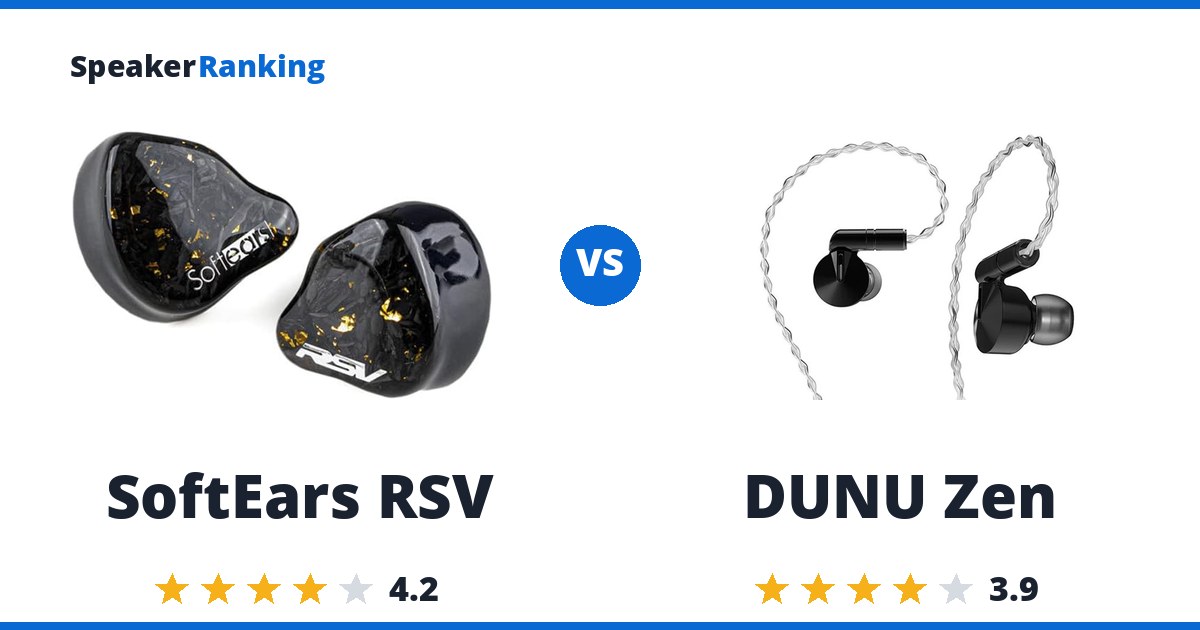
The SoftEars RSV is the better-sounding option. Its preference score of 76 from crinacle’s measurement comes with just 1.76 dB of deviation, so tonal balance is smooth and natural. The tradeoff: Presence runs about 2.9 dB below target, giving vocals and guitars a slightly laid back edge, and a 4 dB dip near 10.3 kHz trims some sparkle.
Why pick the DUNU Zen: Crinacle’s measurement earns it a preference score of 72, and squig.link measurements show a warm, slightly bass-lifted tuning with bass about 1.6 dB above target that suits warm and bassy tastes. The catch: Air above 10 kHz falls about 8 dB short of target, with an 11 dB hole near 11.9 kHz, so the top end sounds rolled off and lacks shimmer.
Buy the SoftEars RSV. It is rated higher for sound quality, and the $29.01 you would save on the DUNU Zen does not close the gap.
Looking for alternatives? See the complete Headphones rankings.
Specifications Side By Side
| SoftEars RSV | DUNU Zen | |
|---|---|---|
| Price | $729.00 | $699.99 |
| Ranked | #184 of 450 in In-Ear Headphones | #303 of 450 in In-Ear Headphones |
| Form Factor | In-ear | In-ear |
| Harman Preference Score | 76 (measured by crinacle, via AutoEQ) | 72 (measured by crinacle, via AutoEQ) |
| Deviation From Target | 1.76 dB standard deviation | 2.48 dB standard deviation |
| Tonal Tilt | -0.39 (negative is warmer, positive brighter) | +0.21 (negative is warmer, positive brighter) |
| Connection | Wired | Wired |
| Driver Type | Balanced armature | Dynamic |
| Drivers | 5 x balanced armature | 1 x dynamic |
| Impedance | 8 ohms | 16 ohms |
| Sensitivity | 125 dB/Vrms | 112 dB |
| Frequency Response | 5Hz - 40kHz (Manufacturer specified) | 5Hz - 40kHz (Manufacturer specified) |
| Built-in Microphone | No | No |
| Back | Closed | Closed |
| Sub-bass Extension | Within 6 dB of target down to 20 Hz (-3.1 dB at 30 Hz) | Within 6 dB of target down to 20 Hz (-1.6 dB at 30 Hz) |
Related Headphone Comparisons
More top alternatives to SoftEars RSV:
- FlipEars Aisha Electri vs SoftEars RSV
- SoftEars RSV vs Shanling Regal
- SoftEars RSV vs ISN Audio EBC80
- ISN Audio EBC80 vs DUNU Zen
- Fearless Audio S8Z vs DUNU Zen
Prices on this page were last checked October 11, 2026 at 4:59 PM UTC. Product prices and availability are accurate as of that date/time and are subject to change; the price and availability shown on Amazon at the time of purchase will apply to the purchase of this product.
As an eBay Partner, we may be compensated if you make a purchase.
The Two Headphones In Full
 SoftEars RSV: $729.00 Amazon eBay

Pros: Its preference score of 76 from crinacle’s measurement comes with just 1.76 dB of deviation, so tonal balance is smooth and natural. Across 21 hobbyist measurements on squig.link no band strays more than about 3 dB from target, and sub-bass stays within 6 dB down to 20 Hz. It is rated above the SoftEars Twilight, which costs more, and its 125 dB/Vrms sensitivity makes it easy to drive from a phone.
Cons: Presence runs about 2.9 dB below target, giving vocals and guitars a slightly laid back edge, and a 4 dB dip near 10.3 kHz trims some sparkle. The 8 ohm impedance is very low, so it pairs best with sources that have low output impedance to keep its tuning intact.
Full SoftEars RSV review and specifications →
| Released | 2021 (5 years ago) |
|---|---|
| Back | Closed |
| Built-in Microphone | No |
| Connection | Wired |
| Deviation From Target | 1.76 dB standard deviation |
| Driver Type | Balanced armature |
| Drivers | 5 x balanced armature |
| Form Factor | In-ear |
| Frequency Response | 5Hz - 40kHz (Manufacturer specified) |
| Harman Preference Score | 76 (measured by crinacle, via AutoEQ) |
| Impedance | 8 ohms |
| Sensitivity | 125 dB/Vrms |
| Sub-bass Extension | Within 6 dB of target down to 20 Hz (-3.1 dB at 30 Hz) |
| Tonal Tilt | -0.39 (negative is warmer, positive brighter) |
EQ preset to match the Harman target
Set a preamp of -4.4 dB, then add these filters in any parametric equalizer (Wavelet, Equalizer APO, Peace, or a player with parametric EQ). Calculated by AutoEQ from its measured frequency response.
| Filter | Frequency | Gain | Q |
|---|---|---|---|
| Low shelf | 105 Hz | +0.5 dB | 0.70 |
| Peak | 9,429 Hz | +5.8 dB | 1.27 |
| Peak | 350 Hz | -1.4 dB | 0.18 |
| Peak | 862 Hz | +1.8 dB | 2.03 |
| Peak | 4,128 Hz | +1.5 dB | 4.48 |
| High shelf | 10,000 Hz | -3.5 dB | 0.70 |
| Peak | 2,856 Hz | -1.3 dB | 4.73 |
| Peak | 2,096 Hz | +0.9 dB | 3.23 |
| Peak | 40 Hz | -0.4 dB | 2.22 |
| Peak | 80 Hz | +0.3 dB | 1.97 |
- Reviews, Comparisons and Sound Samples
- Head-to-Head Comparisons
 DUNU Zen: $699.99 Shenzhenaudio eBay

Pros: Crinacle’s measurement earns it a preference score of 72, and squig.link measurements show a warm, slightly bass-lifted tuning with bass about 1.6 dB above target that suits warm and bassy tastes. A single dynamic driver at 16 ohms and 112 dB sensitivity plays loudly from a phone. It matches the rating of the Unique Melody MEXT while costing less.
Cons: Air above 10 kHz falls about 8 dB short of target, with an 11 dB hole near 11.9 kHz, so the top end sounds rolled off and lacks shimmer. A 6 dB peak near 8.1 kHz sits right before that drop and can make some cymbal hits and sibilants stand out. The Fearless Audio S8Z is rated higher for less money.
Full DUNU Zen review and specifications →
| Released | Dec 2020 (5 years ago) |
|---|---|
| Back | Closed |
| Built-in Microphone | No |
| Connection | Wired |
| Deviation From Target | 2.48 dB standard deviation |
| Driver Type | Dynamic |
| Drivers | 1 x dynamic |
| Form Factor | In-ear |
| Frequency Response | 5Hz - 40kHz (Manufacturer specified) |
| Harman Preference Score | 72 (measured by crinacle, via AutoEQ) |
| Impedance | 16 ohms |
| Sensitivity | 112 dB |
| Sub-bass Extension | Within 6 dB of target down to 20 Hz (-1.6 dB at 30 Hz) |
| Tonal Tilt | +0.21 (negative is warmer, positive brighter) |
EQ preset to match the Harman target
Set a preamp of -6.6 dB, then add these filters in any parametric equalizer (Wavelet, Equalizer APO, Peace, or a player with parametric EQ). Calculated by AutoEQ from its measured frequency response.
| Filter | Frequency | Gain | Q |
|---|---|---|---|
| Low shelf | 105 Hz | +10.4 dB | 0.70 |
| Peak | 1,937 Hz | -5.1 dB | 0.78 |
| Peak | 44 Hz | -8.2 dB | 0.33 |
| Peak | 900 Hz | +3.5 dB | 0.58 |
| Peak | 6,107 Hz | +6.5 dB | 1.54 |
| High shelf | 10,000 Hz | +6.5 dB | 0.70 |
| Peak | 7,456 Hz | -2.8 dB | 4.76 |
| Peak | 4,201 Hz | -1.7 dB | 4.97 |
| Peak | 3,114 Hz | +1.5 dB | 3.87 |
| Peak | 2,317 Hz | -0.9 dB | 4.50 |
- Reviews, Comparisons and Sound Samples
- Head-to-Head Comparisons