Short answer: a tie on sound quality. Both are rated 4.5/5 (#63 and #64 of 450 in-ear headphones), so choose on features and fit.
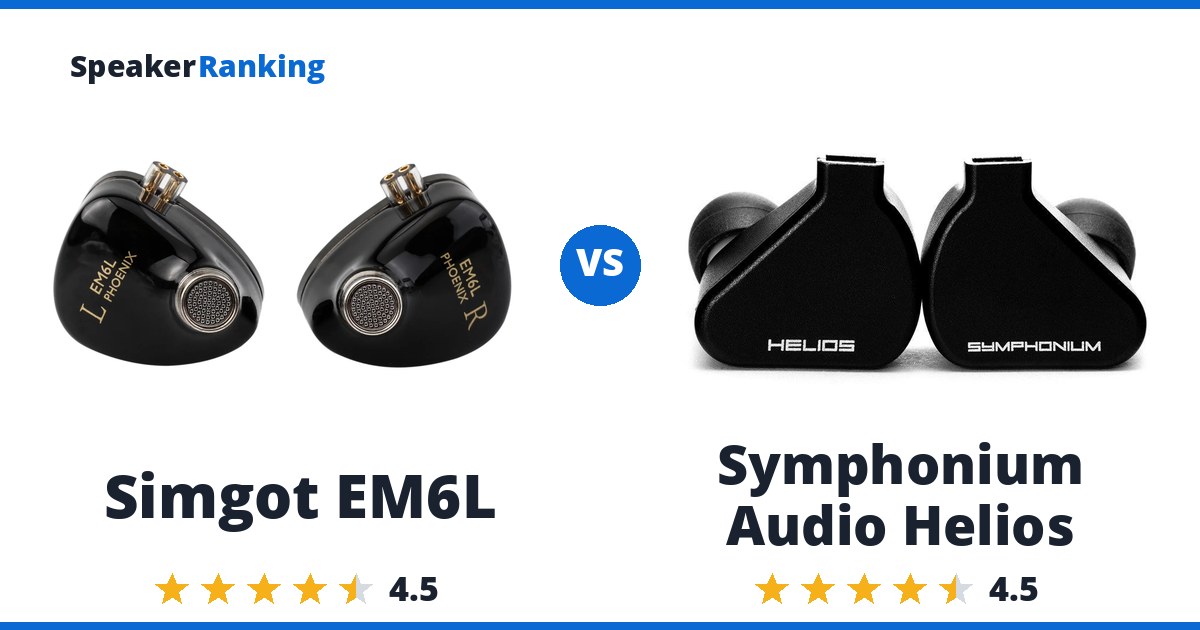
What the Simgot EM6L does well: Crinacle’s measurement returns a preference score of 80, and a deviation of only 1.51 dB means few uneven spots anywhere in the range. Watch for: The air band rises 5.5 dB above target with a 6.7 dB peak near 11.9 kHz, which some listeners will hear as extra sparkle or sharpness on cymbals.
Why pick the Symphonium Audio Helios: One of the smoothest in-ears measured, with a 1.57 dB standard deviation from the Harman target and a preference score of 80. The catch: The presence region from 3 to 6 kHz sits 3.5 dB below target, with a 6.3 dB dip near 6.95 kHz, so vocals and guitars lose a little bite and detail.
Buy the Simgot EM6L or the Symphonium Audio Helios on features: they are rated the same for sound quality at close to the same price.
Want more options? Browse the full Headphones rankings.
Specifications Side By Side
| Simgot EM6L | Symphonium Audio Helios | |
|---|---|---|
| Price | - | $1,099.00 |
| Ranked | #63 of 450 in In-Ear Headphones | #64 of 450 in In-Ear Headphones |
| Form Factor | In-ear | In-ear |
| Back | Closed | Closed |
| Harman Preference Score | 80 (measured by crinacle, via AutoEQ) | 80 (measured by HypetheSonics, via AutoEQ) |
| Deviation From Target | 1.51 dB standard deviation | 1.57 dB standard deviation |
| Tonal Tilt | -0.31 (negative is warmer, positive brighter) | +0.02 (negative is warmer, positive brighter) |
| Connection | Wired | Wired |
| Driver Type | Hybrid (1 dynamic + 4 balanced armature) | Balanced armature |
| Drivers | 1 x 8mm dynamic + 4 x balanced armature | - |
| Impedance | 26 ohms | 8.5 ohms |
| Sensitivity | 119 dB/Vrms | 104 dB/Vrms |
| Frequency Response | 8Hz - 40kHz (Manufacturer specified) | 12Hz - 24kHz (Manufacturer specified) |
| Sub-bass Extension | Within 6 dB of target down to 20 Hz (+0.1 dB at 30 Hz) | Within 6 dB of target down to 20 Hz (-1.3 dB at 30 Hz) |
| Weight | 0 lbs (7 g) per earbud | - |
| Built-in Microphone | - | No |
Related Headphone Comparisons
How Simgot EM6L compares with other leading options:
- Final Audio A4000 vs Simgot EM6L
- Shuoer S12 vs Simgot EM6L
- Symphonium Audio Helios vs ThieAudio Monarch MKIV
- ThieAudio Monarch MKIII vs Symphonium Audio Helios
- Symphonium Audio Helios vs Letshuoer Mystic 8
Prices on this page were last checked October 11, 2026 at 4:59 PM UTC. Product prices and availability are accurate as of that date/time and are subject to change; the price and availability shown on Amazon at the time of purchase will apply to the purchase of this product.
As an eBay Partner, we may be compensated if you make a purchase.
The Two Headphones In Full
 Simgot EM6L AliExpress eBay

Pros: Crinacle’s measurement returns a preference score of 80, and a deviation of only 1.51 dB means few uneven spots anywhere in the range. Across 46 hobbyist measurements on squig.link the presence and upper mids sit within 0.3 dB of target, so vocals and instruments sound natural, while bass about 2.5 dB above target adds warmth. With 119 dB/V sensitivity and 26 ohms it drives easily from a phone or basic dongle.
Cons: The air band rises 5.5 dB above target with a 6.7 dB peak near 11.9 kHz, which some listeners will hear as extra sparkle or sharpness on cymbals. It is wired only and lists no microphone.
Full Simgot EM6L review and specifications →
| Released | 2023 (3 years ago) |
|---|---|
| Back | Closed |
| Connection | Wired |
| Deviation From Target | 1.51 dB standard deviation |
| Driver Type | Hybrid (1 dynamic + 4 balanced armature) |
| Drivers | 1 x 8mm dynamic + 4 x balanced armature |
| Form Factor | In-ear |
| Frequency Response | 8Hz - 40kHz (Manufacturer specified) |
| Harman Preference Score | 80 (measured by crinacle, via AutoEQ) |
| Impedance | 26 ohms |
| Sensitivity | 119 dB/Vrms |
| Sub-bass Extension | Within 6 dB of target down to 20 Hz (+0.1 dB at 30 Hz) |
| Tonal Tilt | -0.31 (negative is warmer, positive brighter) |
| Weight | 0 lbs (7 g) per earbud |
EQ preset to match the Harman target
Set a preamp of -1.9 dB, then add these filters in any parametric equalizer (Wavelet, Equalizer APO, Peace, or a player with parametric EQ). Calculated by AutoEQ from its measured frequency response.
| Filter | Frequency | Gain | Q |
|---|---|---|---|
| Low shelf | 105 Hz | +0.5 dB | 0.70 |
| Peak | 176 Hz | -2.5 dB | 0.73 |
| Peak | 839 Hz | +2.1 dB | 1.27 |
| Peak | 8,479 Hz | +1.8 dB | 2.59 |
| Peak | 5,586 Hz | +1.6 dB | 4.29 |
| High shelf | 10,000 Hz | -1.8 dB | 0.70 |
| Peak | 3,212 Hz | -0.8 dB | 2.70 |
| Peak | 2,167 Hz | +0.8 dB | 2.93 |
| Peak | 37 Hz | -0.2 dB | 2.16 |
| Peak | 1,399 Hz | -0.4 dB | 3.64 |
- Reviews, Comparisons and Sound Samples
- Head-to-Head Comparisons
 Symphonium Audio Helios: $1,099.00 Headphones.com eBay
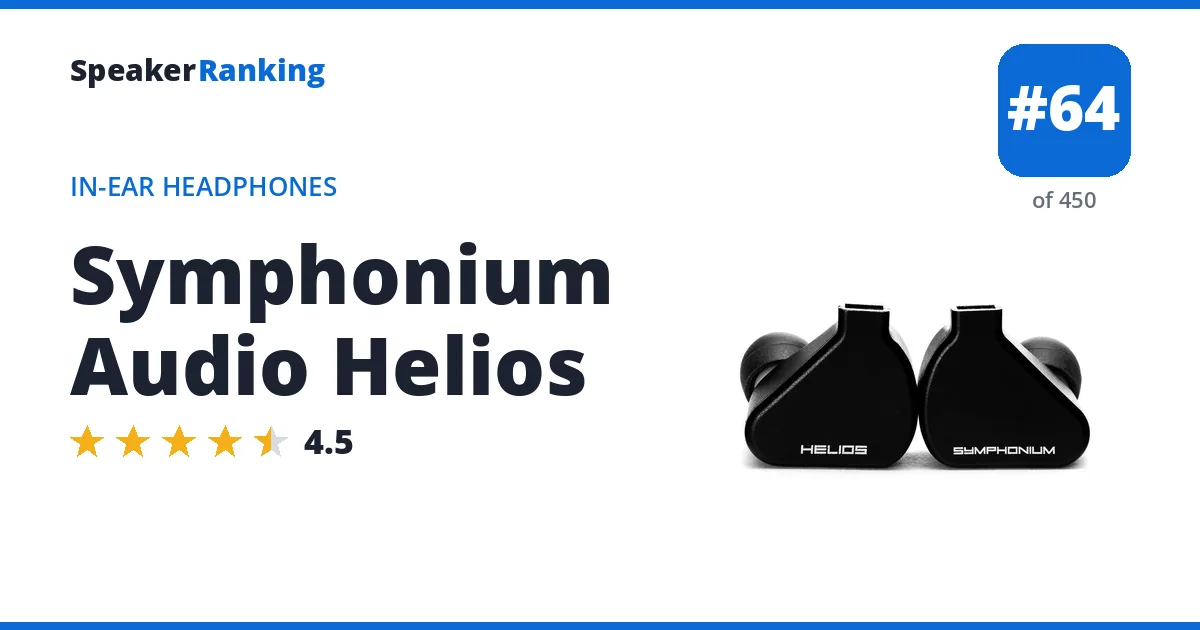
Pros: One of the smoothest in-ears measured, with a 1.57 dB standard deviation from the Harman target and a preference score of 80. Bass reaches all the way down, sitting only 1.3 dB under target at 30 Hz, so kick drums and synth bass keep their rumble from an all balanced armature design. Overall tilt is essentially flat, and listeners who like a warm, bass-forward balance are the best match. It earns a higher rating than the SoftEars Twilight and the HIFIMAN RE2000.
Cons: The presence region from 3 to 6 kHz sits 3.5 dB below target, with a 6.3 dB dip near 6.95 kHz, so vocals and guitars lose a little bite and detail. The ThieAudio Monarch MKIII costs about the same and carries a higher rating.
Full Symphonium Audio Helios review and specifications →
| Released | 2021 (5 years ago) |
|---|---|
| Back | Closed |
| Built-in Microphone | No |
| Connection | Wired |
| Deviation From Target | 1.57 dB standard deviation |
| Driver Type | Balanced armature |
| Form Factor | In-ear |
| Frequency Response | 12Hz - 24kHz (Manufacturer specified) |
| Harman Preference Score | 80 (measured by HypetheSonics, via AutoEQ) |
| Impedance | 8.5 ohms |
| Sensitivity | 104 dB/Vrms |
| Sub-bass Extension | Within 6 dB of target down to 20 Hz (-1.3 dB at 30 Hz) |
| Tonal Tilt | +0.02 (negative is warmer, positive brighter) |
EQ preset to match the Harman target
Set a preamp of -2.8 dB, then add these filters in any parametric equalizer (Wavelet, Equalizer APO, Peace, or a player with parametric EQ). Calculated by AutoEQ from its measured frequency response.
| Filter | Frequency | Gain | Q |
|---|---|---|---|
| Low shelf | 105 Hz | -2.6 dB | 0.70 |
| Peak | 1,245 Hz | -1.7 dB | 0.50 |
| Peak | 71 Hz | +3.6 dB | 0.56 |
| Peak | 6,561 Hz | +3.7 dB | 4.67 |
| Peak | 3,355 Hz | +2.2 dB | 2.99 |
| High shelf | 10,000 Hz | -7.3 dB | 0.70 |
| Peak | 276 Hz | +0.5 dB | 1.70 |
| Peak | 533 Hz | -0.4 dB | 2.28 |
| Peak | 4,907 Hz | +1.5 dB | 6.00 |
| Peak | 139 Hz | -0.3 dB | 2.01 |
- Reviews, Comparisons and Sound Samples
- Head-to-Head Comparisons