Short answer: the Tin HiFi P1 Max. Both are rated 3.6/5 for sound quality (#342 and #346 of 450 in-ear headphones), and the Tin HiFi P1 Max costs $219 against $269 for the Shanling ME500, so with nothing between them on sound quality, price settles it.
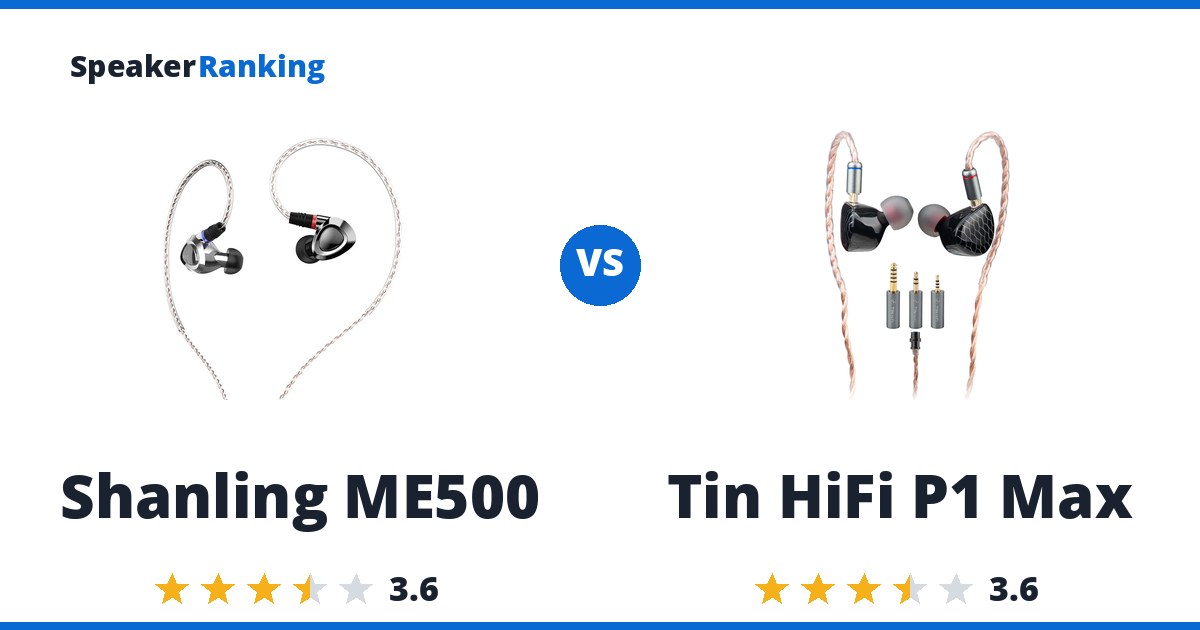
What the Shanling ME500 does well: A one dynamic plus two balanced armature hybrid with a preference score of 69 in crinacle’s measurement and a balance that leans very slightly bright rather than warm. The tradeoff: An average deviation of about 2.8 dB from target means some frequency bands still stand out.
What the Tin HiFi P1 Max does well: Its 14.2 mm planar magnetic driver earns a preference score of 69 in crinacle’s measurement, and across 12 hobbyist measurements on squig.link bass, low mids and treble from 6 to 10 kHz all stay within about a decibel of target. The catch: Hobbyist measurements show the presence region about 5.6 dB below target with a 6.6 dB dip near 3.6 kHz, which pushes vocals and lead instruments back, while a 4.8 dB peak near 8.1 kHz can make sibilants stand out.
Buy the Tin HiFi P1 Max. Both are rated the same for sound quality, and it costs $50 less than the Shanling ME500.
Want more options? Browse the full Headphones rankings.
Specifications Side By Side
| Shanling ME500 | Tin HiFi P1 Max | |
|---|---|---|
| Price | $269.00 | $219.00 |
| Ranked | #346 of 450 in In-Ear Headphones | #342 of 450 in In-Ear Headphones |
| Form Factor | In-ear | In-ear |
| Back | Closed | Closed |
| Harman Preference Score | 69 (measured by crinacle, via AutoEQ) | 69 (measured by crinacle, via AutoEQ) |
| Deviation From Target | 2.76 dB standard deviation | 2.79 dB standard deviation |
| Tonal Tilt | +0.15 (negative is warmer, positive brighter) | +0.05 (negative is warmer, positive brighter) |
| Connection | Wired | Wired |
| Driver Type | Hybrid (1 dynamic + 2 balanced armature) | Planar magnetic |
| Drivers | 1 x 10mm dynamic + 2 x balanced armature | 1 x 14.2mm planar magnetic |
| Impedance | 18 ohms | 16 ohms |
| Sensitivity | 111 dB | 98 dB @ 1kHz |
| Frequency Response | 20Hz - 40kHz (Manufacturer specified) | 10Hz - 20kHz (Manufacturer specified) |
| Built-in Microphone | No | - |
| Sub-bass Extension | - | Within 6 dB of target down to 20 Hz (-3.0 dB at 30 Hz) |
Related Headphone Comparisons
How Tin HiFi P1 Max compares with other leading options:
- 7Hz Timeless II vs Tin HiFi P1 Max
- 7Hz Eternal vs Tin HiFi P1 Max
- Tin HiFi P1 Max vs Shanling ME200
- 7Hz Eternal vs Shanling ME500
- TANGZU Wu Legend vs Shanling ME500
Prices on this page were last checked October 11, 2026 at 4:59 PM UTC. Product prices and availability are accurate as of that date/time and are subject to change; the price and availability shown on Amazon at the time of purchase will apply to the purchase of this product.
As an eBay Partner, we may be compensated if you make a purchase.
The Two Headphones In Full
 Shanling ME500: $269.00 Apos Audio eBay
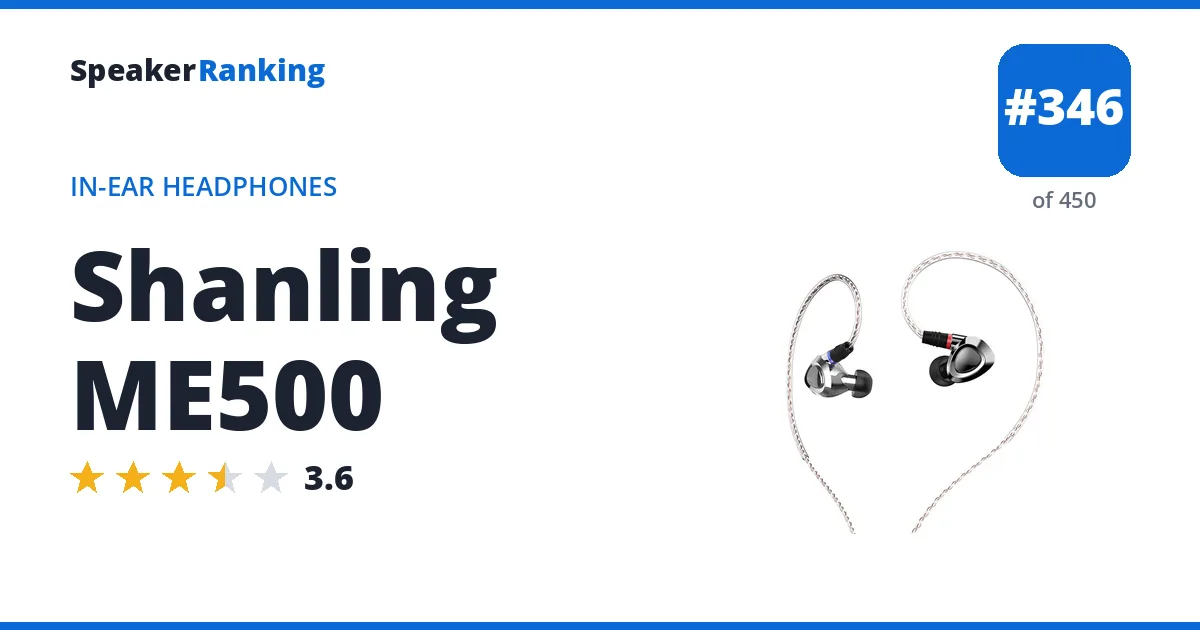
Pros: A one dynamic plus two balanced armature hybrid with a preference score of 69 in crinacle’s measurement and a balance that leans very slightly bright rather than warm. It rates higher than the cheaper Shanling ME200, and at 18 ohms and 111 dB sensitivity it is easy to drive from a phone.
Cons: An average deviation of about 2.8 dB from target means some frequency bands still stand out. The Fearless Audio Shangri-la rates clearly higher for a little less money.
Full Shanling ME500 review and specifications →
| Back | Closed |
|---|---|
| Built-in Microphone | No |
| Connection | Wired |
| Deviation From Target | 2.76 dB standard deviation |
| Driver Type | Hybrid (1 dynamic + 2 balanced armature) |
| Drivers | 1 x 10mm dynamic + 2 x balanced armature |
| Form Factor | In-ear |
| Frequency Response | 20Hz - 40kHz (Manufacturer specified) |
| Harman Preference Score | 69 (measured by crinacle, via AutoEQ) |
| Impedance | 18 ohms |
| Sensitivity | 111 dB |
| Tonal Tilt | +0.15 (negative is warmer, positive brighter) |
EQ preset to match the Harman target
Set a preamp of -6.3 dB, then add these filters in any parametric equalizer (Wavelet, Equalizer APO, Peace, or a player with parametric EQ). Calculated by AutoEQ from its measured frequency response.
| Filter | Frequency | Gain | Q |
|---|---|---|---|
| Low shelf | 105 Hz | +7.3 dB | 0.70 |
| Peak | 83 Hz | -4.6 dB | 0.24 |
| Peak | 6,418 Hz | +5.5 dB | 2.11 |
| Peak | 876 Hz | +3.7 dB | 0.90 |
| Peak | 1,774 Hz | -2.5 dB | 1.61 |
| High shelf | 10,000 Hz | +3.0 dB | 0.70 |
| Peak | 6,985 Hz | +3.9 dB | 1.20 |
| Peak | 4,343 Hz | -5.2 dB | 4.21 |
| Peak | 3,205 Hz | +2.1 dB | 5.60 |
| Peak | 7,141 Hz | -6.2 dB | 3.77 |
- Reviews, Comparisons and Sound Samples
- Head-to-Head Comparisons
 Tin HiFi P1 Max: $219.00 Amazon eBay
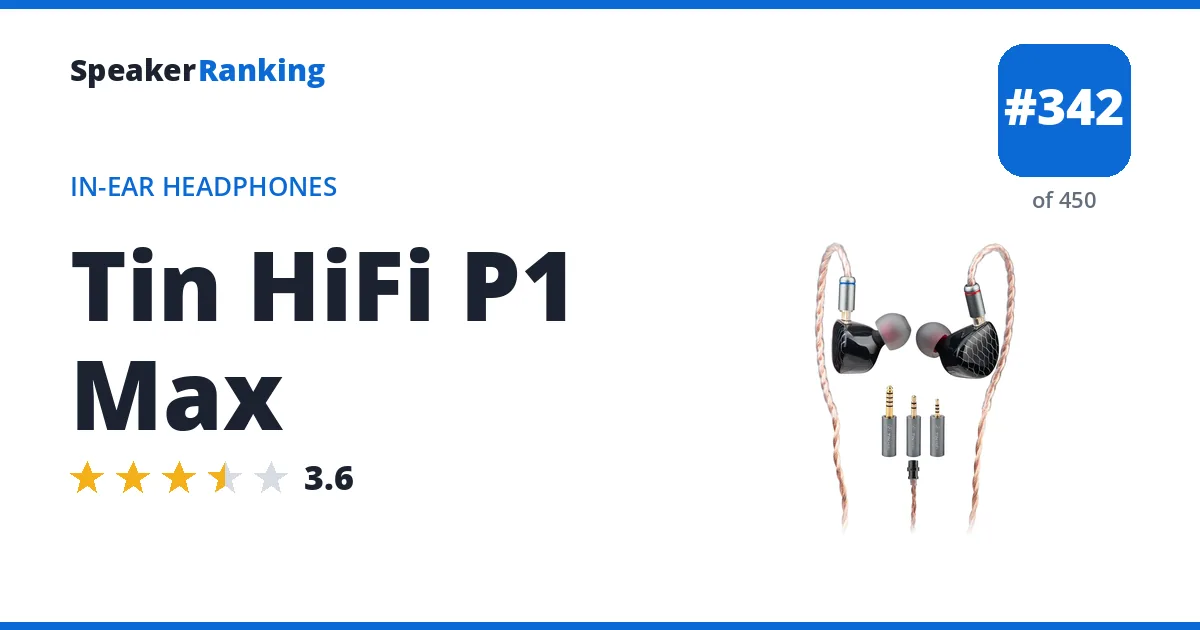
Pros: Its 14.2 mm planar magnetic driver earns a preference score of 69 in crinacle’s measurement, and across 12 hobbyist measurements on squig.link bass, low mids and treble from 6 to 10 kHz all stay within about a decibel of target. That gives instruments a clean, uncolored foundation. It rates higher than the pricier FiiO FH7S.
Cons: Hobbyist measurements show the presence region about 5.6 dB below target with a 6.6 dB dip near 3.6 kHz, which pushes vocals and lead instruments back, while a 4.8 dB peak near 8.1 kHz can make sibilants stand out. Its 98 dB sensitivity is low for an in-ear, so it needs more volume than most. The cheaper Etymotic ER2XR and Samsung Galaxy Buds2 both rate higher.
Full Tin HiFi P1 Max review and specifications →
| Back | Closed |
|---|---|
| Connection | Wired |
| Deviation From Target | 2.79 dB standard deviation |
| Driver Type | Planar magnetic |
| Drivers | 1 x 14.2mm planar magnetic |
| Form Factor | In-ear |
| Frequency Response | 10Hz - 20kHz (Manufacturer specified) |
| Harman Preference Score | 69 (measured by crinacle, via AutoEQ) |
| Impedance | 16 ohms |
| Sensitivity | 98 dB @ 1kHz |
| Sub-bass Extension | Within 6 dB of target down to 20 Hz (-3.0 dB at 30 Hz) |
| Tonal Tilt | +0.05 (negative is warmer, positive brighter) |
EQ preset to match the Harman target
Set a preamp of -5.5 dB, then add these filters in any parametric equalizer (Wavelet, Equalizer APO, Peace, or a player with parametric EQ). Calculated by AutoEQ from its measured frequency response.
| Filter | Frequency | Gain | Q |
|---|---|---|---|
| Low shelf | 105 Hz | +3.6 dB | 0.70 |
| Peak | 4,217 Hz | +5.8 dB | 1.42 |
| Peak | 124 Hz | -2.9 dB | 0.65 |
| Peak | 1,773 Hz | -2.6 dB | 1.13 |
| Peak | 2,792 Hz | +1.7 dB | 3.50 |
| High shelf | 10,000 Hz | -4.7 dB | 0.70 |
| Peak | 434 Hz | +1.1 dB | 2.30 |
| Peak | 228 Hz | -0.5 dB | 1.92 |
| Peak | 6,433 Hz | +1.6 dB | 5.31 |
| Peak | 43 Hz | -0.4 dB | 2.18 |
- Reviews, Comparisons and Sound Samples
- Head-to-Head Comparisons