Short answer: both are discontinued, so this only matters if you are buying used. Used, the Revel F206 is the better pick: it ranks #29 of 188 floorstanding speakers by sound quality (rated 4.5/5), against #148 (rated 3.5/5) for the Infinity Reference 253. If you want one new, the Revel F226Be replaces the Revel F206 and is rated 4.6/5 at $8,469.90.
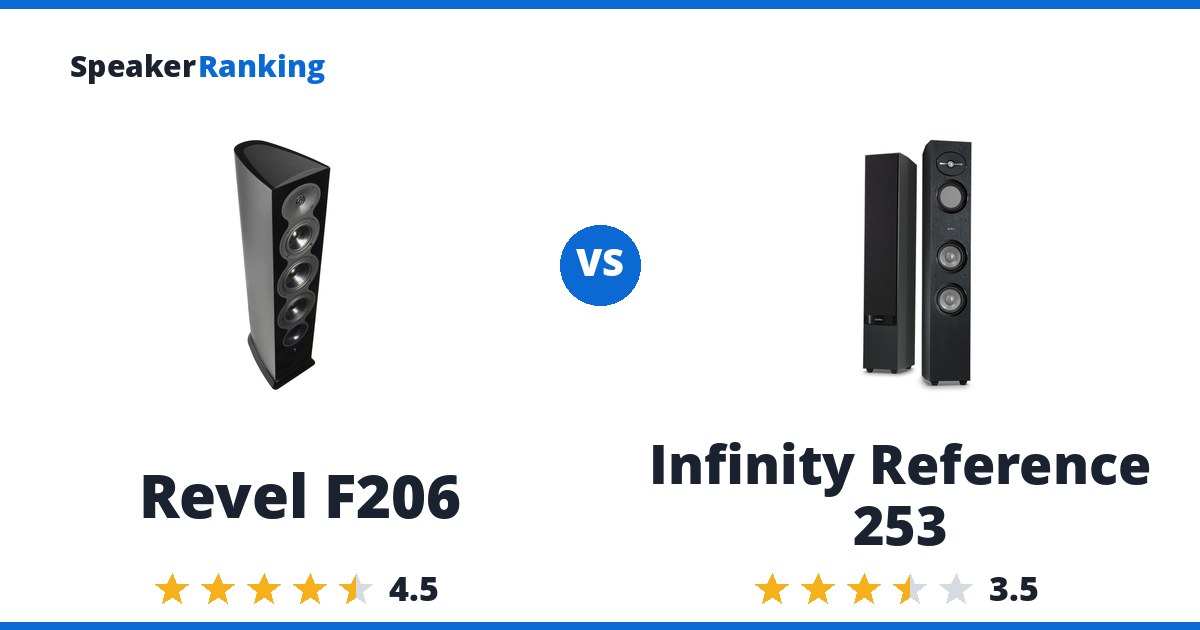
The Revel F206 is the better-sounding, deeper-bass option. CEA2034 spinorama shows a pretty even on-axis response. Its bass reaches about 60Hz before falling 3dB, against 78Hz for the Infinity Reference 253. The catch: Some directivity error and a small peak around 4.5kHz show up alongside the directivity error around 3kHz.
What the Infinity Reference 253 does well: Horizontal beamwidth of about ±60 degrees is fairly smooth and well controlled. The tradeoff: CEA2034 spinorama and predicted in-room response both show elevated treble above 4kHz (“too hot”), a dip around 2kHz, and bass shelved down relative to the midrange.
Buy the Revel F206 only if you find one used in good condition; both are discontinued, and it is the better rated of the two. For a new speaker, buy the Revel F226Be, which replaces the Revel F206.
Looking for alternatives? See the complete Passive Home rankings.
Specifications Side By Side
| Revel F206 | Infinity Reference 253 | |
|---|---|---|
| Price | $2,000 per pair used, Discontinued | $400 per pair used, Discontinued |
| Ranked | #29 of 188 in Large Size Floorstanding Speakers | #148 of 188 in Large Size Floorstanding Speakers |
| Bass Extension (-10dB) | 34Hz (measured, Audio Science Review) | 38Hz (measured, Audio Science Review) |
| Bass Extension (-3dB) | 60Hz (measured, Audio Science Review) | 78Hz (measured, Audio Science Review) |
| Dimensions | 40.3”H x 8.4”W x 12.2”D (1023.6 x 213.4 x 309.9 mm) | 40.3”H x 6.8”W x 12.4”D (1023.6 x 172.7 x 315 mm) |
| Impedance | 4 ohms nominal (3.3 ohms minimum, measured by Audio Science Review) | 6 ohms |
| Drivers | Dual 6.5” (16.5 cm) Aluminum Cone, Cast-frame Woofers, 5.25” (13.3 cm) Aluminum Cone, Cast-frame Midrange, 1” (2.5 cm) Aluminum Tweeter with Acoustic Lens Waveguide | Dual 5.25” (130mm) CMMD™ woofers, 5.25” (130mm) flat-piston CMMD™ midrange, 1” (25mm) CMMD™ tweeter |
| Sensitivity | 87dB (measured, Audio Science Review) | 86.9dB (measured by Audio Science Review; 88dB manufacturer specified) |
| Weight | 57.3 lbs (26 kg) each | 39.2 lbs (17.8 kg) each |
| Woofer Cabinet | ported, front | ported, rear |
| Spinorama Preference Score | 5.51 | 5.43 (spinorama.org) |
| Spinorama Preference Score with Perfect Sub | 7.52 | 7.31 (spinorama.org) |
| DIY Kit | No | No |
Related Speaker Comparisons
More worthwhile head-to-heads for Revel F206:
- Revel F206 vs KEF Blade Two Meta
- MoFi SourcePoint 888 vs Revel F206
- Revel F328Be vs Revel F206
- KEF R5 Meta vs Revel F206
- Revel F206 vs Revel F226Be
Prices on this page were last checked October 9, 2026 at 8:01 AM UTC. Product prices and availability are accurate as of that date/time and are subject to change; the price and availability shown on Amazon at the time of purchase will apply to the purchase of this product.
As an eBay Partner, we may be compensated if you make a purchase.
The Two Speakers In Full
 Revel F206: $2,000 per pair used Discontinued eBay
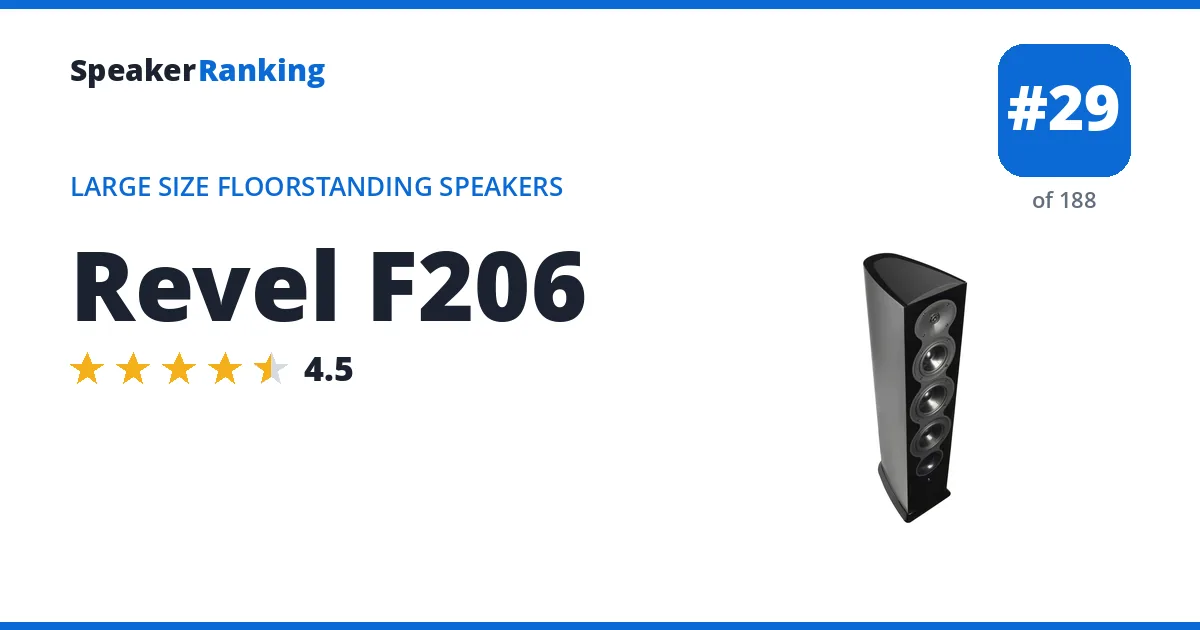
Newer model: the Revel F226Be, ranked higher, rated 4.6/5.
Same family: the Revel M105 (smaller bookshelf, rated 4.2/5), the Revel M106 (larger bookshelf, rated 4.6/5), the Revel F208 (larger floorstanding, ranked higher, rated 4.5/5), the Revel Performa3 C205 (smaller center, rated 4.1/5) and the Revel Performa3 C208 (larger center, rated 4/5).
Pros: CEA2034 spinorama shows a pretty even on-axis response. Predicted in-room response is excellent, with a smooth downward slope. Horizontal beamwidth of about ±65 degrees is wide, if a bit uneven. Distortion is very nice at 86dB SPL/1m, falling below the frequency range where human hearing is most sensitive, and stays excellent even at 96dB SPL/1m. Near-field measurements of the individual drivers show nice suppression of port and woofer resonances. Really amazing value for the performance. Measured bass extension of 60Hz (-3dB), with a measured sensitivity of 87dB.
Cons: Some directivity error and a small peak around 4.5kHz show up alongside the directivity error around 3kHz. Vertical directivity means listening position needs to stay within the tweeter axis, though the reviewer notes there is some leeway. Minimum impedance dips to 3.3 ohms, calling for an amplifier comfortable with a demanding load. Discontinued.
Full Revel F206 review and specifications →
| Bass Extension (-10dB) | 34Hz (measured, Audio Science Review) |
|---|---|
| Bass Extension (-3dB) | 60Hz (measured, Audio Science Review) |
| DIY Kit | No |
| Dimensions | 40.3”H x 8.4”W x 12.2”D (1023.6 x 213.4 x 309.9 mm) |
| Drivers | Dual 6.5” (16.5 cm) Aluminum Cone, Cast-frame Woofers, 5.25” (13.3 cm) Aluminum Cone, Cast-frame Midrange, 1” (2.5 cm) Aluminum Tweeter with Acoustic Lens Waveguide |
| Impedance | 4 ohms nominal (3.3 ohms minimum, measured by Audio Science Review) |
| Sensitivity | 87dB (measured, Audio Science Review) |
| Spinorama Preference Score | 5.51 |
| Spinorama Preference Score with Perfect Sub | 7.52 |
| Weight | 57.3 lbs (26 kg) each |
| Woofer Cabinet | ported, front |
- Links
- Reviews, Comparisons and Sound Samples
- Head-to-Head Comparisons
 Infinity Reference 253: $400 per pair used Discontinued eBay
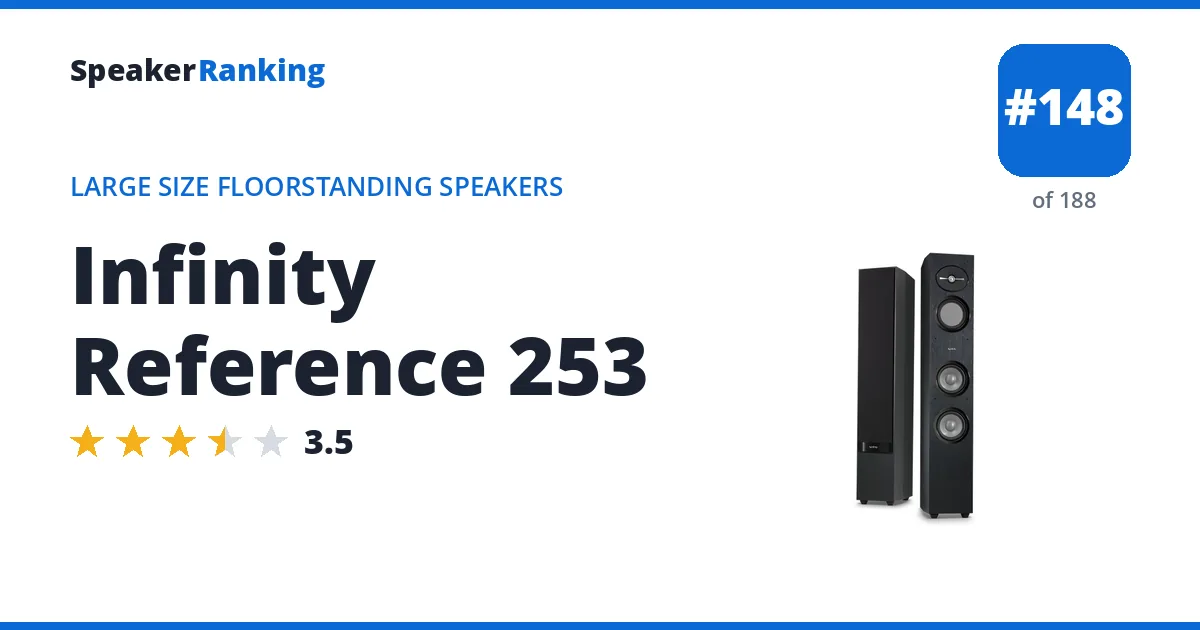
Same family: the Infinity Reference R152 (smaller bookshelf, rated 3.8/5), the Infinity Reference R162 (larger bookshelf, rated 3.8/5), the Infinity Reference R263 (larger floorstanding, ranked higher, rated 4.4/5), the Infinity Reference RC252 (smaller center, rated 4.4/5) and the Infinity Reference RC263 (larger center, rated 4.2/5).
Pros: Horizontal beamwidth of about ±60 degrees is fairly smooth and well controlled. Really amazing value for the performance. Measured bass extension of 78Hz (-3dB), with a measured sensitivity of 86.9dB.
Cons: CEA2034 spinorama and predicted in-room response both show elevated treble above 4kHz (“too hot”), a dip around 2kHz, and bass shelved down relative to the midrange. Vertical directivity requires staying at or below the tweeter axis for accurate tonal balance. Distortion at 96dB SPL/1m is broadly elevated above the reviewer’s audibility threshold across much of the midrange. Minimum impedance dips to 4.2 ohms. Discontinued.
Full Infinity Reference 253 review and specifications →
| Bass Extension (-10dB) | 38Hz (measured, Audio Science Review) |
|---|---|
| Bass Extension (-3dB) | 78Hz (measured, Audio Science Review) |
| DIY Kit | No |
| Dimensions | 40.3”H x 6.8”W x 12.4”D (1023.6 x 172.7 x 315 mm) |
| Drivers | Dual 5.25” (130mm) CMMD™ woofers, 5.25” (130mm) flat-piston CMMD™ midrange, 1” (25mm) CMMD™ tweeter |
| Impedance | 6 ohms |
| Sensitivity | 86.9dB (measured by Audio Science Review; 88dB manufacturer specified) |
| Spinorama Preference Score | 5.43 (spinorama.org) |
| Spinorama Preference Score with Perfect Sub | 7.31 (spinorama.org) |
| Weight | 39.2 lbs (17.8 kg) each |
| Woofer Cabinet | ported, rear |
- Links
- Reviews, Comparisons and Sound Samples
- Head-to-Head Comparisons
- Infinity Reference 253 vs Magnepan LRS+
- Infinity Reference 253 vs Polk Signature Elite ES60
- Infinity Reference 253 vs JBL Stage 2 280F
- Infinity Reference 253 vs Focal Aria Evo X N°2
- Infinity Reference 253 vs Polk T50
- Infinity Reference 253 vs SVS Ultra Evolution Pinnacle
- Infinity Reference 253 vs Definitive Technology BP-9020
- Infinity Reference 253 vs Sony SS-CS3
- See all 34 comparisons