Short answer: the MoFi SourcePoint 888 for bass output, the Revel F206 for a more even on-axis response. The F206’s spinorama shows a pretty even on-axis response, but a small peak around 4.5kHz sits alongside directivity error around 3kHz, and it costs $3495 less. The 888’s three-way coaxial design with two 8” woofers crossed at about 130Hz is a significant investment best ordered from a dealer with a good return policy.
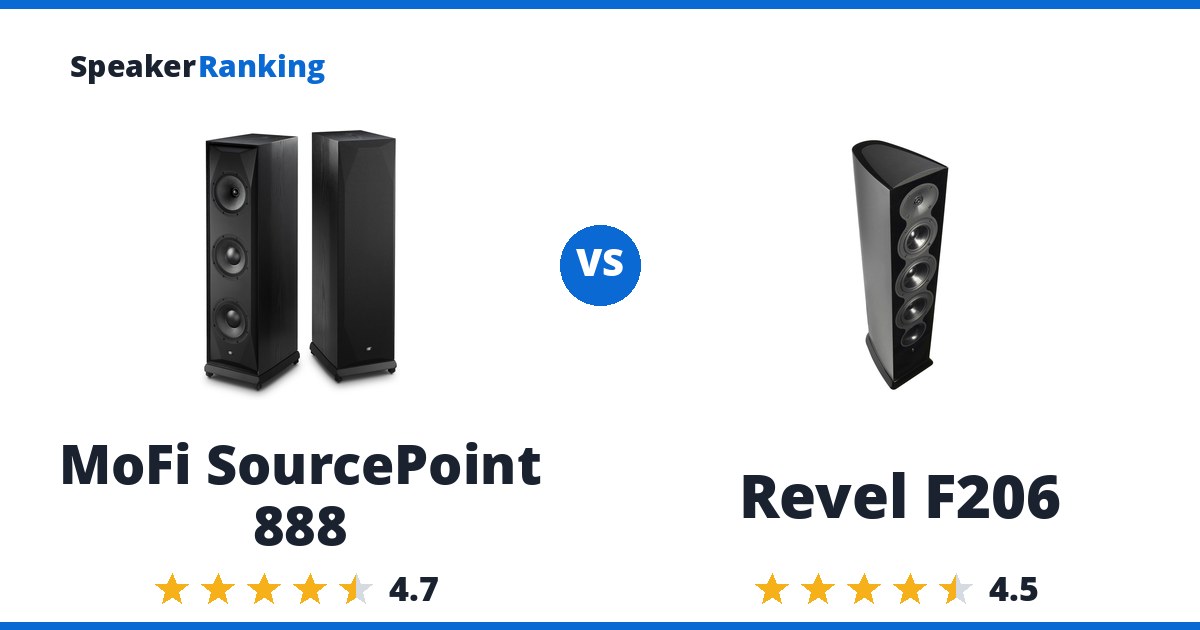
On the MoFi SourcePoint 888 side: Three-way vented design: an 8” coaxial mid-range/1.25” dome tweeter driver plus two additional 8” woofers crossed at about 130Hz. The tradeoff: A significant investment, best ordered from a dealer with a good return policy.
The case for the Revel F206: CEA2034 spinorama shows a pretty even on-axis response. Set against that: Some directivity error and a small peak around 4.5kHz show up alongside the directivity error around 3kHz.
Worth knowing: the Revel F206 is discontinued, though it still ranks #22 of 71 floorstanding speakers by sound quality, so a used unit beats most of what is still sold new.
Buy the MoFi SourcePoint 888 if sound quality matters more than the price. Buy the Revel F206 if the price matters more than sound quality.
Looking for alternatives? See the complete Passive Home rankings.
Specifications Side By Side
| MoFi SourcePoint 888 | Revel F206 | |
|---|---|---|
| Price | $5495 per pair | $2000 per pair used, Discontinued |
| Ranked | #4 of 71 in Large Size Floorstanding Speakers | #22 of 71 in Large Size Floorstanding Speakers |
| Bass Extension (-10dB) | 26Hz (measured, Erin's Audio Corner) | 34Hz (measured, Audio Science Review) |
| Bass Extension (-3dB) | 34Hz (measured, Erin's Audio Corner) | 60Hz (measured, Audio Science Review) |
| Dimensions | 41.2"H x 12.6"W x 16.1"D (1046.5 x 320 x 408.9 mm) | 40.3"H x 8.4"W x 12.2"D (1023.6 x 213.4 x 309.9 mm) |
| Impedance | 6 ohms nominal, 5 ohms minimum (measured, Erin's Audio Corner) | 4 ohms nominal (3.3 ohms minimum, measured by Audio Science Review) |
| Drivers | Dual 8" paper cone woofers, 8" Paper Cone midrange, 1.25" wide roll soft dome tweeter | Dual 6.5" (16.5 cm) Aluminum Cone, Cast-frame Woofers, 5.25" (13.3 cm) Aluminum Cone, Cast-frame Midrange, 1" (2.5 cm) Aluminum Tweeter with Acoustic Lens Waveguide |
| Sensitivity | 85.6dB (measured, Erin's Audio Corner) | 87dB (measured, Audio Science Review) |
| Weight | 94.8 lbs (43 kg) each | 57.3 lbs (26 kg) each |
| Woofer Cabinet | ported, rear | ported, front |
| Spinorama Preference Score | 5.21 | 4.72 |
| Spinorama Preference Score with Perfect Sub | 6.33 | 6.73 |
| DIY Kit | No | No |
| Discontinued | - | Yes |
Related Speaker Comparisons
More top alternatives to MoFi SourcePoint 888:
- GR-Research NX-Treme vs MoFi SourcePoint 888
- KEF Blade Two Meta vs MoFi SourcePoint 888
- MoFi SourcePoint 888 vs MoFi SourcePoint V10 Master Edition
- Radiant Acoustics Clarity 66 vs MoFi SourcePoint 888
- MoFi SourcePoint 888 vs Ascend Acoustics ELX Ribbon Tower
Prices on this page were last checked September 23, 2026 at 11:24 PM UTC. Product prices and availability are accurate as of that date/time and are subject to change; the price and availability shown on Amazon at the time of purchase will apply to the purchase of this product.
As an eBay Partner, we may be compensated if you make a purchase.
The Two Speakers In Full
 MoFi SourcePoint 888: $5495 per pair Crutchfield eBay
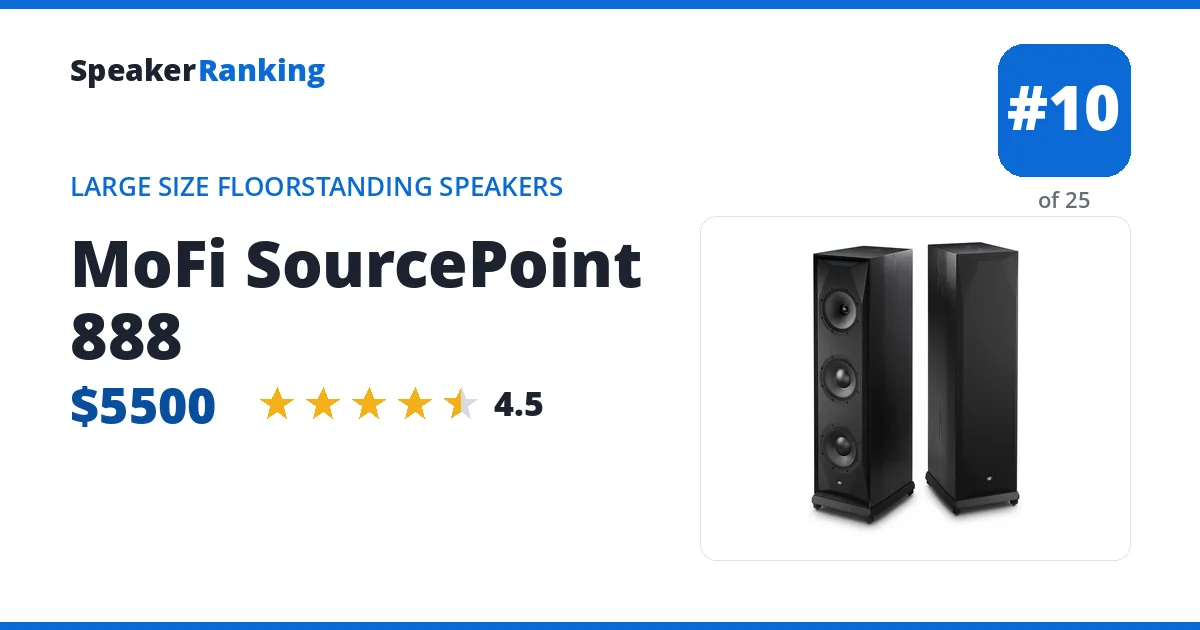
Pros: Three-way vented design: an 8” coaxial mid-range/1.25” dome tweeter driver plus two additional 8” woofers crossed at about 130Hz, giving genuinely full-range output (F3 34Hz, F10 26Hz) other than the deepest subsonic content. Ranked by the reviewer among his personal top three speakers out of roughly 200 tested, alongside the KEF Blade 2 Meta and Dutch & Dutch 8C, despite costing a small fraction of either. Excellent compression/dynamic-range linearity, holding its own against much pricier speakers like the March Audio Sointuva AWG, KEF Reference 1 Meta, and KEF Blade 2 Meta. On-axis (0°) and 30°-off-axis estimated in-room responses track within about 1-1.5dB of each other above 500Hz, so tonal balance barely changes with placement or listening angle - excellent for multi-seat home theater or entertaining. Wide horizontal dispersion of about ±60°. Distortion stays low: under 1% at 86dB, and under 1% above 200Hz even at 96dB, with multitone distortion mostly under 1% as well. Not a difficult amplifier load (5-ohm minimum impedance, 4.2-ohm minimum EPDR). Checks the three boxes the reviewer considers essential for a home theater speaker: low compression, low distortion, and excellent directivity. Measured bass extension of 34Hz (-3dB), with a measured sensitivity of 85.6dB.
Cons: A significant investment, best ordered from a dealer with a good return policy. Large and heavy floorstander (about 96 lbs, 42” tall) requiring real floor space and rear clearance. Positioning is fairly specific: needs about 2 feet from the rear wall - closer causes boominess in the 40-50Hz region, farther loses bass extension. Vertical dispersion (about ±50°) is narrower than horizontal (about ±60°), since the two 8” woofers are spaced vertically apart on a tower cabinet, causing some vertical mismatch at lower frequencies. A small on-axis dip around 500Hz and a deliberately lower tweeter level (about 0.5dB below the midrange) are intentional design choices for smoother in-room response, but mean the raw on-axis measurement isn’t perfectly flat. A mild diffraction-related dip appears around 3kHz in directivity measurements. Toeing the speaker out more than about 10° starts to noticeably reduce top-end energy.
Full MoFi SourcePoint 888 review and specifications →
| Bass Extension (-10dB) | 26Hz (measured, Erin's Audio Corner) |
|---|---|
| Bass Extension (-3dB) | 34Hz (measured, Erin's Audio Corner) |
| DIY Kit | No |
| Dimensions | 41.2"H x 12.6"W x 16.1"D (1046.5 x 320 x 408.9 mm) |
| Drivers | Dual 8" paper cone woofers, 8" Paper Cone midrange, 1.25" wide roll soft dome tweeter |
| Impedance | 6 ohms nominal, 5 ohms minimum (measured, Erin's Audio Corner) |
| Sensitivity | 85.6dB (measured, Erin's Audio Corner) |
| Spinorama Preference Score | 5.21 |
| Spinorama Preference Score with Perfect Sub | 6.33 |
| Weight | 94.8 lbs (43 kg) each |
| Woofer Cabinet | ported, rear |
- Links
- Reviews, Comparisons and Sound Samples
- Head-to-Head Comparisons
- MoFi SourcePoint 888 vs MoFi SourcePoint V10 Master Edition
- MoFi SourcePoint 888 vs Radiant Acoustics Clarity 66
- MoFi SourcePoint 888 vs KEF Blade Two Meta
- MoFi SourcePoint 888 vs Ascend Acoustics ELX Ribbon Tower
- MoFi SourcePoint 888 vs GR-Research NX-Treme
- MoFi SourcePoint 888 vs JBL HDI-3800
- MoFi SourcePoint 888 vs Revel F328Be
- MoFi SourcePoint 888 vs KEF R5 Meta
- See all 35 comparisons
 Revel F206: $2000 per pair used, Discontinued eBay
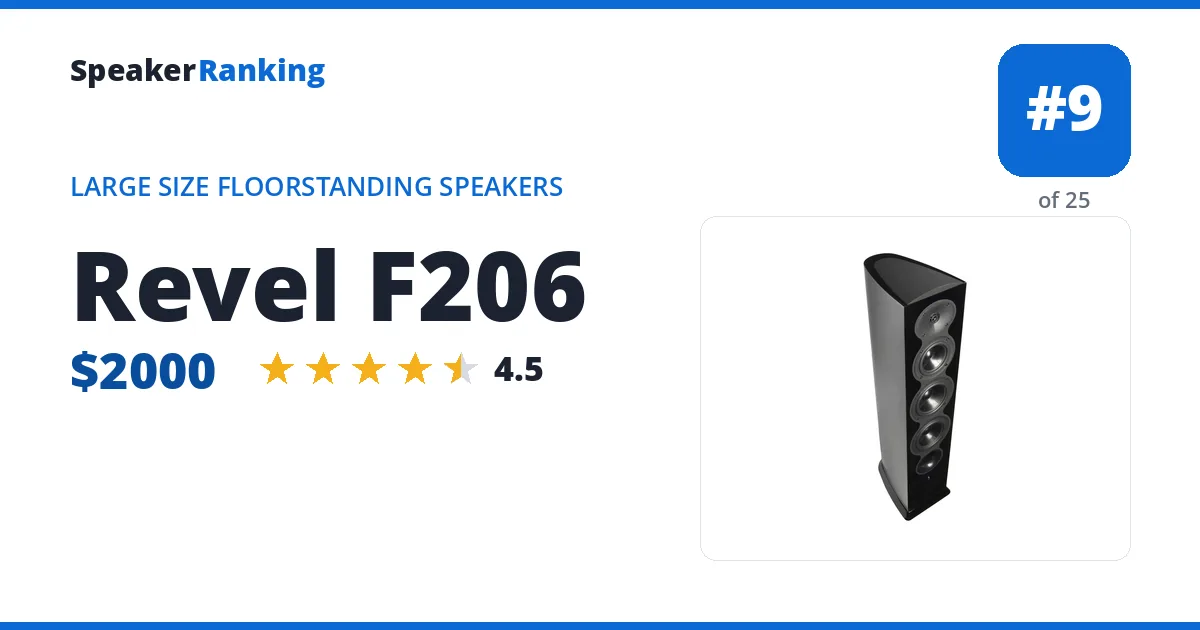
Pros: CEA2034 spinorama shows a pretty even on-axis response. Predicted in-room response is excellent, with a smooth downward slope. Horizontal beamwidth of about ±65 degrees is wide, if a bit uneven. Distortion is very nice at 86dB SPL/1m, falling below the frequency range where human hearing is most sensitive, and stays excellent even at 96dB SPL/1m. Near-field measurements of the individual drivers show nice suppression of port and woofer resonances. Really amazing value for the performance. Measured bass extension of 60Hz (-3dB), with a measured sensitivity of 87dB.
Cons: Some directivity error and a small peak around 4.5kHz show up alongside the directivity error around 3kHz. Vertical directivity means listening position needs to stay within the tweeter axis, though the reviewer notes there is some leeway. Minimum impedance dips to 3.3 ohms, calling for an amplifier comfortable with a demanding load. Discontinued.
Full Revel F206 review and specifications →
| Bass Extension (-10dB) | 34Hz (measured, Audio Science Review) |
|---|---|
| Bass Extension (-3dB) | 60Hz (measured, Audio Science Review) |
| DIY Kit | No |
| Dimensions | 40.3"H x 8.4"W x 12.2"D (1023.6 x 213.4 x 309.9 mm) |
| Discontinued | Yes |
| Drivers | Dual 6.5" (16.5 cm) Aluminum Cone, Cast-frame Woofers, 5.25" (13.3 cm) Aluminum Cone, Cast-frame Midrange, 1" (2.5 cm) Aluminum Tweeter with Acoustic Lens Waveguide |
| Impedance | 4 ohms nominal (3.3 ohms minimum, measured by Audio Science Review) |
| Sensitivity | 87dB (measured, Audio Science Review) |
| Spinorama Preference Score | 4.72 |
| Spinorama Preference Score with Perfect Sub | 6.73 |
| Weight | 57.3 lbs (26 kg) each |
| Woofer Cabinet | ported, front |
- Links
- Reviews, Comparisons and Sound Samples
- Head-to-Head Comparisons