Short answer: the Perlisten R210s. It ranks #26 of 212 subwoofers by sound quality, rated 4.0/5, at $4,995; the Bowers & Wilkins DB2D ranks #44, rated 3.9/5, and costs $5,800, so there is not much of a tradeoff to weigh.

Why pick the Perlisten R210s: A smaller Perlisten Audio R212s with two 10” glass fiber drivers in push-pull and 1300W, rated to 20Hz (-6dB). The catch: No independent measurements yet, so its output can’t be compared with ranked subwoofers.
What the Bowers & Wilkins DB2D does well: Dual-opposed 10-inch Aerofoil drive units identical to those in the flagship 800 Series Diamond speakers, driven by 1,000 watts of Class D amplification. Watch for: Substantial price point for a dual 10-inch system.
Buy the Perlisten R210s. It is rated higher for sound quality than the Bowers & Wilkins DB2D and costs less, so it is the default pick unless a specific strength of the other one matters more to you.
Worth knowing: the Perlisten R210s has not been measured yet. Its rating is estimated from related models, with a likely range of 3.8 to 4.2, so treat this verdict as provisional.
Want more options? Browse the full Subwoofers rankings.
Specifications Side By Side
| Perlisten R210s | Bowers & Wilkins DB2D | |
|---|---|---|
| Price | $4,995 each | $5,800.00 each |
| Ranked | #26 of 212 in Medium Home Subwoofers (30-75 lbs) Estimated | #44 of 212 in Medium Home Subwoofers (30-75 lbs) |
| Country | United States | United Kingdom |
| Drivers | 2x 10” glass fiber push-pull drivers | 2x 10” (254mm) Aerofoil drivers |
| Frequency Response | 20Hz - 290Hz (-6dB, THX EQ, manufacturer specified) | - |
| Dimensions | 21.5”H x 15”W x 17.7”D (545 x 380 x 450 mm) | 16.9”H x 14.8”W x 14.2”D (430.0 x 377.0 x 360.0 mm) |
| Weight | 97 lbs (44.0 kg) | 76.1 lbs (34.5 kg) |
| Amplifier Power | 1300W RMS (short term) | 1000W RMS |
| Inputs | 2x balanced XLR, 2x RCA | XLR (2, balanced), RCA (2, unbalanced) |
| Enclosure | Sealed, push-pull | sealed |
| CEA-2010-A Average (40-80Hz) | - | 115.7 dB |
| Cabinet Color | - | gloss black, satin white, rosenut |
| Measurement Source | - | Audioholics |
| Output SPL at 15 Hz | - | 91.2 dB |
| Output SPL at 20 Hz | - | 98.5 dB |
| Output SPL at 25 Hz | - | 103.8 dB |
| Output SPL at 31.5 Hz | - | 108.6 dB |
| Output SPL at 40 Hz | - | 113.2 dB |
| Output SPL at 50 Hz | - | 115.5 dB |
| Output SPL at 63 Hz | - | 116.8 dB |
| Output SPL at 80 Hz | - | 117.4 dB |
| Output SPL at 100 Hz | - | 117.8 dB |
| Output SPL at 125 Hz | - | 118.0 dB |
| RCA Input | - | Yes |
| Warranty | - | 5 |
| XLR Input | - | Yes |
Related Speaker Comparisons
More worthwhile head-to-heads for Perlisten R210s:
- Paradigm XR11 vs Perlisten R210s
- Perlisten R210s vs Sigberg Audio 10D
- Bowers & Wilkins DB2D vs Sigberg Audio 10D
- Paradigm XR11 vs Bowers & Wilkins DB2D
- Bowers & Wilkins DB2D vs KEF Reference 8b
Prices on this page were last checked October 11, 2026 at 4:59 PM UTC. Product prices and availability are accurate as of that date/time and are subject to change; the price and availability shown on Amazon at the time of purchase will apply to the purchase of this product.
As an eBay Partner, we may be compensated if you make a purchase.
The Two Speakers In Full
 Perlisten R210s: $4,995 each Estimated The Music Room (TMR Audio) eBay
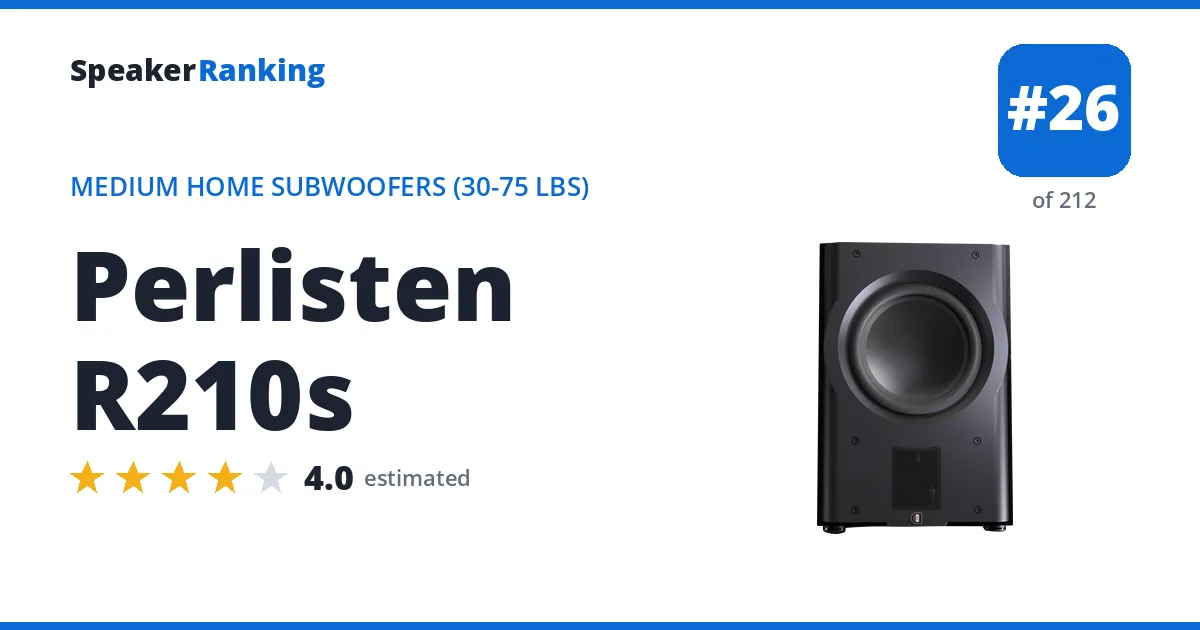
Same family: the Perlisten Audio R10s (smaller subwoofer, ranked lower, estimated 3.8/5), the Perlisten Audio R12s (smaller subwoofer, ranked lower, estimated 3.9/5), the Perlisten Audio R15s (smaller subwoofer, estimated 4/5), the Perlisten Audio R18s (larger subwoofer, rated 4.1/5) and the Perlisten Audio R212s (larger subwoofer, rated 4.1/5).
Pros: A smaller Perlisten Audio R212s with two 10” glass fiber drivers in push-pull and 1300W, rated to 20Hz (-6dB).
Cons: No independent measurements yet, so its output can’t be compared with ranked subwoofers. Less output than the dual 12” R212s, and at 44 kg it is heavy for its size.
Full Perlisten R210s review and specifications →
| Released | Oct 2022 (4 years ago) |
|---|---|
| Amplifier Power | 1300W RMS (short term) |
| Country | United States |
| Dimensions | 21.5”H x 15”W x 17.7”D (545 x 380 x 450 mm) |
| Drivers | 2x 10” glass fiber push-pull drivers |
| Enclosure | Sealed, push-pull |
| Frequency Response | 20Hz - 290Hz (-6dB, THX EQ, manufacturer specified) |
| Inputs | 2x balanced XLR, 2x RCA |
| Weight | 97 lbs (44.0 kg) |
- Links
- Reviews, Comparisons and Sound Samples
- Head-to-Head Comparisons
 Bowers & Wilkins DB2D: $5,800.00 each Bowers & Wilkins eBay

Same family: the Bowers & Wilkins DB4S (smaller subwoofer, ranked lower, rated 3.8/5), the Bowers & Wilkins DB3D (smaller subwoofer, rated 3.7/5) and the Bowers & Wilkins DB1D (larger subwoofer, rated 4.1/5).
Pros: Dual-opposed 10-inch Aerofoil drive units identical to those in the flagship 800 Series Diamond speakers, driven by 1,000 watts of Class D amplification. Completely inertia-balanced cabinet delivers clean, highly musical low end with app-based parametric EQ and digital room correction.
Cons: Substantial price point for a dual 10-inch system. Maximum SPL drops below 25Hz compared to larger 12-inch or 15-inch subwoofers.
Full Bowers & Wilkins DB2D review and specifications →
| Released | 2017 (9 years ago) |
|---|---|
| Amplifier Power | 1000W RMS |
| CEA-2010-A Average (40-80Hz) | 115.7 dB |
| Cabinet Color | gloss black, satin white, rosenut |
| Country | United Kingdom |
| Dimensions | 16.9”H x 14.8”W x 14.2”D (430.0 x 377.0 x 360.0 mm) |
| Drivers | 2x 10” (254mm) Aerofoil drivers |
| Enclosure | sealed |
| Inputs | XLR (2, balanced), RCA (2, unbalanced) |
| Measurement Source | Audioholics |
| Output SPL at 15 Hz | 91.2 dB |
| Output SPL at 20 Hz | 98.5 dB |
| Output SPL at 25 Hz | 103.8 dB |
| Output SPL at 31.5 Hz | 108.6 dB |
| Output SPL at 40 Hz | 113.2 dB |
| Output SPL at 50 Hz | 115.5 dB |
| Output SPL at 63 Hz | 116.8 dB |
| Output SPL at 80 Hz | 117.4 dB |
| Output SPL at 100 Hz | 117.8 dB |
| Output SPL at 125 Hz | 118.0 dB |
| RCA Input | Yes |
| Warranty | 5 |
| Weight | 76.1 lbs (34.5 kg) |
| XLR Input | Yes |
- Links
- Reviews, Comparisons and Sound Samples
- Head-to-Head Comparisons