Short answer: the Oriolus Mellianus. Both are rated 3.6/5 for sound quality (#348 and #349 of 450 in-ear headphones), and the Oriolus Mellianus costs $2,400 against $2,900 for the Noble Audio Sultan, with sound quality a draw, the lower price decides it.

The case for the Noble Audio Sultan: Bass extends on target to 20 Hz with about 2.6 dB of extra midbass in HypetheSonics’ measurement, giving a warm, full low end, and its 2.4 dB average deviation is fairly smooth. Watch for: A 7.4 dB dip near 3.2 kHz and a 3.4 dB shortfall across 3 to 6 kHz recess vocals and the attack of guitars and pianos.
Why pick the Oriolus Mellianus: Ten balanced armature drivers per side earn a preference score of 69 in crinacle’s measurement, with an overall balance that is neither warm nor bright. The tradeoff: Its response wanders about 2.8 dB from target on average, so some bands stand out more than on the best in-ears.
Buy the Oriolus Mellianus. Both are rated the same for sound quality, and it costs $500 less than the Noble Audio Sultan.
Want more options? Browse the full Headphones rankings.
Specifications Side By Side
| Noble Audio Sultan | Oriolus Mellianus | |
|---|---|---|
| Price | $2,900.00 | $2,400.00 |
| Ranked | #349 of 450 in In-Ear Headphones | #348 of 450 in In-Ear Headphones |
| Form Factor | In-ear | In-ear |
| Back | Closed | Closed |
| Harman Preference Score | 69 (measured by HypetheSonics, via AutoEQ) | 69 (measured by crinacle, via AutoEQ) |
| Deviation From Target | 2.41 dB standard deviation | 2.79 dB standard deviation |
| Tonal Tilt | -0.60 (negative is warmer, positive brighter) | -0.03 (negative is warmer, positive brighter) |
| Sub-bass Extension | Within 6 dB of target down to 20 Hz (+0.4 dB at 30 Hz) | - |
| Connection | Wired | Wired |
| Driver Type | Hybrid (1 dynamic + 4 balanced armature + 2 electrostatic) | Balanced armature |
| Drivers | 1 x 10mm dynamic + 4 x balanced armature + 2 x electrostatic | 10 x balanced armature |
| Built-in Microphone | No | No |
| Impedance | - | 36 ohms |
| Sensitivity | - | 109 dB |
| Frequency Response | - | 10Hz - 40kHz (Manufacturer specified) |
Related Headphone Comparisons
How Oriolus Mellianus compares with other leading options:
- Oriolus Mellianus vs qdc Anole VX
- Oriolus Mellianus vs 64 Audio Tia Trio
- Noble Audio Sultan vs qdc Anole VX
- Unique Melody MEST Fortune vs Noble Audio Sultan
- Kinera Loki Divine Mark vs Noble Audio Sultan
Prices on this page were last checked October 11, 2026 at 4:59 PM UTC. Product prices and availability are accurate as of that date/time and are subject to change; the price and availability shown on Amazon at the time of purchase will apply to the purchase of this product.
As an eBay Partner, we may be compensated if you make a purchase.
The Two Headphones In Full
 Noble Audio Sultan: $2,900.00 Audio46 eBay
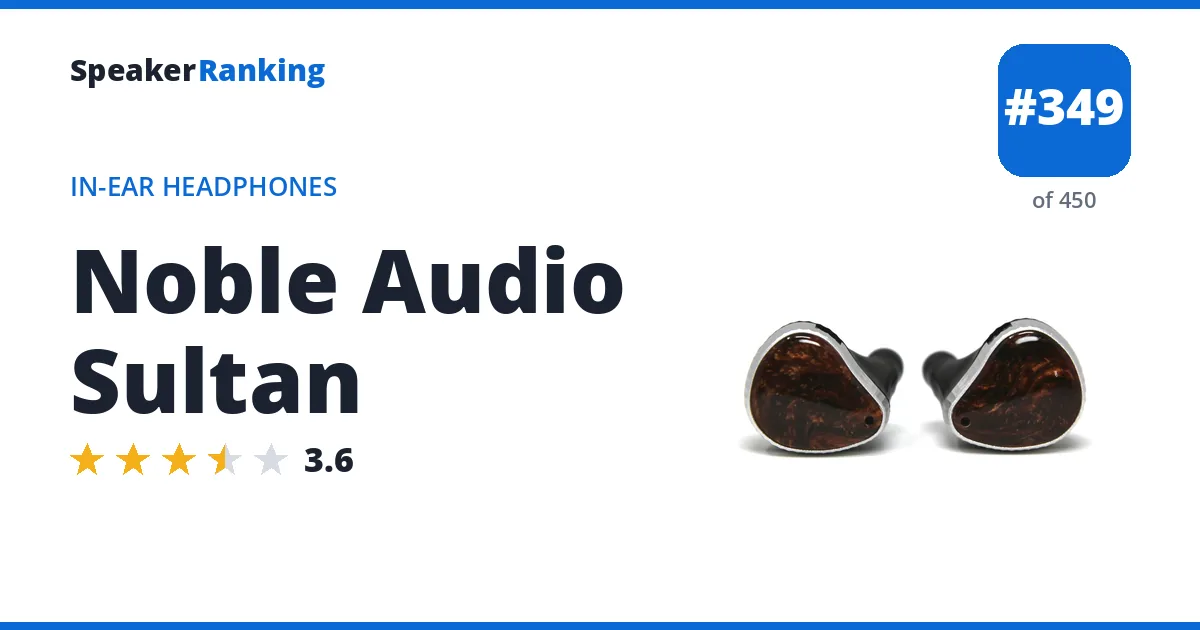
Pros: Bass extends on target to 20 Hz with about 2.6 dB of extra midbass in HypetheSonics’ measurement, giving a warm, full low end, and its 2.4 dB average deviation is fairly smooth. Treble from 6 to 10 kHz sits about 2.6 dB above target without sharp peaks, so cymbals keep sparkle without harshness. It rates higher than the 64 Audio Tia Trio.
Cons: A 7.4 dB dip near 3.2 kHz and a 3.4 dB shortfall across 3 to 6 kHz recess vocals and the attack of guitars and pianos. The Oriolus Mellianus earns the same rating for noticeably less money.
Full Noble Audio Sultan review and specifications →
| Released | May 2020 (6 years ago) |
|---|---|
| Back | Closed |
| Built-in Microphone | No |
| Connection | Wired |
| Deviation From Target | 2.41 dB standard deviation |
| Driver Type | Hybrid (1 dynamic + 4 balanced armature + 2 electrostatic) |
| Drivers | 1 x 10mm dynamic + 4 x balanced armature + 2 x electrostatic |
| Form Factor | In-ear |
| Harman Preference Score | 69 (measured by HypetheSonics, via AutoEQ) |
| Sub-bass Extension | Within 6 dB of target down to 20 Hz (+0.4 dB at 30 Hz) |
| Tonal Tilt | -0.60 (negative is warmer, positive brighter) |
EQ preset to match the Harman target
Set a preamp of -6.7 dB, then add these filters in any parametric equalizer (Wavelet, Equalizer APO, Peace, or a player with parametric EQ). Calculated by AutoEQ from its measured frequency response.
| Filter | Frequency | Gain | Q |
|---|---|---|---|
| Low shelf | 105 Hz | -1.3 dB | 0.70 |
| Peak | 3,280 Hz | +7.0 dB | 2.31 |
| Peak | 189 Hz | -2.7 dB | 0.94 |
| Peak | 7,074 Hz | -3.3 dB | 1.84 |
| Peak | 798 Hz | +1.3 dB | 1.55 |
| High shelf | 10,000 Hz | +1.2 dB | 0.70 |
| Peak | 69 Hz | +0.6 dB | 1.79 |
| Peak | 9,606 Hz | -0.6 dB | 2.32 |
| Peak | 120 Hz | -0.4 dB | 2.39 |
| Peak | 4,645 Hz | -0.8 dB | 6.00 |
- Reviews, Comparisons and Sound Samples
- Head-to-Head Comparisons
 Oriolus Mellianus: $2,400.00 HiFiGo eBay

Pros: Ten balanced armature drivers per side earn a preference score of 69 in crinacle’s measurement, with an overall balance that is neither warm nor bright. At 36 ohms and 109 dB sensitivity it runs easily from a phone or a small dongle, and the closed shell blocks outside noise like any sealed in-ear.
Cons: Its response wanders about 2.8 dB from target on average, so some bands stand out more than on the best in-ears. The Noble Audio Kadence rates clearly higher while costing less.
Full Oriolus Mellianus review and specifications →
| Back | Closed |
|---|---|
| Built-in Microphone | No |
| Connection | Wired |
| Deviation From Target | 2.79 dB standard deviation |
| Driver Type | Balanced armature |
| Drivers | 10 x balanced armature |
| Form Factor | In-ear |
| Frequency Response | 10Hz - 40kHz (Manufacturer specified) |
| Harman Preference Score | 69 (measured by crinacle, via AutoEQ) |
| Impedance | 36 ohms |
| Sensitivity | 109 dB |
| Tonal Tilt | -0.03 (negative is warmer, positive brighter) |
EQ preset to match the Harman target
Set a preamp of -6.9 dB, then add these filters in any parametric equalizer (Wavelet, Equalizer APO, Peace, or a player with parametric EQ). Calculated by AutoEQ from its measured frequency response.
| Filter | Frequency | Gain | Q |
|---|---|---|---|
| Low shelf | 105 Hz | +8.8 dB | 0.70 |
| Peak | 53 Hz | -7.0 dB | 0.32 |
| Peak | 5,072 Hz | +5.8 dB | 3.24 |
| Peak | 1,500 Hz | -7.2 dB | 1.62 |
| Peak | 1,299 Hz | +2.8 dB | 0.31 |
| High shelf | 10,000 Hz | -2.8 dB | 0.70 |
| Peak | 9,645 Hz | +2.0 dB | 2.59 |
| Peak | 3,608 Hz | -3.4 dB | 5.78 |
| Peak | 2,734 Hz | +1.7 dB | 3.83 |
| Peak | 4,344 Hz | +1.8 dB | 6.00 |
- Reviews, Comparisons and Sound Samples
- Head-to-Head Comparisons