Short answer: the Moondrop Dark Saber. Both are rated 4.9/5 for sound quality (#14 and #1 of 450 in-ear headphones), and the Moondrop Dark Saber costs $899.99 against $999 for the ThieAudio Monarch MKIII, and with sound quality even, the cheaper one is the better buy.
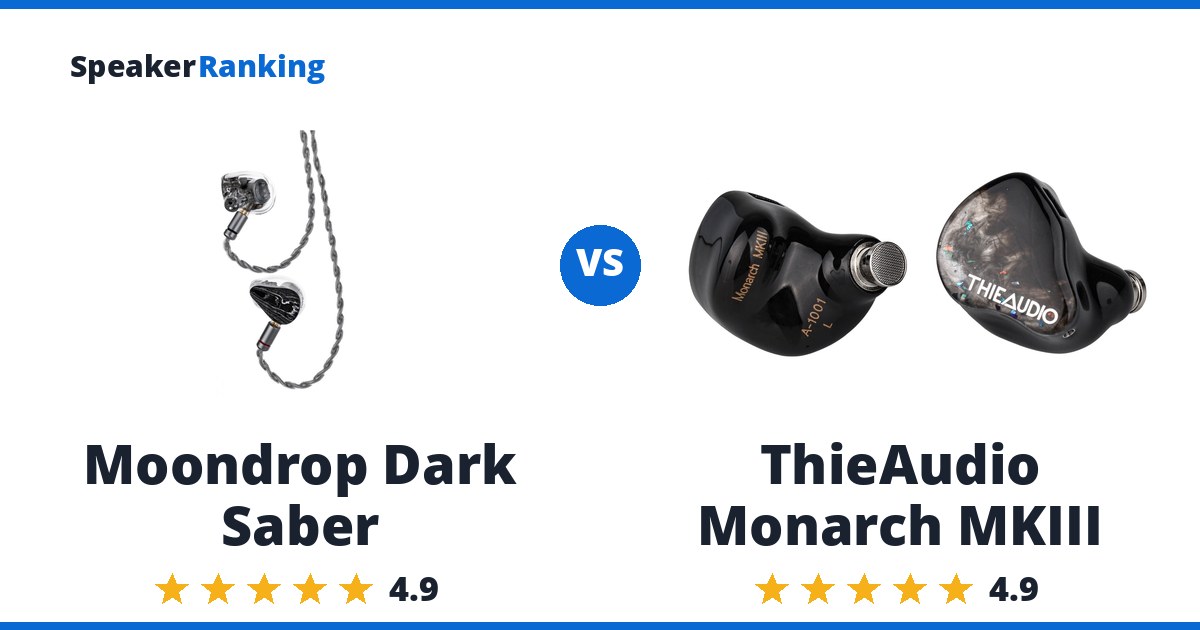
What the Moondrop Dark Saber does well: Across ten hobbyist measurements on squig.link, the Dark Saber tracks the target unusually closely, with only about 1.1 dB of unevenness and a preference score of 84. Watch for: The presence and lower treble regions sit about 2 dB below target with a 5.4 dB dip near 6.5 kHz, so some listeners will find vocals and cymbals slightly recessed and soft.
Why pick the ThieAudio Monarch MKIII: A preference score of 91 in HypetheSonics’ measurement, with an exceptionally smooth 0.77 dB standard deviation from target. Watch for: The air band from 10 to 16 kHz sits about 5.7 dB above target with a 4.4 dB peak near 11.9 kHz, which can add a hint of glare on bright or sibilant recordings.
Buy the Moondrop Dark Saber. Both are rated the same for sound quality, and it costs $99.01 less than the ThieAudio Monarch MKIII.
Still deciding? The full Headphones rankings cover every ranked option.
Specifications Side By Side
| Moondrop Dark Saber | ThieAudio Monarch MKIII | |
|---|---|---|
| Price | $899.99 | $999.00 |
| Ranked | #14 of 450 in In-Ear Headphones | #1 of 450 in In-Ear Headphones |
| Form Factor | In-ear | In-ear |
| Back | Closed | Closed |
| Harman Preference Score | 84 (median of 10 squig.link measurements, calibrated to AutoEQ) | 91 (measured by HypetheSonics, via AutoEQ) |
| Deviation From Target | 1.12 dB standard deviation | 0.77 dB standard deviation |
| Tonal Tilt | -0.15 (negative is warmer, positive brighter) | -0.11 (negative is warmer, positive brighter) |
| Sub-bass Extension | Within 6 dB of target down to 20 Hz (-0.3 dB at 30 Hz) | Within 6 dB of target down to 20 Hz (-0.8 dB at 30 Hz) |
| Connection | Wired | Wired |
| Driver Type | Hybrid (2 dynamic + 8 balanced armature) | Hybrid (2 dynamic + 6 balanced armature + 2 electrostatic) |
| Drivers | 2 x 10mm dynamic + 8 x balanced armature | 2 x 10mm dynamic + 6 x balanced armature + 2 x electrostatic |
| Impedance | 22 ohms | 18 ohms |
| Sensitivity | 128 dB/Vrms | 99 dB @ 1kHz |
| Frequency Response | 7Hz - 41kHz (Manufacturer specified) | 20Hz - 80kHz (Manufacturer specified) |
| Built-in Microphone | - | No |
Related Headphone Comparisons
More top alternatives to ThieAudio Monarch MKIII:
- ThieAudio Monarch MKIII vs Simgot EW100P
- ThieAudio Monarch MKII vs ThieAudio Monarch MKIII
- ThieAudio Monarch MKIII vs Symphonium Audio Helios
- ThieAudio Monarch MKIII vs ThieAudio Monarch MKIV
- Moondrop Dark Saber vs Simgot EW100P
Prices on this page were last checked October 11, 2026 at 4:59 PM UTC. Product prices and availability are accurate as of that date/time and are subject to change; the price and availability shown on Amazon at the time of purchase will apply to the purchase of this product.
As an eBay Partner, we may be compensated if you make a purchase.
The Two Headphones In Full
 Moondrop Dark Saber: $899.99 Amazon eBay

Pros: Across ten hobbyist measurements on squig.link, the Dark Saber tracks the target unusually closely, with only about 1.1 dB of unevenness and a preference score of 84. Sub-bass holds within about 1 dB of target down to 20 Hz, so its two dynamic drivers deliver full rumble without bloating the midrange. Its 128 dB/Vrms sensitivity means any phone drives it easily, and it rates higher than the pricier Symphonium Audio Helios.
Cons: The presence and lower treble regions sit about 2 dB below target with a 5.4 dB dip near 6.5 kHz, so some listeners will find vocals and cymbals slightly recessed and soft. The ThieAudio Monarch MKIII earns the same rating for those who want an alternative, and a ten driver hybrid at this price is a large spend for a modest gain over far cheaper well tuned sets.
Full Moondrop Dark Saber review and specifications →
| Released | Sep 2023 (3 years ago) |
|---|---|
| Back | Closed |
| Connection | Wired |
| Deviation From Target | 1.12 dB standard deviation |
| Driver Type | Hybrid (2 dynamic + 8 balanced armature) |
| Drivers | 2 x 10mm dynamic + 8 x balanced armature |
| Form Factor | In-ear |
| Frequency Response | 7Hz - 41kHz (Manufacturer specified) |
| Harman Preference Score | 84 (median of 10 squig.link measurements, calibrated to AutoEQ) |
| Impedance | 22 ohms |
| Sensitivity | 128 dB/Vrms |
| Sub-bass Extension | Within 6 dB of target down to 20 Hz (-0.3 dB at 30 Hz) |
| Tonal Tilt | -0.15 (negative is warmer, positive brighter) |
- Reviews, Comparisons and Sound Samples
- Head-to-Head Comparisons
 ThieAudio Monarch MKIII: $999.00 Linsoul eBay

Pros: A preference score of 91 in HypetheSonics’ measurement, with an exceptionally smooth 0.77 dB standard deviation from target. Everything from 20 Hz to 10 kHz stays within about 1.1 dB of target, so bass, vocals and treble all sound balanced and true. It rates above the pricier Symphonium Audio Helios and well above the SoftEars RSV.
Cons: The air band from 10 to 16 kHz sits about 5.7 dB above target with a 4.4 dB peak near 11.9 kHz, which can add a hint of glare on bright or sibilant recordings. It is a wired in-ear with no built-in microphone, so it is not suited to calls on the go.
Full ThieAudio Monarch MKIII review and specifications →
| Released | 2023 (3 years ago) |
|---|---|
| Back | Closed |
| Built-in Microphone | No |
| Connection | Wired |
| Deviation From Target | 0.77 dB standard deviation |
| Driver Type | Hybrid (2 dynamic + 6 balanced armature + 2 electrostatic) |
| Drivers | 2 x 10mm dynamic + 6 x balanced armature + 2 x electrostatic |
| Form Factor | In-ear |
| Frequency Response | 20Hz - 80kHz (Manufacturer specified) |
| Harman Preference Score | 91 (measured by HypetheSonics, via AutoEQ) |
| Impedance | 18 ohms |
| Sensitivity | 99 dB @ 1kHz |
| Sub-bass Extension | Within 6 dB of target down to 20 Hz (-0.8 dB at 30 Hz) |
| Tonal Tilt | -0.11 (negative is warmer, positive brighter) |
EQ preset to match the Harman target
Set a preamp of -1.0 dB, then add these filters in any parametric equalizer (Wavelet, Equalizer APO, Peace, or a player with parametric EQ). Calculated by AutoEQ from its measured frequency response.
| Filter | Frequency | Gain | Q |
|---|---|---|---|
| Low shelf | 105 Hz | -0.1 dB | 0.70 |
| Peak | 742 Hz | +1.1 dB | 1.13 |
| Peak | 130 Hz | -1.1 dB | 1.51 |
| Peak | 1,584 Hz | -0.6 dB | 1.19 |
| Peak | 3,281 Hz | +0.9 dB | 4.08 |
| High shelf | 10,000 Hz | -7.9 dB | 0.70 |
| Peak | 8,077 Hz | +1.8 dB | 1.48 |
| Peak | 5,639 Hz | -1.4 dB | 6.00 |
| Peak | 9,669 Hz | +1.1 dB | 4.55 |
| Peak | 60 Hz | +0.1 dB | 2.11 |
- Reviews, Comparisons and Sound Samples
- Head-to-Head Comparisons