Short answer: the Meze 109 Pro. It ranks #91 of 216 over-ear headphones by sound quality, rated 3.8/5, at $799; the Denon AH-D5200 ranks #107, rated 3.7/5, at $799. The price gap is small enough that the sound-quality ranking should decide it.

What the Meze 109 Pro does well: The open back has a warm, full tuning, with bass from 60 to 200 Hz about 2 dB above target and low mids 2.2 dB above, giving music weight and body. The tradeoff: A 6.3 dB dip near 9.5 kHz sits next to a 4.5 dB peak near 7.4 kHz, so cymbals and sibilants sound uneven.
The case for the Denon AH-D5200: Bass is lifted about 2 dB from 60 to 200 Hz while sub-bass stays within 1 dB of target, giving a full, controlled low end. The catch: Treble from 6 to 10 kHz is about 2.9 dB under target and a 6.2 dB dip near 9 kHz dulls cymbals and air.
Buy the Meze 109 Pro. It is rated higher for sound quality than the Denon AH-D5200 at the same price, so only choose the other one for a particular feature it does better.
Looking for alternatives? See the complete Headphones rankings.
Specifications Side By Side
| Meze 109 Pro | Denon AH-D5200 | |
|---|---|---|
| Price | $799.00 | $799.00 |
| Ranked | #91 of 216 in Over-Ear Headphones | #107 of 216 in Over-Ear Headphones |
| Form Factor | Over-ear | Over-ear |
| Harman Preference Score | 78 (measured by oratory1990, via AutoEQ) | 75 (measured by oratory1990, via AutoEQ) |
| Deviation From Target | 2.25 dB standard deviation | 2.12 dB standard deviation |
| Tonal Tilt | -0.50 (negative is warmer, positive brighter) | -0.83 (negative is warmer, positive brighter) |
| Sub-bass Extension | Within 6 dB of target down to 20 Hz (-4.6 dB at 30 Hz) | Within 6 dB of target down to 20 Hz (-1.4 dB at 30 Hz) |
| Connection | Wired | Wired |
| Back | Open | Closed |
| Driver Type | Dynamic | Dynamic |
| Drivers | 1 x 50mm dynamic | 1 x 50mm dynamic |
| Impedance | 40 ohms | 24 ohms |
| Sensitivity | 112 dB SPL/mW | 103 dB/mW |
| Weight | 0.8 lbs (375 g) | 0.8 lbs (385 g) |
| Frequency Response | 5Hz - 30kHz (Manufacturer specified) | 5Hz - 40kHz (Manufacturer specified) |
| Built-in Microphone | - | No |
Related Headphone Comparisons
More worthwhile head-to-heads for Meze 109 Pro:
- HIFIMAN Mini Shangri-La vs Meze 109 Pro
- Focal Spirit Classic vs Meze 109 Pro
- Meze 109 Pro vs Focal Bathys
- Denon AH-D5200 vs Focal Bathys
- Denon AH-D5200 vs Fostex TH610
Prices on this page were last checked October 11, 2026 at 4:59 PM UTC. Product prices and availability are accurate as of that date/time and are subject to change; the price and availability shown on Amazon at the time of purchase will apply to the purchase of this product.
As an eBay Partner, we may be compensated if you make a purchase.
The Two Headphones In Full
 Meze 109 Pro: $799.00 Amazon eBay

Pros: The open back has a warm, full tuning, with bass from 60 to 200 Hz about 2 dB above target and low mids 2.2 dB above, giving music weight and body. Treble and air are lifted, with the top octave about 4.7 dB above target, which adds some openness. It uses a single 50 mm dynamic driver, runs at 40 ohms and 112 dB SPL per milliwatt so a phone can drive it, and the preference score is 78.
Cons: A 6.3 dB dip near 9.5 kHz sits next to a 4.5 dB peak near 7.4 kHz, so cymbals and sibilants sound uneven. The upper mids are about 1.8 dB low, which pulls vocals back slightly. It costs well above the HIFIMAN Audivina yet rates lower, and at 375 g it is heavier than some alternatives.
Full Meze 109 Pro review and specifications →
| Back | Open |
|---|---|
| Connection | Wired |
| Deviation From Target | 2.25 dB standard deviation |
| Driver Type | Dynamic |
| Drivers | 1 x 50mm dynamic |
| Form Factor | Over-ear |
| Frequency Response | 5Hz - 30kHz (Manufacturer specified) |
| Harman Preference Score | 78 (measured by oratory1990, via AutoEQ) |
| Impedance | 40 ohms |
| Sensitivity | 112 dB SPL/mW |
| Sub-bass Extension | Within 6 dB of target down to 20 Hz (-4.6 dB at 30 Hz) |
| Tonal Tilt | -0.50 (negative is warmer, positive brighter) |
| Weight | 0.8 lbs (375 g) |
EQ preset to match the Harman target
Set a preamp of -5.3 dB, then add these filters in any parametric equalizer (Wavelet, Equalizer APO, Peace, or a player with parametric EQ). Calculated by AutoEQ from its measured frequency response.
| Filter | Frequency | Gain | Q |
|---|---|---|---|
| Low shelf | 105 Hz | +7.4 dB | 0.70 |
| Peak | 72 Hz | -4.2 dB | 0.25 |
| Peak | 2,028 Hz | +5.6 dB | 1.63 |
| Peak | 2,856 Hz | -1.9 dB | 4.04 |
| Peak | 83 Hz | -1.2 dB | 1.11 |
| High shelf | 10,000 Hz | -4.7 dB | 0.70 |
| Peak | 8,692 Hz | +1.6 dB | 2.63 |
| Peak | 825 Hz | -0.9 dB | 2.44 |
| Peak | 475 Hz | +0.4 dB | 1.32 |
| Peak | 4,705 Hz | +1.3 dB | 6.00 |
- Reviews, Comparisons and Sound Samples
- Head-to-Head Comparisons
 Denon AH-D5200: $799.00 Amazon eBay
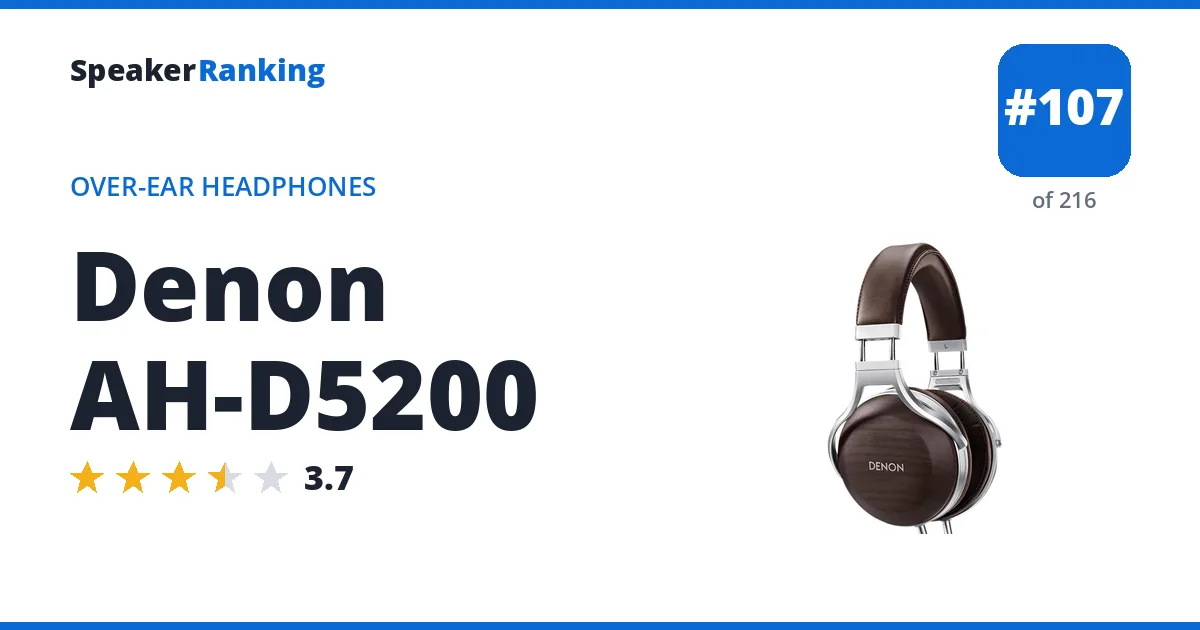
Pros: Bass is lifted about 2 dB from 60 to 200 Hz while sub-bass stays within 1 dB of target, giving a full, controlled low end. The 2.1 dB deviation is smooth, and 24 ohms with 103 dB/mW runs easily from a phone or portable player. The large 50 mm driver and closed back suit relaxed home listening.
Cons: Treble from 6 to 10 kHz is about 2.9 dB under target and a 6.2 dB dip near 9 kHz dulls cymbals and air. At 385 g it is heavy for the class and has no microphone. The AKG K712 and Focal Spirit Classic both hold higher ratings for less money.
Full Denon AH-D5200 review and specifications →
| Released | 2018 (8 years ago) |
|---|---|
| Back | Closed |
| Built-in Microphone | No |
| Connection | Wired |
| Deviation From Target | 2.12 dB standard deviation |
| Driver Type | Dynamic |
| Drivers | 1 x 50mm dynamic |
| Form Factor | Over-ear |
| Frequency Response | 5Hz - 40kHz (Manufacturer specified) |
| Harman Preference Score | 75 (measured by oratory1990, via AutoEQ) |
| Impedance | 24 ohms |
| Sensitivity | 103 dB/mW |
| Sub-bass Extension | Within 6 dB of target down to 20 Hz (-1.4 dB at 30 Hz) |
| Tonal Tilt | -0.83 (negative is warmer, positive brighter) |
| Weight | 0.8 lbs (385 g) |
EQ preset to match the Harman target
Set a preamp of -3.1 dB, then add these filters in any parametric equalizer (Wavelet, Equalizer APO, Peace, or a player with parametric EQ). Calculated by AutoEQ from its measured frequency response.
| Filter | Frequency | Gain | Q |
|---|---|---|---|
| Low shelf | 105 Hz | +5.1 dB | 0.70 |
| Peak | 86 Hz | -4.7 dB | 0.23 |
| Peak | 8,914 Hz | +2.5 dB | 2.81 |
| Peak | 2,317 Hz | +3.1 dB | 1.77 |
| Peak | 405 Hz | +3.6 dB | 2.20 |
| High shelf | 10,000 Hz | -0.6 dB | 0.70 |
| Peak | 5,418 Hz | -4.0 dB | 4.92 |
| Peak | 1,225 Hz | +2.0 dB | 6.00 |
| Peak | 6,714 Hz | +2.2 dB | 5.01 |
| Peak | 40 Hz | -0.5 dB | 2.06 |
- Reviews, Comparisons and Sound Samples
- Head-to-Head Comparisons