Short answer: the Melody Wings Neptune. Both are rated 4.4/5 for sound quality (#107 and #89 of 450 in-ear headphones), and the Melody Wings Neptune costs $328 against $359.99 for the Moondrop Blessing 3, so with nothing between them on sound quality, price settles it.

What the Melody Wings Neptune does well: Across 6 squig.link measurements it scores 78.9 with a 1.48 dB spread, and its bass and mids stay within about 1 dB of target, so voices and instruments keep a natural balance. Watch for: The 5.6 dB peak near 8.2 kHz can make sibilance and bright recordings sound edgy at higher volumes.
The case for the Moondrop Blessing 3: Crinacle’s measurement gives it a preference score of 79, and the median of 38 hobbyist measurements on squig.link keeps every band from 20 Hz to 10 kHz within 2 dB of the Harman target, with a smooth 1.65 dB deviation. Watch for: The Etymotic EVO matches its rating for noticeably less money.
Buy the Melody Wings Neptune. Both are rated the same for sound quality, and it costs $31.99 less than the Moondrop Blessing 3.
Want more options? Browse the full Headphones rankings.
Specifications Side By Side
| Melody Wings Neptune | Moondrop Blessing 3 | |
|---|---|---|
| Price | $328.00 | $359.99 |
| Ranked | #107 of 450 in In-Ear Headphones | #89 of 450 in In-Ear Headphones |
| Form Factor | In-ear | In-ear |
| Back | Closed | Closed |
| Harman Preference Score | 79 (median of 6 squig.link measurements, calibrated to AutoEQ) | 79 (measured by crinacle, via AutoEQ) |
| Deviation From Target | 1.48 dB standard deviation | 1.65 dB standard deviation |
| Tonal Tilt | +0.07 (negative is warmer, positive brighter) | +0.34 (negative is warmer, positive brighter) |
| Sub-bass Extension | Within 6 dB of target down to 20 Hz (-1.2 dB at 30 Hz) | Within 6 dB of target down to 20 Hz (-1.9 dB at 30 Hz) |
| Connection | Wired | Wired |
| Driver Type | Hybrid (1 dynamic + 4 balanced armature + 1 bone conduction) | Hybrid (2 dynamic + 4 balanced armature) |
| Drivers | 1 x 10mm dynamic + 4 x balanced armature + 1 x bone conduction | 2 x dynamic + 4 x balanced armature |
| Impedance | 19 ohms | 14.8 ohms |
| Sensitivity | 108 dB/mW | 120 dB/Vrms |
| Frequency Response | 20Hz - 20kHz (Manufacturer specified) | 10Hz - 30kHz (Manufacturer specified) |
| Built-in Microphone | No | - |
Related Headphone Comparisons
More worthwhile head-to-heads for Moondrop Blessing 3:
- Moondrop Blessing 3 vs Truthear x Crinacle Zero
- Moondrop Blessing 3 vs Moondrop Variations
- Moondrop Blessing vs Moondrop Blessing 3
- Moondrop Blessing 3 vs Unique Melody 3DT
- Inawaken Twilight-DS vs Moondrop Blessing 3
Prices on this page were last checked October 11, 2026 at 4:59 PM UTC. Product prices and availability are accurate as of that date/time and are subject to change; the price and availability shown on Amazon at the time of purchase will apply to the purchase of this product.
As an eBay Partner, we may be compensated if you make a purchase.
The Two Headphones In Full
 Melody Wings Neptune: $328.00 Bloom Audio eBay
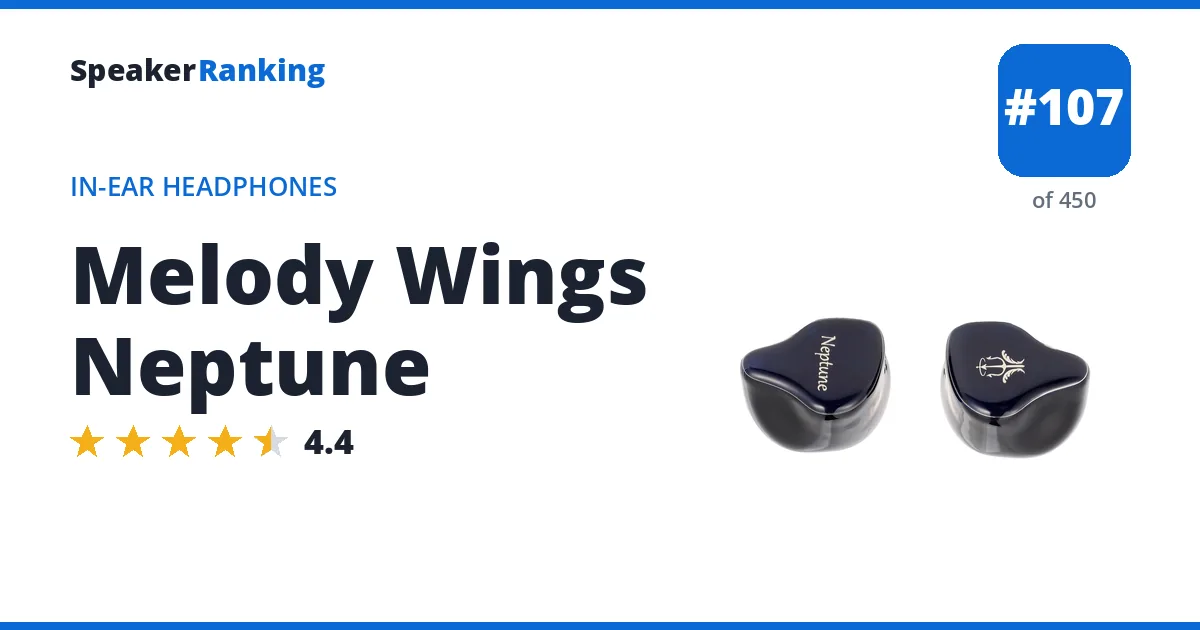
Pros: Across 6 squig.link measurements it scores 78.9 with a 1.48 dB spread, and its bass and mids stay within about 1 dB of target, so voices and instruments keep a natural balance. Treble rises 1.7 dB above target from 6 to 10 kHz and 5.6 dB in the air band, giving cymbals and strings plenty of detail and openness for listeners who like a crisp top end. A sensitivity of 108 dB/mW means it runs well from a phone.
Cons: The 5.6 dB peak near 8.2 kHz can make sibilance and bright recordings sound edgy at higher volumes. A 3.8 dB dip near 6.3 kHz sits right beside it, which leaves the upper treble slightly uneven, and it costs more than the equally rated Binary 1900 and DUNU Falcon Ultra.
Full Melody Wings Neptune review and specifications →
| Released | 2026 (this year) |
|---|---|
| Back | Closed |
| Built-in Microphone | No |
| Connection | Wired |
| Deviation From Target | 1.48 dB standard deviation |
| Driver Type | Hybrid (1 dynamic + 4 balanced armature + 1 bone conduction) |
| Drivers | 1 x 10mm dynamic + 4 x balanced armature + 1 x bone conduction |
| Form Factor | In-ear |
| Frequency Response | 20Hz - 20kHz (Manufacturer specified) |
| Harman Preference Score | 79 (median of 6 squig.link measurements, calibrated to AutoEQ) |
| Impedance | 19 ohms |
| Sensitivity | 108 dB/mW |
| Sub-bass Extension | Within 6 dB of target down to 20 Hz (-1.2 dB at 30 Hz) |
| Tonal Tilt | +0.07 (negative is warmer, positive brighter) |
- Reviews, Comparisons and Sound Samples
- Head-to-Head Comparisons
 Moondrop Blessing 3: $359.99 Amazon AliExpress eBay

Pros: Crinacle’s measurement gives it a preference score of 79, and the median of 38 hobbyist measurements on squig.link keeps every band from 20 Hz to 10 kHz within 2 dB of the Harman target, with a smooth 1.65 dB deviation. The result is balanced, natural sounding vocals and instruments with full bass extension. At 14.8 ohms and 120 dB/V it is easy to drive from a phone, and it rates above the Kiwi Ears Orchestra Lite and the FiiO FH5s.
Cons: The Etymotic EVO matches its rating for noticeably less money. A 3.8 dB dip near 6.9 kHz next to a 3.6 dB peak near 8.1 kHz gives the treble slight unevenness, and sub-bass sits about 2 dB under target, so it lacks the extra rumble bass lovers may want.
Full Moondrop Blessing 3 review and specifications →
| Back | Closed |
|---|---|
| Connection | Wired |
| Deviation From Target | 1.65 dB standard deviation |
| Driver Type | Hybrid (2 dynamic + 4 balanced armature) |
| Drivers | 2 x dynamic + 4 x balanced armature |
| Form Factor | In-ear |
| Frequency Response | 10Hz - 30kHz (Manufacturer specified) |
| Harman Preference Score | 79 (measured by crinacle, via AutoEQ) |
| Impedance | 14.8 ohms |
| Sensitivity | 120 dB/Vrms |
| Sub-bass Extension | Within 6 dB of target down to 20 Hz (-1.9 dB at 30 Hz) |
| Tonal Tilt | +0.34 (negative is warmer, positive brighter) |
EQ preset to match the Harman target
Set a preamp of -2.9 dB, then add these filters in any parametric equalizer (Wavelet, Equalizer APO, Peace, or a player with parametric EQ). Calculated by AutoEQ from its measured frequency response.
| Filter | Frequency | Gain | Q |
|---|---|---|---|
| Low shelf | 105 Hz | +2.5 dB | 0.70 |
| Peak | 10,000 Hz | +2.8 dB | 0.97 |
| Peak | 3,076 Hz | -2.1 dB | 3.52 |
| Peak | 237 Hz | -0.5 dB | 1.04 |
| Peak | 1,479 Hz | -1.1 dB | 3.10 |
| High shelf | 10,000 Hz | -8.7 dB | 0.70 |
| Peak | 9,596 Hz | +3.9 dB | 2.54 |
| Peak | 863 Hz | +0.8 dB | 2.44 |
| Peak | 451 Hz | -0.2 dB | 1.54 |
| Peak | 6,947 Hz | +1.4 dB | 5.99 |
- Reviews, Comparisons and Sound Samples
- Head-to-Head Comparisons