Short answer: the KZ ZAX. It ranks #326 of 450 in-ear headphones by sound quality, rated 3.8/5, at $65.99. The TFZ T2 Galaxy ranks #340, rated 3.6/5, at $59, $6.99 cheaper, which does not close the gap in sound quality.

The case for the KZ ZAX: Across hobbyist measurements on squig.link sub-bass sits within 0.2 dB of target down to 20 Hz, and a 3.2 dB bass lift adds warmth and punch for pop and electronic music. The catch: A 9 dB peak near 11.2 kHz lifts the top octave about 6 dB above target, which can make cymbals and sibilants sound sizzly on bright recordings, and a 3.8 dB dip near 3.4 kHz slightly recesses vocals.
The case for the TFZ T2 Galaxy: Oratory1990’s measurement shows sub-bass about 3.7 dB and bass about 3.5 dB above the Harman target, which gives kick drums and bass lines a solid, punchy foundation that suits bassy and V-shaped tastes. Watch for: A peak of 4.9 dB near 8 kHz can make cymbals and sibilant vocals sound sharp.
Buy the KZ ZAX. It is rated higher for sound quality, and saving $6.99 with the TFZ T2 Galaxy does not make up for the sound-quality gap.
Looking for alternatives? See the complete Headphones rankings.
Specifications Side By Side
| KZ ZAX | TFZ T2 Galaxy | |
|---|---|---|
| Price | $65.99 | $59.00 |
| Ranked | #326 of 450 in In-Ear Headphones | #340 of 450 in In-Ear Headphones |
| Form Factor | In-ear | In-ear |
| Harman Preference Score | 71 (measured by crinacle, via AutoEQ) | 69 (measured by oratory1990, via AutoEQ) |
| Deviation From Target | 2.29 dB standard deviation | 2.12 dB standard deviation |
| Tonal Tilt | -0.43 (negative is warmer, positive brighter) | -0.77 (negative is warmer, positive brighter) |
| Connection | Wired | Wired |
| Driver Type | Hybrid (1 dynamic + 7 balanced armature) | Dynamic |
| Drivers | 1 x dynamic + 7 x balanced armature | 1 x 12mm dynamic |
| Impedance | 24 ohms | 16 ohms |
| Sensitivity | 113 dB | 110 dB/mW |
| Frequency Response | 10Hz - 40kHz (Manufacturer specified) | 5Hz - 40kHz (Manufacturer specified) |
| Back | Closed | Closed |
| Sub-bass Extension | Within 6 dB of target down to 20 Hz (-0.7 dB at 30 Hz) | Within 6 dB of target down to 20 Hz (+4.2 dB at 30 Hz) |
| Built-in Microphone | - | No |
Related Headphone Comparisons
How KZ ZAX compares with other leading options:
- EarFun Air Pro 4 vs KZ ZAX
- Inawaken Dawn Mistwood vs KZ ZAX
- KZ ZAX vs MEE Audio M6 Pro
- KZ ZAX vs Pula Unicrom
- KZ ZS10 Pro 2 vs TFZ T2 Galaxy
Prices on this page were last checked October 11, 2026 at 4:59 PM UTC. Product prices and availability are accurate as of that date/time and are subject to change; the price and availability shown on Amazon at the time of purchase will apply to the purchase of this product.
As an eBay Partner, we may be compensated if you make a purchase.
The Two Headphones In Full
 KZ ZAX: $65.99 Amazon eBay

Pros: Across hobbyist measurements on squig.link sub-bass sits within 0.2 dB of target down to 20 Hz, and a 3.2 dB bass lift adds warmth and punch for pop and electronic music. Crinacle’s measurement gives it a preference score of 71. Its one dynamic and seven balanced armature hybrid runs at 24 ohms and 113 dB, so any phone or dongle drives it loud.
Cons: A 9 dB peak near 11.2 kHz lifts the top octave about 6 dB above target, which can make cymbals and sibilants sound sizzly on bright recordings, and a 3.8 dB dip near 3.4 kHz slightly recesses vocals. It costs more than the CCA C12 for the same rating, while the Tin HiFi T4 rates higher for a little more.
Full KZ ZAX review and specifications →
| Back | Closed |
|---|---|
| Connection | Wired |
| Deviation From Target | 2.29 dB standard deviation |
| Driver Type | Hybrid (1 dynamic + 7 balanced armature) |
| Drivers | 1 x dynamic + 7 x balanced armature |
| Form Factor | In-ear |
| Frequency Response | 10Hz - 40kHz (Manufacturer specified) |
| Harman Preference Score | 71 (measured by crinacle, via AutoEQ) |
| Impedance | 24 ohms |
| Sensitivity | 113 dB |
| Sub-bass Extension | Within 6 dB of target down to 20 Hz (-0.7 dB at 30 Hz) |
| Tonal Tilt | -0.43 (negative is warmer, positive brighter) |
EQ preset to match the Harman target
Set a preamp of -4.5 dB, then add these filters in any parametric equalizer (Wavelet, Equalizer APO, Peace, or a player with parametric EQ). Calculated by AutoEQ from its measured frequency response.
| Filter | Frequency | Gain | Q |
|---|---|---|---|
| Low shelf | 105 Hz | +1.0 dB | 0.70 |
| Peak | 197 Hz | -3.9 dB | 0.41 |
| Peak | 639 Hz | +3.6 dB | 0.62 |
| Peak | 2,128 Hz | -6.0 dB | 1.80 |
| Peak | 4,125 Hz | +2.9 dB | 0.42 |
| High shelf | 10,000 Hz | +0.0 dB | 0.70 |
| Peak | 4,387 Hz | -3.1 dB | 5.67 |
| Peak | 9,739 Hz | -1.1 dB | 2.42 |
| Peak | 3,351 Hz | +1.7 dB | 4.33 |
| Peak | 6,468 Hz | +2.5 dB | 6.00 |
- Reviews, Comparisons and Sound Samples
- Head-to-Head Comparisons
 TFZ T2 Galaxy: $59.00 Amazon eBay
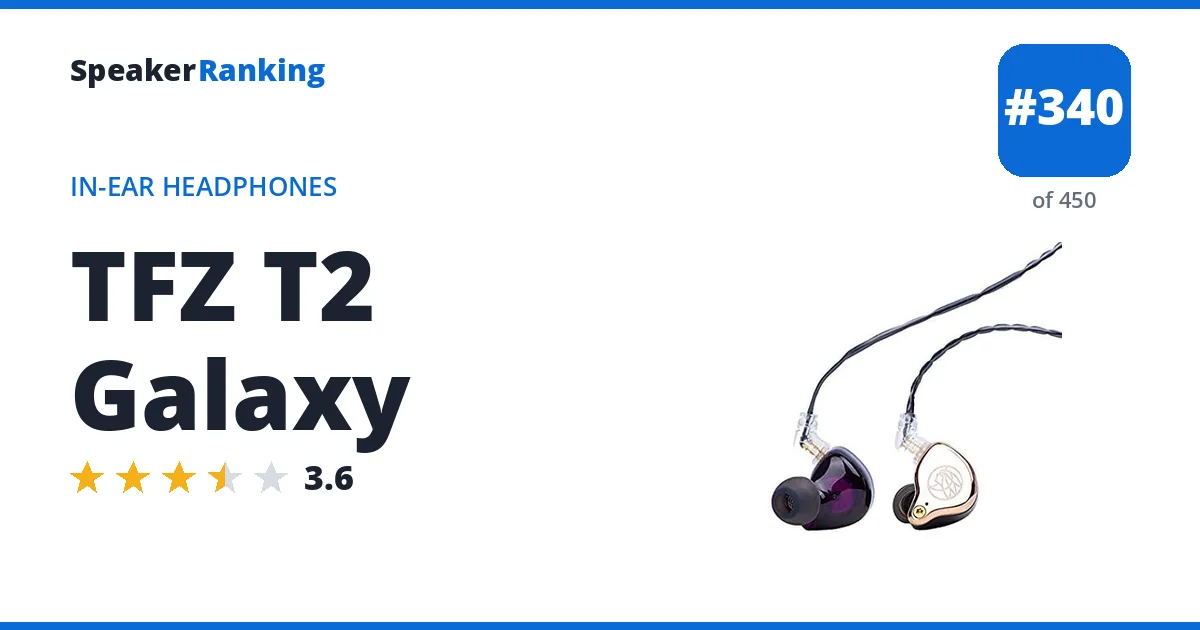
Pros: Oratory1990’s measurement shows sub-bass about 3.7 dB and bass about 3.5 dB above the Harman target, which gives kick drums and bass lines a solid, punchy foundation that suits bassy and V-shaped tastes. The 16 ohm impedance and 110 dB/mW sensitivity mean it plays loud from a phone without an amp. The preference score of 69 is respectable for a budget wired in-ear, and its 12 mm dynamic driver stays simple and easy to drive.
Cons: A peak of 4.9 dB near 8 kHz can make cymbals and sibilant vocals sound sharp. Output above 10 kHz sits roughly 4.3 dB under target, with a 6.2 dB dip near 11.9 kHz, so the top end loses air and sparkle. The bass boost of more than 3 dB can also make male vocals and low instruments sound heavier than they should. There is no built-in microphone.
Full TFZ T2 Galaxy review and specifications →
| Back | Closed |
|---|---|
| Built-in Microphone | No |
| Connection | Wired |
| Deviation From Target | 2.12 dB standard deviation |
| Driver Type | Dynamic |
| Drivers | 1 x 12mm dynamic |
| Form Factor | In-ear |
| Frequency Response | 5Hz - 40kHz (Manufacturer specified) |
| Harman Preference Score | 69 (measured by oratory1990, via AutoEQ) |
| Impedance | 16 ohms |
| Sensitivity | 110 dB/mW |
| Sub-bass Extension | Within 6 dB of target down to 20 Hz (+4.2 dB at 30 Hz) |
| Tonal Tilt | -0.77 (negative is warmer, positive brighter) |
EQ preset to match the Harman target
Set a preamp of -3.4 dB, then add these filters in any parametric equalizer (Wavelet, Equalizer APO, Peace, or a player with parametric EQ). Calculated by AutoEQ from its measured frequency response.
| Filter | Frequency | Gain | Q |
|---|---|---|---|
| Low shelf | 105 Hz | -3.4 dB | 0.70 |
| Peak | 750 Hz | +3.0 dB | 0.89 |
| Peak | 178 Hz | -2.3 dB | 1.50 |
| Peak | 1,788 Hz | -2.0 dB | 1.39 |
| Peak | 3,012 Hz | +2.5 dB | 3.09 |
| High shelf | 10,000 Hz | +3.4 dB | 0.70 |
| Peak | 4,584 Hz | -3.9 dB | 5.24 |
| Peak | 5,910 Hz | +3.5 dB | 5.10 |
| Peak | 70 Hz | +1.0 dB | 1.75 |
| Peak | 124 Hz | -0.7 dB | 2.97 |
- Reviews, Comparisons and Sound Samples
- Head-to-Head Comparisons