Short answer: the Kiwi Ears Quintet. It ranks #46 of 450 in-ear headphones by sound quality, rated 4.6/5, at $208.05; the Simgot SuperMix 5 ranks #69, rated 4.5/5, and costs $208.99, so there is little reason to consider the other one.

Why pick the Kiwi Ears Quintet: The median of 39 squig.link measurements, a large sample, scores it 81.5 for preference with only 1.23 dB of deviation. The tradeoff: Presence dips about 2.1 dB below target and bottoms out 4 dB down near 6.3 kHz, which can soften consonants and snare attack.
Why pick the Simgot SuperMix 5: Its five driver hybrid scores 80.1 for preference across 22 squig.link measurements, with a 1.24 dB deviation that keeps the whole range smooth. The catch: Presence and treble sit about 2.5 dB below target from 3 to 10 kHz with a 3.9 dB dip near 6.1 kHz, so the sound is a bit laid back and cymbals lack bite.
Buy the Kiwi Ears Quintet. It is rated higher for sound quality than the Simgot SuperMix 5 and costs less, so only choose the other one for a particular feature it does better.
Looking for alternatives? See the complete Headphones rankings.
Specifications Side By Side
| Kiwi Ears Quintet | Simgot SuperMix 5 | |
|---|---|---|
| Price | $208.05 | $208.99 |
| Ranked | #46 of 450 in In-Ear Headphones | #69 of 450 in In-Ear Headphones |
| Form Factor | In-ear | In-ear |
| Back | Closed | Closed |
| Harman Preference Score | 81 (median of 40 squig.link measurements, calibrated to AutoEQ) | 80 (median of 22 squig.link measurements, calibrated to AutoEQ) |
| Deviation From Target | 1.24 dB standard deviation | 1.24 dB standard deviation |
| Tonal Tilt | -0.37 (negative is warmer, positive brighter) | -0.22 (negative is warmer, positive brighter) |
| Sub-bass Extension | Within 6 dB of target down to 20 Hz (+0.2 dB at 30 Hz) | Within 6 dB of target down to 20 Hz (-2.0 dB at 30 Hz) |
| Connection | Wired | Wired |
| Driver Type | Hybrid (1 dynamic + 2 balanced armature + 1 planar magnetic + 1 bone conduction) | Hybrid (1 dynamic + 2 balanced armature + 1 planar magnetic + 1 bone conduction) |
| Drivers | 1 x 10mm dynamic + 2 x balanced armature + 1 x planar magnetic + 1 x bone conduction | 1 x dynamic + 2 x balanced armature + 1 x micro planar + 1 x bone conduction |
| Impedance | 32 ohms | 19 ohms |
| Frequency Response | 20Hz - 30kHz (Manufacturer specified) | 8Hz - 40kHz (Manufacturer specified) |
| Built-in Microphone | No | No |
| Sensitivity | - | 120 dB/Vrms |
Related Headphone Comparisons
More worthwhile head-to-heads for Kiwi Ears Quintet:
- BGVP Solomon vs Kiwi Ears Quintet
- Kiwi Ears Quintet vs Kiiboom Evoke
- Simgot SuperMix 5 vs DUNU Falcon Ultra
- Kiiboom Evoke vs Simgot SuperMix 5
- Simgot SuperMix 4 vs Simgot SuperMix 5
Prices on this page were last checked October 11, 2026 at 4:59 PM UTC. Product prices and availability are accurate as of that date/time and are subject to change; the price and availability shown on Amazon at the time of purchase will apply to the purchase of this product.
As an eBay Partner, we may be compensated if you make a purchase.
The Two Headphones In Full
 Kiwi Ears Quintet: $208.05 Amazon eBay

Pros: The median of 39 squig.link measurements, a large sample, scores it 81.5 for preference with only 1.23 dB of deviation. Sub-bass sits on target at 30 Hz and bass runs about 1 dB over, a full but controlled low end. Its five driver hybrid, with a dynamic driver, two balanced armatures, a planar and a bone conduction unit, keeps the midrange within half a dB of target, and air lifts about 2.8 dB for an open top end.
Cons: Presence dips about 2.1 dB below target and bottoms out 4 dB down near 6.3 kHz, which can soften consonants and snare attack. A 4.2 dB peak near 11.9 kHz adds a touch of glare to cymbals on bright recordings, and there is no inline mic.
Full Kiwi Ears Quintet review and specifications →
| Released | 2023 (3 years ago) |
|---|---|
| Back | Closed |
| Built-in Microphone | No |
| Connection | Wired |
| Deviation From Target | 1.24 dB standard deviation |
| Driver Type | Hybrid (1 dynamic + 2 balanced armature + 1 planar magnetic + 1 bone conduction) |
| Drivers | 1 x 10mm dynamic + 2 x balanced armature + 1 x planar magnetic + 1 x bone conduction |
| Form Factor | In-ear |
| Frequency Response | 20Hz - 30kHz (Manufacturer specified) |
| Harman Preference Score | 81 (median of 40 squig.link measurements, calibrated to AutoEQ) |
| Impedance | 32 ohms |
| Sub-bass Extension | Within 6 dB of target down to 20 Hz (+0.2 dB at 30 Hz) |
| Tonal Tilt | -0.37 (negative is warmer, positive brighter) |
- Reviews, Comparisons and Sound Samples
- Head-to-Head Comparisons
 Simgot SuperMix 5: $208.99 Amazon eBay
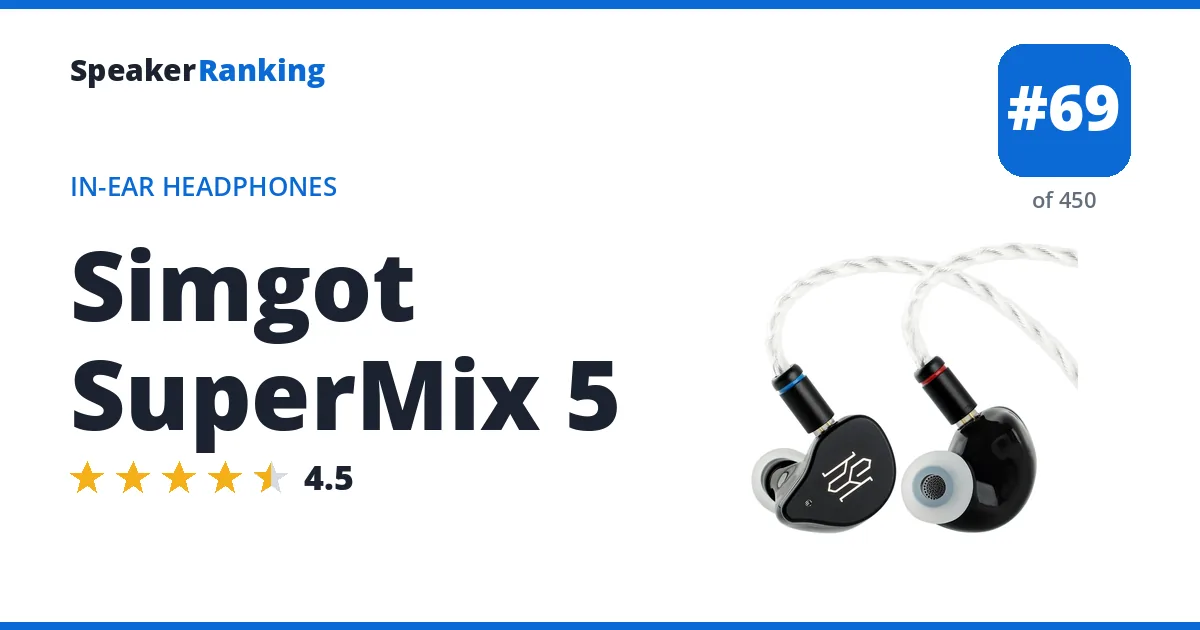
Pros: Its five driver hybrid scores 80.1 for preference across 22 squig.link measurements, with a 1.24 dB deviation that keeps the whole range smooth. Bass and lower midrange stay within about 1 dB of target, giving a warm, relaxed sound with natural vocals. The 120 dB/Vrms sensitivity and 19 ohm impedance make it easy to drive from a phone.
Cons: Presence and treble sit about 2.5 dB below target from 3 to 10 kHz with a 3.9 dB dip near 6.1 kHz, so the sound is a bit laid back and cymbals lack bite. The Meze Alba and Shuoer S12 carry the same rating for less money.
Full Simgot SuperMix 5 review and specifications →
| Back | Closed |
|---|---|
| Built-in Microphone | No |
| Connection | Wired |
| Deviation From Target | 1.24 dB standard deviation |
| Driver Type | Hybrid (1 dynamic + 2 balanced armature + 1 planar magnetic + 1 bone conduction) |
| Drivers | 1 x dynamic + 2 x balanced armature + 1 x micro planar + 1 x bone conduction |
| Form Factor | In-ear |
| Frequency Response | 8Hz - 40kHz (Manufacturer specified) |
| Harman Preference Score | 80 (median of 22 squig.link measurements, calibrated to AutoEQ) |
| Impedance | 19 ohms |
| Sensitivity | 120 dB/Vrms |
| Sub-bass Extension | Within 6 dB of target down to 20 Hz (-2.0 dB at 30 Hz) |
| Tonal Tilt | -0.22 (negative is warmer, positive brighter) |
- Reviews, Comparisons and Sound Samples
- Head-to-Head Comparisons