Short answer: the JBL Control 24CT. It ranks #1 of 26 surface-mount and background music speakers by sound quality, rated 4.1/5, at $350; the Yamaha VXS5 ranks #8, rated 3.0/5, and costs $392.98, so there is little reason to consider the other one.

The JBL Control 24CT is the more accurate choice. A 4” two-way ceiling speaker for background and foreground music with a coaxial 3/4” titanium-coated tweeter, a 130 degree conical coverage pattern and a built-in transformer for 70V and 100V distributed systems. Its measured preference score, a predictor of how neutral it sounds, is 7.35 against 1.86 for the Yamaha VXS5. Watch for: It has no 8 ohm bypass, so it needs a 70V or 100V amplifier rather than a normal home amplifier.
Why pick the Yamaha VXS5: A compact surface-mount speaker for commercial installations with a 5.25” woofer and a dome tweeter, weather-resistant for covered outdoor use. The catch: Bass is limited, so it needs a subwoofer for full-range music, and the on-axis response is uneven (0.95 average deviation).
Buy the JBL Control 24CT. It is rated higher for sound quality than the Yamaha VXS5 and costs less, so only choose the other one for a particular feature it does better.
Want more options? Browse the full PA & Live Sound rankings.
Specifications Side By Side
| JBL Control 24CT | Yamaha VXS5 | |
|---|---|---|
| Price | $350.00 per pair Passive | $392.98 per pair Passive |
| Ranked | #1 of 26 in Surface-Mount and Background Music Speakers | #8 of 26 in Surface-Mount and Background Music Speakers |
| Weight | 6 lbs (2.7 kg) | 7.9 lbs (3.6 kg) |
| Rigging | None | Wall/ceiling mount bracket included |
| Passive | Yes | Yes |
| Drivers | 4” (100mm) polypropylene-coated woofer, coaxial 3/4” (19mm) titanium-coated tweeter | 5.25” woofer, dome tweeter |
| Sensitivity | 86dB (manufacturer specified) | - |
| Frequency Response | 80Hz-20kHz -10dB (manufacturer specified) | - |
| Maximum SPL | 102dB (manufacturer specified) | 114dB peak (manufacturer specified) |
| Power Handling | 30W multitap transformer (70V/100V) | - |
| Spinorama Preference Score | 7.35 | 1.86 |
| Spinorama Preference Score with Perfect Sub | 8.65 | 5.17 |
| DIY Kit | No | No |
| Bluetooth | No | No |
| Bass Extension (-3dB) | - | 95.0Hz (measured, manufacturer data via spinorama.org) |
| Bass Extension (-10dB) | - | about 69.5Hz (measured, manufacturer data via spinorama.org) |
Frequency Response Compared
Both speakers’ spinorama measurements, overlaid. A flatter line is more neutral: peaks sound forward or harsh, dips sound recessed. Each curve is shifted so its average from 300 Hz to 3 kHz sits at 0 dB, so loudness differences between the two are removed and only the shape is compared.
Measurement data: JBL Control 24CT (measured by the manufacturer) and Yamaha VXS5 (measured by the manufacturer), via spinorama.org.
Related Speaker Comparisons
More top alternatives to JBL Control 24CT:
- JBL Control 24CT vs Electro-Voice EVID-S5.2X
- JBL Control 24CT vs Martin Audio CDD5
- Martin Audio CDD5 vs Yamaha VXS5
- Electro-Voice EVID-S5.2X vs Yamaha VXS5
- Martin Audio CDD6 vs Yamaha VXS5
Prices on this page were last checked October 11, 2026 at 4:59 PM UTC. Product prices and availability are accurate as of that date/time and are subject to change; the price and availability shown on Amazon at the time of purchase will apply to the purchase of this product.
As an eBay Partner, we may be compensated if you make a purchase.
The Two Speakers In Full
 JBL Control 24CT: $350.00 per pair Passive Amazon eBay
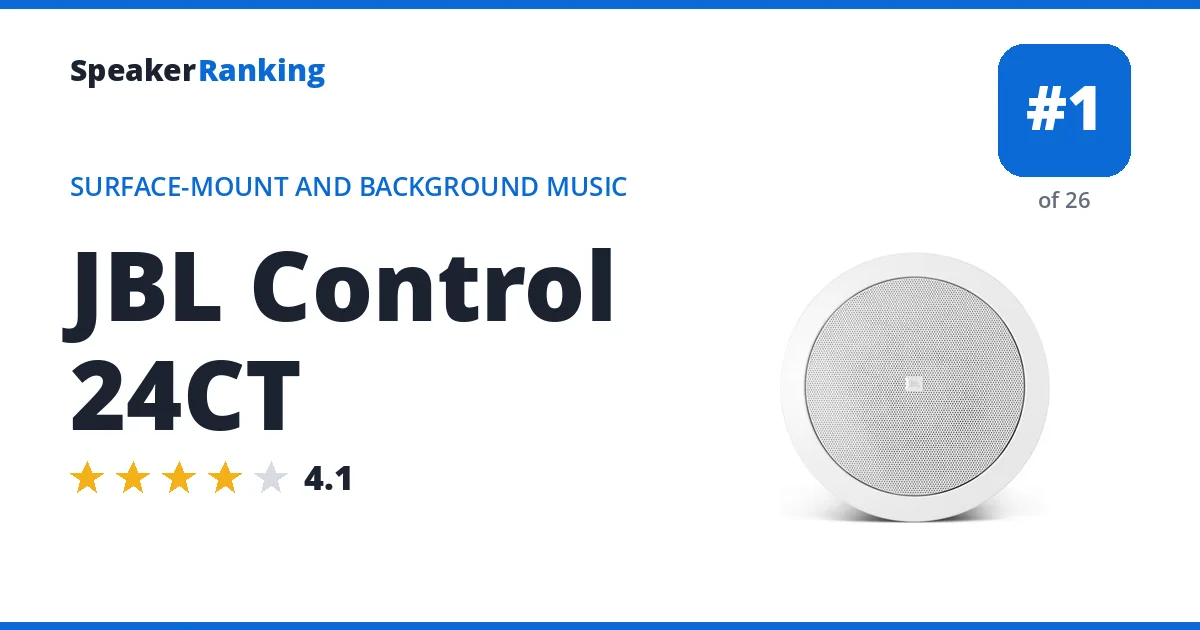
Pros: A 4” two-way ceiling speaker for background and foreground music with a coaxial 3/4” titanium-coated tweeter, a 130 degree conical coverage pattern and a built-in transformer for 70V and 100V distributed systems. JBL’s data shows a very even listening window (0.13 deviation), for a preference score of 7.35.
Cons: It has no 8 ohm bypass, so it needs a 70V or 100V amplifier rather than a normal home amplifier. Output is limited to 102dB, and the on-axis response is less even (1.14 average deviation) because it is meant to be heard off-axis from the ceiling. That data comes from JBL.
Full JBL Control 24CT review and specifications →
| Bluetooth | No |
|---|---|
| DIY Kit | No |
| Drivers | 4” (100mm) polypropylene-coated woofer, coaxial 3/4” (19mm) titanium-coated tweeter |
| Frequency Response | 80Hz-20kHz -10dB (manufacturer specified) |
| Maximum SPL | 102dB (manufacturer specified) |
| Passive | Yes |
| Power Handling | 30W multitap transformer (70V/100V) |
| Rigging | None |
| Sensitivity | 86dB (manufacturer specified) |
| Spinorama Preference Score | 7.35 |
| Spinorama Preference Score with Perfect Sub | 8.65 |
| Weight | 6 lbs (2.7 kg) |
- Reviews, Comparisons and Sound Samples
- Head-to-Head Comparisons
 Yamaha VXS5: $392.98 per pair Passive Amazon eBay
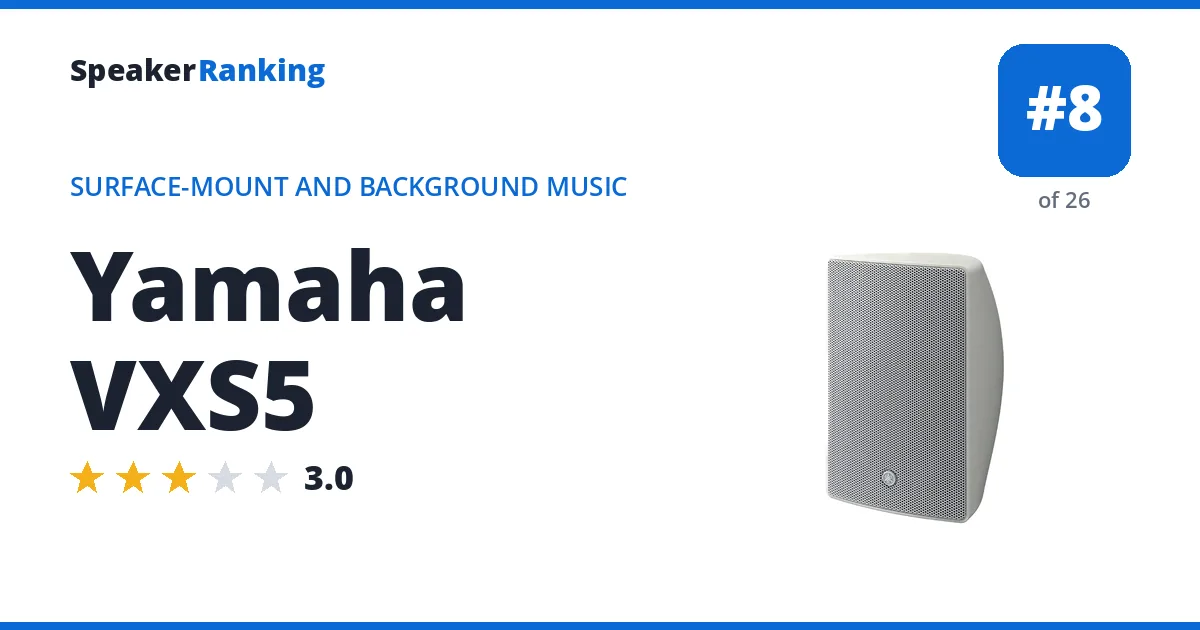
Same family: the Yamaha VXS1ML (smaller model, ranked lower, estimated 2.4/5), the Yamaha VXS3F (smaller model, ranked lower, rated 2.6/5) and the Yamaha VXS8 (larger model, ranked lower, estimated 3/5).
Pros: A compact surface-mount speaker for commercial installations with a 5.25” woofer and a dome tweeter, weather-resistant for covered outdoor use. Yamaha’s measurements show a preference score of 1.86 that reaches 5.17 with an ideal subwoofer, with 0.59 listening window deviation.
Cons: Bass is limited, so it needs a subwoofer for full-range music, and the on-axis response is uneven (0.95 average deviation). The data comes from Yamaha. Bass reaches 95.0Hz (-3dB) and about 70Hz (-10dB).
Full Yamaha VXS5 review and specifications →
| Bass Extension (-10dB) | about 69.5Hz (measured, manufacturer data via spinorama.org) |
|---|---|
| Bass Extension (-3dB) | 95.0Hz (measured, manufacturer data via spinorama.org) |
| Bluetooth | No |
| DIY Kit | No |
| Drivers | 5.25” woofer, dome tweeter |
| Maximum SPL | 114dB peak (manufacturer specified) |
| Passive | Yes |
| Rigging | Wall/ceiling mount bracket included |
| Spinorama Preference Score | 1.86 |
| Spinorama Preference Score with Perfect Sub | 5.17 |
| Weight | 7.9 lbs (3.6 kg) |
- Reviews, Comparisons and Sound Samples
- Head-to-Head Comparisons