Short answer: the Jabra Evolve 75e, though neither ranks well in its class. It ranks #410 of 450 in-ear headphones by sound quality, rated 2.7/5, at $399.95. The V-MODA Zn ranks #419, rated 2.4/5, at $358.35, $41.60 cheaper, a saving that is not big enough to make up the sound-quality gap. Both are rated below 3.0/5 among the 450 in-ear headphones; for better sound, the Truthear Nova ranks #2 at $169.99.

The Jabra Evolve 75e is the better-sounding choice. It brings wireless convenience with active noise cancelling, a built in microphone for calls, 14 hours of claimed battery life and IP54 resistance to sweat and splashes. The tradeoff: In oratory1990’s measurement a 15.9 dB peak near 10.7 kHz and air about 10 dB above target make cymbals, hi hats and sibilance harsh and fatiguing.
The case for the V-MODA Zn: An inline microphone and a 16 ohm, 105 dB/mW load make it a convenient phone earphone that gets loud without an amplifier. The tradeoff: In oratory1990’s measurement an 8.9 dB peak near 5.8 kHz adds harshness to vocals and snares, while low mids 4.4 dB above target thicken and muddy the midrange.
Buy the Jabra Evolve 75e. It is rated higher for sound quality, and the $41.60 you would save on the V-MODA Zn does not close the gap.
Looking for alternatives? See the complete Headphones rankings.
Specifications Side By Side
| Jabra Evolve 75e | V-MODA Zn | |
|---|---|---|
| Price | $399.95 | $358.35 |
| Ranked | #410 of 450 in In-Ear Headphones | #419 of 450 in In-Ear Headphones |
| Form Factor | In-ear | In-ear |
| Back | Closed | Closed |
| Harman Preference Score | 58 (measured by oratory1990, via AutoEQ) | 54 (measured by oratory1990, via AutoEQ) |
| Deviation From Target | 3.21 dB standard deviation | 3.76 dB standard deviation |
| Tonal Tilt | -0.81 (negative is warmer, positive brighter) | -0.38 (negative is warmer, positive brighter) |
| Sub-bass Extension | Within 6 dB of target down to 20 Hz (+4.3 dB at 30 Hz) | Within 6 dB of target down to 20 Hz (-3.9 dB at 30 Hz) |
| Connection | Wireless | Wired |
| Driver Type | Dynamic | Dynamic |
| Drivers | 1 x 15mm dynamic | 1 x 8mm dynamic |
| Weight | 0.1 lbs (50 g) | - |
| Frequency Response | 20Hz - 20kHz (Manufacturer specified) | 2Hz - 25kHz (Manufacturer specified) |
| Active Noise Cancelling | Yes | - |
| Battery Life | 14 hours (Manufacturer specified) | - |
| Bluetooth Version | 4.2 | - |
| Built-in Microphone | Yes | Yes |
| IP Rating | IP54 | - |
| Impedance | - | 16 ohms |
| Sensitivity | - | 105 dB/mW |
Related Headphone Comparisons
How Jabra Evolve 75e compares with other leading options:
- Cayin Fantasy vs Jabra Evolve 75e
- FiiO FA9 vs Jabra Evolve 75e
- Jabra Evolve 75e vs Kinera Skuld
- Shure SE535 vs V-MODA Zn
- V-MODA Zn vs Shure SE425
Prices on this page were last checked October 11, 2026 at 4:59 PM UTC. Product prices and availability are accurate as of that date/time and are subject to change; the price and availability shown on Amazon at the time of purchase will apply to the purchase of this product.
As an eBay Partner, we may be compensated if you make a purchase.
The Two Headphones In Full
 Jabra Evolve 75e: $399.95 Wireless Amazon eBay

Pros: It brings wireless convenience with active noise cancelling, a built in microphone for calls, 14 hours of claimed battery life and IP54 resistance to sweat and splashes. Bass is boosted about 6 dB above the Harman target down to 20 Hz, which suits bassy and V shaped listening tastes.
Cons: In oratory1990’s measurement a 15.9 dB peak near 10.7 kHz and air about 10 dB above target make cymbals, hi hats and sibilance harsh and fatiguing. Bluetooth 4.2 is an older version, and the Etymotic ER4XR rates higher for less money.
Full Jabra Evolve 75e review and specifications →
| Released | Jan 2018 (8 years ago) |
|---|---|
| Active Noise Cancelling | Yes |
| Back | Closed |
| Battery Life | 14 hours (Manufacturer specified) |
| Bluetooth Version | 4.2 |
| Built-in Microphone | Yes |
| Connection | Wireless |
| Deviation From Target | 3.21 dB standard deviation |
| Driver Type | Dynamic |
| Drivers | 1 x 15mm dynamic |
| Form Factor | In-ear |
| Frequency Response | 20Hz - 20kHz (Manufacturer specified) |
| Harman Preference Score | 58 (measured by oratory1990, via AutoEQ) |
| IP Rating | IP54 |
| Sub-bass Extension | Within 6 dB of target down to 20 Hz (+4.3 dB at 30 Hz) |
| Tonal Tilt | -0.81 (negative is warmer, positive brighter) |
| Weight | 0.1 lbs (50 g) |
EQ preset to match the Harman target
Set a preamp of -5.3 dB, then add these filters in any parametric equalizer (Wavelet, Equalizer APO, Peace, or a player with parametric EQ). Calculated by AutoEQ from its measured frequency response.
| Filter | Frequency | Gain | Q |
|---|---|---|---|
| Low shelf | 105 Hz | -4.5 dB | 0.70 |
| Peak | 1,163 Hz | +5.3 dB | 1.54 |
| Peak | 164 Hz | -2.0 dB | 1.25 |
| Peak | 3,000 Hz | +1.7 dB | 1.85 |
| Peak | 1,969 Hz | -1.7 dB | 4.51 |
| High shelf | 10,000 Hz | -7.7 dB | 0.70 |
| Peak | 8,669 Hz | -4.7 dB | 1.19 |
| Peak | 6,130 Hz | +4.5 dB | 4.26 |
| Peak | 4,336 Hz | +1.5 dB | 2.06 |
| Peak | 6,938 Hz | -2.9 dB | 6.00 |
- Reviews, Comparisons and Sound Samples
- Head-to-Head Comparisons
 V-MODA Zn: $358.35 Amazon eBay
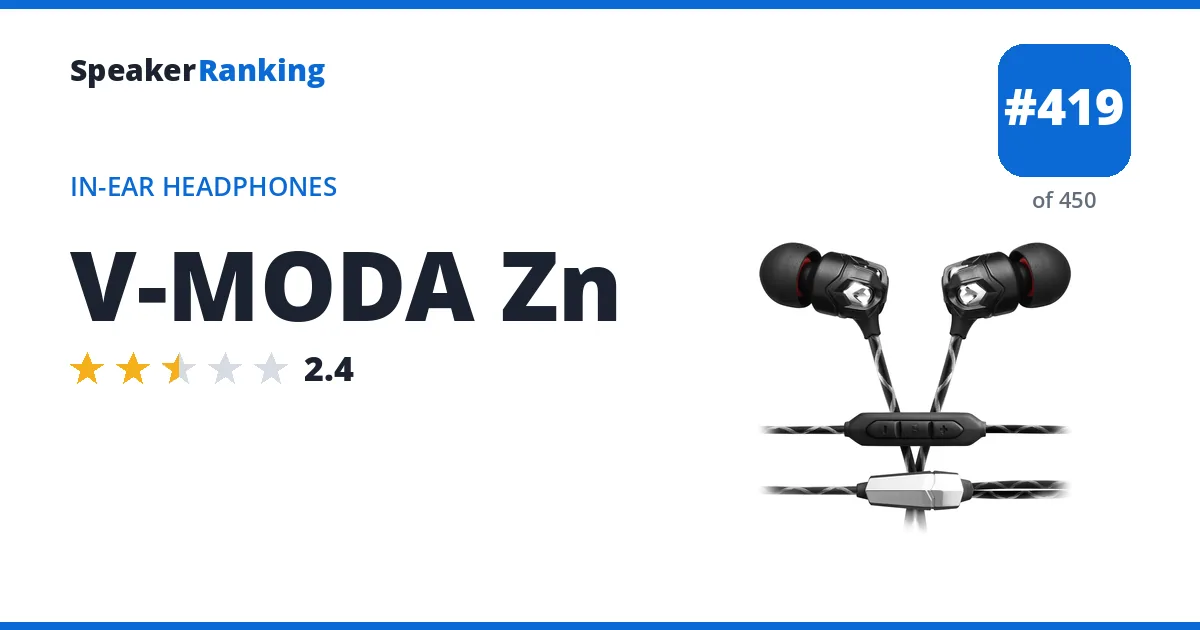
Pros: An inline microphone and a 16 ohm, 105 dB/mW load make it a convenient phone earphone that gets loud without an amplifier. Bass sits about 6.9 dB above target with lifted treble, a fit for listeners who like a warm, V-shaped sound.
Cons: In oratory1990’s measurement an 8.9 dB peak near 5.8 kHz adds harshness to vocals and snares, while low mids 4.4 dB above target thicken and muddy the midrange. The Etymotic ER4XR rates higher and costs less.
Full V-MODA Zn review and specifications →
| Released | Nov 2015 (10 years ago) |
|---|---|
| Back | Closed |
| Built-in Microphone | Yes |
| Connection | Wired |
| Deviation From Target | 3.76 dB standard deviation |
| Driver Type | Dynamic |
| Drivers | 1 x 8mm dynamic |
| Form Factor | In-ear |
| Frequency Response | 2Hz - 25kHz (Manufacturer specified) |
| Harman Preference Score | 54 (measured by oratory1990, via AutoEQ) |
| Impedance | 16 ohms |
| Sensitivity | 105 dB/mW |
| Sub-bass Extension | Within 6 dB of target down to 20 Hz (-3.9 dB at 30 Hz) |
| Tonal Tilt | -0.38 (negative is warmer, positive brighter) |
EQ preset to match the Harman target
Set a preamp of -5.6 dB, then add these filters in any parametric equalizer (Wavelet, Equalizer APO, Peace, or a player with parametric EQ). Calculated by AutoEQ from its measured frequency response.
| Filter | Frequency | Gain | Q |
|---|---|---|---|
| Low shelf | 105 Hz | +11.1 dB | 0.70 |
| Peak | 66 Hz | -10.5 dB | 0.29 |
| Peak | 1,777 Hz | +5.3 dB | 0.68 |
| Peak | 5,743 Hz | -8.0 dB | 5.88 |
| Peak | 730 Hz | +1.9 dB | 1.53 |
| High shelf | 10,000 Hz | +2.9 dB | 0.70 |
| Peak | 2,999 Hz | -1.7 dB | 4.26 |
| Peak | 4,097 Hz | +1.1 dB | 4.14 |
| Peak | 2,216 Hz | +1.0 dB | 3.61 |
| Peak | 2,910 Hz | -0.3 dB | 2.57 |
- Reviews, Comparisons and Sound Samples
- Head-to-Head Comparisons