Short answer: the Final Audio A4000. It ranks #61 of 450 in-ear headphones by sound quality, rated 4.5/5, at $125; the Kefine Quatio ranks #99, rated 4.4/5, and costs $129, so there is not much of a tradeoff to weigh.
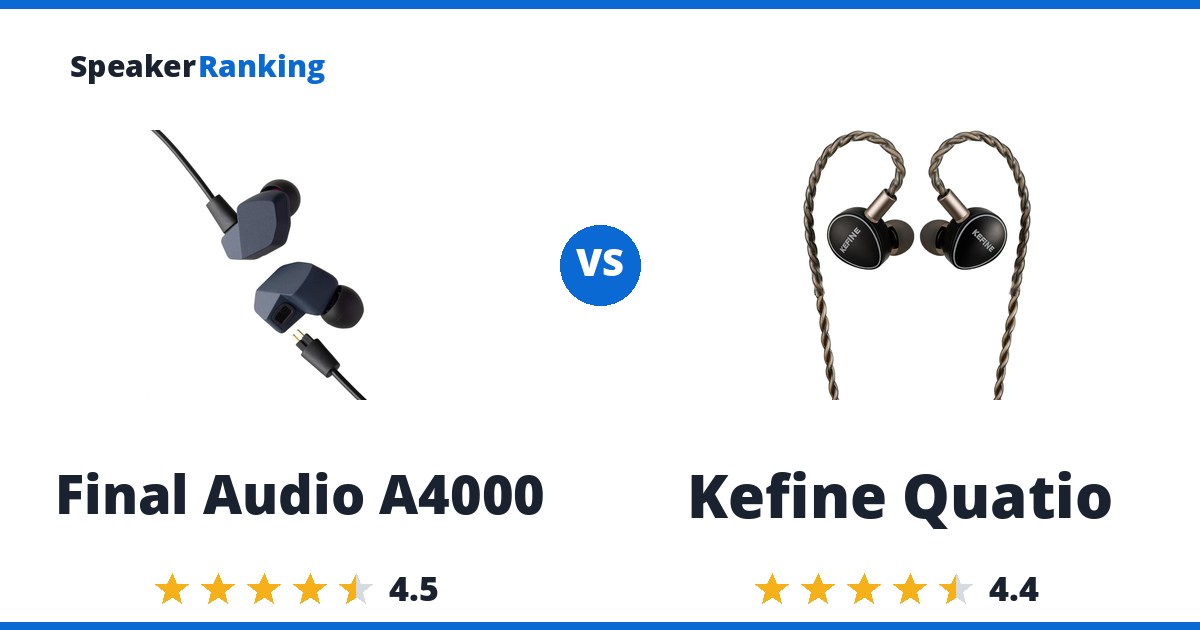
Why pick the Final Audio A4000: A preference score of 80 and a deviation of only 1.67 dB from target make this one of the most accurate single dynamic driver in-ears available at its price. The tradeoff: Treble runs about 6 to 7 dB above target from 6 to 16 kHz in hobbyist measurements on squig.link, with an 8.7 dB peak near 8.7 kHz that can make bright recordings sharp.
Why pick the Kefine Quatio: In the median of 13 squig.link measurements it scores 78.8 with a smooth 1.38 dB spread and no treble peak above 1.5 dB, so cymbals and sibilance never turn harsh. Watch for: A 4 dB dip near 3.6 kHz and presence about 2.5 dB under target push vocals slightly back and soften attack.
Buy the Final Audio A4000. It is rated higher for sound quality than the Kefine Quatio and costs less, which makes it the one to get unless you need something the other one does better.
Looking for alternatives? See the complete Headphones rankings.
Specifications Side By Side
| Final Audio A4000 | Kefine Quatio | |
|---|---|---|
| Price | $125.00 | $129.00 |
| Ranked | #61 of 450 in In-Ear Headphones | #99 of 450 in In-Ear Headphones |
| Form Factor | In-ear | In-ear |
| Harman Preference Score | 80 (measured by crinacle, via AutoEQ) | 79 (median of 13 squig.link measurements, calibrated to AutoEQ) |
| Deviation From Target | 1.67 dB standard deviation | 1.38 dB standard deviation |
| Tonal Tilt | +0.11 (negative is warmer, positive brighter) | -0.50 (negative is warmer, positive brighter) |
| Connection | Wired | Wired |
| Driver Type | Dynamic | Hybrid (2 dynamic + 2 balanced armature) |
| Drivers | 1 x 6mm dynamic | 1 x 10mm dynamic + 1 x 8mm dynamic + 2 x balanced armature |
| Impedance | 18 ohms | 32 ohms |
| Sensitivity | 100 dB/mW | 107 dB |
| Weight | 0 lbs (18 g) | - |
| Built-in Microphone | No | No |
| Back | Closed | Closed |
| Sub-bass Extension | Within 6 dB of target down to 20 Hz (-0.7 dB at 30 Hz) | Within 6 dB of target down to 20 Hz (+0.6 dB at 30 Hz) |
| Frequency Response | - | 20Hz - 20kHz (Manufacturer specified) |
Related Headphone Comparisons
More worthwhile head-to-heads for Final Audio A4000:
- Final Audio A4000 vs Shuoer S12
- Final Audio A4000 vs Simgot EM6L
- Final Audio A4000 vs Kiwi Ears Ember
- Shuoer S12 vs Kefine Quatio
- Kefine Quatio vs Queen of Audio Ryusei
Prices on this page were last checked October 11, 2026 at 4:59 PM UTC. Product prices and availability are accurate as of that date/time and are subject to change; the price and availability shown on Amazon at the time of purchase will apply to the purchase of this product.
As an eBay Partner, we may be compensated if you make a purchase.
The Two Headphones In Full
 Final Audio A4000: $125.00 Amazon eBay
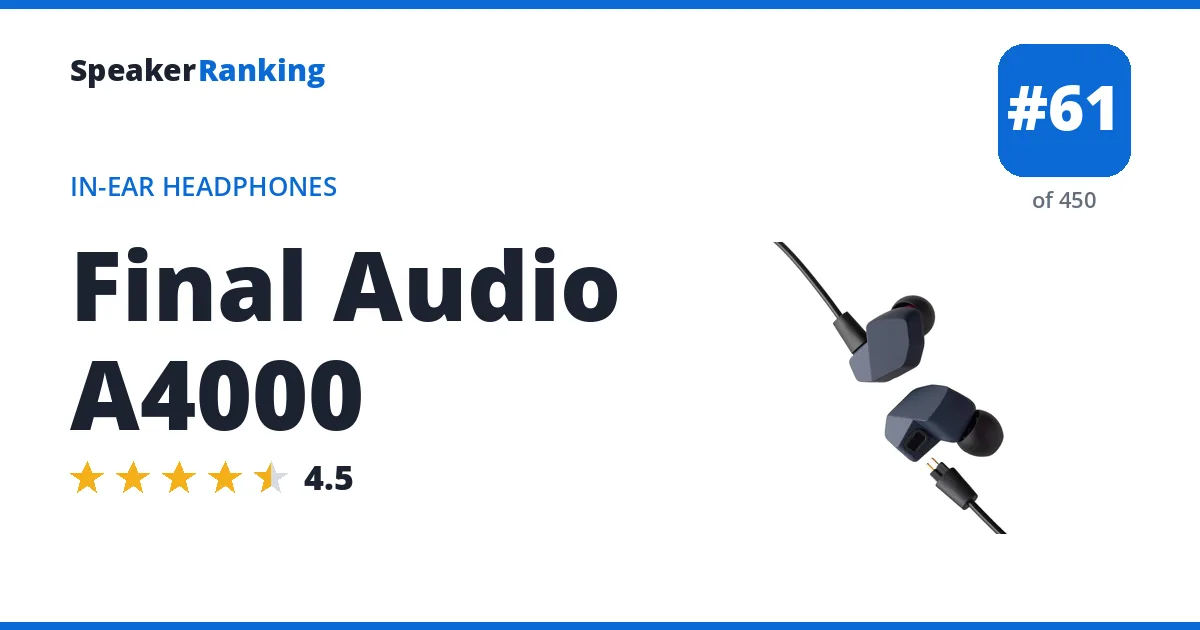
Pros: A preference score of 80 and a deviation of only 1.67 dB from target make this one of the most accurate single dynamic driver in-ears available at its price. Sub-bass holds within 1 dB of target down to 20 Hz, and a 3 dB lift in the upper bass adds warmth and punch. It matches the Shuoer S12 in rating while costing less, and at 18 g it is very light.
Cons: Treble runs about 6 to 7 dB above target from 6 to 16 kHz in hobbyist measurements on squig.link, with an 8.7 dB peak near 8.7 kHz that can make bright recordings sharp. Listeners sensitive to sibilance may find it fatiguing at high volume. At 100 dB/mW it needs a bit more volume than very sensitive in-ears, though phones still drive it.
Full Final Audio A4000 review and specifications →
| Back | Closed |
|---|---|
| Built-in Microphone | No |
| Connection | Wired |
| Deviation From Target | 1.67 dB standard deviation |
| Driver Type | Dynamic |
| Drivers | 1 x 6mm dynamic |
| Form Factor | In-ear |
| Harman Preference Score | 80 (measured by crinacle, via AutoEQ) |
| Impedance | 18 ohms |
| Sensitivity | 100 dB/mW |
| Sub-bass Extension | Within 6 dB of target down to 20 Hz (-0.7 dB at 30 Hz) |
| Tonal Tilt | +0.11 (negative is warmer, positive brighter) |
| Weight | 0 lbs (18 g) |
EQ preset to match the Harman target
Set a preamp of -2.9 dB, then add these filters in any parametric equalizer (Wavelet, Equalizer APO, Peace, or a player with parametric EQ). Calculated by AutoEQ from its measured frequency response.
| Filter | Frequency | Gain | Q |
|---|---|---|---|
| Low shelf | 105 Hz | +0.5 dB | 0.70 |
| Peak | 831 Hz | +3.0 dB | 1.09 |
| Peak | 177 Hz | -1.6 dB | 1.02 |
| Peak | 6,348 Hz | -3.7 dB | 2.04 |
| Peak | 2,022 Hz | +2.0 dB | 3.11 |
| High shelf | 10,000 Hz | -3.9 dB | 0.70 |
| Peak | 9,639 Hz | +2.1 dB | 2.54 |
| Peak | 3,246 Hz | -2.0 dB | 3.75 |
| Peak | 4,630 Hz | +0.9 dB | 3.78 |
| Peak | 2,482 Hz | +0.9 dB | 5.02 |
- Reviews, Comparisons and Sound Samples
- Head-to-Head Comparisons
 Kefine Quatio: $129.00 Amazon eBay

Pros: In the median of 13 squig.link measurements it scores 78.8 with a smooth 1.38 dB spread and no treble peak above 1.5 dB, so cymbals and sibilance never turn harsh. Bass rises about 1.8 dB above target with full extension to 20 Hz, giving a warm, full low end that suits bass lovers. Its 32 ohm, 107 dB load is easy to drive from a phone.
Cons: A 4 dB dip near 3.6 kHz and presence about 2.5 dB under target push vocals slightly back and soften attack. The air band runs 1.3 dB low, so it sounds less airy and spacious than brighter rivals, and the equally rated 7Hz Salnotes Dioko costs less.
Full Kefine Quatio review and specifications →
| Released | Jul 2025 (1 year ago) |
|---|---|
| Back | Closed |
| Built-in Microphone | No |
| Connection | Wired |
| Deviation From Target | 1.38 dB standard deviation |
| Driver Type | Hybrid (2 dynamic + 2 balanced armature) |
| Drivers | 1 x 10mm dynamic + 1 x 8mm dynamic + 2 x balanced armature |
| Form Factor | In-ear |
| Frequency Response | 20Hz - 20kHz (Manufacturer specified) |
| Harman Preference Score | 79 (median of 13 squig.link measurements, calibrated to AutoEQ) |
| Impedance | 32 ohms |
| Sensitivity | 107 dB |
| Sub-bass Extension | Within 6 dB of target down to 20 Hz (+0.6 dB at 30 Hz) |
| Tonal Tilt | -0.50 (negative is warmer, positive brighter) |
- Reviews, Comparisons and Sound Samples
- Head-to-Head Comparisons