Short answer: the KZ ASX, though neither ranks well in its class. Both are rated 2.0/5 for sound quality (#431 and #430 of 450 in-ear headphones), and the KZ ASX costs $131.99 against $149.99 for the Etymotic ER3SE, with sound quality a draw, the lower price decides it. Both are rated below 3.0/5 among the 450 in-ear headphones; for better sound, the Truthear Nova ranks #2 at $169.99.
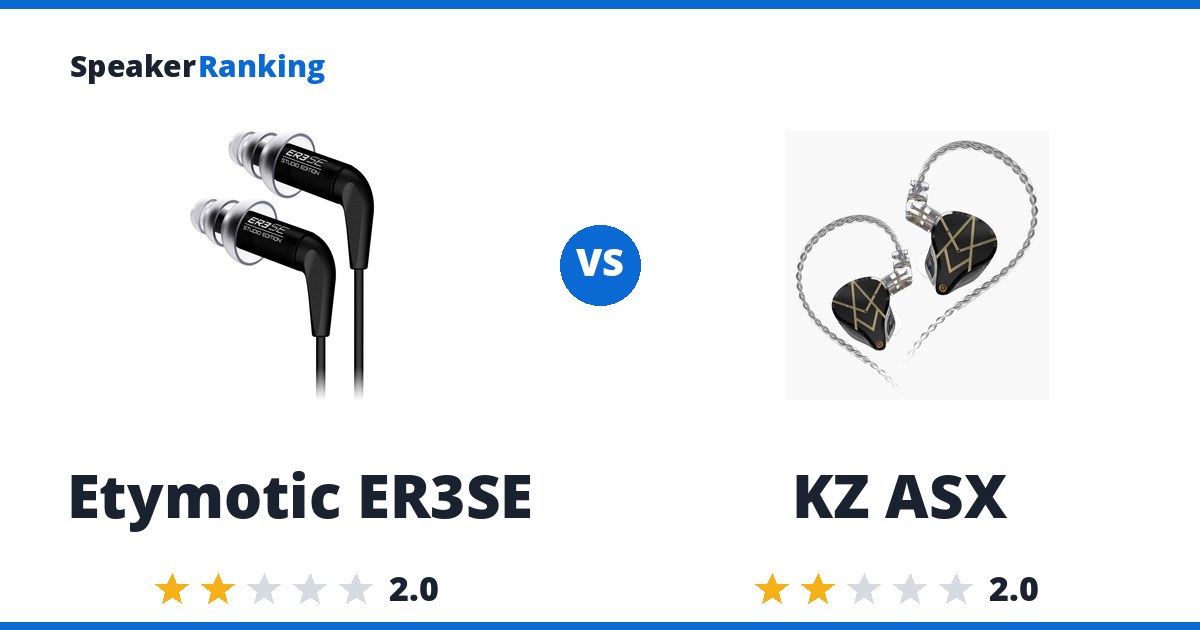
Why pick the Etymotic ER3SE: A single balanced armature at 22 ohms and 102 dB/mW reaches comfortable volume from any phone or laptop without an amp. The catch: In oratory1990’s measurement sub-bass sits 9.9 dB below target and falls 6 dB short as high as 67 Hz, so bass lines sound thin and lack weight.
What the KZ ASX does well: Ten balanced armature drivers per side run easily from a phone thanks to 20 ohm impedance and 106 dB/mW sensitivity. The tradeoff: A deep 13.2 dB dip near 7.3 kHz and treble about 5.9 dB below target leave cymbals and detail dull, while a 5.1 dB peak near 1.7 kHz can make vocals sound pushy and nasal.
Buy the KZ ASX. Both are rated the same for sound quality, and it costs $18 less than the Etymotic ER3SE.
Looking for alternatives? See the complete Headphones rankings.
Specifications Side By Side
| Etymotic ER3SE | KZ ASX | |
|---|---|---|
| Price | $149.99 | $131.99 |
| Ranked | #430 of 450 in In-Ear Headphones | #431 of 450 in In-Ear Headphones |
| Form Factor | In-ear | In-ear |
| Back | Closed | Closed |
| Harman Preference Score | 49 (measured by oratory1990, via AutoEQ) | 49 (measured by crinacle, via AutoEQ) |
| Deviation From Target | 4.18 dB standard deviation | 3.75 dB standard deviation |
| Tonal Tilt | +0.73 (negative is warmer, positive brighter) | -1.04 (negative is warmer, positive brighter) |
| Sub-bass Extension | Falls 6 dB below target at 67 Hz (-9.9 dB at 30 Hz) | Within 6 dB of target down to 20 Hz (+1.5 dB at 30 Hz) |
| Connection | Wired | Wired |
| Driver Type | Balanced armature | Balanced armature |
| Drivers | 1 x balanced armature | 10 x balanced armature |
| Impedance | 22 ohms | 20 ohms |
| Sensitivity | 102 dB/mW | 106 dB/mW |
| Frequency Response | 20Hz - 16kHz (Manufacturer specified) | - |
| Built-in Microphone | No | - |
Related Headphone Comparisons
More top alternatives to Etymotic ER3SE:
- Master & Dynamic MW07 vs Etymotic ER3SE
- 1MORE Penta Driver vs Etymotic ER3SE
- Etymotic ER2SE vs Etymotic ER3SE
- Etymotic ER3SE vs 1MORE Quad Driver
- Etymotic ER2SE vs KZ ASX
Prices on this page were last checked October 11, 2026 at 4:59 PM UTC. Product prices and availability are accurate as of that date/time and are subject to change; the price and availability shown on Amazon at the time of purchase will apply to the purchase of this product.
As an eBay Partner, we may be compensated if you make a purchase.
The Two Headphones In Full
 Etymotic ER3SE: $149.99 Amazon eBay

Pros: A single balanced armature at 22 ohms and 102 dB/mW reaches comfortable volume from any phone or laptop without an amp. Its tuning lines up best with listeners who lean toward a neutral or warm taste rather than a bass-heavy one. It carries a higher rating than the pricier Westone W10.
Cons: In oratory1990’s measurement sub-bass sits 9.9 dB below target and falls 6 dB short as high as 67 Hz, so bass lines sound thin and lack weight. The treble drops 9.5 dB under target from 6 to 10 kHz with a 13.8 dB dip near 11.8 kHz, leaving cymbals and detail dull, and a preference score of 49 with 4.18 dB of deviation means most listeners hear it as colored. There is no built-in microphone for calls.
Full Etymotic ER3SE review and specifications →
| Released | 2018 (8 years ago) |
|---|---|
| Back | Closed |
| Built-in Microphone | No |
| Connection | Wired |
| Deviation From Target | 4.18 dB standard deviation |
| Driver Type | Balanced armature |
| Drivers | 1 x balanced armature |
| Form Factor | In-ear |
| Frequency Response | 20Hz - 16kHz (Manufacturer specified) |
| Harman Preference Score | 49 (measured by oratory1990, via AutoEQ) |
| Impedance | 22 ohms |
| Sensitivity | 102 dB/mW |
| Sub-bass Extension | Falls 6 dB below target at 67 Hz (-9.9 dB at 30 Hz) |
| Tonal Tilt | +0.73 (negative is warmer, positive brighter) |
EQ preset to match the Harman target
Set a preamp of -6.5 dB, then add these filters in any parametric equalizer (Wavelet, Equalizer APO, Peace, or a player with parametric EQ). Calculated by AutoEQ from its measured frequency response.
| Filter | Frequency | Gain | Q |
|---|---|---|---|
| Low shelf | 105 Hz | +6.2 dB | 0.70 |
| Peak | 7,528 Hz | +7.4 dB | 0.72 |
| Peak | 1,942 Hz | -4.2 dB | 0.45 |
| Peak | 206 Hz | -1.6 dB | 0.65 |
| Peak | 837 Hz | +1.9 dB | 1.72 |
| High shelf | 10,000 Hz | +4.0 dB | 0.70 |
| Peak | 8,498 Hz | -1.8 dB | 2.74 |
| Peak | 1,388 Hz | -0.3 dB | 3.82 |
| Peak | 6,000 Hz | +0.9 dB | 6.00 |
| Peak | 4,933 Hz | -0.6 dB | 3.44 |
- Reviews, Comparisons and Sound Samples
- Head-to-Head Comparisons
 KZ ASX: $131.99 Amazon eBay

Pros: Ten balanced armature drivers per side run easily from a phone thanks to 20 ohm impedance and 106 dB/mW sensitivity. Bass sits about 4.1 dB above target in the squig.link median, so listeners who want a bassy, warm signature get extra punch.
Cons: A deep 13.2 dB dip near 7.3 kHz and treble about 5.9 dB below target leave cymbals and detail dull, while a 5.1 dB peak near 1.7 kHz can make vocals sound pushy and nasal. The Zero Audio Duoza ZH-DWX10 rates slightly higher for less money.
Full KZ ASX review and specifications →
| Released | 2020 (6 years ago) |
|---|---|
| Back | Closed |
| Connection | Wired |
| Deviation From Target | 3.75 dB standard deviation |
| Driver Type | Balanced armature |
| Drivers | 10 x balanced armature |
| Form Factor | In-ear |
| Harman Preference Score | 49 (measured by crinacle, via AutoEQ) |
| Impedance | 20 ohms |
| Sensitivity | 106 dB/mW |
| Sub-bass Extension | Within 6 dB of target down to 20 Hz (+1.5 dB at 30 Hz) |
| Tonal Tilt | -1.04 (negative is warmer, positive brighter) |
EQ preset to match the Harman target
Set a preamp of -8.1 dB, then add these filters in any parametric equalizer (Wavelet, Equalizer APO, Peace, or a player with parametric EQ). Calculated by AutoEQ from its measured frequency response.
| Filter | Frequency | Gain | Q |
|---|---|---|---|
| Low shelf | 105 Hz | -0.7 dB | 0.70 |
| Peak | 8,524 Hz | +7.0 dB | 2.10 |
| Peak | 170 Hz | -4.8 dB | 0.68 |
| Peak | 1,663 Hz | -7.0 dB | 1.97 |
| Peak | 715 Hz | +5.0 dB | 0.94 |
| High shelf | 10,000 Hz | +3.8 dB | 0.70 |
| Peak | 3,831 Hz | +2.7 dB | 2.15 |
| Peak | 5,171 Hz | -5.9 dB | 4.41 |
| Peak | 2,135 Hz | -1.9 dB | 5.06 |
| Peak | 2,688 Hz | +1.2 dB | 3.43 |
- Reviews, Comparisons and Sound Samples
- Head-to-Head Comparisons