Short answer: the Edifier Stax Spirit S3. It ranks #21 of 216 over-ear headphones by sound quality, rated 4.3/5, at $514.55. The Grado Hemp ranks #53, rated 4.1/5, at $495, $19.55 cheaper, a saving that is not big enough to make up the sound-quality gap.

Why pick the Edifier Stax Spirit S3: This is a rare wireless planar magnetic headphone, with Bluetooth 5.2, aptX Adaptive and aptX HD support, a built in microphone and a claimed 80 hours of battery life. The tradeoff: Those measurements show a 6.8 dB dip near 6.9 kHz and the 6 to 10 kHz band sits about 3 dB low, so cymbals and sibilance come across dulled and less detailed.
Why pick the Grado Hemp: A preference score of 83 with mids within about 1 dB of target (upper mids 1.1 dB above, low mids 0.2 dB above) gives vocals and instruments a natural presence. Watch for: Sub-bass is about 10 dB below target under 60 Hz, a large loss that removes most deep rumble.
Buy the Edifier Stax Spirit S3. It is rated higher for sound quality, and the $19.55 you would save on the Grado Hemp does not close the gap.
Looking for alternatives? See the complete Headphones rankings.
Specifications Side By Side
| Edifier Stax Spirit S3 | Grado Hemp | |
|---|---|---|
| Price | $514.55 | $495.00 |
| Ranked | #21 of 216 in Over-Ear Headphones | #53 of 216 in Over-Ear Headphones |
| Form Factor | Over-ear | Over-ear |
| Harman Preference Score | 89 (median of 6 squig.link measurements, calibrated to AutoEQ) | 83 (measured by oratory1990, via AutoEQ) |
| Deviation From Target | 1.62 dB standard deviation | 2.41 dB standard deviation |
| Tonal Tilt | -0.20 (negative is warmer, positive brighter) | +0.09 (negative is warmer, positive brighter) |
| Sub-bass Extension | Within 6 dB of target down to 20 Hz (-1.9 dB at 30 Hz) | Falls 6 dB below target at 47 Hz (-11.6 dB at 30 Hz) |
| Connection | Wireless and wired | Wired |
| Back | Closed | Open |
| Driver Type | Planar magnetic | Dynamic |
| Drivers | 1 x 89x70mm planar magnetic | - |
| Impedance | 24 ohms | 38 ohms |
| Sensitivity | 94 dB SPL(A) | 99.8 dB SPL |
| Weight | 0.7 lbs (329 g) | - |
| Frequency Response | 20Hz - 40kHz (Manufacturer specified) | 13Hz - 28kHz (Manufacturer specified) |
| Active Noise Cancelling | No | - |
| Battery Life | 80 hours (Manufacturer specified) | - |
| Bluetooth Version | 5.2 | - |
| Bluetooth Codecs | SBC, aptX, aptX HD, aptX Adaptive | - |
| Built-in Microphone | Yes | - |
Related Headphone Comparisons
More worthwhile head-to-heads for Edifier Stax Spirit S3:
- Edifier Stax Spirit S3 vs Stax SR-L300
- Edifier Stax Spirit S3 vs HIFIMAN Arya Stealth Magnet Version
- Grado Hemp vs Moondrop Para 2
- Stax SR-L300 vs Grado Hemp
- Grado Hemp vs HIFIMAN Arya Stealth Magnet Version
Prices on this page were last checked October 11, 2026 at 4:59 PM UTC. Product prices and availability are accurate as of that date/time and are subject to change; the price and availability shown on Amazon at the time of purchase will apply to the purchase of this product.
As an eBay Partner, we may be compensated if you make a purchase.
The Two Headphones In Full
 Edifier Stax Spirit S3: $514.55 Wireless Amazon eBay
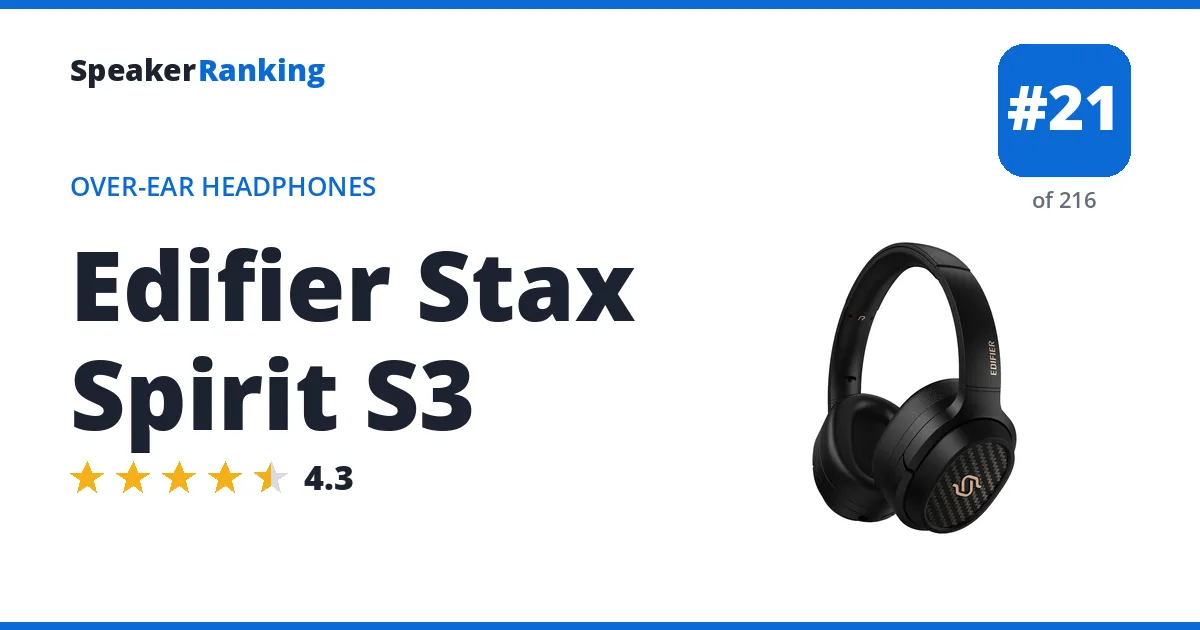
Pros: This is a rare wireless planar magnetic headphone, with Bluetooth 5.2, aptX Adaptive and aptX HD support, a built in microphone and a claimed 80 hours of battery life. The median of six hobbyist measurements on squig.link yields a preference score of 89 with a gently warm tilt, and bass holds to within about 2 dB of target at 30 Hz. The closed back keeps sound in, making it usable in offices and on transit.
Cons: Those measurements show a 6.8 dB dip near 6.9 kHz and the 6 to 10 kHz band sits about 3 dB low, so cymbals and sibilance come across dulled and less detailed. There is no active noise cancelling, and at 329 grams it is on the heavy side for a wireless headphone.
Full Edifier Stax Spirit S3 review and specifications →
| Released | Jun 2022 (4 years ago) |
|---|---|
| Active Noise Cancelling | No |
| Back | Closed |
| Battery Life | 80 hours (Manufacturer specified) |
| Bluetooth Codecs | SBC, aptX, aptX HD, aptX Adaptive |
| Bluetooth Version | 5.2 |
| Built-in Microphone | Yes |
| Connection | Wireless and wired |
| Deviation From Target | 1.62 dB standard deviation |
| Driver Type | Planar magnetic |
| Drivers | 1 x 89x70mm planar magnetic |
| Form Factor | Over-ear |
| Frequency Response | 20Hz - 40kHz (Manufacturer specified) |
| Harman Preference Score | 89 (median of 6 squig.link measurements, calibrated to AutoEQ) |
| Impedance | 24 ohms |
| Sensitivity | 94 dB SPL(A) |
| Sub-bass Extension | Within 6 dB of target down to 20 Hz (-1.9 dB at 30 Hz) |
| Tonal Tilt | -0.20 (negative is warmer, positive brighter) |
| Weight | 0.7 lbs (329 g) |
- Reviews, Comparisons and Sound Samples
- Head-to-Head Comparisons
 Grado Hemp: $495.00 Amazon eBay

Pros: A preference score of 83 with mids within about 1 dB of target (upper mids 1.1 dB above, low mids 0.2 dB above) gives vocals and instruments a natural presence. Bass from 60 to 200 Hz is within 1 dB of target, and the neutral tilt of 0.09 fits listeners who want a balanced tonality. At 38 ohms and 99.8 dB sensitivity it is easy to drive from a phone or laptop.
Cons: Sub-bass is about 10 dB below target under 60 Hz, a large loss that removes most deep rumble. A 5 dB peak near 2.2 kHz can add forwardness to voices, and a 6 dB dip near 5.3 kHz takes some bite from cymbals and consonants. The open back leaks sound and gives no isolation.
Full Grado Hemp review and specifications →
| Back | Open |
|---|---|
| Connection | Wired |
| Deviation From Target | 2.41 dB standard deviation |
| Driver Type | Dynamic |
| Form Factor | Over-ear |
| Frequency Response | 13Hz - 28kHz (Manufacturer specified) |
| Harman Preference Score | 83 (measured by oratory1990, via AutoEQ) |
| Impedance | 38 ohms |
| Sensitivity | 99.8 dB SPL |
| Sub-bass Extension | Falls 6 dB below target at 47 Hz (-11.6 dB at 30 Hz) |
| Tonal Tilt | +0.09 (negative is warmer, positive brighter) |
EQ preset to match the Harman target
Set a preamp of -6.5 dB, then add these filters in any parametric equalizer (Wavelet, Equalizer APO, Peace, or a player with parametric EQ). Calculated by AutoEQ from its measured frequency response.
| Filter | Frequency | Gain | Q |
|---|---|---|---|
| Low shelf | 105 Hz | +6.7 dB | 0.70 |
| Peak | 5,779 Hz | +5.8 dB | 3.08 |
| Peak | 103 Hz | -3.0 dB | 0.63 |
| Peak | 2,201 Hz | -5.7 dB | 3.90 |
| Peak | 3,309 Hz | +4.0 dB | 4.69 |
| High shelf | 10,000 Hz | +0.5 dB | 0.70 |
| Peak | 627 Hz | +0.5 dB | 1.53 |
| Peak | 276 Hz | -1.0 dB | 4.28 |
| Peak | 4,235 Hz | -1.5 dB | 6.00 |
| Peak | 45 Hz | +0.7 dB | 4.16 |
- Reviews, Comparisons and Sound Samples
- Head-to-Head Comparisons