Short answer: the Audio-Technica ATH-ADX5000. It ranks #17 of 216 over-ear headphones by sound quality, rated 4.3/5, at $2,199. The AKG K812 ranks #44, rated 4.1/5, at $1,999, $200 cheaper, a saving that is not big enough to make up the sound-quality gap.
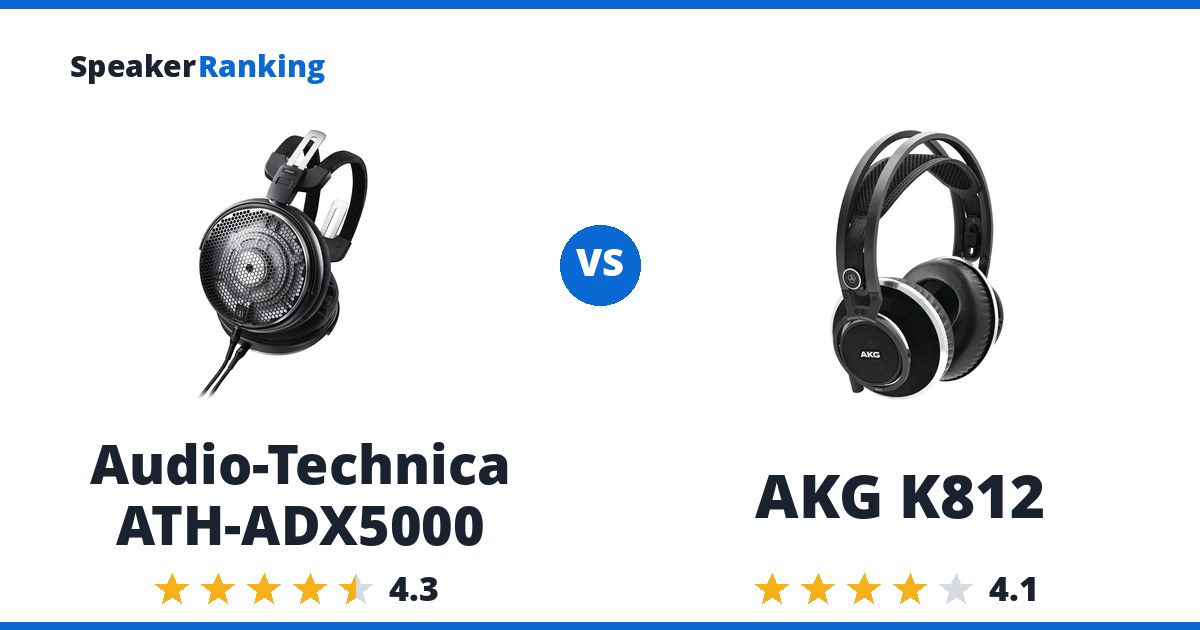
The case for the Audio-Technica ATH-ADX5000: A preference score of 89 with a perfectly neutral tilt reflects a balanced tuning, with bass and low mids within about 0.7 dB of target. Watch for: The 420 ohm impedance calls for a dedicated headphone amplifier, because a phone or dongle will struggle to drive it to a satisfying volume.
Why pick the AKG K812: In oratory1990’s measurement it earns a preference score of 85 with only a 2.2 dB deviation from target, so the overall balance sits close to what most listeners prefer. The catch: A 6.9 dB peak near 5.8 kHz adds an edge to vocals, cymbals and sibilance on bright recordings, while a 3.8 dB dip near 2.3 kHz pulls the upper mids back slightly.
Buy the Audio-Technica ATH-ADX5000. It is rated higher for sound quality, and the $200 saving on the AKG K812 is not enough to make up the difference.
Want more options? Browse the full Headphones rankings.
Specifications Side By Side
| Audio-Technica ATH-ADX5000 | AKG K812 | |
|---|---|---|
| Price | $2,199.00 | $1,999.00 |
| Ranked | #17 of 216 in Over-Ear Headphones | #44 of 216 in Over-Ear Headphones |
| Form Factor | Over-ear | Over-ear |
| Harman Preference Score | 89 (measured by oratory1990, via AutoEQ) | 85 (measured by oratory1990, via AutoEQ) |
| Deviation From Target | 1.99 dB standard deviation | 2.20 dB standard deviation |
| Tonal Tilt | -0.01 (negative is warmer, positive brighter) | -0.11 (negative is warmer, positive brighter) |
| Sub-bass Extension | Falls 6 dB below target at 32 Hz (-6.6 dB at 30 Hz) | Within 6 dB of target down to 20 Hz (-4.7 dB at 30 Hz) |
| Connection | Wired | Wired |
| Back | Open | Open |
| Driver Type | Dynamic | Dynamic |
| Drivers | 1 x 58mm dynamic | 1 x 53mm dynamic |
| Impedance | 420 ohms | 36 ohms |
| Sensitivity | 100 dB/mW | 110 dB SPL/V |
| Weight | 0.6 lbs (270 g) | 0.9 lbs (390 g) |
| Frequency Response | 5Hz - 50kHz (Manufacturer specified) | 5Hz - 54kHz (Manufacturer specified) |
| Built-in Microphone | - | No |
Related Headphone Comparisons
More worthwhile head-to-heads for Audio-Technica ATH-ADX5000:
- Dan Clark Audio E3 vs Audio-Technica ATH-ADX5000
- Audio-Technica ATH-ADX5000 vs Sennheiser HD 800 S
- Audio-Technica ATH-ADX5000 vs Warwick Acoustics Bravura
- Dan Clark Audio E3 vs AKG K812
- AKG K812 vs Warwick Acoustics Bravura
Prices on this page were last checked October 11, 2026 at 4:59 PM UTC. Product prices and availability are accurate as of that date/time and are subject to change; the price and availability shown on Amazon at the time of purchase will apply to the purchase of this product.
As an eBay Partner, we may be compensated if you make a purchase.
The Two Headphones In Full
 Audio-Technica ATH-ADX5000: $2,199.00 Amazon eBay

Pros: A preference score of 89 with a perfectly neutral tilt reflects a balanced tuning, with bass and low mids within about 0.7 dB of target. Treble from 6 to 10 kHz lands right on target, giving cymbals and vocals a natural level. It weighs only 270 g for an open back flagship, and it rates higher than the Sennheiser HD 800 S and HIFIMAN HE6.
Cons: The 420 ohm impedance calls for a dedicated headphone amplifier, because a phone or dongle will struggle to drive it to a satisfying volume. Sub-bass is about 6 dB under target below 60 Hz, a 4.4 dB dip near 2.2 kHz thins some vocals, and the air region above 10 kHz runs about 3.6 dB hot with a 6 dB peak near 11.9 kHz. The open back leaks sound and offers no isolation. See headphone amps and DACs with enough power to drive it.
Full Audio-Technica ATH-ADX5000 review and specifications →
| Released | Nov 2017 (8 years ago) |
|---|---|
| Back | Open |
| Connection | Wired |
| Deviation From Target | 1.99 dB standard deviation |
| Driver Type | Dynamic |
| Drivers | 1 x 58mm dynamic |
| Form Factor | Over-ear |
| Frequency Response | 5Hz - 50kHz (Manufacturer specified) |
| Harman Preference Score | 89 (measured by oratory1990, via AutoEQ) |
| Impedance | 420 ohms |
| Sensitivity | 100 dB/mW |
| Sub-bass Extension | Falls 6 dB below target at 32 Hz (-6.6 dB at 30 Hz) |
| Tonal Tilt | -0.01 (negative is warmer, positive brighter) |
| Weight | 0.6 lbs (270 g) |
EQ preset to match the Harman target
Set a preamp of -6.5 dB, then add these filters in any parametric equalizer (Wavelet, Equalizer APO, Peace, or a player with parametric EQ). Calculated by AutoEQ from its measured frequency response.
| Filter | Frequency | Gain | Q |
|---|---|---|---|
| Low shelf | 105 Hz | +7.4 dB | 0.70 |
| Peak | 97 Hz | -4.1 dB | 0.44 |
| Peak | 2,345 Hz | +5.6 dB | 2.03 |
| Peak | 449 Hz | +2.4 dB | 1.99 |
| Peak | 4,171 Hz | -3.6 dB | 1.46 |
| High shelf | 10,000 Hz | -5.7 dB | 0.70 |
| Peak | 1,070 Hz | -1.9 dB | 2.30 |
| Peak | 643 Hz | +0.6 dB | 2.45 |
| Peak | 1,798 Hz | +0.9 dB | 3.35 |
| Peak | 5,950 Hz | -0.4 dB | 6.00 |
- Reviews, Comparisons and Sound Samples
- Head-to-Head Comparisons
 AKG K812: $1,999.00 B&H Photo Video eBay

Pros: In oratory1990’s measurement it earns a preference score of 85 with only a 2.2 dB deviation from target, so the overall balance sits close to what most listeners prefer. Sub-bass holds within 6 dB of target down to 20 Hz and the 60 to 200 Hz bass band runs about 1 dB above target, giving full, extended lows for an open design. The 36 ohm impedance means it does not need a high-voltage amp, and it rates level with the HIFIMAN HE6 and above the HIFIMAN HE1000se.
Cons: A 6.9 dB peak near 5.8 kHz adds an edge to vocals, cymbals and sibilance on bright recordings, while a 3.8 dB dip near 2.3 kHz pulls the upper mids back slightly. The open back leaks sound and blocks no outside noise, and the Sennheiser HD 800 S rates a little higher for less money.
Full AKG K812 review and specifications →
| Released | Oct 2013 (13 years ago) |
|---|---|
| Back | Open |
| Built-in Microphone | No |
| Connection | Wired |
| Deviation From Target | 2.20 dB standard deviation |
| Driver Type | Dynamic |
| Drivers | 1 x 53mm dynamic |
| Form Factor | Over-ear |
| Frequency Response | 5Hz - 54kHz (Manufacturer specified) |
| Harman Preference Score | 85 (measured by oratory1990, via AutoEQ) |
| Impedance | 36 ohms |
| Sensitivity | 110 dB SPL/V |
| Sub-bass Extension | Within 6 dB of target down to 20 Hz (-4.7 dB at 30 Hz) |
| Tonal Tilt | -0.11 (negative is warmer, positive brighter) |
| Weight | 0.9 lbs (390 g) |
EQ preset to match the Harman target
Set a preamp of -4.9 dB, then add these filters in any parametric equalizer (Wavelet, Equalizer APO, Peace, or a player with parametric EQ). Calculated by AutoEQ from its measured frequency response.
| Filter | Frequency | Gain | Q |
|---|---|---|---|
| Low shelf | 105 Hz | +6.5 dB | 0.70 |
| Peak | 89 Hz | -3.3 dB | 0.25 |
| Peak | 2,233 Hz | +4.4 dB | 0.94 |
| Peak | 5,780 Hz | -6.7 dB | 5.69 |
| Peak | 3,821 Hz | -4.5 dB | 5.90 |
| High shelf | 10,000 Hz | -2.5 dB | 0.70 |
| Peak | 118 Hz | +0.3 dB | 1.60 |
| Peak | 217 Hz | -0.4 dB | 2.69 |
| Peak | 6,875 Hz | +1.4 dB | 6.00 |
| Peak | 55 Hz | -0.2 dB | 1.40 |
- Reviews, Comparisons and Sound Samples
- Head-to-Head Comparisons