Short answer: the Audeze MM-500. It ranks #134 of 216 over-ear headphones by sound quality, rated 3.4/5, at $1,699. The Fostex TH900mk2 ranks #158, rated 3.2/5, at $1,399.98, $299.02 cheaper, not enough of a saving to outweigh the sound-quality gap.
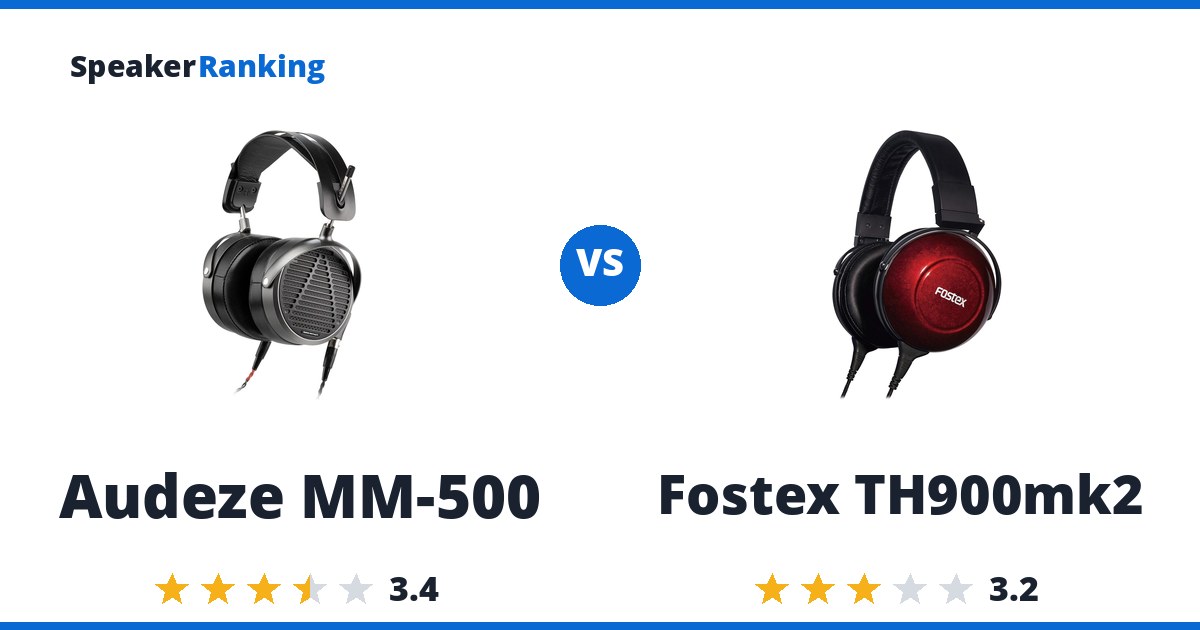
What the Audeze MM-500 does well: The midrange from 200 Hz to 3 kHz tracks the Harman target within about 0.3 dB, so voices and instruments in the core of the music sound accurate. The catch: Treble from 6 to 10 kHz sits about 7.3 dB under target, with a 15 dB dip near 9.6 kHz, so cymbals, hi-hats and vocal air sound dark and muffled.
Why pick the Fostex TH900mk2: Sub-bass and bass sit about 2.7 and 3.7 dB above target, giving a full, weighty low end with strong kick drums and bass guitar. The tradeoff: A 8 dB peak near 5.4 kHz makes vocals, snares and electric guitars sound sharp or shouty, while a 8.3 dB dip near 9.4 kHz leaves the upper treble uneven.
Buy the Audeze MM-500. It is rated higher for sound quality, and saving $299.02 with the Fostex TH900mk2 does not make up for the sound-quality gap.
Want more options? Browse the full Headphones rankings.
Specifications Side By Side
| Audeze MM-500 | Fostex TH900mk2 | |
|---|---|---|
| Price | $1,699.00 | $1,399.98 |
| Ranked | #134 of 216 in Over-Ear Headphones | #158 of 216 in Over-Ear Headphones |
| Form Factor | Over-ear | Over-ear |
| Harman Preference Score | 69 (measured by oratory1990, via AutoEQ) | 63 (measured by oratory1990, via AutoEQ) |
| Deviation From Target | 2.98 dB standard deviation | 2.94 dB standard deviation |
| Tonal Tilt | -0.52 (negative is warmer, positive brighter) | -0.94 (negative is warmer, positive brighter) |
| Sub-bass Extension | Falls 6 dB below target at 32 Hz (-6.1 dB at 30 Hz) | Within 6 dB of target down to 20 Hz (+2.6 dB at 30 Hz) |
| Connection | Wired | Wired |
| Back | Open | Closed |
| Driver Type | Planar magnetic | Dynamic |
| Impedance | 18 ohms | 25 ohms |
| Sensitivity | 100 dB/mW | 100 dB/mW |
| Weight | 1.1 lbs (495 g) | - |
| Frequency Response | 5Hz - 50kHz (Manufacturer specified) | 5Hz - 45kHz (Manufacturer specified) |
| Drivers | - | 1 x 50mm dynamic |
| Built-in Microphone | - | No |
Related Headphone Comparisons
More worthwhile head-to-heads for Audeze MM-500:
- Denon AH-D9200 vs Audeze MM-500
- Audeze MM-500 vs Sendy Peacock
- Audeze MM-500 vs Audio-Technica ATH-AWKT
- Sendy Peacock vs Fostex TH900mk2
- Fostex TH900mk2 vs Audio-Technica ATH-AWAS
Prices on this page were last checked October 11, 2026 at 4:59 PM UTC. Product prices and availability are accurate as of that date/time and are subject to change; the price and availability shown on Amazon at the time of purchase will apply to the purchase of this product.
As an eBay Partner, we may be compensated if you make a purchase.
The Two Headphones In Full
 Audeze MM-500: $1,699.00 Amazon eBay

Pros: The midrange from 200 Hz to 3 kHz tracks the Harman target within about 0.3 dB, so voices and instruments in the core of the music sound accurate. The planar magnetic driver is easy to power at 18 ohms and 100 dB per mW, so a phone or basic dongle can drive it. The open back gives a wide, airy presentation for critical listening at home.
Cons: Treble from 6 to 10 kHz sits about 7.3 dB under target, with a 15 dB dip near 9.6 kHz, so cymbals, hi-hats and vocal air sound dark and muffled. Sub-bass is about 5.8 dB light, which loses rumble in electronic and cinematic music. At 495 g it is heavy for long sessions, the open back leaks sound and offers no isolation, and the Denon AH-D7200 has a higher rating at a much lower price.
Full Audeze MM-500 review and specifications →
| Back | Open |
|---|---|
| Connection | Wired |
| Deviation From Target | 2.98 dB standard deviation |
| Driver Type | Planar magnetic |
| Form Factor | Over-ear |
| Frequency Response | 5Hz - 50kHz (Manufacturer specified) |
| Harman Preference Score | 69 (measured by oratory1990, via AutoEQ) |
| Impedance | 18 ohms |
| Sensitivity | 100 dB/mW |
| Sub-bass Extension | Falls 6 dB below target at 32 Hz (-6.1 dB at 30 Hz) |
| Tonal Tilt | -0.52 (negative is warmer, positive brighter) |
| Weight | 1.1 lbs (495 g) |
EQ preset to match the Harman target
Set a preamp of -5.3 dB, then add these filters in any parametric equalizer (Wavelet, Equalizer APO, Peace, or a player with parametric EQ). Calculated by AutoEQ from its measured frequency response.
| Filter | Frequency | Gain | Q |
|---|---|---|---|
| Low shelf | 105 Hz | +5.6 dB | 0.70 |
| Peak | 8,516 Hz | +7.3 dB | 1.16 |
| Peak | 2,405 Hz | -1.6 dB | 0.21 |
| Peak | 109 Hz | -1.9 dB | 0.31 |
| Peak | 4,306 Hz | +4.4 dB | 4.44 |
| High shelf | 10,000 Hz | -3.6 dB | 0.70 |
| Peak | 1,954 Hz | +2.2 dB | 3.28 |
| Peak | 2,899 Hz | -2.3 dB | 3.50 |
| Peak | 1,242 Hz | -1.1 dB | 2.48 |
| Peak | 2,185 Hz | +0.7 dB | 2.52 |
- Reviews, Comparisons and Sound Samples
- Head-to-Head Comparisons
 Fostex TH900mk2: $1,399.98 Amazon eBay
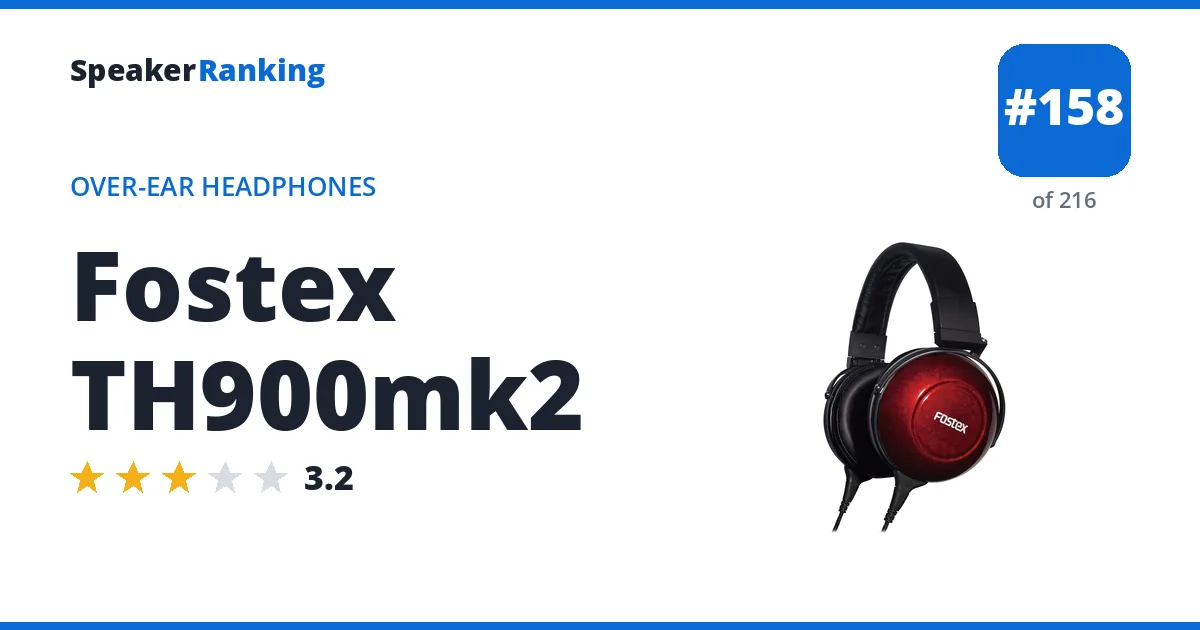
Pros: Sub-bass and bass sit about 2.7 and 3.7 dB above target, giving a full, weighty low end with strong kick drums and bass guitar. The 25 ohm, 100 dB/mW closed-back design runs easily from a phone or portable amp, and presence and air are both lifted about 2.4 dB for added sparkle.
Cons: A 8 dB peak near 5.4 kHz makes vocals, snares and electric guitars sound sharp or shouty, while a 8.3 dB dip near 9.4 kHz leaves the upper treble uneven. Upper mids from 1 to 3 kHz sit about 1.5 dB under target, so the tonal balance feels bass-heavy. There is no built-in microphone.
Full Fostex TH900mk2 review and specifications →
| Back | Closed |
|---|---|
| Built-in Microphone | No |
| Connection | Wired |
| Deviation From Target | 2.94 dB standard deviation |
| Driver Type | Dynamic |
| Drivers | 1 x 50mm dynamic |
| Form Factor | Over-ear |
| Frequency Response | 5Hz - 45kHz (Manufacturer specified) |
| Harman Preference Score | 63 (measured by oratory1990, via AutoEQ) |
| Impedance | 25 ohms |
| Sensitivity | 100 dB/mW |
| Sub-bass Extension | Within 6 dB of target down to 20 Hz (+2.6 dB at 30 Hz) |
| Tonal Tilt | -0.94 (negative is warmer, positive brighter) |
EQ preset to match the Harman target
Set a preamp of -4.9 dB, then add these filters in any parametric equalizer (Wavelet, Equalizer APO, Peace, or a player with parametric EQ). Calculated by AutoEQ from its measured frequency response.
| Filter | Frequency | Gain | Q |
|---|---|---|---|
| Low shelf | 105 Hz | -0.1 dB | 0.70 |
| Peak | 189 Hz | -3.6 dB | 0.18 |
| Peak | 2,364 Hz | +5.5 dB | 1.54 |
| Peak | 5,351 Hz | -8.4 dB | 4.70 |
| Peak | 454 Hz | +5.3 dB | 1.17 |
| High shelf | 10,000 Hz | -3.8 dB | 0.70 |
| Peak | 81 Hz | +0.5 dB | 2.33 |
| Peak | 39 Hz | -0.3 dB | 1.38 |
| Peak | 196 Hz | -0.3 dB | 1.57 |
| Peak | 292 Hz | +0.3 dB | 2.64 |
- Reviews, Comparisons and Sound Samples
- Head-to-Head Comparisons