The SeeAudio Kaguya ranks #194 out of 297 total In-Ear Headphones for sound quality. See all Headphones rankings for every top pick.
Brand: SeeAudio
Prices on this page were last checked October 10, 2026 at 5:37 PM UTC. Product prices and availability are accurate as of that date/time and are subject to change; the price and availability shown on Amazon at the time of purchase will apply to the purchase of this product.
As an eBay Partner, we may be compensated if you make a purchase.
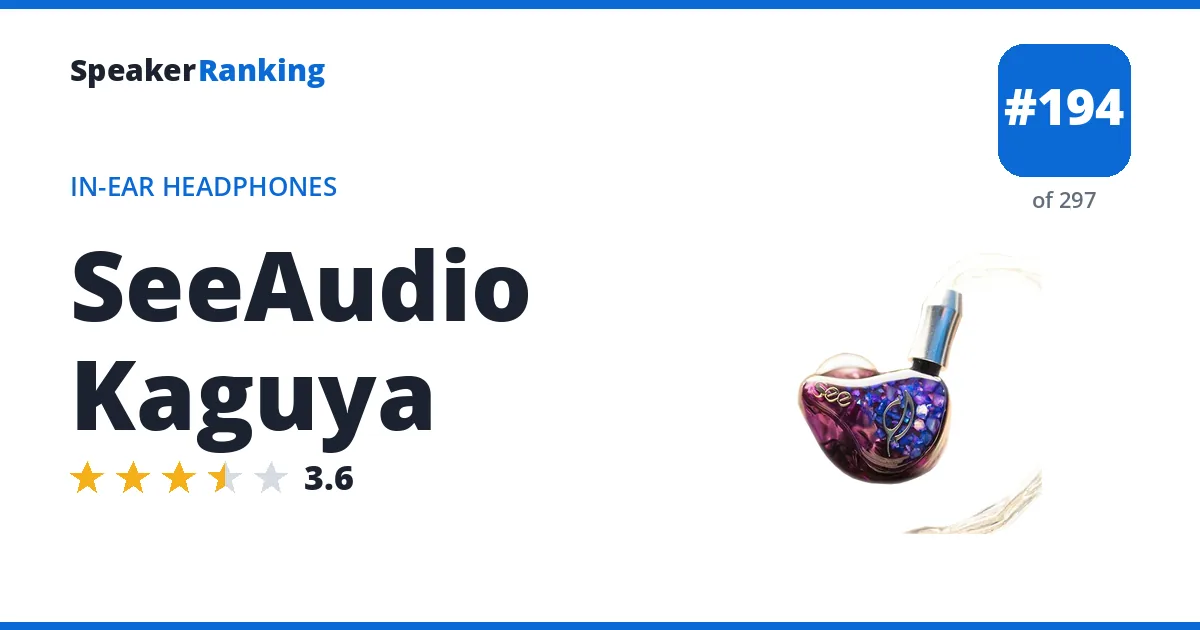
#194 SeeAudio Kaguya: $1,399.00 Linsoul eBay
Pros: A preference score of 69 from crinacle and a 2.2 dB standard deviation give it a fairly even response for a premium hybrid. Bass sits about 2 dB above target with sub-bass near neutral all the way to 20 Hz, so low notes are full without bloat. Four electrostatic tweeters add a 7.4 dB lift in the 10 to 16 kHz air region for an open, airy top end. It rates higher than both the SeeAudio Neo and the DUNU Zen Pro.
Cons: A 10.8 dB peak near 10 kHz in squig.link measurements can make cymbals and hi-hats sound glassy or hissy to treble-sensitive listeners. A 4.6 dB dip near 6 kHz slightly softens vocal consonants. The SoftEars Twilight rates higher for considerably less money.
| Released | Jan 2021 (5 years ago) |
|---|---|
| Back | Closed |
| Built-in Microphone | No |
| Connection | Wired |
| Deviation From Target | 2.22 dB standard deviation |
| Driver Type | Hybrid (4 balanced armature + 4 electrostatic) |
| Drivers | 4 x balanced armature + 4 x electrostatic |
| Form Factor | In-ear |
| Frequency Response | 20Hz - 40kHz (Manufacturer specified) |
| Harman Preference Score | 69 (measured by crinacle, via AutoEQ) |
| Impedance | 28 ohms |
| Sensitivity | 103 dB/mW |
| Sub-bass Extension | Within 6 dB of target down to 20 Hz (+1.3 dB at 30 Hz) |
| Tonal Tilt | -0.56 (negative is warmer, positive brighter) |
EQ preset to match the Harman target
Set a preamp of -6.4 dB, then add these filters in any parametric equalizer (Wavelet, Equalizer APO, Peace, or a player with parametric EQ). Calculated by AutoEQ from its measured frequency response.
| Filter | Frequency | Gain | Q |
|---|---|---|---|
| Low shelf | 105 Hz | -1.7 dB | 0.70 |
| Peak | 831 Hz | +4.2 dB | 0.74 |
| Peak | 166 Hz | -2.6 dB | 1.02 |
| Peak | 5,983 Hz | +6.4 dB | 3.01 |
| Peak | 1,483 Hz | -4.3 dB | 1.10 |
| High shelf | 10,000 Hz | -4.6 dB | 0.70 |
| Peak | 4,008 Hz | -0.9 dB | 5.06 |
| Peak | 65 Hz | +0.3 dB | 2.22 |
| Peak | 6,624 Hz | +1.1 dB | 5.93 |
| Peak | 8,597 Hz | +1.5 dB | 5.55 |
- Reviews, Comparisons and Sound Samples