Coverage note. Speaker Ranking currently covers 3 Westone models across headphones. These are the products in our database, not a complete list of everything Westone makes.
What this page covers. The Westone models ranked here span headphones, including Westone W10, Westone W20 and Westone Pro X50. Use each model’s category position to compare it with alternatives of the same size and use case.
This page lists all 3 Westone speakers ranked on this site across headphones. Each model is shown in the category where it competes, with its current rank and the size of that ranking.
Use the category position rather than the brand name alone: speakers from the same manufacturer can perform very differently by size, price and product family.
Prices on this page were last checked October 10, 2026 at 5:37 PM UTC. Product prices and availability are accurate as of that date/time and are subject to change; the price and availability shown on Amazon at the time of purchase will apply to the purchase of this product.
As an eBay Partner, we may be compensated if you make a purchase.
In-Ear Headphones
 Ranked #101 of 115 in In-Ear Headphones - Westone W10: $199.99 Amazon eBay
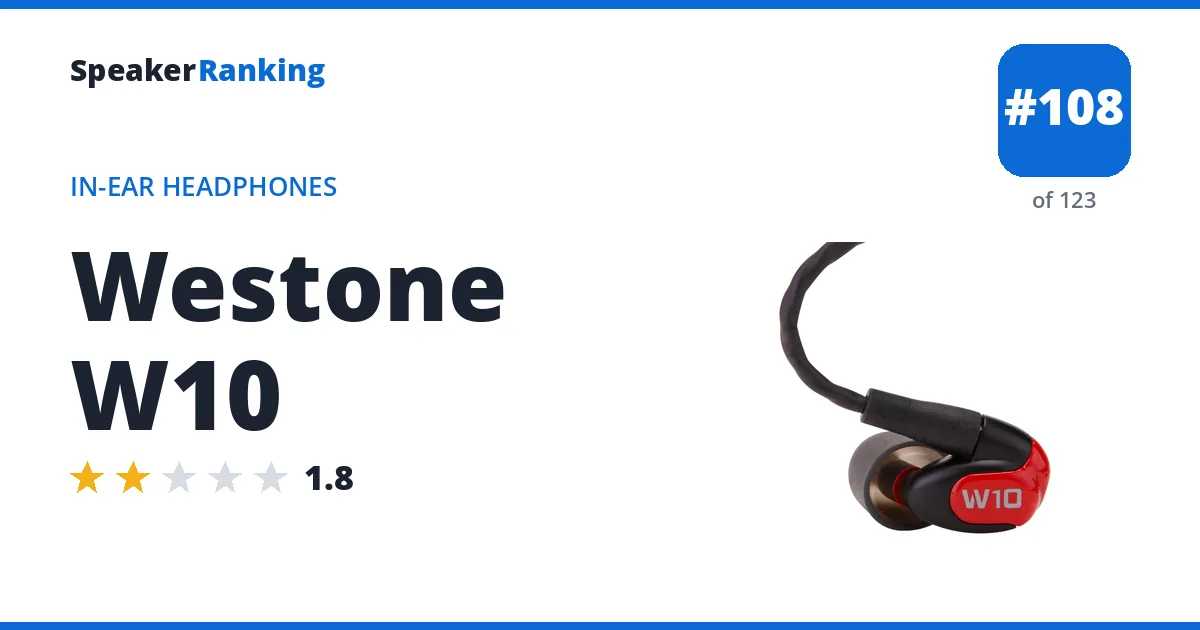
Pros: Its 122 dB SPL/mW sensitivity means a phone drives it to loud levels with no effort, and the cable includes a built-in microphone for calls. The single balanced armature design suits listeners who want a dark, laid-back sound with no treble glare.
Cons: Oratory1990’s measurement shows heavy treble loss, with an 11.5 dB dip near 6 kHz and the air band almost 18 dB below target, so cymbals, string texture and spatial cues are badly muted. Sub-bass falls 6 dB short by 56 Hz, leaving little low end rumble. The cheaper Etymotic ER3SE and KZ ASX both rate higher.
Full Westone W10 review and specifications →
| Back | Closed |
|---|---|
| Built-in Microphone | Yes |
| Connection | Wired |
| Deviation From Target | 4.06 dB standard deviation |
| Driver Type | Balanced armature |
| Drivers | 1 x balanced armature |
| Form Factor | In-ear |
| Frequency Response | 20Hz - 16kHz (Manufacturer specified) |
| Harman Preference Score | 47 (measured by oratory1990, via AutoEQ) |
| Sensitivity | 122 dB SPL/mW |
| Sub-bass Extension | Falls 6 dB below target at 56 Hz (-8.0 dB at 30 Hz) |
| Tonal Tilt | -0.45 (negative is warmer, positive brighter) |
EQ preset to match the Harman target
Set a preamp of -6.2 dB, then add these filters in any parametric equalizer (Wavelet, Equalizer APO, Peace, or a player with parametric EQ). Calculated by AutoEQ from its measured frequency response.
| Filter | Frequency | Gain | Q |
|---|---|---|---|
| Low shelf | 105 Hz | +4.1 dB | 0.70 |
| Peak | 237 Hz | -4.0 dB | 0.18 |
| Peak | 5,987 Hz | +5.9 dB | 0.63 |
| Peak | 2,493 Hz | +2.9 dB | 2.11 |
| Peak | 59 Hz | +1.7 dB | 0.82 |
| High shelf | 10,000 Hz | +5.6 dB | 0.70 |
| Peak | 8,139 Hz | -2.8 dB | 3.70 |
| Peak | 713 Hz | +0.7 dB | 1.13 |
| Peak | 1,201 Hz | -1.0 dB | 2.41 |
| Peak | 237 Hz | -0.4 dB | 1.54 |
- Reviews, Comparisons and Sound Samples
 Ranked #112 of 115 in In-Ear Headphones - Westone W20: $249.95 Amazon eBay
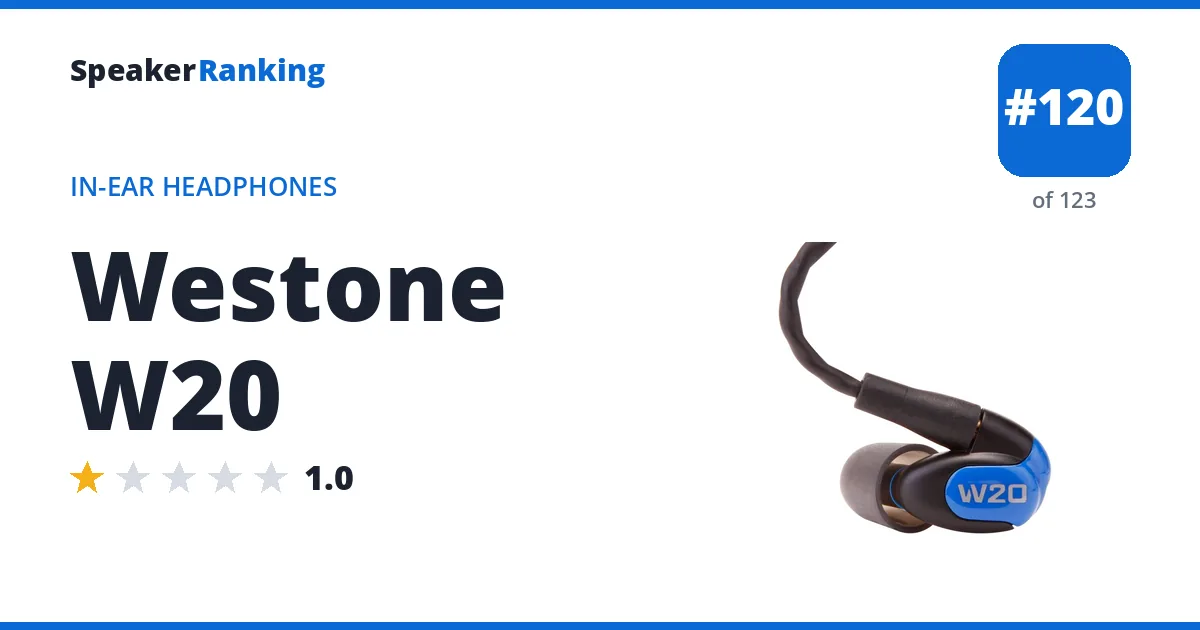
Pros: Two balanced armature drivers and a 117 dB/mW sensitivity make it easy to drive loud from a phone. It includes a built in microphone for calls, and the closed in-ear design blocks outside noise.
Cons: A preference score of 35 in crinacle’s measurement puts its tuning far from the Harman target, so it will sound colored to most listeners without EQ. The claimed response stops at 18 kHz, and the Oriolus Finschi Hifi rates higher and costs less.
Full Westone W20 review and specifications →
| Back | Closed |
|---|---|
| Built-in Microphone | Yes |
| Connection | Wired |
| Deviation From Target | 4.78 dB standard deviation |
| Driver Type | Balanced armature |
| Drivers | 2 x balanced armature |
| Form Factor | In-ear |
| Frequency Response | 20Hz - 18kHz (Manufacturer specified) |
| Harman Preference Score | 35 (measured by crinacle, via AutoEQ) |
| Impedance | 33 ohms |
| Sensitivity | 117 dB/mW |
| Tonal Tilt | -1.08 (negative is warmer, positive brighter) |
EQ preset to match the Harman target
Set a preamp of -6.2 dB, then add these filters in any parametric equalizer (Wavelet, Equalizer APO, Peace, or a player with parametric EQ). Calculated by AutoEQ from its measured frequency response.
| Filter | Frequency | Gain | Q |
|---|---|---|---|
| Low shelf | 105 Hz | +2.4 dB | 0.70 |
| Peak | 5,068 Hz | +6.7 dB | 0.18 |
| Peak | 248 Hz | -6.0 dB | 0.43 |
| Peak | 1,958 Hz | -6.5 dB | 0.82 |
| Peak | 3,230 Hz | +3.4 dB | 2.23 |
| High shelf | 10,000 Hz | -3.3 dB | 0.70 |
| Peak | 68 Hz | +0.3 dB | 2.33 |
| Peak | 969 Hz | +0.5 dB | 3.46 |
| Peak | 1,285 Hz | -0.5 dB | 3.87 |
| Peak | 132 Hz | -0.2 dB | 2.19 |
- Reviews, Comparisons and Sound Samples
 Ranked #115 of 115 in In-Ear Headphones - Westone Pro X50: $599.99 Amazon eBay
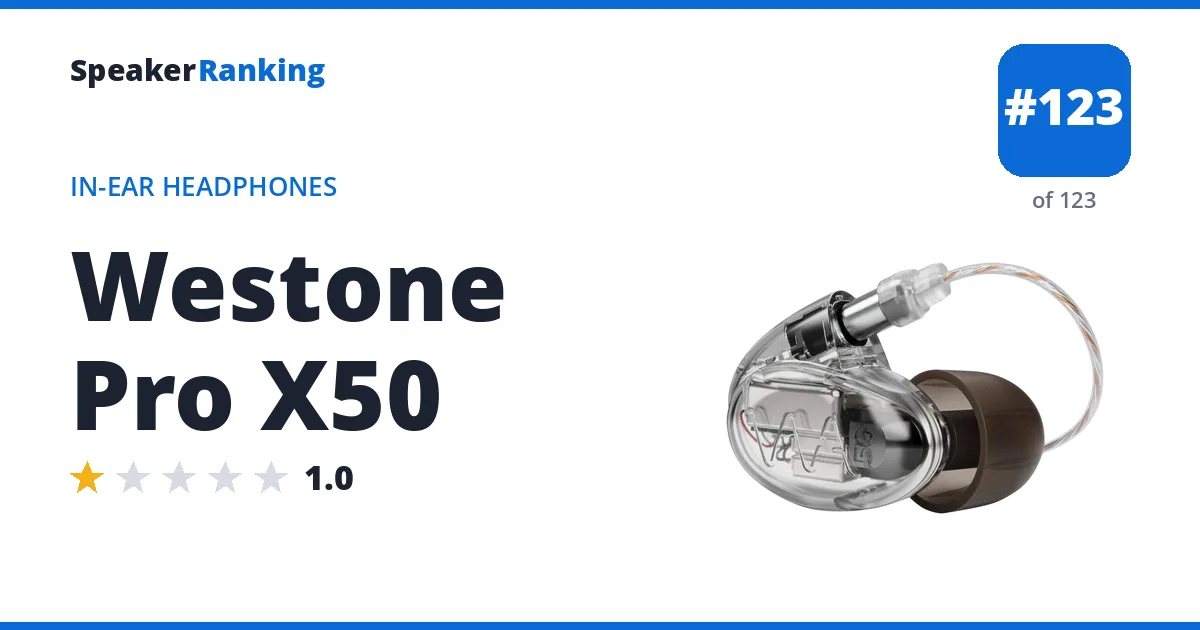
Pros: Five balanced armatures with 115 dB/mW sensitivity make it easy to drive from a phone or stage monitor pack. The closed in-ear design isolates well from loud surroundings.
Cons: Its preference score of 11 from crinacle’s measurement is among the lowest of any in-ear, with 6.39 dB of deviation and a strongly dark tilt, so its tonal balance is far from what most listeners prefer. The Mackie MP-360 and Audio-Technica ATH-E70 earn higher ratings for less money.
Full Westone Pro X50 review and specifications →
| Released | 2021 (5 years ago) |
|---|---|
| Back | Closed |
| Built-in Microphone | No |
| Connection | Wired |
| Deviation From Target | 6.39 dB standard deviation |
| Driver Type | Balanced armature |
| Drivers | 5 x balanced armature |
| Form Factor | In-ear |
| Frequency Response | 20Hz - 20kHz (Manufacturer specified) |
| Harman Preference Score | 11 (measured by crinacle, via AutoEQ) |
| Impedance | 45 ohms |
| Sensitivity | 115 dB/mW |
| Tonal Tilt | -2.11 (negative is warmer, positive brighter) |
EQ preset to match the Harman target
Set a preamp of -6.1 dB, then add these filters in any parametric equalizer (Wavelet, Equalizer APO, Peace, or a player with parametric EQ). Calculated by AutoEQ from its measured frequency response.
| Filter | Frequency | Gain | Q |
|---|---|---|---|
| Low shelf | 105 Hz | +0.5 dB | 0.70 |
| Peak | 221 Hz | -8.1 dB | 0.40 |
| Peak | 2,016 Hz | +7.5 dB | 0.67 |
| Peak | 9,337 Hz | +5.4 dB | 0.36 |
| Peak | 1,719 Hz | -9.7 dB | 1.82 |
| High shelf | 10,000 Hz | -6.4 dB | 0.70 |
| Peak | 9,549 Hz | +2.7 dB | 1.77 |
| Peak | 2,260 Hz | +1.0 dB | 2.61 |
| Peak | 1,810 Hz | +0.1 dB | 6.00 |
| Peak | 2,047 Hz | -1.8 dB | 5.70 |
- Reviews, Comparisons and Sound Samples