Coverage note. Speaker Ranking currently covers 3 Warwick Acoustics models across headphones. These are the products in our database, not a complete list of everything Warwick Acoustics makes.
What this page covers. The Warwick Acoustics models ranked here span headphones, including Warwick Acoustics Sonoma Model One, Warwick Acoustics Bravura and Warwick Acoustics Aperio. Use each model’s category position to compare it with alternatives of the same size and use case.
This page lists all 3 Warwick Acoustics speakers ranked on this site across headphones. Each model is shown in the category where it competes, with its current rank and the size of that ranking.
Use the category position rather than the brand name alone: speakers from the same manufacturer can perform very differently by size, price and product family.
Prices on this page were last checked October 10, 2026 at 5:37 PM UTC. Product prices and availability are accurate as of that date/time and are subject to change; the price and availability shown on Amazon at the time of purchase will apply to the purchase of this product.
As an eBay Partner, we may be compensated if you make a purchase.
Over-Ear Headphones
 Ranked #3 of 201 in Over-Ear Headphones - Warwick Acoustics Sonoma Model One: $4,995.00 Audio46 eBay
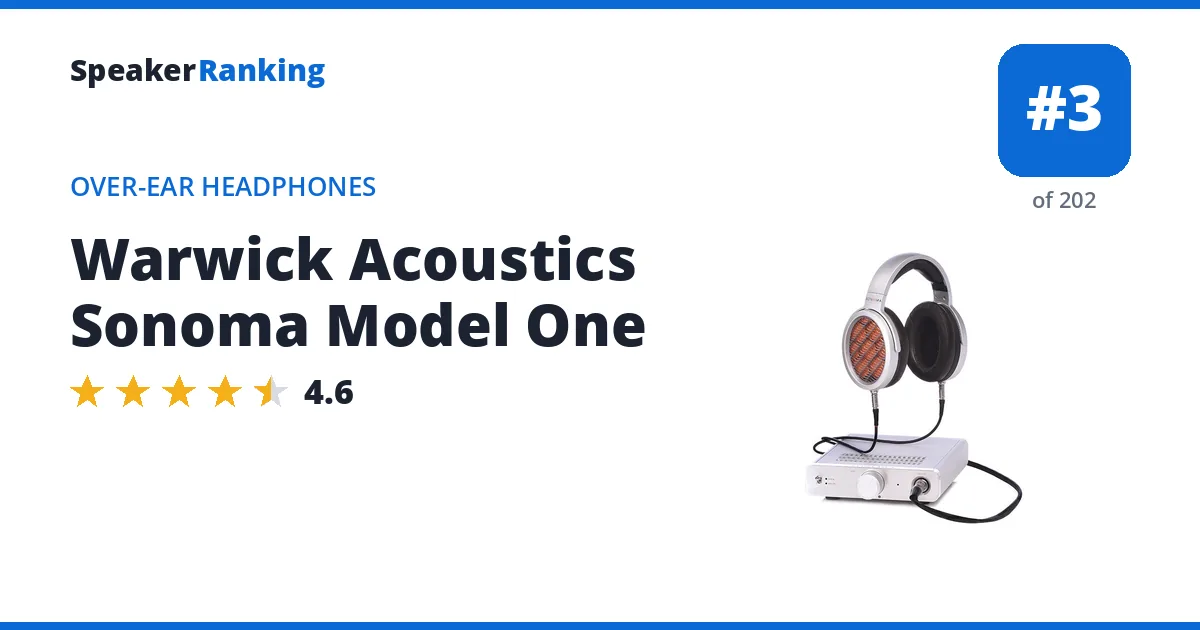
Pros: In oratory1990’s measurement it earns a preference score of 95 with only 1.5 dB of standard deviation from the Harman target, so voices, instruments and bass all sit in natural proportion. The midrange from 200 Hz to 1 kHz lands within 0.2 dB of target, which keeps vocals and acoustic instruments sounding true to life. It rates above the Dan Clark Audio Stealth and the Final Audio D8000 Pro Edition, and at 303 g it is light for a large electrostatic.
Cons: It is electrostatic, so it needs a dedicated electrostatic energizer and cannot plug into a phone, laptop or ordinary headphone amp. Sub-bass sits about 5 dB under target from 20 to 60 Hz, giving deep synth and organ notes less weight, and a 5.6 dB dip near 6.4 kHz slightly softens cymbal attack. The open back leaks sound and blocks no outside noise.
Full Warwick Acoustics Sonoma Model One review and specifications →
| Released | 2017 (9 years ago) |
|---|---|
| Back | Open |
| Built-in Microphone | No |
| Connection | Wired |
| Deviation From Target | 1.50 dB standard deviation |
| Driver Type | Electrostatic |
| Drivers | 1 x electrostatic (3570 mm2 diaphragm area) |
| Form Factor | Over-ear |
| Frequency Response | 10Hz - 60kHz (Manufacturer specified) |
| Harman Preference Score | 95 (measured by oratory1990, via AutoEQ) |
| Sub-bass Extension | Within 6 dB of target down to 20 Hz (-5.1 dB at 30 Hz) |
| Tonal Tilt | +0.02 (negative is warmer, positive brighter) |
| Weight | 0.7 lbs (303 g) |
EQ preset to match the Harman target
Set a preamp of -4.3 dB, then add these filters in any parametric equalizer (Wavelet, Equalizer APO, Peace, or a player with parametric EQ). Calculated by AutoEQ from its measured frequency response.
| Filter | Frequency | Gain | Q |
|---|---|---|---|
| Low shelf | 105 Hz | +4.3 dB | 0.70 |
| Peak | 1,056 Hz | -3.0 dB | 0.99 |
| Peak | 1,938 Hz | +3.5 dB | 2.03 |
| Peak | 74 Hz | -3.3 dB | 2.03 |
| Peak | 6,566 Hz | +3.7 dB | 5.06 |
| High shelf | 10,000 Hz | -4.0 dB | 0.70 |
| Peak | 9,536 Hz | +2.8 dB | 2.28 |
| Peak | 210 Hz | -0.5 dB | 2.77 |
| Peak | 358 Hz | +0.3 dB | 1.79 |
| Peak | 5,435 Hz | -0.6 dB | 6.00 |
- Reviews, Comparisons and Sound Samples
 Ranked #42 of 201 in Over-Ear Headphones - Warwick Acoustics Bravura: $2,395.00 Headphones.com eBay
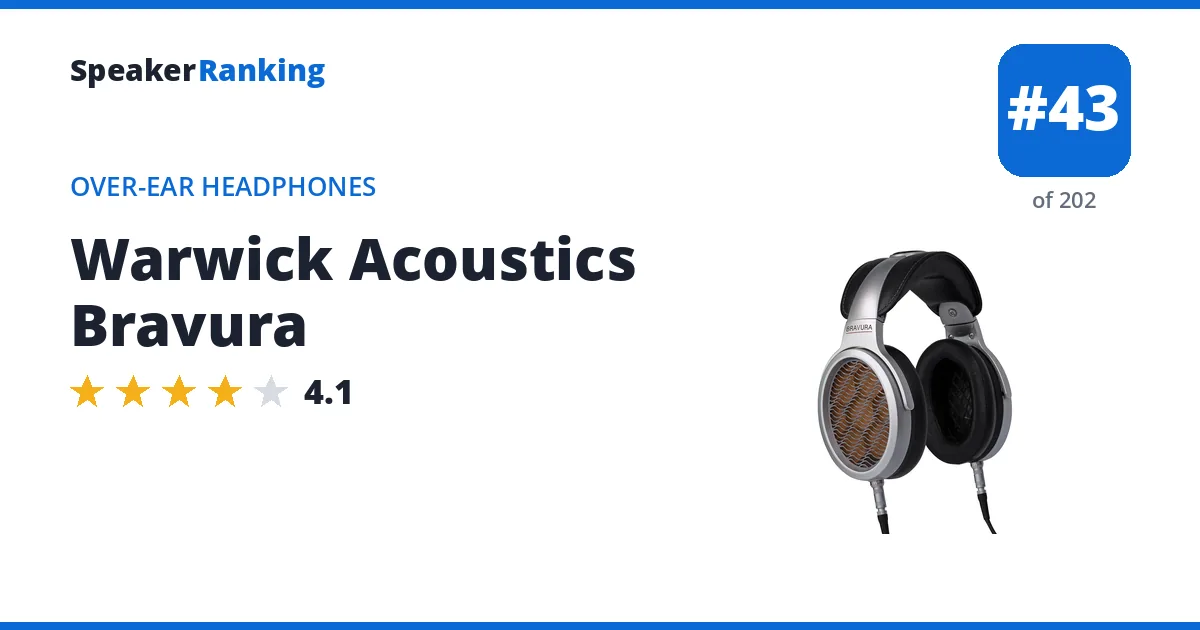
Pros: A preference score of 85 in oratory1990’s measurement, with low mids within 0.2 dB of target so vocals, piano and strings sound natural and uncolored. The response is smooth through the midrange, and its relaxed treble (about 4 dB under target from 6 to 10 kHz) stays easy to listen to for long sessions. It rates level with the AKG K812 and above the HIFIMAN HE1000se.
Cons: It is electrostatic and needs a dedicated electrostatic energizer; it will not run from a phone or standard headphone amp. Sub-bass falls 6 dB below target at 45 Hz and an 8.3 dB dip near 6.3 kHz dulls cymbals, so bass-heavy and bright recordings lose some impact. At 403 g it is heavy, and the open back leaks sound.
Full Warwick Acoustics Bravura review and specifications →
| Released | 2022 (4 years ago) |
|---|---|
| Back | Open |
| Built-in Microphone | No |
| Connection | Wired |
| Deviation From Target | 1.91 dB standard deviation |
| Driver Type | Electrostatic |
| Drivers | 1 x single-ended electrostatic (3570mm² diaphragm) |
| Form Factor | Over-ear |
| Frequency Response | 10Hz - 60kHz (Manufacturer specified) |
| Harman Preference Score | 85 (measured by oratory1990, via AutoEQ) |
| Sub-bass Extension | Falls 6 dB below target at 45 Hz (-6.9 dB at 30 Hz) |
| Tonal Tilt | -0.36 (negative is warmer, positive brighter) |
| Weight | 0.9 lbs (403 g) |
EQ preset to match the Harman target
Set a preamp of -5.8 dB, then add these filters in any parametric equalizer (Wavelet, Equalizer APO, Peace, or a player with parametric EQ). Calculated by AutoEQ from its measured frequency response.
| Filter | Frequency | Gain | Q |
|---|---|---|---|
| Low shelf | 105 Hz | +6.0 dB | 0.70 |
| Peak | 606 Hz | -2.6 dB | 1.18 |
| Peak | 74 Hz | -5.2 dB | 1.45 |
| Peak | 7,673 Hz | +1.9 dB | 0.18 |
| Peak | 1,097 Hz | -3.8 dB | 5.72 |
| High shelf | 10,000 Hz | -3.9 dB | 0.70 |
| Peak | 9,464 Hz | +2.2 dB | 3.07 |
| Peak | 4,978 Hz | -1.8 dB | 3.76 |
| Peak | 205 Hz | -0.8 dB | 2.12 |
| Peak | 6,414 Hz | +3.0 dB | 5.94 |
- Reviews, Comparisons and Sound Samples
 Ranked #71 of 201 in Over-Ear Headphones - Warwick Acoustics Aperio: $30,000.00 Headphones.com eBay
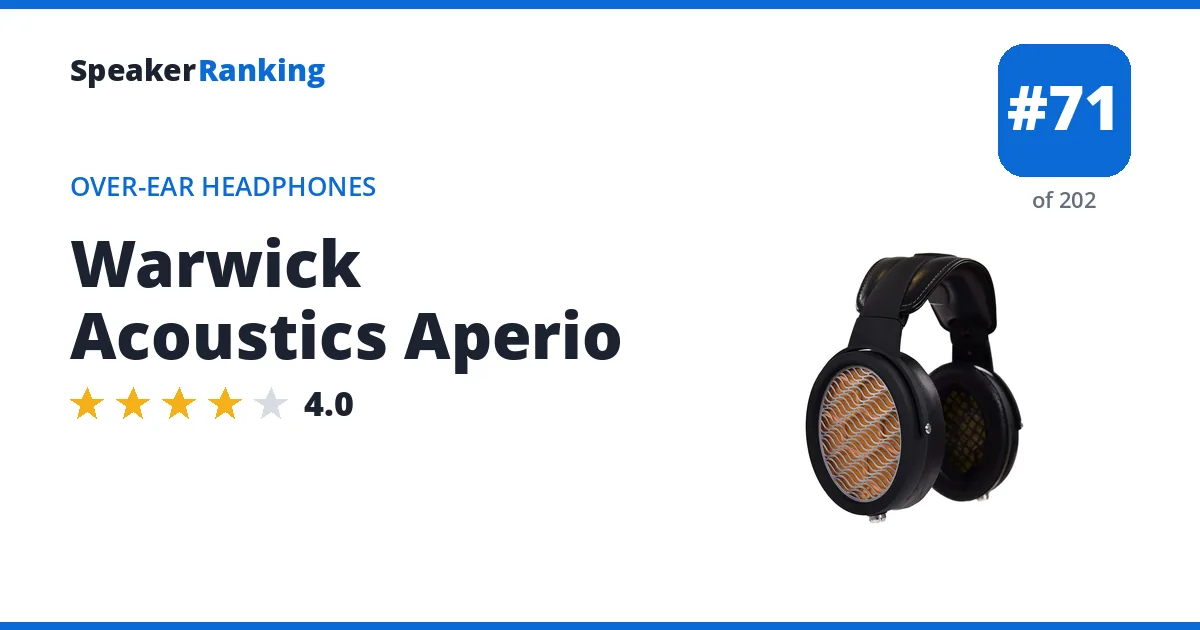
Pros: In oratory1990’s measurement it scores 81 for preference, with low mids within 0.3 dB of target, so vocals and the body of instruments sound natural and unforced. Bass stays within about 1 dB of target from 60 to 200 Hz and reaches down to 20 Hz without falling more than 6 dB.
Cons: It is electrostatic and needs a dedicated electrostatic energizer, so it cannot be driven from a phone or a regular headphone amp. A deep 10.9 dB dip near 9.4 kHz and presence about 2.8 dB under target from 3 to 6 kHz leave cymbals and the leading edge of instruments sounding muted. The open back leaks sound and gives no isolation.
Full Warwick Acoustics Aperio review and specifications →
| Back | Open |
|---|---|
| Built-in Microphone | No |
| Connection | Wired |
| Deviation From Target | 2.24 dB standard deviation |
| Driver Type | Electrostatic |
| Drivers | 1 x balanced-drive electrostatic (3570 mm2 diaphragm area) |
| Form Factor | Over-ear |
| Frequency Response | 10Hz - 60kHz (Manufacturer specified) |
| Harman Preference Score | 81 (measured by oratory1990, via AutoEQ) |
| Sub-bass Extension | Within 6 dB of target down to 20 Hz (-3.3 dB at 30 Hz) |
| Tonal Tilt | -0.33 (negative is warmer, positive brighter) |
| Weight | 0.9 lbs (405 g) |
EQ preset to match the Harman target
Set a preamp of -4.2 dB, then add these filters in any parametric equalizer (Wavelet, Equalizer APO, Peace, or a player with parametric EQ). Calculated by AutoEQ from its measured frequency response.
| Filter | Frequency | Gain | Q |
|---|---|---|---|
| Low shelf | 105 Hz | +2.3 dB | 0.70 |
| Peak | 988 Hz | -3.5 dB | 1.45 |
| Peak | 1,899 Hz | +4.3 dB | 2.92 |
| Peak | 5,388 Hz | +2.3 dB | 1.14 |
| Peak | 165 Hz | -1.5 dB | 0.81 |
| High shelf | 10,000 Hz | -1.6 dB | 0.70 |
| Peak | 58 Hz | +2.8 dB | 5.78 |
| Peak | 72 Hz | -2.1 dB | 5.14 |
| Peak | 2,882 Hz | -1.3 dB | 4.75 |
| Peak | 487 Hz | +1.7 dB | 6.00 |
- Reviews, Comparisons and Sound Samples