Coverage note. Speaker Ranking currently covers 4 TRN models across headphones. These are the products in our database, not a complete list of everything TRN makes.
What this page covers. The TRN models ranked here span headphones, including TRN MT3, TRN Conch and TRN Medusa. Use each model’s category position to compare it with alternatives of the same size and use case.
This page lists all 4 TRN speakers ranked on this site across headphones. Each model is shown in the category where it competes, with its current rank and the size of that ranking.
Use the category position rather than the brand name alone: speakers from the same manufacturer can perform very differently by size, price and product family.
Prices on this page were last checked October 10, 2026 at 5:37 PM UTC. Product prices and availability are accurate as of that date/time and are subject to change; the price and availability shown on Amazon at the time of purchase will apply to the purchase of this product.
As an eBay Partner, we may be compensated if you make a purchase.
In-Ear Headphones
 Ranked #23 of 297 in In-Ear Headphones - TRN MT3: $17.99 Amazon eBay
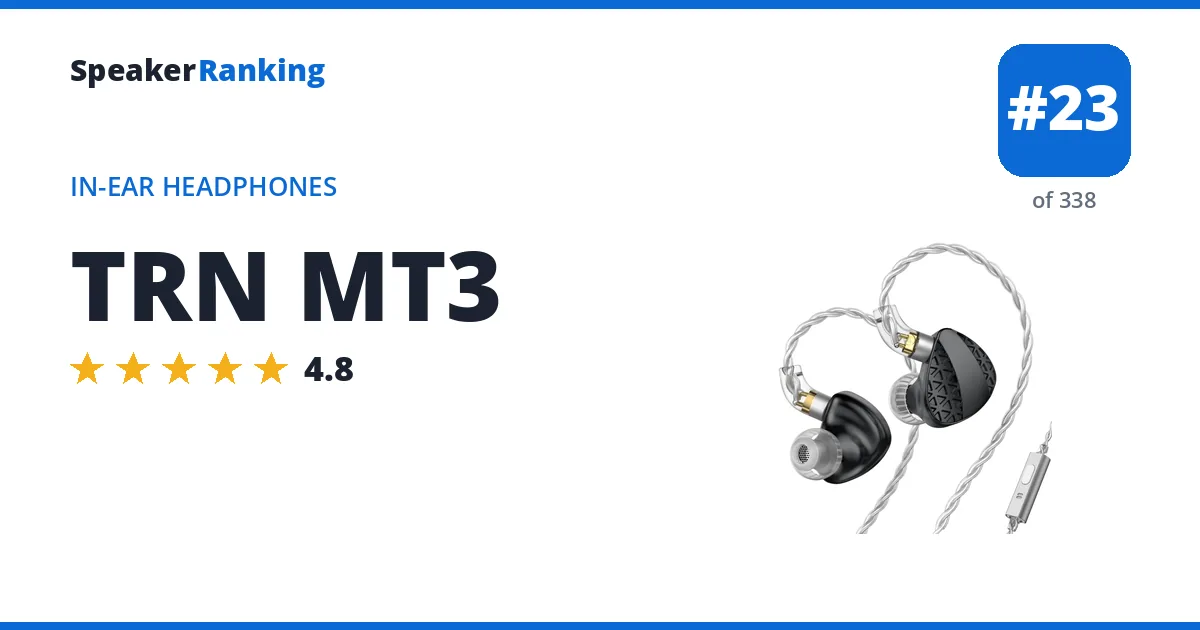
Pros: The MT3 scores 83.4 for preference in the median of eight hobbyist measurements on squig.link, with a smooth 1.18 dB deviation from target. Sub-bass sits right on target and bass runs about 1.6 dB above it, giving kick drums and electronic music a slightly warm, full low end that suits warm and mildly V shaped tastes. Its 114 dB sensitivity at 28 ohms means any phone or dongle drives it loudly.
Cons: Treble is lifted, about 2 dB high from 6 to 10 kHz and 3.6 dB high above 10 kHz, with a 5.1 dB peak near 8.4 kHz that can make sibilance and cymbals sound splashy. A 3.7 dB dip near 11.2 kHz follows, so the top end is not entirely even. It is rated equal to, not above, close rivals such as the 7Hz Salnotes Zero and CCA Trio.
Full TRN MT3 review and specifications →
| Released | 2022 (4 years ago) |
|---|---|
| Back | Closed |
| Connection | Wired |
| Deviation From Target | 1.18 dB standard deviation |
| Driver Type | Dynamic |
| Drivers | 1 x 10mm dynamic |
| Form Factor | In-ear |
| Harman Preference Score | 83 (median of 8 squig.link measurements, calibrated to AutoEQ) |
| Impedance | 28 ohms |
| Sensitivity | 114 dB |
| Sub-bass Extension | Within 6 dB of target down to 20 Hz (+0.2 dB at 30 Hz) |
| Tonal Tilt | -0.09 (negative is warmer, positive brighter) |
- Reviews, Comparisons and Sound Samples
 Ranked #89 of 297 in In-Ear Headphones - TRN Conch: $29.99 Amazon eBay
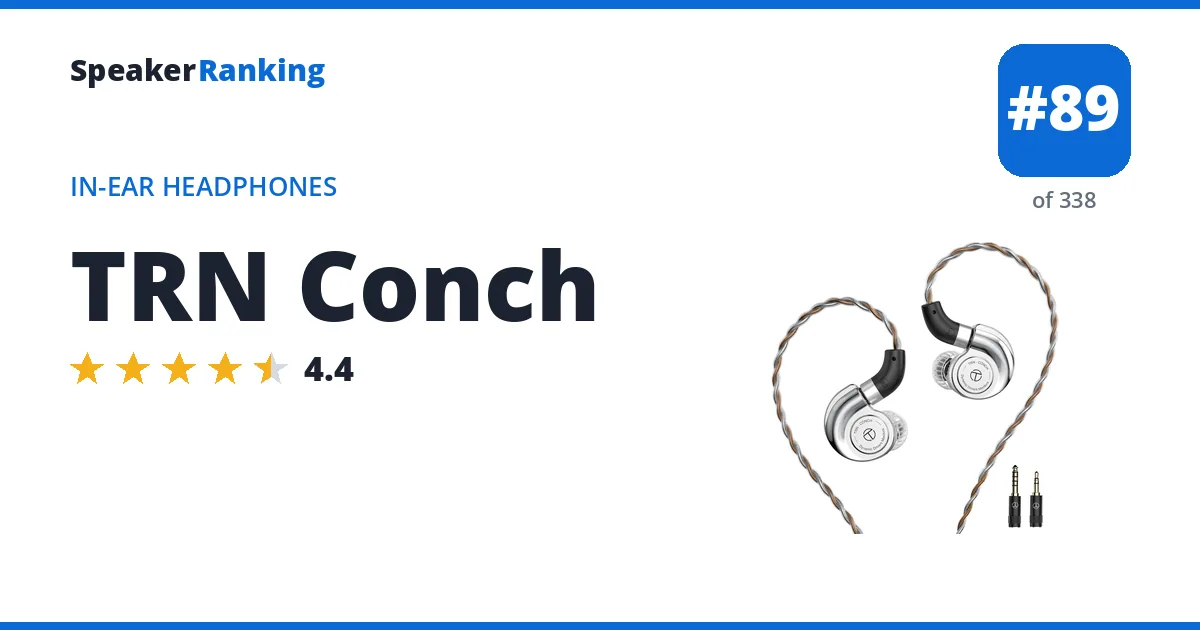
Pros: Fifteen hobbyist measurements on squig.link give the Conch a preference score of 79.0, a strong result for one of the cheapest in-ears around. Bass runs 2.1 dB above target with sub-bass holding on target to 20 Hz, giving music warm weight for V-shaped tastes. Its 114 dB sensitivity and 30 ohm impedance make it simple to drive from a phone.
Cons: Air above 10 kHz sits about 5.8 dB above target with a 6.7 dB peak near 8.1 kHz, so it can sound sharp and sibilant on bright recordings. The presence band 2 dB below target recesses vocals a little, and the KBEAR KB01 earns a higher rating at a similar price.
Full TRN Conch review and specifications →
| Released | Nov 2023 (2 years ago) |
|---|---|
| Back | Closed |
| Connection | Wired |
| Deviation From Target | 1.60 dB standard deviation |
| Driver Type | Dynamic |
| Drivers | 1 x dynamic |
| Form Factor | In-ear |
| Frequency Response | 20Hz - 20kHz (Manufacturer specified) |
| Harman Preference Score | 79 (median of 15 squig.link measurements, calibrated to AutoEQ) |
| Impedance | 30 ohms |
| Sensitivity | 114 dB |
| Sub-bass Extension | Within 6 dB of target down to 20 Hz (-0.6 dB at 30 Hz) |
| Tonal Tilt | -0.15 (negative is warmer, positive brighter) |
- Reviews, Comparisons and Sound Samples
 Ranked #93 of 297 in In-Ear Headphones - TRN Medusa: $53.99 Amazon eBay
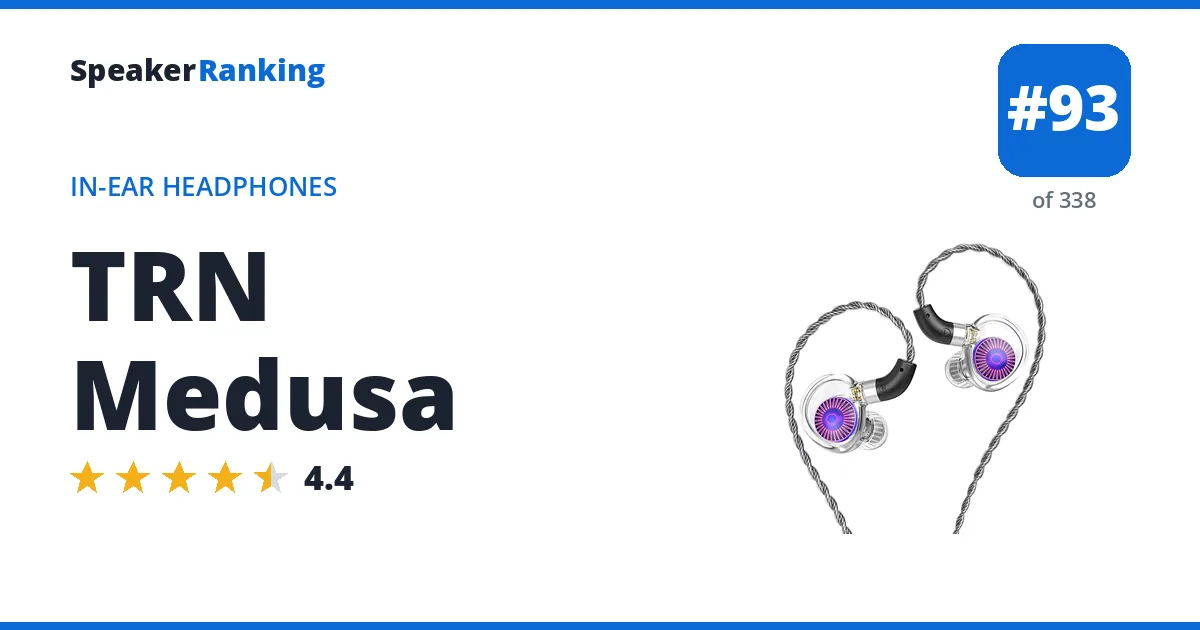
Pros: Thirteen hobbyist measurements on squig.link put the Medusa at a preference score of 78.7, with a single 12mm dynamic driver that holds bass almost exactly on target down to 30 Hz. Midbass sits 1.7 dB above target for punchy drums, while vocals in the 1 to 3 kHz range come through clearly. It weighs 5.1 g per earbud and its 30 ohm, 108 dB load is easy for any phone.
Cons: The air band runs about 6.5 dB above target and peaks 8.6 dB near 11.9 kHz, so it can sound hissy and fatiguing with bright mixes or at high volume. It costs a little more than the equally rated KBEAR KB02 and CCA Pianist.
Full TRN Medusa review and specifications →
| Released | 2024 (2 years ago) |
|---|---|
| Back | Closed |
| Connection | Wired |
| Deviation From Target | 1.55 dB standard deviation |
| Driver Type | Dynamic |
| Drivers | 1 x 12mm dynamic |
| Form Factor | In-ear |
| Frequency Response | 20Hz - 20kHz (Manufacturer specified) |
| Harman Preference Score | 79 (median of 13 squig.link measurements, calibrated to AutoEQ) |
| Impedance | 30 ohms |
| Sensitivity | 108 dB |
| Sub-bass Extension | Within 6 dB of target down to 20 Hz (-0.2 dB at 30 Hz) |
| Tonal Tilt | +0.10 (negative is warmer, positive brighter) |
| Weight | 0 lbs (5.1 g) per earbud |
- Reviews, Comparisons and Sound Samples
 Ranked #188 of 297 in In-Ear Headphones - TRN MT1: $13.95 Amazon AliExpress eBay
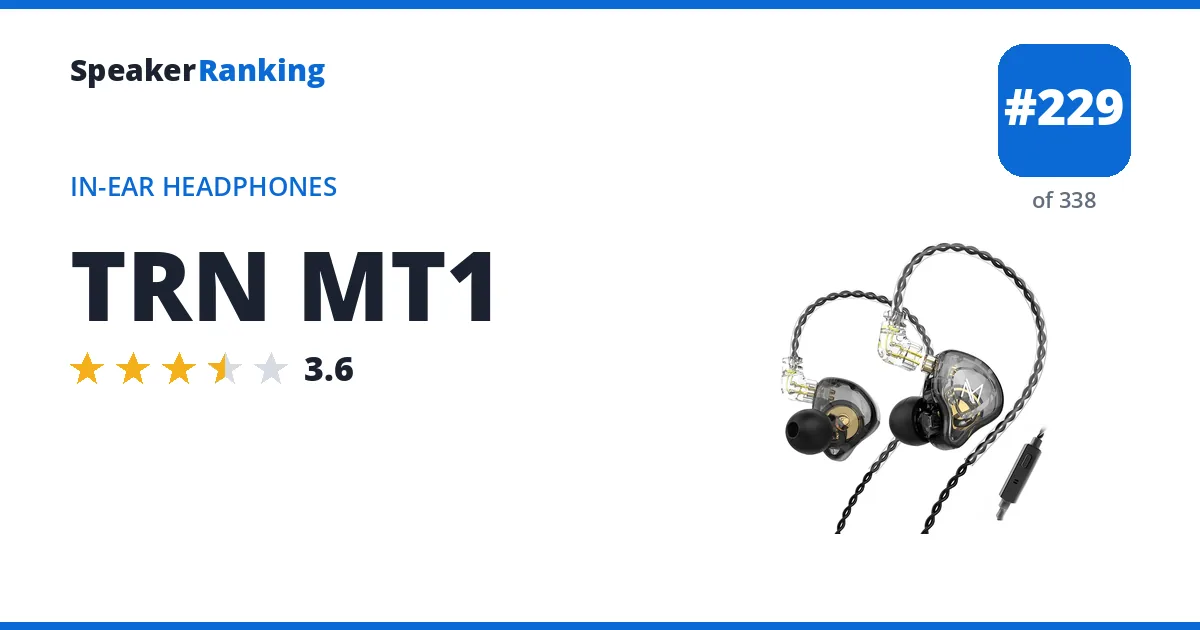
Pros: A preference score of 69 in crinacle’s measurement is a strong result for one of the cheapest in-ears around. Sub-bass is on target down to 30 Hz with bass 2.5 dB above, so it has satisfying punch, and the single 10 mm dynamic driver runs loud from any phone at 22 ohms and 106 dB. An inline microphone handles calls.
Cons: A 10.4 dB peak near 11.9 kHz in hobbyist measurements on squig.link can make cymbals sound tizzy and fatiguing at volume, with a 6 dB dip at 6.5 kHz just below it. The CCA CRA and TANGZU Wan’er S.G are rated higher for only a few dollars more.
Full TRN MT1 review and specifications →
| Back | Closed |
|---|---|
| Built-in Microphone | Yes |
| Connection | Wired |
| Deviation From Target | 2.46 dB standard deviation |
| Driver Type | Dynamic |
| Drivers | 1 x 10mm dynamic |
| Form Factor | In-ear |
| Frequency Response | 20Hz - 20kHz (Manufacturer specified) |
| Harman Preference Score | 69 (measured by crinacle, via AutoEQ) |
| Impedance | 22 ohms |
| Sensitivity | 106 dB |
| Sub-bass Extension | Within 6 dB of target down to 20 Hz (-0.2 dB at 30 Hz) |
| Tonal Tilt | -0.34 (negative is warmer, positive brighter) |
EQ preset to match the Harman target
Set a preamp of -4.6 dB, then add these filters in any parametric equalizer (Wavelet, Equalizer APO, Peace, or a player with parametric EQ). Calculated by AutoEQ from its measured frequency response.
| Filter | Frequency | Gain | Q |
|---|---|---|---|
| Low shelf | 105 Hz | +0.1 dB | 0.70 |
| Peak | 838 Hz | +4.1 dB | 0.67 |
| Peak | 9,762 Hz | +6.7 dB | 0.47 |
| Peak | 156 Hz | -2.7 dB | 0.78 |
| Peak | 3,174 Hz | -6.2 dB | 0.55 |
| High shelf | 10,000 Hz | -7.6 dB | 0.70 |
| Peak | 3,444 Hz | +3.5 dB | 3.06 |
| Peak | 4,523 Hz | -6.4 dB | 2.49 |
| Peak | 6,251 Hz | +3.6 dB | 0.84 |
| Peak | 2,461 Hz | -2.8 dB | 4.84 |
- Reviews, Comparisons and Sound Samples
- Head-to-Head Comparisons