Coverage note. Speaker Ranking currently covers 2 SoftEars models across headphones. These are the products in our database, not a complete list of everything SoftEars makes.
What this page covers. The SoftEars models ranked here span headphones, including SoftEars RSV and SoftEars Twilight. Use each model’s category position to compare it with alternatives of the same size and use case.
This page lists all 2 SoftEars speakers ranked on this site across headphones. Each model is shown in the category where it competes, with its current rank and the size of that ranking.
Use the category position rather than the brand name alone: speakers from the same manufacturer can perform very differently by size, price and product family.
Prices on this page were last checked October 10, 2026 at 5:37 PM UTC. Product prices and availability are accurate as of that date/time and are subject to change; the price and availability shown on Amazon at the time of purchase will apply to the purchase of this product.
As an eBay Partner, we may be compensated if you make a purchase.
In-Ear Headphones
 Ranked #15 of 68 in In-Ear Headphones - SoftEars RSV: $729.00 Amazon eBay
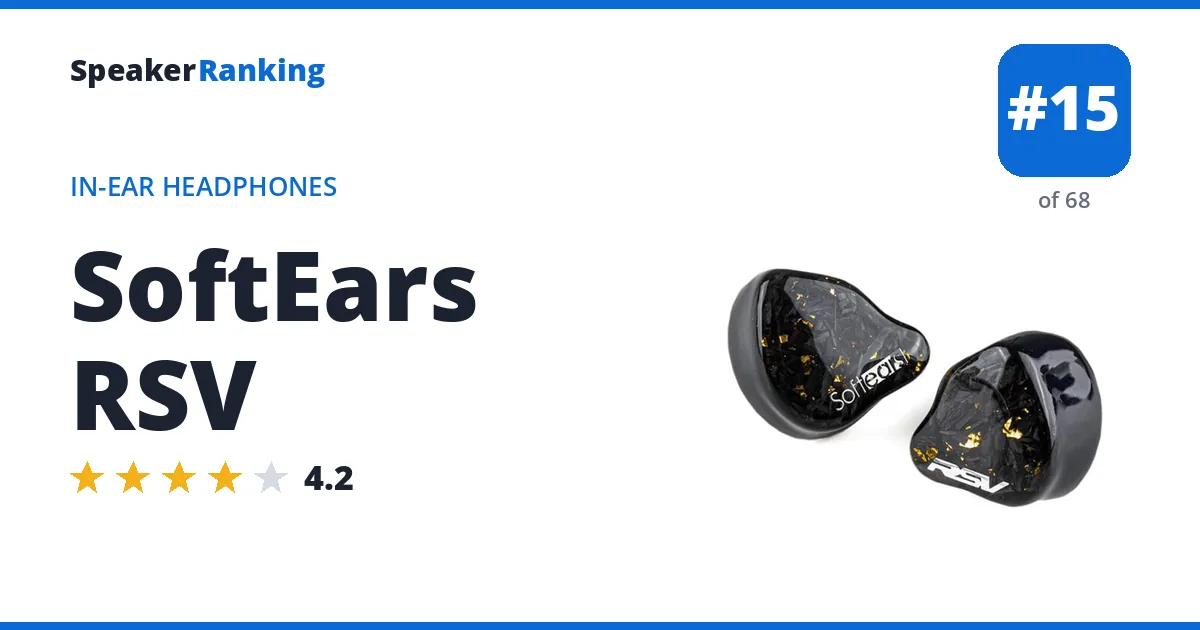
Pros: A preference score of 76 in crinacle’s measurement shows a response that sits close to the Harman target, and it is rated above the FiiO FD5 and the HIFIMAN RE2000. Five balanced armature drivers with 8 ohms impedance and 125 dB sensitivity mean it runs easily from a phone or dongle. The wired design suits home or portable listening with a source of your choice.
Cons: It sits at a premium price for an in-ear, and a preference score of 76 is no higher than far cheaper wired sets achieve. The very low 8 ohm impedance can interact with sources that have a high output impedance, and 125 dB sensitivity can make hiss from noisy sources audible. It is wired only, with no built in microphone.
Full SoftEars RSV review and specifications →
| Released | 2021 (5 years ago) |
|---|---|
| Back | Closed |
| Built-in Microphone | No |
| Connection | Wired |
| Deviation From Target | 1.76 dB standard deviation |
| Driver Type | Balanced armature |
| Drivers | 5 x balanced armature |
| Form Factor | In-ear |
| Frequency Response | 5Hz - 40kHz (Manufacturer specified) |
| Harman Preference Score | 76 (measured by crinacle, via AutoEQ) |
| Impedance | 8 ohms |
| Sensitivity | 125 dB/Vrms |
| Tonal Tilt | -0.39 (negative is warmer, positive brighter) |
EQ preset to match the Harman target
Set a preamp of -4.4 dB, then add these filters in any parametric equalizer (Wavelet, Equalizer APO, Peace, or a player with parametric EQ). Calculated by AutoEQ from its measured frequency response.
| Filter | Frequency | Gain | Q |
|---|---|---|---|
| Low shelf | 105 Hz | +0.5 dB | 0.70 |
| Peak | 9,429 Hz | +5.8 dB | 1.27 |
| Peak | 350 Hz | -1.4 dB | 0.18 |
| Peak | 862 Hz | +1.8 dB | 2.03 |
| Peak | 4,128 Hz | +1.5 dB | 4.48 |
| High shelf | 10,000 Hz | -3.5 dB | 0.70 |
| Peak | 2,856 Hz | -1.3 dB | 4.73 |
| Peak | 2,096 Hz | +0.9 dB | 3.23 |
| Peak | 40 Hz | -0.4 dB | 2.22 |
| Peak | 80 Hz | +0.3 dB | 1.97 |
- Reviews, Comparisons and Sound Samples
 Ranked #30 of 68 in In-Ear Headphones - SoftEars Twilight: $930.00 Amazon eBay
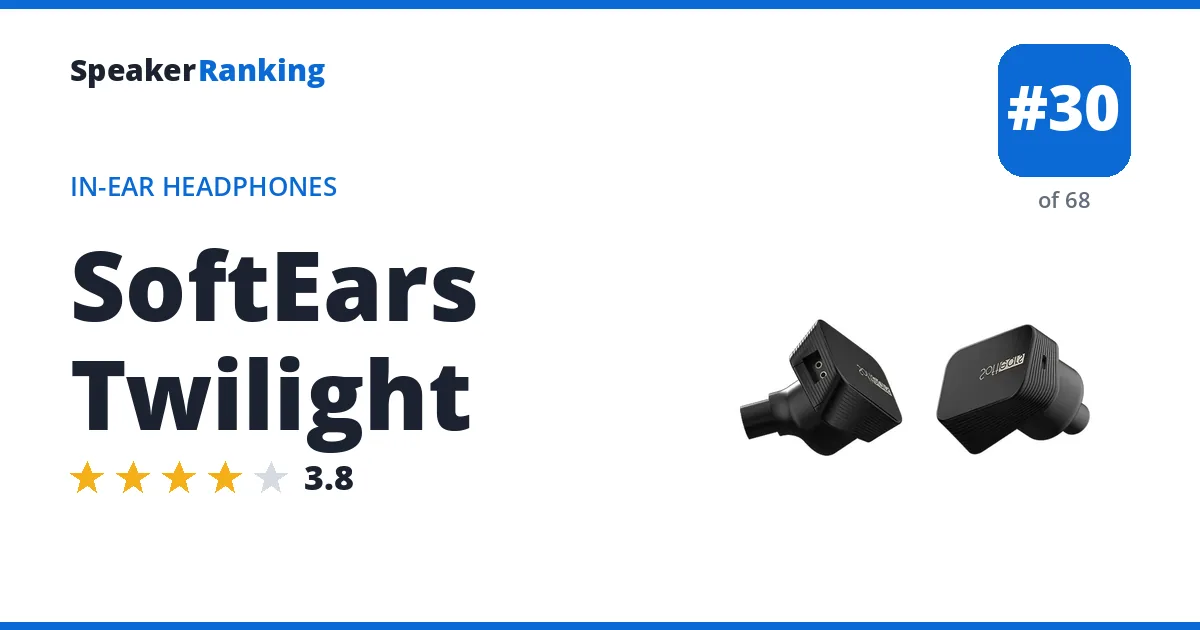
Pros: A preference score of 71 with a deviation of 2.42 dB from target is a respectable result for a single-dynamic-driver in-ear. A 16 ohm impedance and 116 dB/V sensitivity let it run loudly and cleanly from a phone or portable player without extra amplification. It weighs only 6 g per earbud, and its tilt of -0.1 means it is close to tonally balanced rather than skewed warm or bright. It has a higher rating than the HIFIMAN RE2000 and the JVC HA-FW1500.
Cons: The score of 71 is well short of the best in-ears, so some tuning errors remain against the Harman target. The SoftEars RSV from the same brand has a higher rating. It is a wired design only.
Full SoftEars Twilight review and specifications →
| Back | Closed |
|---|---|
| Connection | Wired |
| Deviation From Target | 2.42 dB standard deviation |
| Driver Type | Dynamic |
| Drivers | 1 x 10mm dynamic |
| Form Factor | In-ear |
| Frequency Response | 20Hz - 20kHz (Manufacturer specified) |
| Harman Preference Score | 71 (measured by crinacle, via AutoEQ) |
| Impedance | 16 ohms |
| Sensitivity | 116 dB/V |
| Tonal Tilt | -0.10 (negative is warmer, positive brighter) |
| Weight | 0 lbs (6 g) per earbud |
EQ preset to match the Harman target
Set a preamp of -3.5 dB, then add these filters in any parametric equalizer (Wavelet, Equalizer APO, Peace, or a player with parametric EQ). Calculated by AutoEQ from its measured frequency response.
| Filter | Frequency | Gain | Q |
|---|---|---|---|
| Low shelf | 105 Hz | +3.5 dB | 0.70 |
| Peak | 176 Hz | -3.8 dB | 0.48 |
| Peak | 7,545 Hz | +3.4 dB | 0.90 |
| Peak | 866 Hz | +2.8 dB | 1.07 |
| Peak | 4,388 Hz | -1.1 dB | 2.46 |
| High shelf | 10,000 Hz | +0.8 dB | 0.70 |
| Peak | 2,853 Hz | -0.9 dB | 4.10 |
| Peak | 2,069 Hz | +0.5 dB | 3.38 |
| Peak | 7,411 Hz | -1.0 dB | 5.97 |
| Peak | 6,202 Hz | +0.9 dB | 6.00 |
- Reviews, Comparisons and Sound Samples