Coverage note. Speaker Ranking currently covers 4 Sivga models across headphones. These are the products in our database, not a complete list of everything Sivga makes.
What this page covers. The Sivga models ranked here span headphones, including Sivga Oriole, Sivga SM100 and Sivga Luan. Use each model’s category position to compare it with alternatives of the same size and use case.
This page lists all 4 Sivga speakers ranked on this site across headphones. Each model is shown in the category where it competes, with its current rank and the size of that ranking.
Use the category position rather than the brand name alone: speakers from the same manufacturer can perform very differently by size, price and product family.
Prices on this page were last checked October 10, 2026 at 5:37 PM UTC. Product prices and availability are accurate as of that date/time and are subject to change; the price and availability shown on Amazon at the time of purchase will apply to the purchase of this product.
As an eBay Partner, we may be compensated if you make a purchase.
Quick Navigation
Over-Ear Headphones
 Ranked #55 of 201 in Over-Ear Headphones - Sivga Oriole: $239.00 HiFiGo eBay
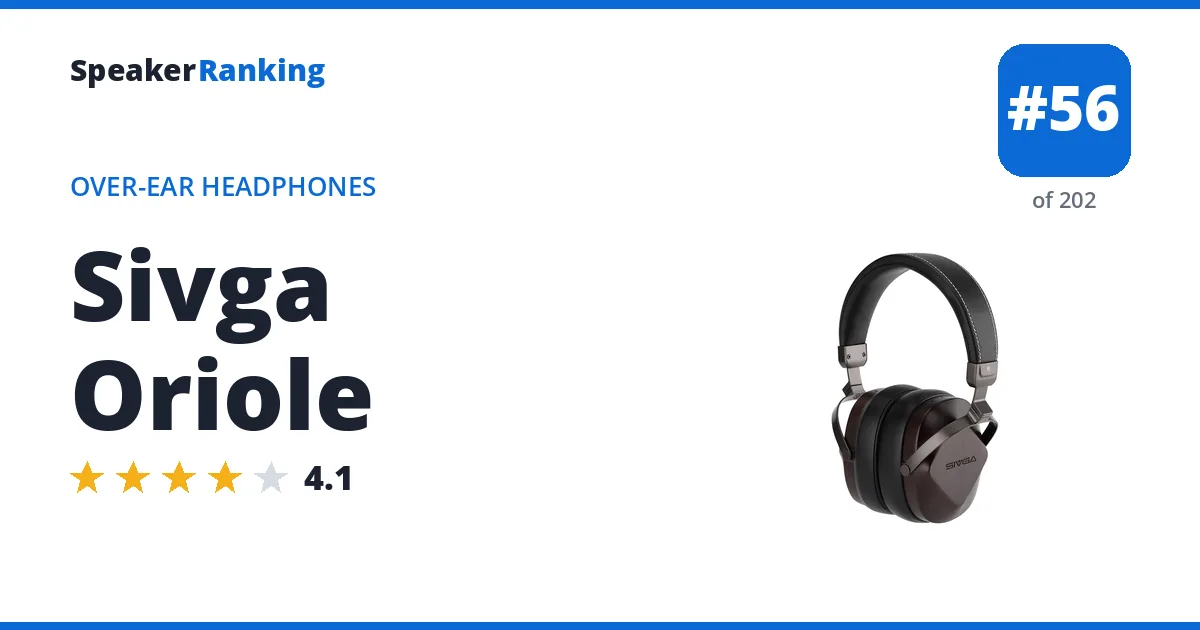
Pros: A preference score of 83 from a closed back design, with sub-bass extension right on target at 30 Hz, so it delivers deep, solid bass while blocking outside noise. Its 32 ohm impedance and 108 dB sensitivity mean a phone or laptop drives it to full volume without an amp. At 280 g it is light, and the bassy, warm balance suits listeners who like a fuller sound.
Cons: An 8.5 dB dip near 5.6 kHz pulls the presence band 3.8 dB below target, softening vocal clarity and the attack of guitars and snares. Low mids sit 2 dB under target, which can thin out the body of voices slightly. The AKG K371 shares the same rating at a much lower price.
Full Sivga Oriole review and specifications →
| Released | Oct 2022 (4 years ago) |
|---|---|
| Back | Closed |
| Built-in Microphone | No |
| Connection | Wired |
| Deviation From Target | 2.28 dB standard deviation |
| Driver Type | Dynamic |
| Drivers | 1 x 50mm dynamic |
| Form Factor | Over-ear |
| Frequency Response | 20Hz - 20kHz (Manufacturer specified) |
| Harman Preference Score | 83 (measured by oratory1990, via AutoEQ) |
| Impedance | 32 ohms |
| Sensitivity | 108 dB |
| Sub-bass Extension | Within 6 dB of target down to 20 Hz (+0.4 dB at 30 Hz) |
| Tonal Tilt | -0.20 (negative is warmer, positive brighter) |
| Weight | 0.6 lbs (280 g) |
EQ preset to match the Harman target
Set a preamp of -5.7 dB, then add these filters in any parametric equalizer (Wavelet, Equalizer APO, Peace, or a player with parametric EQ). Calculated by AutoEQ from its measured frequency response.
| Filter | Frequency | Gain | Q |
|---|---|---|---|
| Low shelf | 105 Hz | -1.1 dB | 0.70 |
| Peak | 1,128 Hz | -2.9 dB | 1.10 |
| Peak | 203 Hz | +8.6 dB | 1.90 |
| Peak | 5,371 Hz | +5.2 dB | 3.75 |
| Peak | 145 Hz | -3.3 dB | 0.66 |
| High shelf | 10,000 Hz | -8.7 dB | 0.70 |
| Peak | 9,481 Hz | +2.5 dB | 0.88 |
| Peak | 46 Hz | -1.1 dB | 2.44 |
| Peak | 3,926 Hz | -1.7 dB | 5.44 |
| Peak | 80 Hz | +0.9 dB | 2.91 |
- Reviews, Comparisons and Sound Samples
 Ranked #75 of 201 in Over-Ear Headphones - Sivga Luan: $299.00 Amazon eBay
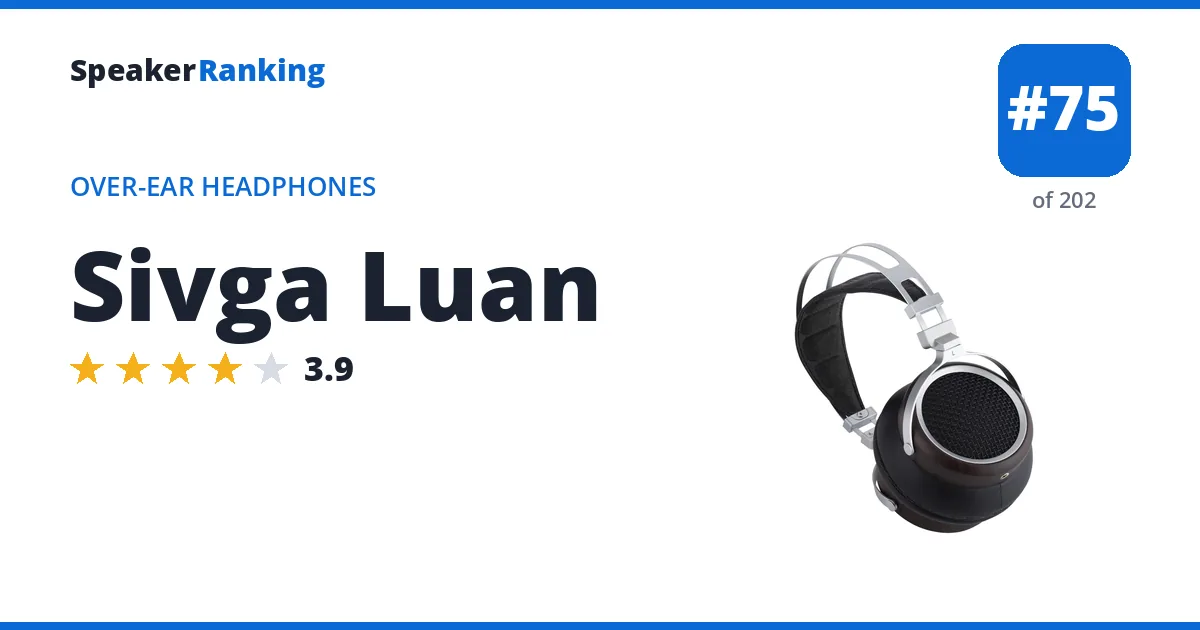
Pros: The open back tuning leans warm, with bass from 60 to 200 Hz about 3 dB above target and the lows and mids around 1.5 dB above, which gives music body and weight that suits rock, pop and hip hop. A deviation of 2.0 dB is among the smoothest in this group, and the preference score is 80. At 38 ohms and 100 dB sensitivity a phone or dongle can drive it, and it weighs 354 g.
Cons: A 5 dB peak near 2.8 kHz can make vocals and guitars sound forward or slightly shouty at higher volume, and a 5.8 dB dip near 9.3 kHz takes the edge off cymbals while the top octave runs 6 dB above target. Listeners who want a neutral balance will find the bass and low mids heavy. The open back leaks sound and has no isolation, and there is no built in microphone.
Full Sivga Luan review and specifications →
| Back | Open |
|---|---|
| Built-in Microphone | No |
| Connection | Wired |
| Deviation From Target | 2.04 dB standard deviation |
| Driver Type | Dynamic |
| Drivers | 1 x 50mm dynamic |
| Form Factor | Over-ear |
| Frequency Response | 20Hz - 40kHz (Manufacturer specified) |
| Harman Preference Score | 80 (measured by oratory1990, via AutoEQ) |
| Impedance | 38 ohms |
| Sensitivity | 100 dB |
| Sub-bass Extension | Within 6 dB of target down to 20 Hz (-3.6 dB at 30 Hz) |
| Tonal Tilt | -0.58 (negative is warmer, positive brighter) |
| Weight | 0.8 lbs (354 g) |
EQ preset to match the Harman target
Set a preamp of -7.0 dB, then add these filters in any parametric equalizer (Wavelet, Equalizer APO, Peace, or a player with parametric EQ). Calculated by AutoEQ from its measured frequency response.
| Filter | Frequency | Gain | Q |
|---|---|---|---|
| Low shelf | 105 Hz | +13.5 dB | 0.70 |
| Peak | 54 Hz | -11.3 dB | 0.36 |
| Peak | 1,033 Hz | +2.6 dB | 0.39 |
| Peak | 2,697 Hz | -5.0 dB | 2.19 |
| Peak | 7,643 Hz | +2.9 dB | 1.41 |
| High shelf | 10,000 Hz | -7.5 dB | 0.70 |
| Peak | 4,022 Hz | -2.2 dB | 6.00 |
| Peak | 5,210 Hz | +2.7 dB | 5.98 |
| Peak | 3,497 Hz | +1.7 dB | 6.00 |
| Peak | 4,281 Hz | -0.8 dB | 4.36 |
- Reviews, Comparisons and Sound Samples
 Ranked #105 of 201 in Over-Ear Headphones - Sivga Audio Phoenix: $309.00 HiFiGo eBay
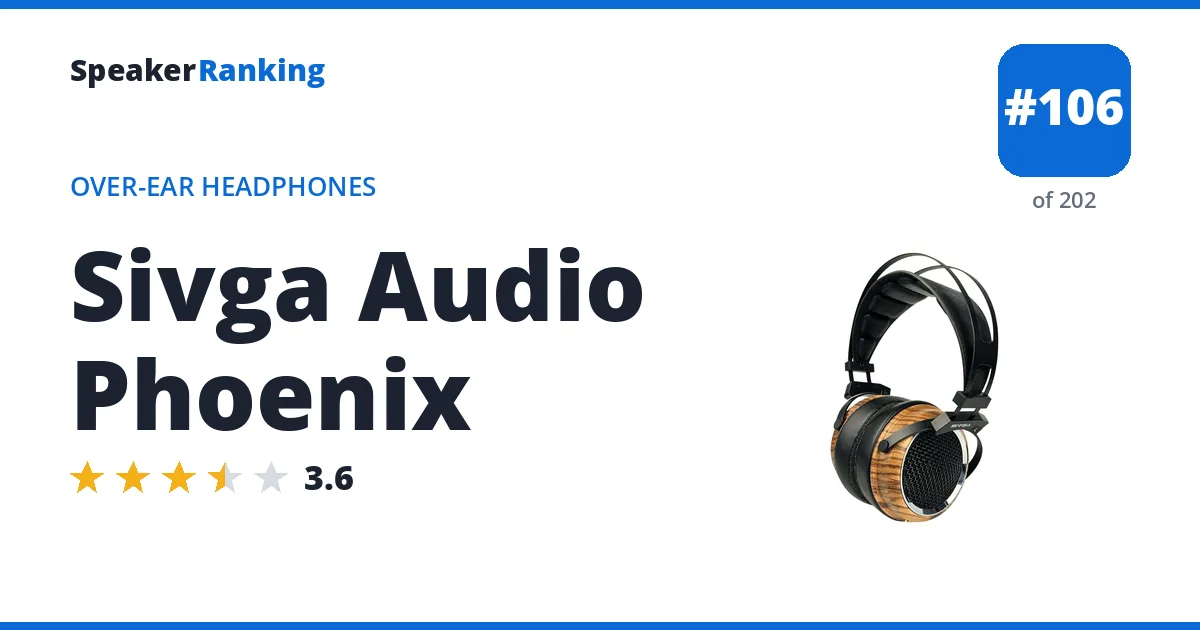
Pros: Oratory1990’s measurement gives it a preference score of 72 with a fairly even 2.3 dB standard deviation, and its warm tilt with bass about 2 dB above target suits warm and bassy tastes. Treble stays within about 1 dB of target from 3 to 10 kHz, so it never turns harsh. At 32 ohms and 103 dB sensitivity it runs well from a phone or laptop, and it weighs 296 g.
Cons: Low mids sit nearly 3 dB above target, which can thicken vocals and make dense mixes sound slightly muddy, and a 4.3 dB dip near 3 kHz recesses voices a touch. The open back leaks sound and blocks little outside noise. The Audio-Technica ATH-M60x is rated higher for less money.
Full Sivga Audio Phoenix review and specifications →
| Released | 2020 (6 years ago) |
|---|---|
| Back | Open |
| Built-in Microphone | No |
| Connection | Wired |
| Deviation From Target | 2.28 dB standard deviation |
| Driver Type | Dynamic |
| Drivers | 1 x 50mm dynamic |
| Form Factor | Over-ear |
| Frequency Response | 20Hz - 20kHz (Manufacturer specified) |
| Harman Preference Score | 72 (measured by oratory1990, via AutoEQ) |
| Impedance | 32 ohms |
| Sensitivity | 103 dB |
| Sub-bass Extension | Within 6 dB of target down to 20 Hz (-3.5 dB at 30 Hz) |
| Tonal Tilt | -0.86 (negative is warmer, positive brighter) |
| Weight | 0.7 lbs (296 g) |
EQ preset to match the Harman target
Set a preamp of -5.2 dB, then add these filters in any parametric equalizer (Wavelet, Equalizer APO, Peace, or a player with parametric EQ). Calculated by AutoEQ from its measured frequency response.
| Filter | Frequency | Gain | Q |
|---|---|---|---|
| Low shelf | 105 Hz | +4.9 dB | 0.70 |
| Peak | 143 Hz | -4.0 dB | 0.18 |
| Peak | 8,971 Hz | +2.1 dB | 1.28 |
| Peak | 1,214 Hz | +3.1 dB | 0.64 |
| Peak | 3,160 Hz | +4.4 dB | 4.21 |
| High shelf | 10,000 Hz | -0.3 dB | 0.70 |
| Peak | 4,592 Hz | -2.6 dB | 4.75 |
| Peak | 5,893 Hz | +2.2 dB | 5.71 |
| Peak | 49 Hz | -0.6 dB | 1.65 |
| Peak | 121 Hz | +0.5 dB | 1.62 |
- Reviews, Comparisons and Sound Samples
In-Ear Headphones
 Ranked #72 of 238 in In-Ear Headphones - Sivga SM100: $39.00 Amazon eBay
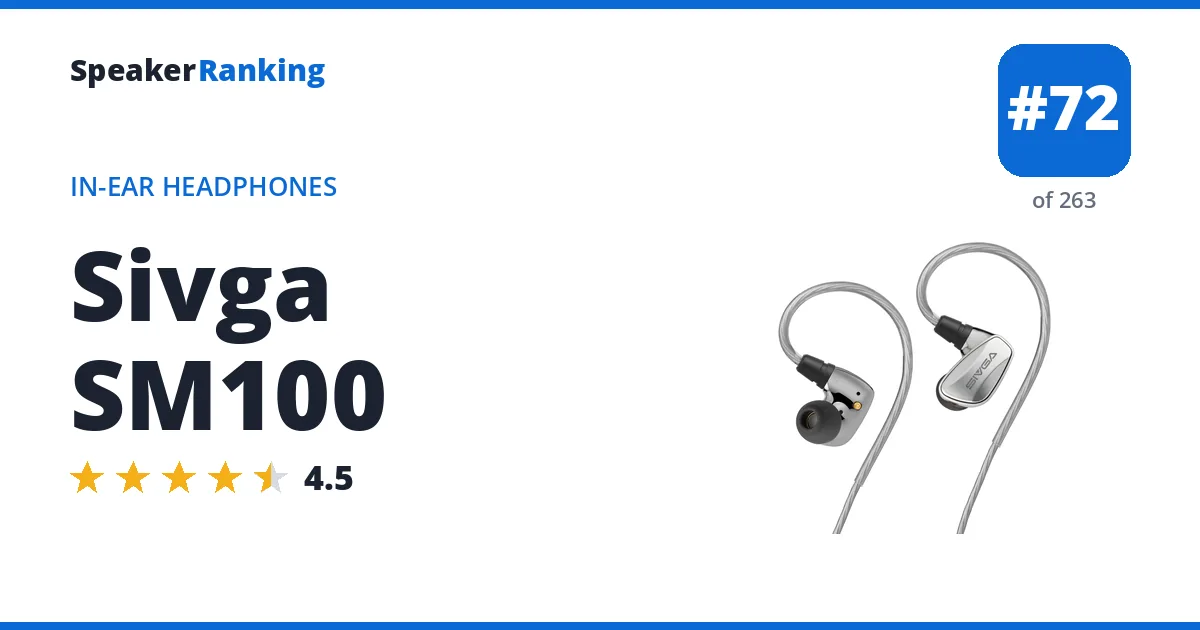
Pros: Twelve hobbyist measurements on squig.link put its preference score at 79.7, with a near neutral tilt and bass sitting within a fraction of a dB of target from 60 to 200 Hz. Upper mids run about 0.8 dB forward, so vocals come through clearly, and a modest air lift of 2.7 dB adds a little sheen. The built-in mic and 32 ohm load suit phone calls and everyday listening.
Cons: Presence between 3 and 6 kHz sits about 2.9 dB under target with a 4.2 dB dip near 3.8 kHz, which softens guitar bite and vocal articulation. Sub-bass slips about 1.8 dB below target, so the deepest bass notes are a touch lighter than the bass focused profile it fits best would suggest.
Full Sivga SM100 review and specifications →
| Back | Closed |
|---|---|
| Built-in Microphone | Yes |
| Connection | Wired |
| Deviation From Target | 1.58 dB standard deviation |
| Driver Type | Dynamic |
| Drivers | 1 x 10mm dynamic |
| Form Factor | In-ear |
| Frequency Response | 20Hz - 40kHz (Manufacturer specified) |
| Harman Preference Score | 80 (median of 12 squig.link measurements, calibrated to AutoEQ) |
| Impedance | 32 ohms |
| Sensitivity | 107 dB |
| Sub-bass Extension | Within 6 dB of target down to 20 Hz (-1.4 dB at 30 Hz) |
| Tonal Tilt | -0.04 (negative is warmer, positive brighter) |
- Reviews, Comparisons and Sound Samples