Coverage note. Speaker Ranking currently covers 2 Etymotic models across headphones. These are the products in our database, not a complete list of everything Etymotic makes.
What this page covers. The Etymotic models ranked here span headphones, including Etymotic EVO and Etymotic ER4XR. Use each model’s category position to compare it with alternatives of the same size and use case.
This page lists all 2 Etymotic speakers ranked on this site across headphones. Each model is shown in the category where it competes, with its current rank and the size of that ranking.
Use the category position rather than the brand name alone: speakers from the same manufacturer can perform very differently by size, price and product family.
Prices on this page were last checked October 10, 2026 at 5:37 PM UTC. Product prices and availability are accurate as of that date/time and are subject to change; the price and availability shown on Amazon at the time of purchase will apply to the purchase of this product.
As an eBay Partner, we may be compensated if you make a purchase.
In-Ear Headphones
 Ranked #10 of 68 in In-Ear Headphones - Etymotic EVO: $298.98 Amazon eBay
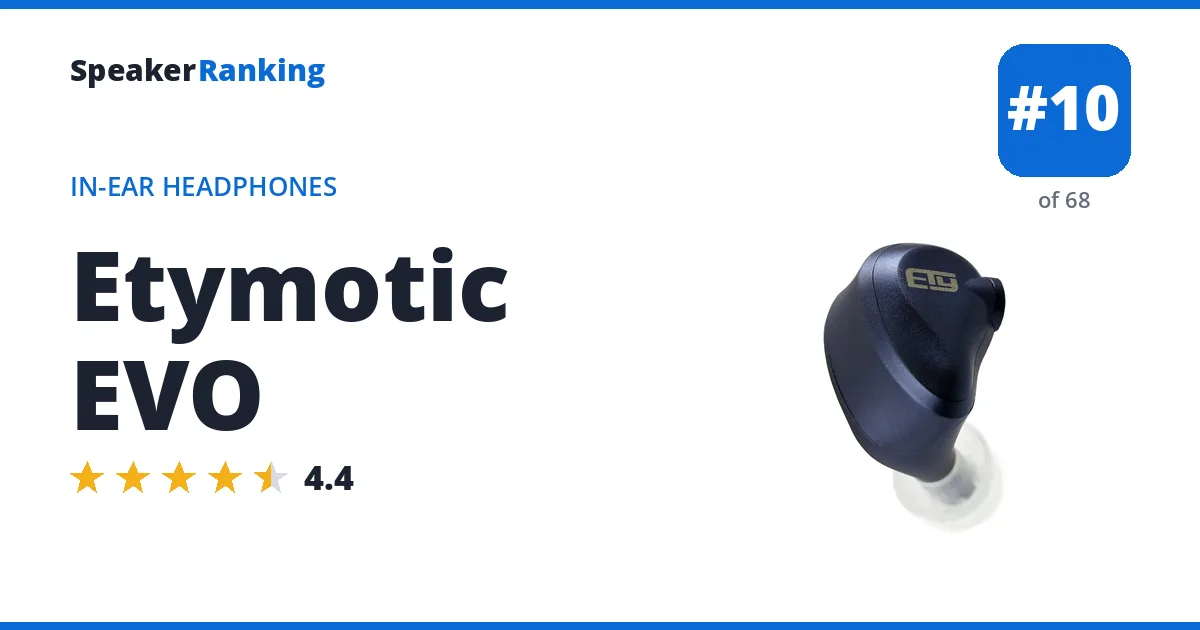
Pros: Three balanced armature drivers deliver a flat, uncolored midrange, with the 1 to 3 kHz region within 0.5 dB of the Harman target and a preference score of 78. Response is smooth, with a standard deviation of 1.89 dB around target. The deep-insertion wired design is passive noise isolating, and the 47 ohm impedance still works from a phone or dongle.
Cons: Bass is lean, with sub-bass about 3.3 dB under target and the 60 to 200 Hz region 1.5 dB under, so kick drums and bass lines have less weight than most listeners prefer. Treble from 6 to 10 kHz is about 3.5 dB low and the response drops 7.4 dB near 11.9 kHz, which makes cymbals and air sound dull. Sensitivity of 99 dB at 0.1V is modest, so volume needs more headroom than the most efficient earphones.
Full Etymotic EVO review and specifications →
| Released | Jun 2021 (5 years ago) |
|---|---|
| Back | Closed |
| Connection | Wired |
| Deviation From Target | 1.89 dB standard deviation |
| Driver Type | Balanced armature |
| Drivers | 3 x balanced armature |
| Form Factor | In-ear |
| Frequency Response | 20Hz - 16kHz (Manufacturer specified) |
| Harman Preference Score | 78 (measured by oratory1990, via AutoEQ) |
| Impedance | 47 ohms |
| Sensitivity | 99 dB SPL at 0.1V, 1kHz |
| Tonal Tilt | +0.08 (negative is warmer, positive brighter) |
EQ preset to match the Harman target
Set a preamp of -4.5 dB, then add these filters in any parametric equalizer (Wavelet, Equalizer APO, Peace, or a player with parametric EQ). Calculated by AutoEQ from its measured frequency response.
| Filter | Frequency | Gain | Q |
|---|---|---|---|
| Low shelf | 105 Hz | +0.7 dB | 0.70 |
| Peak | 1,788 Hz | -3.1 dB | 1.61 |
| Peak | 6,507 Hz | +4.6 dB | 1.49 |
| Peak | 197 Hz | -1.4 dB | 1.38 |
| Peak | 64 Hz | +1.9 dB | 0.98 |
| High shelf | 10,000 Hz | +4.1 dB | 0.70 |
| Peak | 819 Hz | +1.2 dB | 1.66 |
| Peak | 1,255 Hz | -0.9 dB | 3.19 |
| Peak | 4,378 Hz | -0.7 dB | 4.42 |
| Peak | 7,270 Hz | -1.7 dB | 5.95 |
- Reviews, Comparisons and Sound Samples
- Head-to-Head Comparisons
 Ranked #54 of 68 in In-Ear Headphones - Etymotic ER4XR: $299.00 Amazon eBay
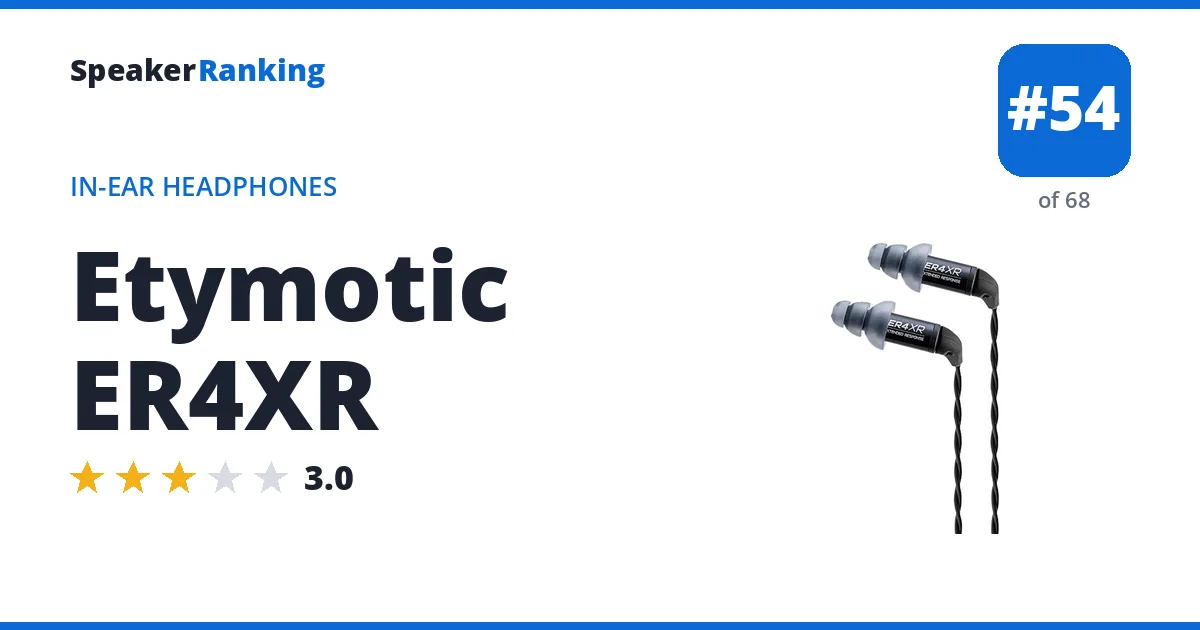
Pros: Upper mids sit within 0.5 dB of the Harman target and low mids within 0.4 dB, so vocals and instruments come through clearly and naturally. Oratory1990’s measurement gives a preference score of 62, and the single balanced armature driver suits listeners who want a neutral, analytical presentation without added bass.
Cons: Sub-bass is about 7.2 dB under target and bass is 2.6 dB low, so kick drums and bass lines lack weight and rumble. Treble from 6 to 10 kHz is 5.4 dB low, with an 8.6 dB dip near 6.7 kHz, which dulls cymbals. A 45 ohm impedance makes it a bit harder to drive than most phone-friendly earphones, and the FiiO FH7S has a higher rating.
Full Etymotic ER4XR review and specifications →
| Back | Closed |
|---|---|
| Connection | Wired |
| Deviation From Target | 3.06 dB standard deviation |
| Driver Type | Balanced armature |
| Drivers | 1 x balanced armature |
| Form Factor | In-ear |
| Frequency Response | 20Hz - 16kHz (Manufacturer specified) |
| Harman Preference Score | 62 (measured by oratory1990, via AutoEQ) |
| Impedance | 45 ohms |
| Tonal Tilt | +0.61 (negative is warmer, positive brighter) |
EQ preset to match the Harman target
Set a preamp of -6.0 dB, then add these filters in any parametric equalizer (Wavelet, Equalizer APO, Peace, or a player with parametric EQ). Calculated by AutoEQ from its measured frequency response.
| Filter | Frequency | Gain | Q |
|---|---|---|---|
| Low shelf | 105 Hz | +5.4 dB | 0.70 |
| Peak | 6,978 Hz | +6.4 dB | 1.06 |
| Peak | 1,623 Hz | -3.6 dB | 0.52 |
| Peak | 164 Hz | -1.4 dB | 0.59 |
| Peak | 806 Hz | +2.6 dB | 1.14 |
| High shelf | 10,000 Hz | +1.3 dB | 0.70 |
| Peak | 7,344 Hz | -1.2 dB | 6.00 |
| Peak | 6,183 Hz | +1.0 dB | 5.99 |
| Peak | 4,894 Hz | -0.6 dB | 4.37 |
| Peak | 1,333 Hz | -0.2 dB | 4.02 |
- Reviews, Comparisons and Sound Samples
- Head-to-Head Comparisons