Short answer: the Arendal 1961 Monitor. It ranks #8 of 168 bookshelf speakers by sound quality (rated 4.3/5) at $1,150 and is still sold new; the Pioneer SP-BS22-LR (Philharmonic AAM Mod) ranks #113 (rated 2.8/5) and is discontinued, so it is only an option used.
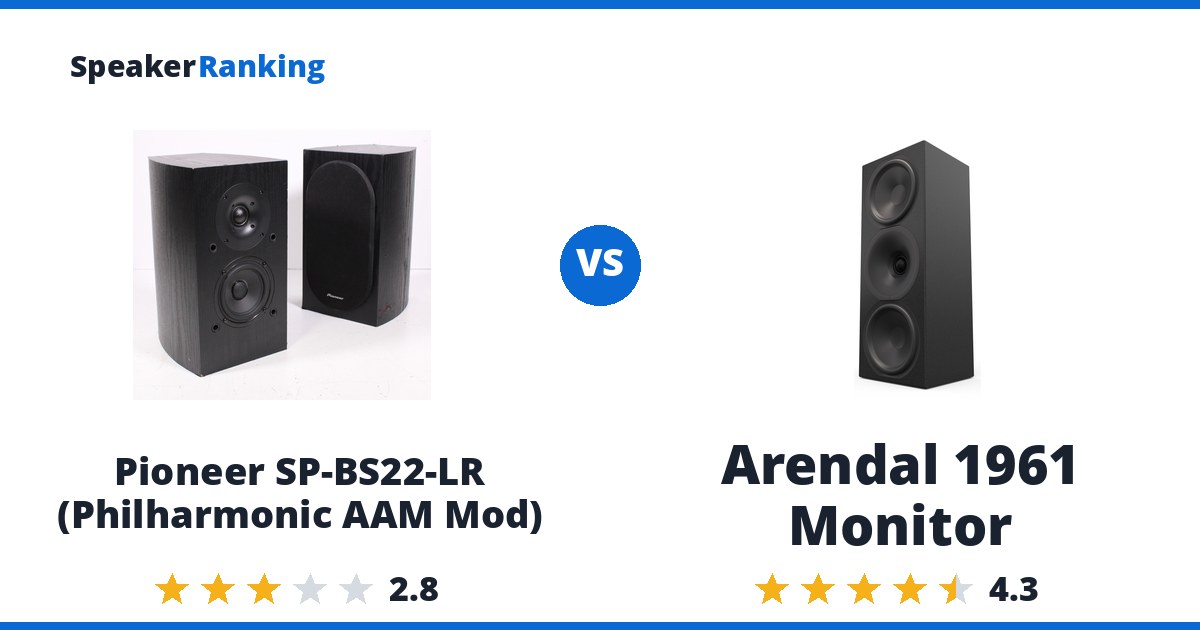
The Pioneer SP-BS22-LR (Philharmonic AAM Mod) is the more accurate option. This is Dennis Murphy’s “Affordable Accuracy Monitor” (AAM) mod of the discontinued, budget Pioneer SP-BS22-LR: the stock tweeter is swapped for a Peerless BC25TG15 dome and a redesigned 3rd-order crossover is built to match it to the stock 4” woofer. Its measured preference score, a predictor of how neutral it sounds, is 5.07 against 3.38 for the Arendal 1961 Monitor. The catch: Some directivity error appears near the crossover frequency.
The Arendal 1961 Monitor is the better-sounding option. A physically robust build the reviewer calls “a little bit of a tank,” delivering low compression, low distortion, and overall really good neutrality: one of the reviewer’s top 10 picks under $1,500 across roughly 250 speakers tested. The tradeoff: Bass rolls off around 70-80Hz, so it cannot be used as full-range mains for music without a subwoofer, and a sub is recommended for home theater use as well.
Buy the Arendal 1961 Monitor. It is rated higher for sound quality, and the Pioneer SP-BS22-LR (Philharmonic AAM Mod) is discontinued, so it is only available used.
Still deciding? The full Passive Home rankings cover every ranked option.
Specifications Side By Side
| Pioneer SP-BS22-LR (Philharmonic AAM Mod) | Arendal 1961 Monitor | |
|---|---|---|
| Price | $168 per pair Discontinued | $1150 per pair |
| Ranked | #113 of 168 in Medium Size Bookshelf Speakers | #8 of 168 in Medium Size Bookshelf Speakers |
| Bass Extension (-3dB) | 78Hz (measured, Audio Science Review) | 84Hz (measured, Erin’s Audio Corner) |
| Bass Extension (-10dB) | 60Hz (measured, Audio Science Review) | 60Hz (measured, Erin’s Audio Corner) |
| Drivers | 1x 4” curvilinear-cone woofer (stock Pioneer), 1x Peerless BC25TG15 1” silk dome tweeter (replacement) | 2 x 5.5” woofers, 28mm tweeter |
| Weight | 9 lbs (4.1 kg) | 16 lbs (7.25 kg) each |
| Sensitivity | 83dB (2.83V/1m, measured by Audio Science Review) | 85.9dB (measured average, Erin’s Audio Corner) |
| Impedance | 8 ohms nominal (approx. 5 ohms minimum, measured by Audio Science Review) | 4 ohms nominal (4.1 ohms minimum above 80Hz, measured by Erin’s Audio Corner) |
| Crossover Frequency | 3000Hz | 1500Hz |
| Dimensions | 12.6”H x 7.1”W x 8.5”D (320.0 x 180.0 x 215.0 mm) | 16.6”H x 6.4”W x 5.9”D (421.6 x 162.6 x 149.9 mm) |
| Woofer Cabinet | ported, rear | sealed |
| Spinorama Preference Score | 5.07 | 3.38 |
| Spinorama Preference Score with Perfect Sub | 7.82 | 6.69 |
| DIY Kit | Yes | No |
Related Speaker Comparisons
How Arendal 1961 Monitor compares with other leading options:
- Audio First Fidelia vs Arendal 1961 Monitor
- Arendal 1961 Monitor vs Philharmonic Ceramic Mini
- Arendal 1961 Monitor vs Ascend Acoustics Sierra 1 v2
- Arendal 1961 Monitor vs KEF LS50 Meta
- XMechanik Mechano23 DIY vs Arendal 1961 Monitor
Prices on this page were last checked October 9, 2026 at 8:01 AM UTC. Product prices and availability are accurate as of that date/time and are subject to change; the price and availability shown on Amazon at the time of purchase will apply to the purchase of this product.
As an eBay Partner, we may be compensated if you make a purchase.
The Two Speakers In Full
 Pioneer SP-BS22-LR (Philharmonic AAM Mod): $168 per pair Discontinued eBay
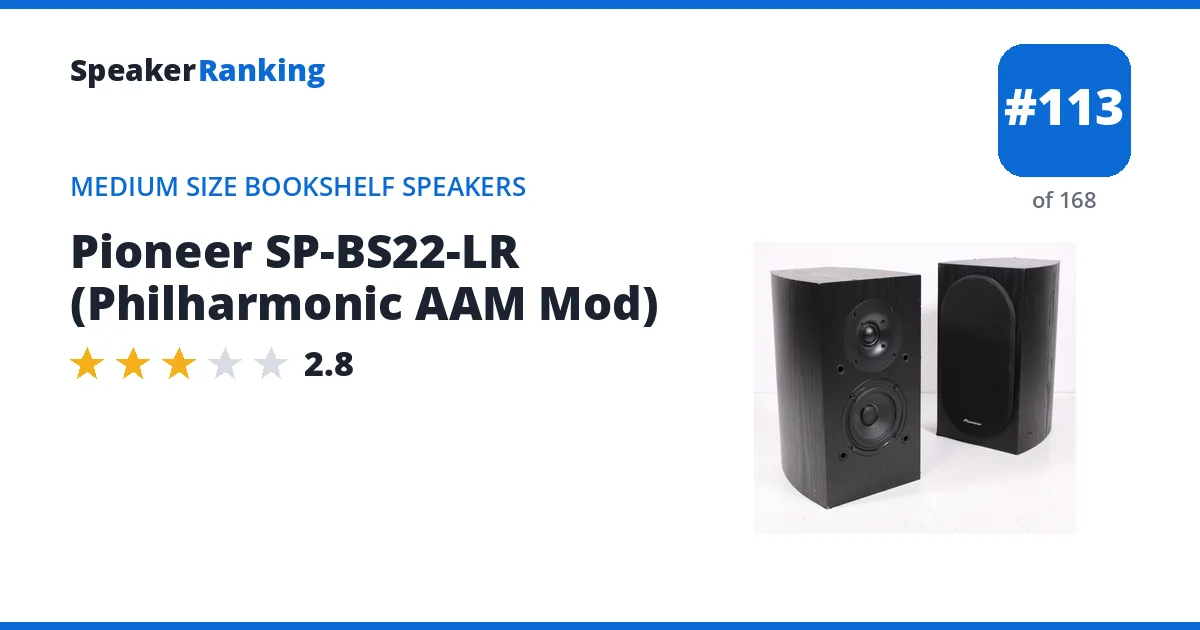
Pros: This is Dennis Murphy’s “Affordable Accuracy Monitor” (AAM) mod of the discontinued, budget Pioneer SP-BS22-LR: the stock tweeter is swapped for a Peerless BC25TG15 dome and a redesigned 3rd-order crossover is built to match it to the stock 4” woofer. CEA2034 spinorama shows only small variations from a flat on-axis response with some directivity error near the crossover, a marked improvement over the unmodified Pioneer, which the reviewer notes shows much more variation from flat. Distortion at 86dB SPL/1m is reasonably controlled above 200Hz, and tweeter distortion barely rises even at 96dB SPL/1m. Measured bass extension of 78Hz (-3dB), with a measured sensitivity of 83dB.
Cons: Some directivity error appears near the crossover frequency. Distortion climbs in the woofer’s range (below 200Hz) at both 86dB and 96dB SPL/1m. Minimum impedance dips to about 5 ohms with a couple of resonance peaks. This is a DIY project, not a finished retail product: Murphy sold ~$168 pre-built pairs for a while but no longer does, so it now requires sourcing a used/discontinued Pioneer SP-BS22-LR pair plus building the crossover and swapping the tweeter yourself. The mod itself is public domain, but there is no current turnkey way to buy this speaker.
Full Pioneer SP-BS22-LR (Philharmonic AAM Mod) review and specifications →
| Bass Extension (-10dB) | 60Hz (measured, Audio Science Review) |
|---|---|
| Bass Extension (-3dB) | 78Hz (measured, Audio Science Review) |
| Crossover Frequency | 3000Hz |
| DIY Kit | Yes |
| Dimensions | 12.6”H x 7.1”W x 8.5”D (320.0 x 180.0 x 215.0 mm) |
| Drivers | 1x 4” curvilinear-cone woofer (stock Pioneer), 1x Peerless BC25TG15 1” silk dome tweeter (replacement) |
| Impedance | 8 ohms nominal (approx. 5 ohms minimum, measured by Audio Science Review) |
| Sensitivity | 83dB (2.83V/1m, measured by Audio Science Review) |
| Spinorama Preference Score | 5.07 |
| Spinorama Preference Score with Perfect Sub | 7.82 |
| Weight | 9 lbs (4.1 kg) |
| Woofer Cabinet | ported, rear |
- Links
- Reviews, Comparisons and Sound Samples
- Head-to-Head Comparisons
- Pioneer SP-BS22-LR (Philharmonic AAM Mod) vs Dynaudio X14
- Pioneer SP-BS22-LR (Philharmonic AAM Mod) vs MartinLogan Motion 4i
- Pioneer SP-BS22-LR (Philharmonic AAM Mod) vs ELAC BS U5
- Pioneer SP-BS22-LR (Philharmonic AAM Mod) vs JBL L52 Classic
- Pioneer SP-BS22-LR (Philharmonic AAM Mod) vs Dynaudio Emit M10
- Pioneer SP-BS22-LR (Philharmonic AAM Mod) vs Parts Express Copperhead Desktop Kit
- Pioneer SP-BS22-LR (Philharmonic AAM Mod) vs JBL Stage A120
- Pioneer SP-BS22-LR (Philharmonic AAM Mod) vs ELAC Uni-Fi 2.0 UB52
- See all 36 comparisons
 Arendal 1961 Monitor: $1150 per pair Arendal Sound eBay
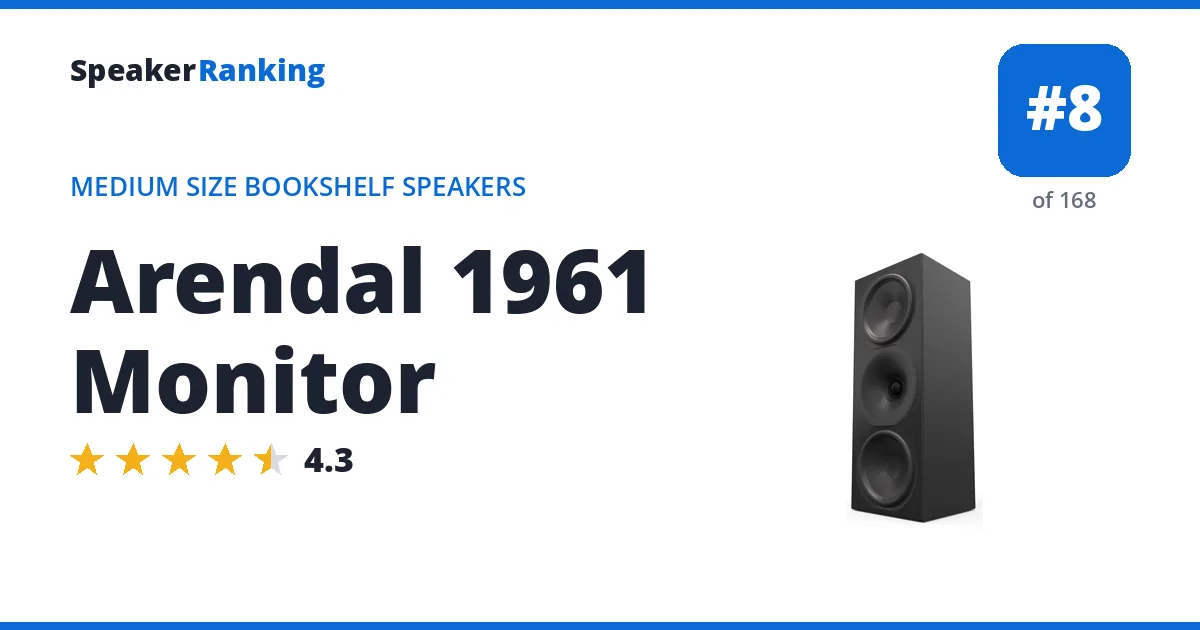
Same family: the Arendal Sound 1961 Bookshelf (smaller bookshelf, ranked lower, rated 4.2/5), the Arendal 1961 Tower (floorstanding, rated 4.4/5) and the Arendal Sound 1961 Center (center, rated 3.6/5).
Pros: A physically robust build the reviewer calls “a little bit of a tank,” delivering low compression, low distortion, and overall really good neutrality: one of the reviewer’s top 10 picks under $1,500 across roughly 250 speakers tested. Works well both as home theater mains and as surrounds. Independent ASR Klippel measurements corroborate the low-distortion finding: THD at 86dB SPL/1m stays well below the reviewer’s audibility threshold, and even at 96dB SPL/1m it stays “far better than most bookshelves” thanks to the built-in high-pass filter that protects the woofers. Measured bass extension of 84Hz (-3dB), with a measured sensitivity of 85.9dB.
Cons: Bass rolls off around 70-80Hz, so it cannot be used as full-range mains for music without a subwoofer, and a sub is recommended for home theater use as well. Vertical radiation window is narrow, typical of MTM (mid-tweeter-mid) layouts (tighter than a standard two-way’s roughly ±20°) so a second home theater row sitting above or below the tweeter axis will hear a noticeably different tonal balance. ASR’s CEA2034 measurements show the response is elevated above 2kHz with resonant peaks around 3kHz and 9kHz, leading the reviewer to predict it will “likely sound bright.” Those same resonances show up as lingering ridges in the cumulative spectral decay (waterfall) at 96dB SPL/1m.
Full Arendal 1961 Monitor review and specifications →
| Released | Jul 2020 (6 years ago) |
|---|---|
| Bass Extension (-10dB) | 60Hz (measured, Erin’s Audio Corner) |
| Bass Extension (-3dB) | 84Hz (measured, Erin’s Audio Corner) |
| Crossover Frequency | 1500Hz |
| DIY Kit | No |
| Dimensions | 16.6”H x 6.4”W x 5.9”D (421.6 x 162.6 x 149.9 mm) |
| Drivers | 2 x 5.5” woofers, 28mm tweeter |
| Impedance | 4 ohms nominal (4.1 ohms minimum above 80Hz, measured by Erin’s Audio Corner) |
| Sensitivity | 85.9dB (measured average, Erin’s Audio Corner) |
| Spinorama Preference Score | 3.38 |
| Spinorama Preference Score with Perfect Sub | 6.69 |
| Weight | 16 lbs (7.25 kg) each |
| Woofer Cabinet | sealed |
- Links
- Reviews, Comparisons and Sound Samples
- Head-to-Head Comparisons
- Arendal 1961 Monitor vs SunAudio Purified 4
- Arendal 1961 Monitor vs Ascend Acoustics HTM-200SE2
- Arendal 1961 Monitor vs XMechanik Mechano23 DIY
- Arendal 1961 Monitor vs Ascend Acoustics Luna V2 Mini-Monitor Titan
- Arendal 1961 Monitor vs Aalto Speakers Aalto 1 EVO
- Arendal 1961 Monitor vs KEF LS50 Meta
- Arendal 1961 Monitor vs Ascend Acoustics Sierra 1 v2
- Arendal 1961 Monitor vs Moondrop M4P MTM
- See all 55 comparisons