Short answer: the Arendal 1961 Monitor. Our notes call it one of the reviewer’s top 10 picks across roughly 250 speakers tested, with a robust build, low compression, low distortion and really good neutrality, and it costs $1,150 against $3,650 for the Purified 4. Neither is full-range: the Arendal rolls off around 70-80Hz, while the Purified 4’s 4-inch woofer is down about 3dB near 71Hz and 10dB near 53Hz, so both want a subwoofer.
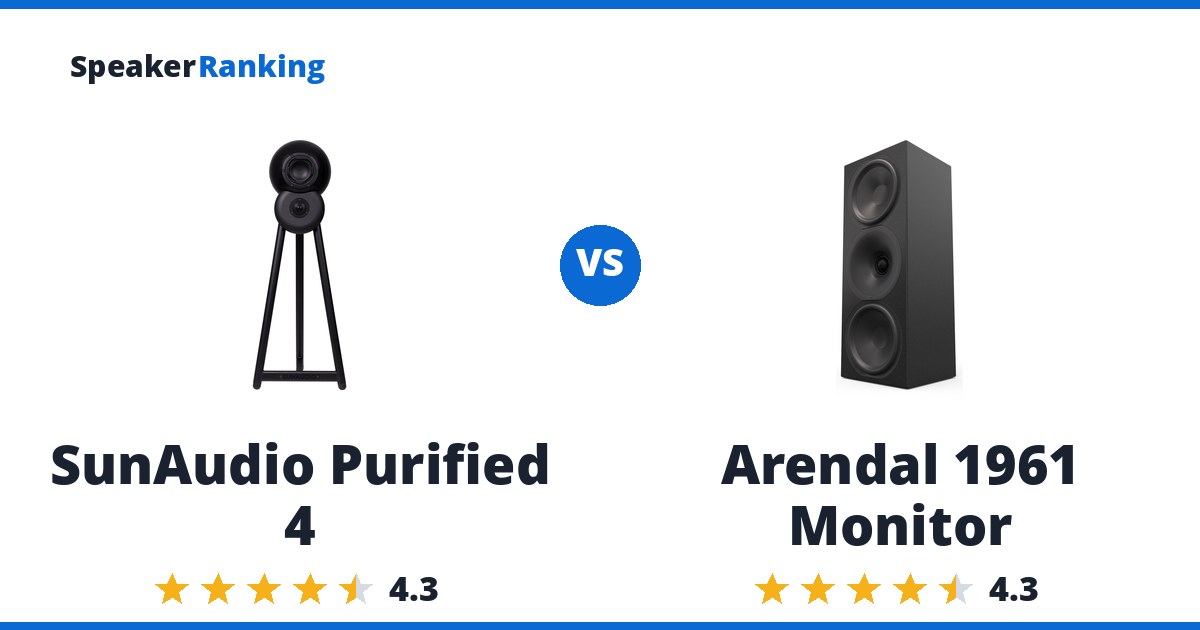
Buy the Arendal 1961 Monitor. Both are rated the same for sound quality, and it costs $2,500 less than the SunAudio Purified 4.
Want more options? Browse the full Passive Home rankings.
Specifications Side By Side
| SunAudio Purified 4 | Arendal 1961 Monitor | |
|---|---|---|
| Price | $3,650 per pair as tested; modular kit, pricing varies by driver/finish configuration | $1150 per pair |
| Ranked | #9 of 101 in Medium Size Bookshelf Speakers | #8 of 101 in Medium Size Bookshelf Speakers |
| Bass Extension (-3dB) | 71Hz (measured, manufacturer spinorama data) | 84Hz (measured, Erin’s Audio Corner) |
| Bass Extension (-10dB) | 53Hz (measured, manufacturer spinorama data) | 60Hz (measured, Erin’s Audio Corner) |
| Sensitivity | 84.4dB (2.83V/1m, measured, manufacturer spinorama data) | 85.9dB (measured average, Erin’s Audio Corner) |
| Drivers | BlieSMa T25A beryllium-dome tweeter (own CNC aluminum enclosure), Purifi 4” Ultra Low Distortion Extended woofer (PP-coated paper/fiber cone) | 2 x 5.5” woofers, 28mm tweeter |
| Impedance | 4 ohms | 4 ohms nominal (4.1 ohms minimum above 80Hz, measured by Erin’s Audio Corner) |
| Power Handling | 200W long-term max (woofer) | - |
| Woofer Cabinet | sealed, separate spherical driver modules on tripod stand | sealed |
| Spinorama Preference Score | 6.73 (manufacturer spinorama data) | 3.38 |
| Spinorama Preference Score with Perfect Sub | 9.44 (manufacturer spinorama data) | 6.69 |
| Dimensions | 34.6” x 12.2” x 11” (880 x 310 x 280 mm) | 16.6”H x 6.4”W x 5.9”D (421.6 x 162.6 x 149.9 mm) |
| DIY Kit | No | No |
| Crossover Frequency | - | 1500Hz |
| Weight | - | 16 lbs (7.25 kg) each |
Related Speaker Comparisons
More worthwhile head-to-heads for Arendal 1961 Monitor:
- Audio First Fidelia vs Arendal 1961 Monitor
- Arendal 1961 Monitor vs Philharmonic Ceramic Mini
- Arendal 1961 Monitor vs Ascend Sierra 1 v2
- Arendal 1961 Monitor vs KEF LS50 Meta
- XMechanik Mechano23 DIY vs Arendal 1961 Monitor
Prices on this page were last checked October 4, 2026 at 9:58 PM UTC. Product prices and availability are accurate as of that date/time and are subject to change; the price and availability shown on Amazon at the time of purchase will apply to the purchase of this product.
As an eBay Partner, we may be compensated if you make a purchase.
The Two Speakers In Full
 SunAudio Purified 4: $3,650 per pair as tested; modular kit, pricing varies by driver/finish configuration SunAudio eBay
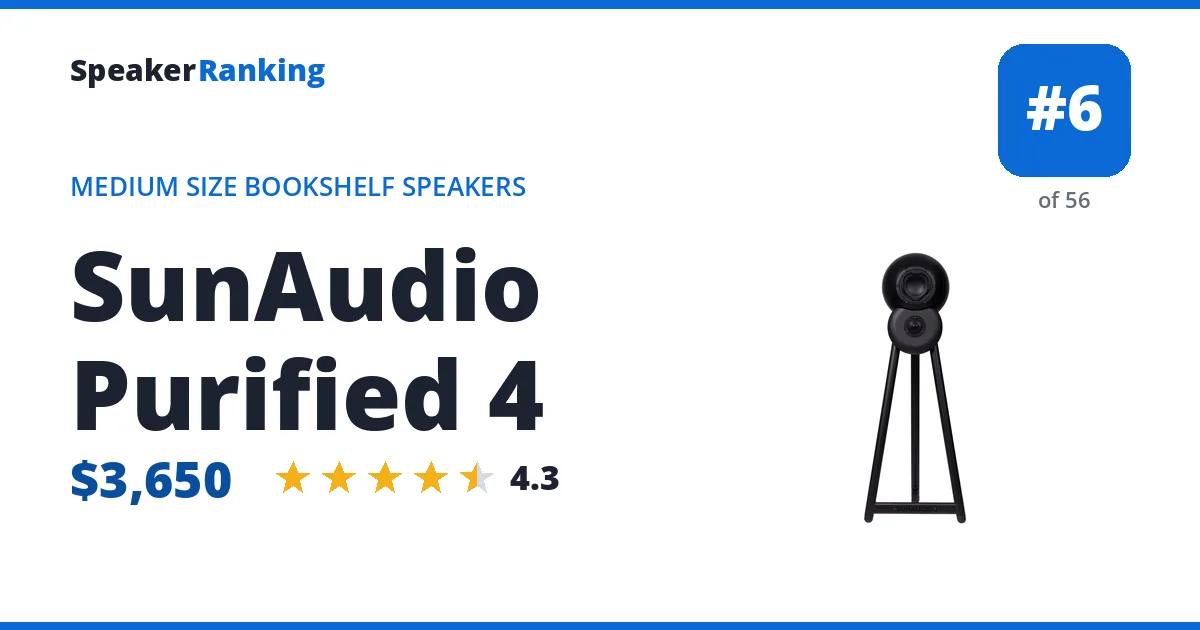
Pros: On-axis response is essentially dead flat from 100Hz to 20kHz, staying within about ±1dB through most of the band and widening only to a gentle +1.5dB rise in the top octave. The listening window curve tracks on-axis almost exactly, meaning off-axis output stays consistent rather than diverging. Both directivity index curves rise smoothly and monotonically from the bass straight through to 20kHz with no bumps, dips, or discontinuities: a sign of very well-integrated driver-to-driver handoff from the beryllium-dome tweeter. Early reflections and sound power both decline smoothly with frequency, with no resonant peaks anywhere in the response. The manufacturer’s own preference-score modeling comes out to 6.65 unequalized (rising to 9.36 with an ideal subwoofer) with a frequency deviation of just 0.8dB across 300Hz-5kHz: genuinely flagship-tier numbers for a 4-inch woofer design. Distinctive modular build: separate CNC-machined aluminum enclosures for the Purifi 4” woofer and BlieSMa T25A beryllium-dome tweeter, mounted on their own tripod stand, with cone-material and finish options. Measured sensitivity of 84.4dB.
Cons: A 4-inch woofer means real bass extension is limited (-3dB around 71Hz and -10dB around 53Hz) so a subwoofer is needed for anything below the low-100s. Measured sensitivity of 84.4dB is on the low side, meaning it needs more amplifier power than more efficient designs to reach the same volume. This is manufacturer self-measured data with no independent third-party review, so there’s no outside verification of distortion, unit-to-unit consistency, or how the reference crossover performs outside SunAudio’s own lab. The modular two-sphere design and tripod stand is unconventional, and pricing is steep for such a small woofer given the niche, boutique nature of the brand.
Full SunAudio Purified 4 review and specifications →
| Bass Extension (-10dB) | 53Hz (measured, manufacturer spinorama data) |
|---|---|
| Bass Extension (-3dB) | 71Hz (measured, manufacturer spinorama data) |
| DIY Kit | No |
| Dimensions | 34.6” x 12.2” x 11” (880 x 310 x 280 mm) |
| Drivers | BlieSMa T25A beryllium-dome tweeter (own CNC aluminum enclosure), Purifi 4” Ultra Low Distortion Extended woofer (PP-coated paper/fiber cone) |
| Impedance | 4 ohms |
| Power Handling | 200W long-term max (woofer) |
| Sensitivity | 84.4dB (2.83V/1m, measured, manufacturer spinorama data) |
| Spinorama Preference Score | 6.73 (manufacturer spinorama data) |
| Spinorama Preference Score with Perfect Sub | 9.44 (manufacturer spinorama data) |
| Woofer Cabinet | sealed, separate spherical driver modules on tripod stand |
- Links
- Reviews, Comparisons and Sound Samples
- Head-to-Head Comparisons
 Arendal 1961 Monitor: $1150 per pair Arendal Sound eBay
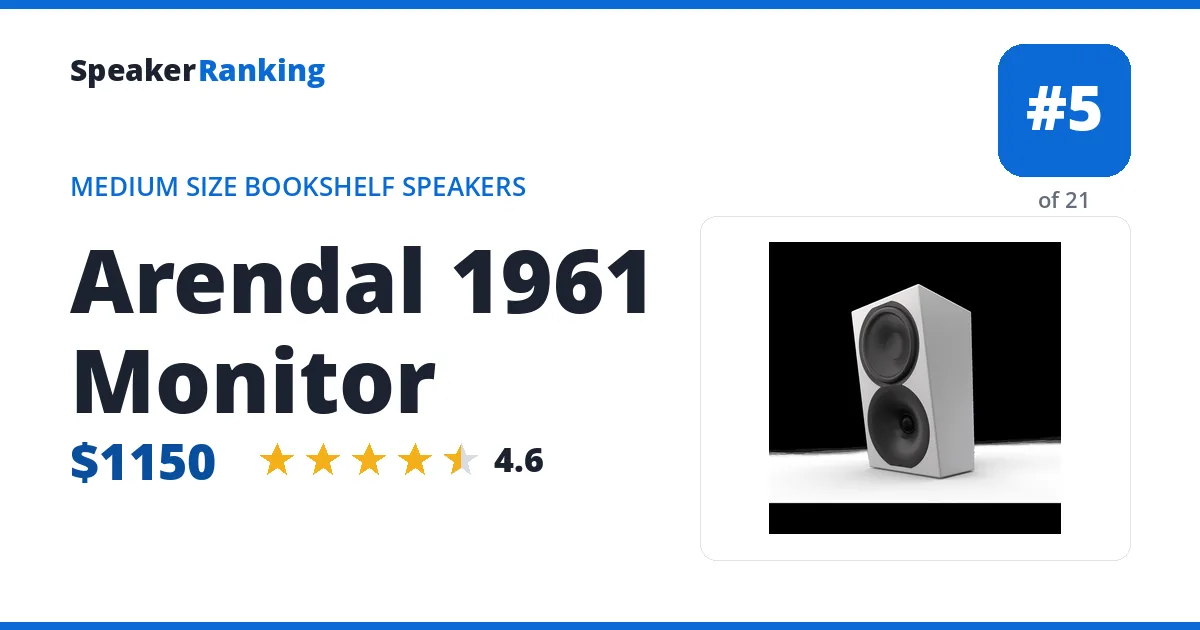
Larger model: the Arendal 1961 Tower (rated 4.4/5).
Pros: A physically robust build the reviewer calls “a little bit of a tank,” delivering low compression, low distortion, and overall really good neutrality: one of the reviewer’s top 10 picks under $1,500 across roughly 250 speakers tested. Works well both as home theater mains and as surrounds. Independent ASR Klippel measurements corroborate the low-distortion finding: THD at 86dB SPL/1m stays well below the reviewer’s audibility threshold, and even at 96dB SPL/1m it stays “far better than most bookshelves” thanks to the built-in high-pass filter that protects the woofers. Measured bass extension of 84Hz (-3dB), with a measured sensitivity of 85.9dB.
Cons: Bass rolls off around 70-80Hz, so it cannot be used as full-range mains for music without a subwoofer, and a sub is recommended for home theater use as well. Vertical radiation window is narrow, typical of MTM (mid-tweeter-mid) layouts (tighter than a standard two-way’s roughly ±20°) so a second home theater row sitting above or below the tweeter axis will hear a noticeably different tonal balance. ASR’s CEA2034 measurements show the response is elevated above 2kHz with resonant peaks around 3kHz and 9kHz, leading the reviewer to predict it will “likely sound bright.” Those same resonances show up as lingering ridges in the cumulative spectral decay (waterfall) at 96dB SPL/1m.
Full Arendal 1961 Monitor review and specifications →
| Bass Extension (-10dB) | 60Hz (measured, Erin’s Audio Corner) |
|---|---|
| Bass Extension (-3dB) | 84Hz (measured, Erin’s Audio Corner) |
| Crossover Frequency | 1500Hz |
| DIY Kit | No |
| Dimensions | 16.6”H x 6.4”W x 5.9”D (421.6 x 162.6 x 149.9 mm) |
| Drivers | 2 x 5.5” woofers, 28mm tweeter |
| Impedance | 4 ohms nominal (4.1 ohms minimum above 80Hz, measured by Erin’s Audio Corner) |
| Sensitivity | 85.9dB (measured average, Erin’s Audio Corner) |
| Spinorama Preference Score | 3.38 |
| Spinorama Preference Score with Perfect Sub | 6.69 |
| Weight | 16 lbs (7.25 kg) each |
| Woofer Cabinet | sealed |
- Links
- Reviews, Comparisons and Sound Samples
- Head-to-Head Comparisons
- Arendal 1961 Monitor vs Ascend Acoustics HTM-200SE2
- Arendal 1961 Monitor vs XMechanik Mechano23 DIY
- Arendal 1961 Monitor vs Ascend Acoustics Luna V2 Mini-Monitor Titan
- Arendal 1961 Monitor vs Aalto Speakers Aalto 1 EVO
- Arendal 1961 Monitor vs Moondrop M4P MTM
- Arendal 1961 Monitor vs KEF LS50 Meta
- Arendal 1961 Monitor vs Ascend Sierra 1 v2
- Arendal 1961 Monitor vs Revel M105
- See all 55 comparisons