Short answer: both are discontinued, so this only matters if you are buying used. Used, the Revel F206 is the better pick: it ranks #29 of 188 floorstanding speakers by sound quality (rated 4.5/5), against #177 (rated 2.8/5) for the Sony SS-CS3. If you want one new, the Revel F226Be replaces the Revel F206 and is rated 4.6/5 at $8,469.90.
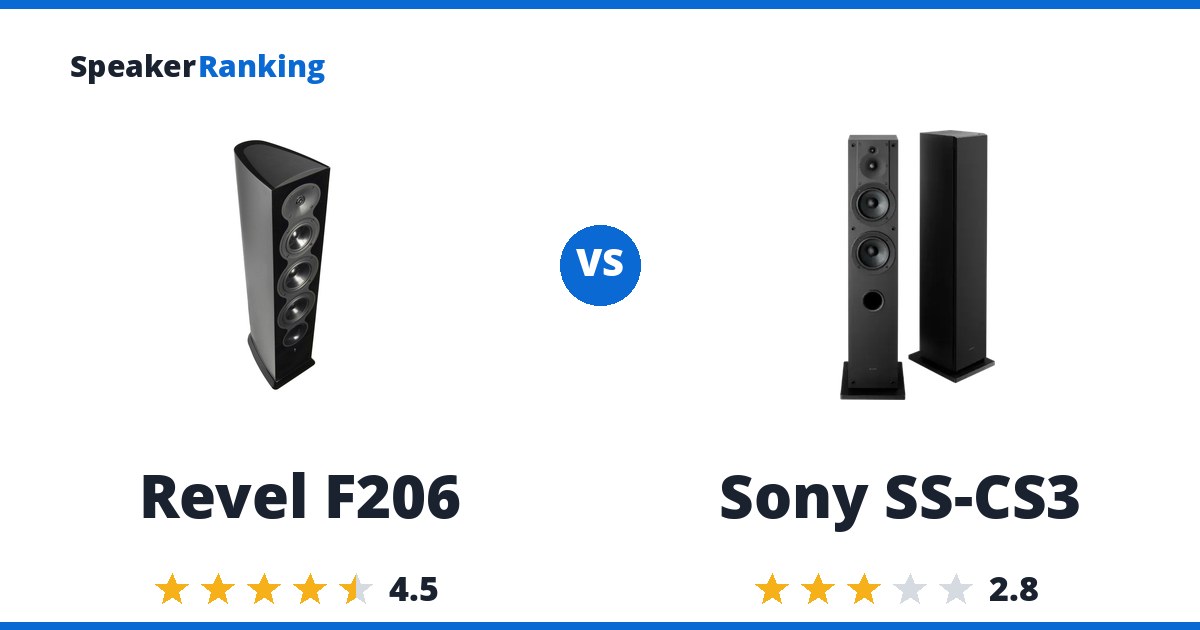
The Revel F206 is the more accurate, deeper-bass choice. CEA2034 spinorama shows a pretty even on-axis response. Its measured preference score, a predictor of how neutral it sounds, is 5.51 against 4.11 for the Sony SS-CS3. Its bass reaches about 60Hz before falling 3dB, against 72Hz for the Sony SS-CS3. Watch for: Some directivity error and a small peak around 4.5kHz show up alongside the directivity error around 3kHz.
The case for the Sony SS-CS3: Affordable entry-level floorstanding tower offering solid sensitivity (88.6dB SPL at 2.83V/1m), making it easy to power with standard budget AVRs. The tradeoff: Severe cabinet and driver resonances plague the passband between 100Hz and 600Hz, imparting audible coloration and chesty resonances to male vocals and acoustic instruments.
Buy the Revel F206 only if you find one used in good condition; both are discontinued, and it is the better rated of the two. For a new speaker, buy the Revel F226Be, which replaces the Revel F206.
Want more options? Browse the full Passive Home rankings.
Specifications Side By Side
| Revel F206 | Sony SS-CS3 | |
|---|---|---|
| Price | $2,000 per pair used, Discontinued | $450 per pair Discontinued |
| Ranked | #29 of 188 in Large Size Floorstanding Speakers | #177 of 188 in Large Size Floorstanding Speakers |
| Bass Extension (-10dB) | 34Hz (measured, Audio Science Review) | 39Hz (measured, Erin’s Audio Corner) |
| Bass Extension (-3dB) | 60Hz (measured, Audio Science Review) | 72Hz (measured, Erin’s Audio Corner) |
| Dimensions | 40.3”H x 8.4”W x 12.2”D (1023.6 x 213.4 x 309.9 mm) | 36.3”H x 9.1”W x 10.2”D (922 x 230 x 260 mm) |
| Impedance | 4 ohms nominal (3.3 ohms minimum, measured by Audio Science Review) | 6 ohms nominal |
| Drivers | Dual 6.5” (16.5 cm) Aluminum Cone, Cast-frame Woofers, 5.25” (13.3 cm) Aluminum Cone, Cast-frame Midrange, 1” (2.5 cm) Aluminum Tweeter with Acoustic Lens Waveguide | 0.75 in. supertweeter, 0.98 in. polyester main tweeter, dual 5.12 in. MRC woofers |
| Sensitivity | 87dB (measured, Audio Science Review) | 88.6dB (measured average, Erin’s Audio Corner) |
| Weight | 57.3 lbs (26 kg) each | 25.4 lbs (11.5 kg) each |
| Woofer Cabinet | ported, front | ported, front |
| Spinorama Preference Score | 5.51 | 4.11 |
| Spinorama Preference Score with Perfect Sub | 7.52 | 6.65 |
| DIY Kit | No | No |
Related Speaker Comparisons
More worthwhile head-to-heads for Revel F206:
- Revel F206 vs KEF Blade Two Meta
- MoFi SourcePoint 888 vs Revel F206
- Revel F328Be vs Revel F206
- KEF R5 Meta vs Revel F206
- Revel F206 vs Revel F226Be
Prices on this page were last checked October 7, 2026 at 9:25 PM UTC. Product prices and availability are accurate as of that date/time and are subject to change; the price and availability shown on Amazon at the time of purchase will apply to the purchase of this product.
As an eBay Partner, we may be compensated if you make a purchase.
The Two Speakers In Full
 Revel F206: $2,000 per pair used Discontinued eBay
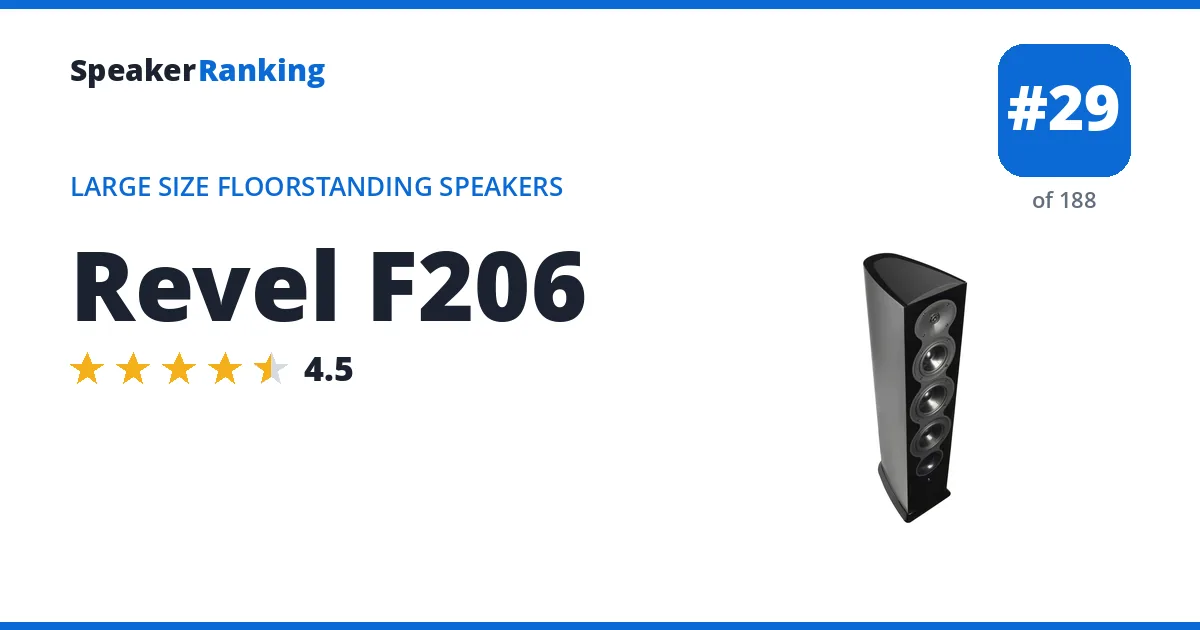
Newer model: the Revel F226Be, ranked higher, rated 4.6/5.
Same family: the Revel M105 (smaller bookshelf, rated 4.2/5), the Revel M106 (larger bookshelf, rated 4.6/5), the Revel F208 (larger floorstanding, ranked higher, rated 4.5/5), the Revel Performa3 C205 (smaller center, rated 4.1/5) and the Revel Performa3 C208 (larger center, rated 4/5).
Pros: CEA2034 spinorama shows a pretty even on-axis response. Predicted in-room response is excellent, with a smooth downward slope. Horizontal beamwidth of about ±65 degrees is wide, if a bit uneven. Distortion is very nice at 86dB SPL/1m, falling below the frequency range where human hearing is most sensitive, and stays excellent even at 96dB SPL/1m. Near-field measurements of the individual drivers show nice suppression of port and woofer resonances. Really amazing value for the performance. Measured bass extension of 60Hz (-3dB), with a measured sensitivity of 87dB.
Cons: Some directivity error and a small peak around 4.5kHz show up alongside the directivity error around 3kHz. Vertical directivity means listening position needs to stay within the tweeter axis, though the reviewer notes there is some leeway. Minimum impedance dips to 3.3 ohms, calling for an amplifier comfortable with a demanding load. Discontinued.
Full Revel F206 review and specifications →
| Bass Extension (-10dB) | 34Hz (measured, Audio Science Review) |
|---|---|
| Bass Extension (-3dB) | 60Hz (measured, Audio Science Review) |
| DIY Kit | No |
| Dimensions | 40.3”H x 8.4”W x 12.2”D (1023.6 x 213.4 x 309.9 mm) |
| Drivers | Dual 6.5” (16.5 cm) Aluminum Cone, Cast-frame Woofers, 5.25” (13.3 cm) Aluminum Cone, Cast-frame Midrange, 1” (2.5 cm) Aluminum Tweeter with Acoustic Lens Waveguide |
| Impedance | 4 ohms nominal (3.3 ohms minimum, measured by Audio Science Review) |
| Sensitivity | 87dB (measured, Audio Science Review) |
| Spinorama Preference Score | 5.51 |
| Spinorama Preference Score with Perfect Sub | 7.52 |
| Weight | 57.3 lbs (26 kg) each |
| Woofer Cabinet | ported, front |
- Links
- Reviews, Comparisons and Sound Samples
- Head-to-Head Comparisons
 Sony SS-CS3: $450 per pair Discontinued eBay
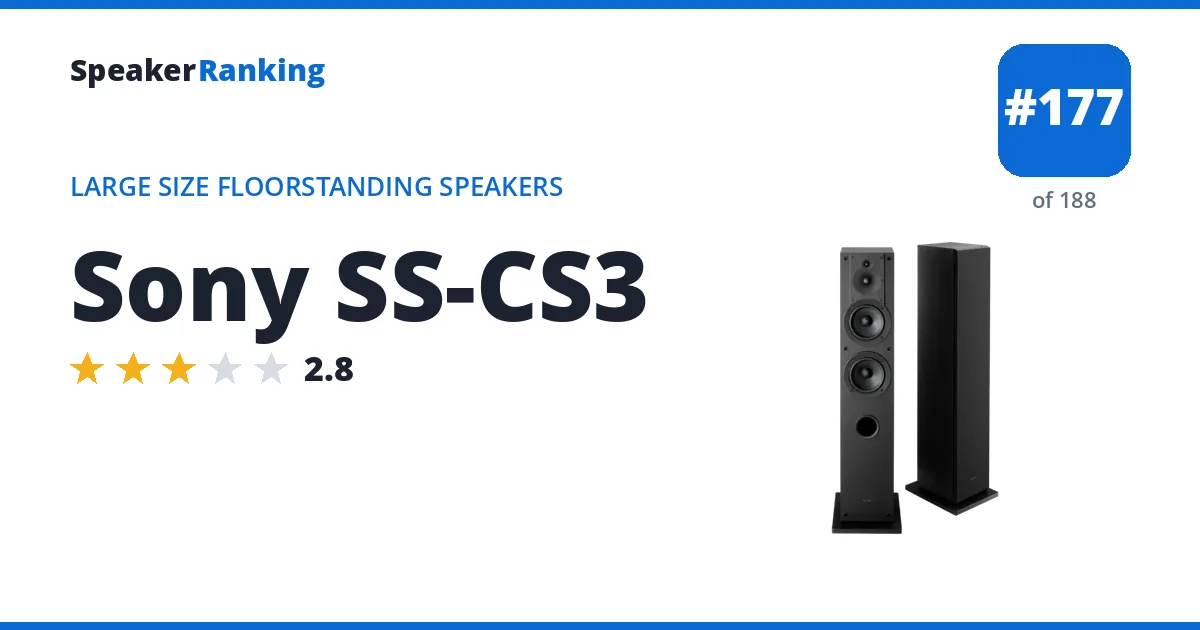
Newer model: the Sony SS-CS3 M2, ranked higher, estimated 3/5.
Same family: the Sony SS-CS5 (bookshelf, rated 3.5/5).
Pros: Affordable entry-level floorstanding tower offering solid sensitivity (88.6dB SPL at 2.83V/1m), making it easy to power with standard budget AVRs. Harmonic distortion remains reasonably low at moderate listening levels (86dB SPL) when high-pass filtered above 80-100Hz with a dedicated subwoofer. Front-ported design allows relatively close placement to front boundaries without excessive port occlusion. Measured bass extension of 72Hz (-3dB), with a measured sensitivity of 88.6dB.
Cons: Severe cabinet and driver resonances plague the passband between 100Hz and 600Hz, imparting audible coloration and chesty resonances to male vocals and acoustic instruments. Irregular frequency response peaks and dips make automated receiver room correction difficult to equalize effectively. Poor low-frequency extension (F3 of 72Hz, F10 of 39Hz) for a floorstander, combined with rapid distortion escalation below 80Hz at higher SPLs (96dB+). Supertweeter driver adds crossover complexity without providing audible high-frequency benefit within the human hearing spectrum. Discontinued.
Full Sony SS-CS3 review and specifications →
| Bass Extension (-10dB) | 39Hz (measured, Erin’s Audio Corner) |
|---|---|
| Bass Extension (-3dB) | 72Hz (measured, Erin’s Audio Corner) |
| DIY Kit | No |
| Dimensions | 36.3”H x 9.1”W x 10.2”D (922 x 230 x 260 mm) |
| Drivers | 0.75 in. supertweeter, 0.98 in. polyester main tweeter, dual 5.12 in. MRC woofers |
| Impedance | 6 ohms nominal |
| Sensitivity | 88.6dB (measured average, Erin’s Audio Corner) |
| Spinorama Preference Score | 4.11 |
| Spinorama Preference Score with Perfect Sub | 6.65 |
| Weight | 25.4 lbs (11.5 kg) each |
| Woofer Cabinet | ported, front |
- Links
- Reviews, Comparisons and Sound Samples
- Head-to-Head Comparisons