Short answer: the Edifier R1280T. It ranks #93 of 105 powered bookshelf speakers by sound quality, rated 3.1/5, at $119.99. The Mackie CR3-X ranks #33, rated 3.0/5, at $99.99, $20 cheaper, a saving that is not big enough to make up the sound-quality gap.
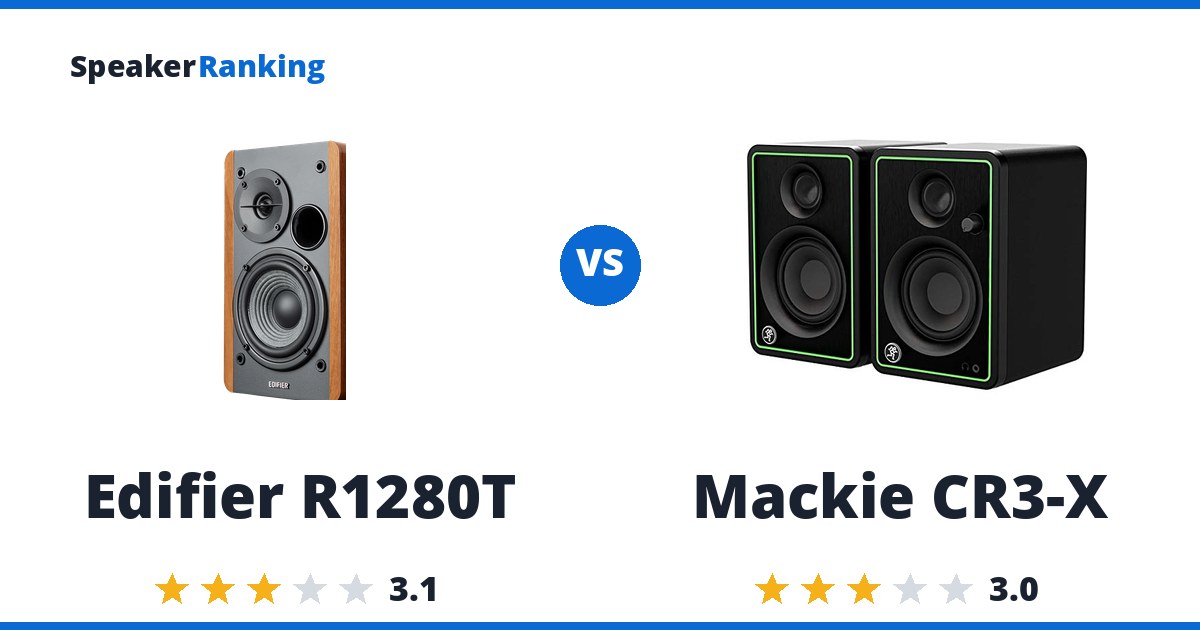
The Edifier R1280T is the deeper-bass pick. ASR’s review found useful moderate-level bass output from an inexpensive powered pair. Its bass reaches about 63Hz before falling 3dB, against 80Hz for the Mackie CR3-X. The catch: Preference scores of 2.41 standalone and 5.02 with an ideal subwoofer reflect substantial tonal limitations, not just missing bass.
What the Mackie CR3-X does well: Erin’s Klippel data predicts 2.50 standalone and 5.42 with an ideal subwoofer. It keeps a wired aux input, which the Edifier R1280T lacks. Watch for: The response spans 4.4dB from 300Hz to 5kHz, with substantial narrow-band irregularities and bass rolloff reaching -3dB around 75Hz.
Buy the Edifier R1280T. It is rated higher for sound quality, and the $20 saving on the Mackie CR3-X is not enough to make up the difference.
Still deciding? The full Powered Home rankings cover every ranked option.
Specifications Side By Side
| Edifier R1280T | Mackie CR3-X | |
|---|---|---|
| Price | $119.99 per pair | $99.99 per pair |
| Ranked | #93 of 105 in Medium Size Powered Bookshelf Speakers | #33 of 47 in Small Size Powered Bookshelf Speakers |
| Bass Extension (-3dB) | 63Hz (measured, Audio Science Review) | 80Hz (measured, Erin’s Audio Corner) |
| Bass Extension (-10dB) | 53.2Hz (derived, log-interpolated between spinorama.org -9dB/-12dB points) | 70Hz (measured, Erin’s Audio Corner) |
| Dimensions | 9.2”H x 7.7”W x 5.7”D (234 x 196 x 146 mm) | 8.1”H x 5.5”W x 7.1”D (205.7 x 139.7 x 180.3 mm) |
| Frequency Response | 52Hz - 20kHz (Manufacturer specified) | 80 Hz-20 kHz (-3dB) (Manufacturer specified) |
| Inputs | 2x RCA Input | RCA, Aux |
| Outputs | None | 1/8” headphone jack |
| Weight | 10.8 lbs (4.9 kg) | 7.7 lbs (3.5 kg) |
| Drivers | 4” (102mm) woofer | 3” woofer, 0.75” silk dome tweeter |
| App | No | No |
| Bluetooth | No | No |
| EQ | No | No |
| Amplifier Power | 42w RMS Total | 50W total (25W per speaker) |
| Spinorama Preference Score | 2.41 | 2.50 |
| Spinorama Preference Score with Perfect Sub | 5.02 | 5.42 |
| XLR Input | No | No |
| RCA Input | Yes | Yes |
| TRS Input | No | No |
| Optical Input | No | No |
| Coaxial Input | No | No |
| USB Input | No | No |
| HDMI Input | No | No |
| AES Input | No | No |
| Aux Input | No | Yes |
| Sensitivity | - | 96dB (measured at 0.3V/1m, Erin’s Audio Corner) |
| Maximum SPL | - | 92dB @ 1m (manufacturer specified) |
| Headphone Output | - | Yes |
Frequency Response Compared
Both speakers’ spinorama measurements, overlaid. A flatter line is more neutral: peaks sound forward or harsh, dips sound recessed. Each curve is shifted so its average from 300 Hz to 3 kHz sits at 0 dB, so loudness differences between the two are removed and only the shape is compared. The two were measured by different sources, so small differences, especially in the bass, can come from the measurement setup rather than the speakers.
Measurement data: Edifier R1280T (measured by Audio Science Review) and Mackie CR3-X (measured by Erin’s Audio Corner), via spinorama.org.
Watch Them Compared
Videos and reviews that test both speakers side by side.
Related Speaker Comparisons
More worthwhile head-to-heads for Mackie CR3-X:
- Genelec 8010A vs Mackie CR3-X
- ADAM Audio D3v vs Mackie CR3-X
- Mackie CR3-X vs Cambridge Audio L/R S
- Mackie CR3-X vs IK Multimedia iLoud Micro Monitor
- Mackie CR3-X vs Edifier M60
Prices on this page were last checked October 10, 2026 at 5:37 PM UTC. Product prices and availability are accurate as of that date/time and are subject to change; the price and availability shown on Amazon at the time of purchase will apply to the purchase of this product.
As an eBay Partner, we may be compensated if you make a purchase.
The Two Speakers In Full
 Edifier R1280T: $119.99 per pair Amazon eBay
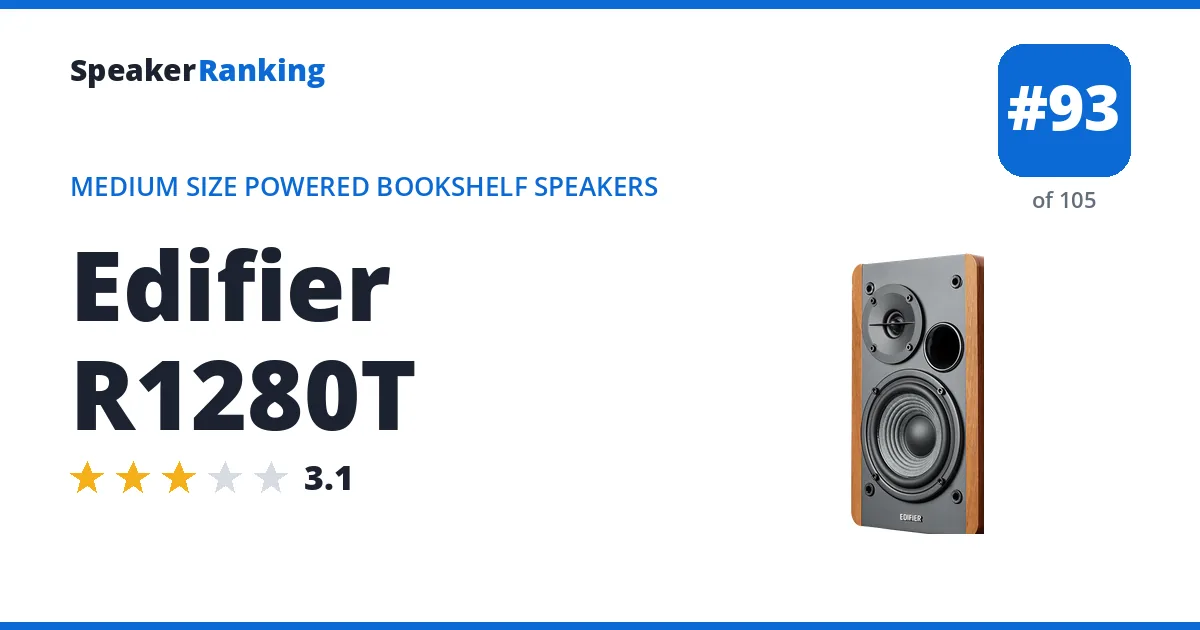
Pros: ASR’s review found useful moderate-level bass output from an inexpensive powered pair. Remote volume and bass/treble controls make it easy to use without separate amplification. Measured bass reaches -3dB around 63Hz. Measured bass extension of 63Hz (-3dB).
Cons: Preference scores of 2.41 standalone and 5.02 with an ideal subwoofer reflect substantial tonal limitations, not just missing bass. The response spans 5.5dB from 300Hz to 5kHz, and listening-window narrow-band deviation is 0.650. Resonances and treble unevenness affect reflected sound too. Listening height is important, and high-level compression changes the balance.
Full Edifier R1280T review and specifications →
| AES Input | No |
|---|---|
| Amplifier Power | 42w RMS Total |
| App | No |
| Aux Input | No |
| Bass Extension (-10dB) | 53.2Hz (derived, log-interpolated between spinorama.org -9dB/-12dB points) |
| Bass Extension (-3dB) | 63Hz (measured, Audio Science Review) |
| Bluetooth | No |
| Coaxial Input | No |
| Dimensions | 9.2”H x 7.7”W x 5.7”D (234 x 196 x 146 mm) |
| Drivers | 4” (102mm) woofer |
| EQ | No |
| Frequency Response | 52Hz - 20kHz (Manufacturer specified) |
| HDMI Input | No |
| Inputs | 2x RCA Input |
| Optical Input | No |
| Outputs | None |
| RCA Input | Yes |
| Spinorama Preference Score | 2.41 |
| Spinorama Preference Score with Perfect Sub | 5.02 |
| TRS Input | No |
| USB Input | No |
| Weight | 10.8 lbs (4.9 kg) |
| XLR Input | No |
- Links
- Reviews, Comparisons and Sound Samples
- Audio Science Review Measurements More from Audio Science Review →
- Audio Science Review Measurements (spinorama.org)
- Jasper Tech: Best Desktop Computer Speakers for Every Budget – 2026 More from Jasper Tech →
- Jasper Tech: Best Powered Bookshelf Speakers for Every Budget - 2025
- DSAUDIO.review: Presonus Eris E3.5 vs Edifier R1280T Sound Demo w/ Bass Test More from DSAUDIOreview →
- DSAUDIO.review: Mackie CR3-X vs Edifier R1280T Sound, Distortion & Frequency Response Comparison
- DSAUDIO.review: Edifier R1280T vs Edifier R2000DB Sound Demo
- Head-to-Head Comparisons
- Edifier R1280T vs Edifier R1280DB
- Edifier R1280T vs Midiplus MI5 II
- Edifier R1280T vs JBL One Series 104
- Edifier R1280T vs Edifier R1700BT
- Edifier R1280T vs Audioengine HD4
- Edifier R1280T vs Fluid Audio FX50 V2
- Edifier R1280T vs NHT Pro M-00
- Edifier R1280T vs Kali Audio IN-UNF
- See all 61 comparisons
 Mackie CR3-X: $99.99 per pair Amazon eBay
Newer model: the Mackie CR3.5, ranked lower, estimated 3/5, released Oct 2024. See every Mackie CR generation.
Same family: the Mackie CR4-X (larger bookshelf, ranked higher, estimated 3.3/5).
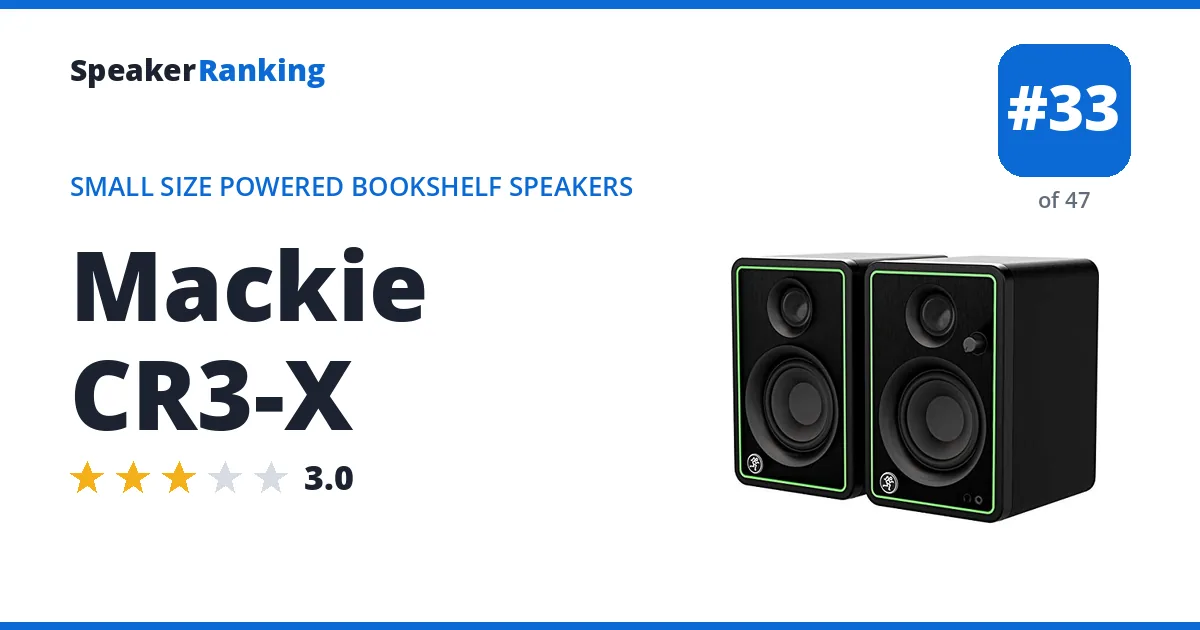
Pros: Erin’s Klippel data predicts 2.50 standalone and 5.42 with an ideal subwoofer. The existing comparative review found less exaggerated tonal shaping and better sustained-output behavior than the original PreSonus Eris E3.5 tested alongside it. Midrange distortion was reasonably controlled for inexpensive desktop speakers at moderate listening levels. Measured bass extension of 80Hz (-3dB), with a measured sensitivity of 96dB.
Cons: The response spans 4.4dB from 300Hz to 5kHz, with substantial narrow-band irregularities and bass rolloff reaching -3dB around 75Hz. Bass peaking and crossover-region changes with listening height prevent neutral monitoring. Limiting becomes intrusive above modest desktop levels, and there are no tone controls. Comparisons with the original PreSonus Eris E3.5 should not be treated as measurements of its second generation.
Full Mackie CR3-X review and specifications →
| Released | Jun 2020 (6 years ago) |
|---|---|
| AES Input | No |
| Amplifier Power | 50W total (25W per speaker) |
| App | No |
| Aux Input | Yes |
| Bass Extension (-10dB) | 70Hz (measured, Erin’s Audio Corner) |
| Bass Extension (-3dB) | 80Hz (measured, Erin’s Audio Corner) |
| Bluetooth | No |
| Coaxial Input | No |
| Dimensions | 8.1”H x 5.5”W x 7.1”D (205.7 x 139.7 x 180.3 mm) |
| Drivers | 3” woofer, 0.75” silk dome tweeter |
| EQ | No |
| Frequency Response | 80 Hz-20 kHz (-3dB) (Manufacturer specified) |
| HDMI Input | No |
| Headphone Output | Yes |
| Inputs | RCA, Aux |
| Maximum SPL | 92dB @ 1m (manufacturer specified) |
| Optical Input | No |
| Outputs | 1/8” headphone jack |
| RCA Input | Yes |
| Sensitivity | 96dB (measured at 0.3V/1m, Erin’s Audio Corner) |
| Spinorama Preference Score | 2.50 |
| Spinorama Preference Score with Perfect Sub | 5.42 |
| TRS Input | No |
| USB Input | No |
| Weight | 7.7 lbs (3.5 kg) |
| XLR Input | No |
- Links
- Reviews, Comparisons and Sound Samples
- Erin’s Audio Corner Review Measurements More from Erin’s Audio Corner →
- Audio Science Review Measurements More from Audio Science Review →
- DSAUDIO.review: Presonus Eris E3.5 vs Mackie CR3 Sound Demo w/ Bass Test More from DSAUDIOreview →
- DSAUDIO.review: Mackie CR3-X vs Edifier R1280T Sound, Distortion & Frequency Response Comparison
- Erin’s Audio Corner: Mackie CR3-X vs PreSonus E3.5 Budget Monitor Showdown!
- Erin’s Audio Corner Measurements (spinorama.org)
- Head-to-Head Comparisons