Short answer: the Mackie CR3-X. It ranks #18 of 24 powered bookshelf speakers by sound quality, rated 3.0/5, at $99.99; the Monoprice DT-3 ranks #24, rated 2.3/5, and costs $139.99, so there is not much of a tradeoff to weigh.
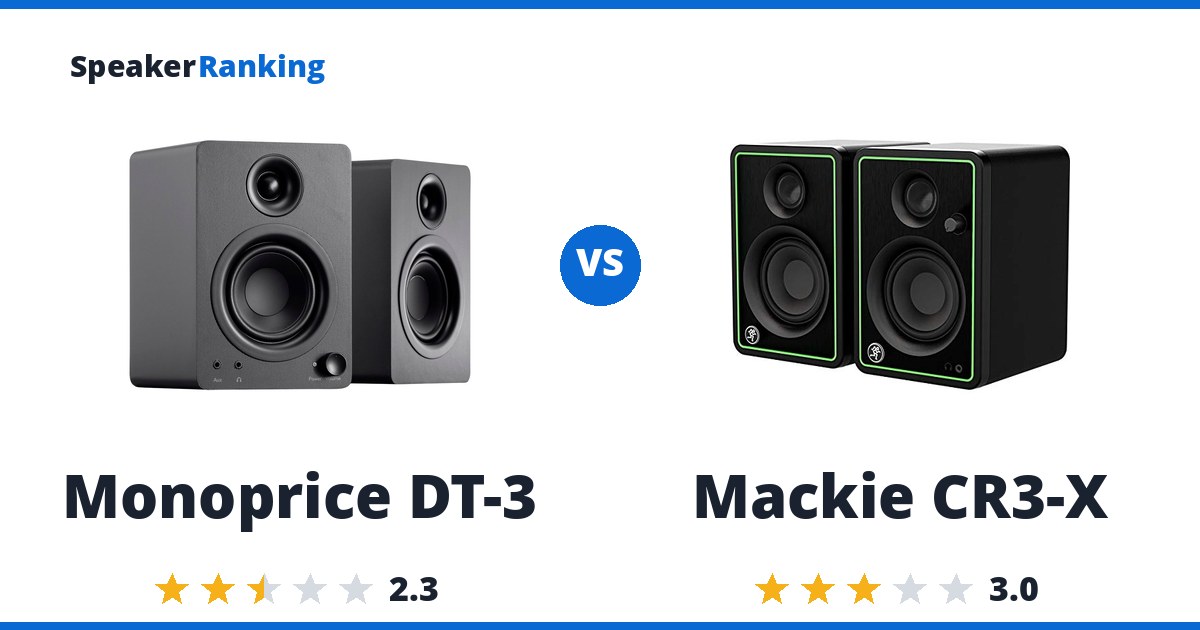
The case for the Monoprice DT-3: An inexpensive, compact powered pair with front volume control, auxiliary input and headphone output. Watch for: The measured response spans 7.6dB from 300Hz to 5kHz, with large irregularities both on-axis and across the listening window.
What the Mackie CR3-X does well: Erin’s Klippel data predicts 2.50 standalone and 5.42 with an ideal subwoofer. The tradeoff: The response spans 4.4dB from 300Hz to 5kHz, with substantial narrow-band irregularities and bass rolloff reaching -3dB around 75Hz.
Buy the Mackie CR3-X. It is rated higher for sound quality than the Monoprice DT-3 and costs less, which settles it without a real tradeoff to make.
Want more options? Browse the full Powered Home rankings.
Specifications Side By Side
| Monoprice DT-3 | Mackie CR3-X | |
|---|---|---|
| Price | $139.99 per pair | $99.99 per pair |
| Ranked | #24 of 24 in Small Size Powered Bookshelf Speakers | #18 of 24 in Small Size Powered Bookshelf Speakers |
| Enclosure | Powered 2-way stereo pair, rear-ported | - |
| Drivers | 0.75-inch tweeter, 3.5-inch woofer | 3" woofer, 0.75" silk dome tweeter |
| Amplifier Power | 50W system | 50W total (25W per speaker) |
| Bass Extension (-6dB) | 69Hz (measured, Spinorama) | - |
| Inputs | Rear stereo RCA and front 3.5mm auxiliary | RCA, Aux |
| Outputs | Front headphone | 1/8" headphone jack |
| Dimensions | 8H x 5.5W x 5.9D in each | 8.1"H x 5.5"W x 7.1"D (205.7 x 139.7 x 180.3 mm) |
| Spinorama Preference Score | 0.10 | 2.50 |
| Spinorama Preference Score with Perfect Sub | 3.03 | 5.42 |
| Headphone Output | Yes | Yes |
| XLR Input | No | No |
| RCA Input | Yes | Yes |
| TRS Input | No | No |
| Optical Input | No | No |
| Coaxial Input | No | No |
| USB Input | No | No |
| HDMI Input | No | No |
| AES Input | No | No |
| Aux Input | Yes | Yes |
| Bluetooth | No | No |
| Frequency Response | 75Hz - 20kHz (Manufacturer specified) | 80 Hz-20 kHz (-3dB) (Manufacturer specified) |
| Weight | - | 7.7 lbs (3.5 kg) |
| App | - | No |
| Bass Extension (-10dB) | - | 70Hz (measured, Erin's Audio Corner) |
| Bass Extension (-3dB) | - | 80Hz (measured, Erin's Audio Corner) |
| EQ | - | No |
| Sensitivity | - | 96dB (measured at 0.3V/1m, Erin's Audio Corner) |
| Maximum SPL | - | 92dB @ 1m (manufacturer specified) |
Related Speaker Comparisons
More worthwhile head-to-heads for Mackie CR3-X:
- Genelec 8010A vs Mackie CR3-X
- Adam Audio D3v vs Mackie CR3-X
- Mackie CR3-X vs Cambridge Audio L/R S
- Mackie CR3-X vs IK Multimedia iLoud Micro Monitor
- Mackie CR3-X vs Edifier M60
Prices on this page were last checked September 23, 2026 at 11:24 PM UTC. Product prices and availability are accurate as of that date/time and are subject to change; the price and availability shown on Amazon at the time of purchase will apply to the purchase of this product.
As an eBay Partner, we may be compensated if you make a purchase.
The Two Speakers In Full
 Monoprice DT-3: $139.99 per pair Monoprice eBay
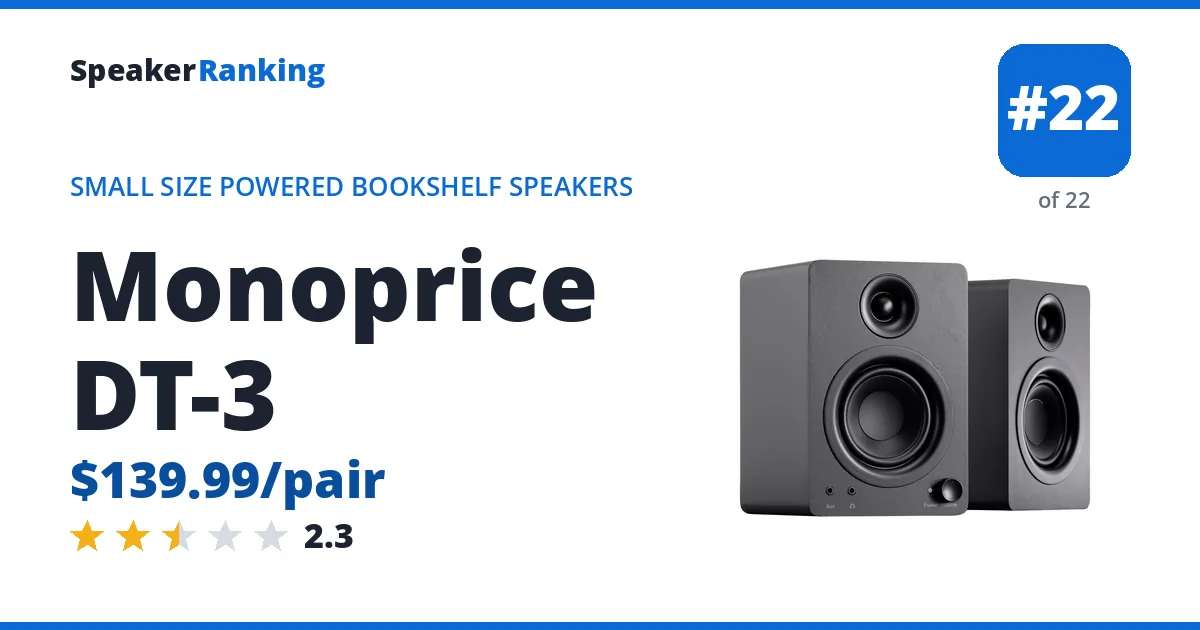
Pros: An inexpensive, compact powered pair with front volume control, auxiliary input and headphone output. Erin’s Klippel measurements put the -3dB bass point around 74Hz, sufficient for some upper-bass content at a desk.
Cons: The measured response spans 7.6dB from 300Hz to 5kHz, with large irregularities both on-axis and across the listening window. Preference scores are 0.10 standalone and only 3.03 with an ideal subwoofer, the weakest comparable result in this group. That means adding bass support does not remove its major tonal problems. It offers little reason to choose it for accurate listening over better-measuring budget alternatives.
Full Monoprice DT-3 review and specifications →
| AES Input | No |
|---|---|
| Amplifier Power | 50W system |
| Aux Input | Yes |
| Bass Extension (-6dB) | 69Hz (measured, Spinorama) |
| Bluetooth | No |
| Coaxial Input | No |
| Dimensions | 8H x 5.5W x 5.9D in each |
| Drivers | 0.75-inch tweeter, 3.5-inch woofer |
| Enclosure | Powered 2-way stereo pair, rear-ported |
| Frequency Response | 75Hz - 20kHz (Manufacturer specified) |
| HDMI Input | No |
| Headphone Output | Yes |
| Inputs | Rear stereo RCA and front 3.5mm auxiliary |
| Optical Input | No |
| Outputs | Front headphone |
| RCA Input | Yes |
| Spinorama Preference Score | 0.10 |
| Spinorama Preference Score with Perfect Sub | 3.03 |
| TRS Input | No |
| USB Input | No |
| XLR Input | No |
- Links
- Reviews, Comparisons and Sound Samples
- Head-to-Head Comparisons
 Mackie CR3-X: $99.99 per pair Amazon eBay
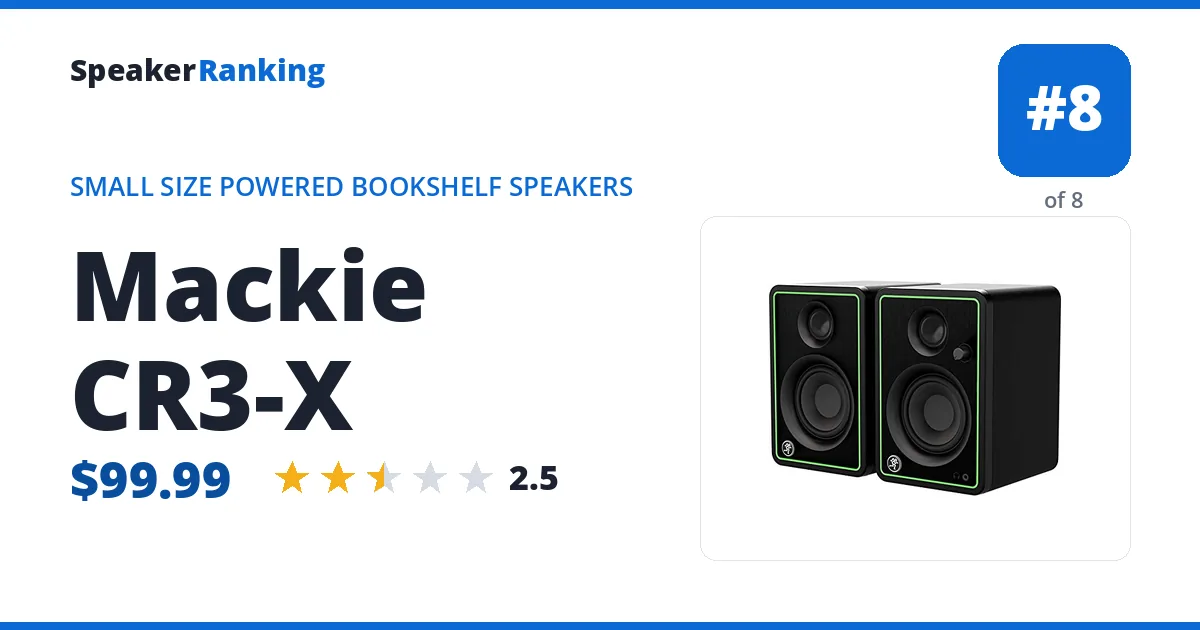
Pros: Erin’s Klippel data predicts 2.50 standalone and 5.42 with an ideal subwoofer. The existing comparative review found less exaggerated tonal shaping and better sustained-output behavior than the original PreSonus E3.5 tested alongside it. Midrange distortion was reasonably controlled for inexpensive desktop speakers at moderate listening levels. Measured bass extension of 80Hz (-3dB), with a measured sensitivity of 96dB.
Cons: The response spans 4.4dB from 300Hz to 5kHz, with substantial narrow-band irregularities and bass rolloff reaching -3dB around 75Hz. Bass peaking and crossover-region changes with listening height prevent neutral monitoring. Limiting becomes intrusive above modest desktop levels, and there are no tone controls. Comparisons with the original E3.5 should not be treated as measurements of its second generation.
Full Mackie CR3-X review and specifications →
| AES Input | No |
|---|---|
| Amplifier Power | 50W total (25W per speaker) |
| App | No |
| Aux Input | Yes |
| Bass Extension (-10dB) | 70Hz (measured, Erin's Audio Corner) |
| Bass Extension (-3dB) | 80Hz (measured, Erin's Audio Corner) |
| Bluetooth | No |
| Coaxial Input | No |
| Dimensions | 8.1"H x 5.5"W x 7.1"D (205.7 x 139.7 x 180.3 mm) |
| Drivers | 3" woofer, 0.75" silk dome tweeter |
| EQ | No |
| Frequency Response | 80 Hz-20 kHz (-3dB) (Manufacturer specified) |
| HDMI Input | No |
| Headphone Output | Yes |
| Inputs | RCA, Aux |
| Maximum SPL | 92dB @ 1m (manufacturer specified) |
| Optical Input | No |
| Outputs | 1/8" headphone jack |
| RCA Input | Yes |
| Sensitivity | 96dB (measured at 0.3V/1m, Erin's Audio Corner) |
| Spinorama Preference Score | 2.50 |
| Spinorama Preference Score with Perfect Sub | 5.42 |
| TRS Input | No |
| USB Input | No |
| Weight | 7.7 lbs (3.5 kg) |
| XLR Input | No |
- Links
- Reviews, Comparisons and Sound Samples
- Erin’s Audio Corner Review Measurements More from Erin’s Audio Corner →
- Audio Science Review Measurements More from Audio Science Review →
- DSAUDIO.review: Presonus Eris E3.5 vs Mackie CR3 Sound Demo w/ Bass Test More from DSAUDIOreview →
- DSAUDIO.review: Mackie CR3-X vs Edifier R1280T Sound, Distortion & Frequency Response Comparison
- Erin’s Audio Corner: Mackie CR3-X vs PreSonus E3.5 Budget Monitor Showdown!
- Erin’s Audio Corner Measurements (spinorama.org)
- Head-to-Head Comparisons