Coverage note. Speaker Ranking currently covers 17 Revel models across passive speakers and subwoofers. These are the products in our database, not a complete list of everything Revel makes.
What this page covers. The Revel models ranked here span passive speakers and subwoofers, including Revel M106, Revel F328Be and Revel W553L. Use each model’s category position to compare it with alternatives of the same size and use case.
This page lists all 17 Revel speakers ranked on this site across passive speakers and subwoofers. Each model is shown in the category where it competes, with its current rank and the size of that ranking.
Use the category position rather than the brand name alone: speakers from the same manufacturer can perform very differently by size, price and product family.
Prices on this page were last checked September 30, 2026 at 2:57 PM UTC. Product prices and availability are accurate as of that date/time and are subject to change; the price and availability shown on Amazon at the time of purchase will apply to the purchase of this product.
As an eBay Partner, we may be compensated if you make a purchase.
Quick Navigation
- Large Size Bookshelf Speakers
- Large Size Floorstanding Speakers
- In-Wall & In-Ceiling Speakers
- Discontinued Revel Models
Large Size Bookshelf Speakers
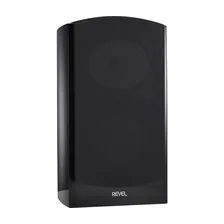 Ranked #34 of 134 in Large Size Bookshelf Speakers - Revel M126Be: $4,400 per pair Crutchfield eBay
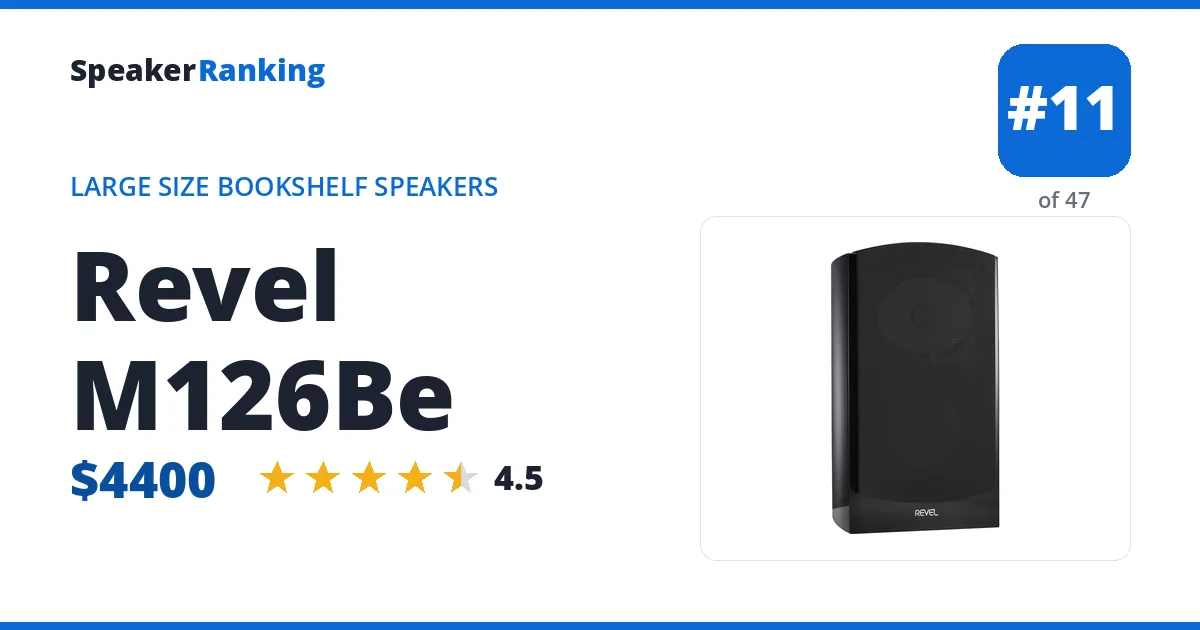
Older model: the Revel M106 (ranked higher, rated 4.6/5).
Pros: Two-way design pairing a 6.5” midwoofer with a 1” beryllium dome tweeter, the smaller sibling to the reviewer’s favorite Revel F226Be. Wide, immersive stereo imaging: hard-panned sounds in test tracks localized 2-3 feet outside the physical speaker positions without losing pinpoint precision. Horizontal radiation of about 60-70°, landing right in the reviewer’s preferred range for an enveloping yet still well-focused soundstage. Extended bass-shelf tuning (similar in concept to the KEF R3 Meta) combines with in-room gain for a more linear low end rather than a boomy hump. Diffraction dips visible on-axis around 3kHz and 7kHz largely disappear in the estimated in-room response, since they fill in as you move off-axis. Distortion stays within 3% down to about 100Hz at both 86dB and 96dB output: strong performance for a 6.5” bookshelf woofer. Can be driven by a standard AVR thanks to a manageable 4.9-ohm minimum impedance. Measured bass extension of 103Hz (-3dB), with a measured sensitivity of 86.1dB.
Cons: At $2200/pair, the reviewer doesn’t consider it a strong value: an improvement over Revel’s less expensive M106 and Performa3 models, but not proportional to the price jump. Bass tops out around 50Hz in-room; a subwoofer is still needed for real low-end extension. Vertical placement is fairly critical: there’s a notable hole in the response around the 1.7kHz crossover if you sit above the tweeter axis. Toeing the speaker out to a full 30° introduces a roughly 1dB discontinuity in the midrange along with high-frequency rolloff; the reviewer recommends staying close to on-axis or within about 10°. An unexplained jump in distortion appears right at the 1.7kHz crossover point under compression testing, which may be linked to an occasional “glaring” quality the reviewer noticed in the 2-3kHz region at very high volumes (92-93dB from 2 meters). A mild 2-3kHz forwardness occasionally stood out on some tracks, correctable with about 1dB of EQ, though the reviewer considers it minor.
Full Revel M126Be review and specifications →
| Bass Extension (-10dB) | 44Hz (measured, Erin’s Audio Corner) |
|---|---|
| Bass Extension (-3dB) | 103Hz (measured, Erin’s Audio Corner) |
| DIY Kit | No |
| Dimensions | 15.2”H x 8.3”W x 10.3”D (386.1 x 210.8 x 261.6 mm) |
| Drivers | 6.5” Deep Ceramic Composite (DCC) Aluminum Cone with cast frame woofer, 1” Beryllium dome with acoustic lens waveguide tweeter |
| Impedance | 6 ohms nominal (4.9 ohms minimum, measured, Erin’s Audio Corner) |
| Sensitivity | 86.1dB (measured, Erin’s Audio Corner) |
| Spinorama Preference Score | 5.08 |
| Spinorama Preference Score with Perfect Sub | 7.34 |
| Weight | 22 lbs (10.0 kg) each |
| Woofer Cabinet | ported, rear |
- Links
- Reviews, Comparisons and Sound Samples
- Head-to-Head Comparisons
- Revel M126Be vs ELAC VELA BS 403
- Revel M126Be vs Ascend Acoustics Sierra-LX
- Revel M126Be vs Wharfedale Linton 85
- Revel M126Be vs Selah Audio Purezza
- Revel M126Be vs Ascend Acoustics Sierra-2EX V2
- Revel M126Be vs JTR Noesis 210HT
- Revel M126Be vs Dynaudio Heritage Special
- Revel M126Be vs Radiant Acoustics Clarity 6.2
- See all 24 comparisons
Large Size Floorstanding Speakers
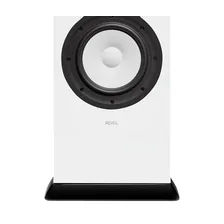 Ranked #5 of 74 in Large Size Floorstanding Speakers - Revel F328Be: $19,359.90 per pair Crutchfield eBay
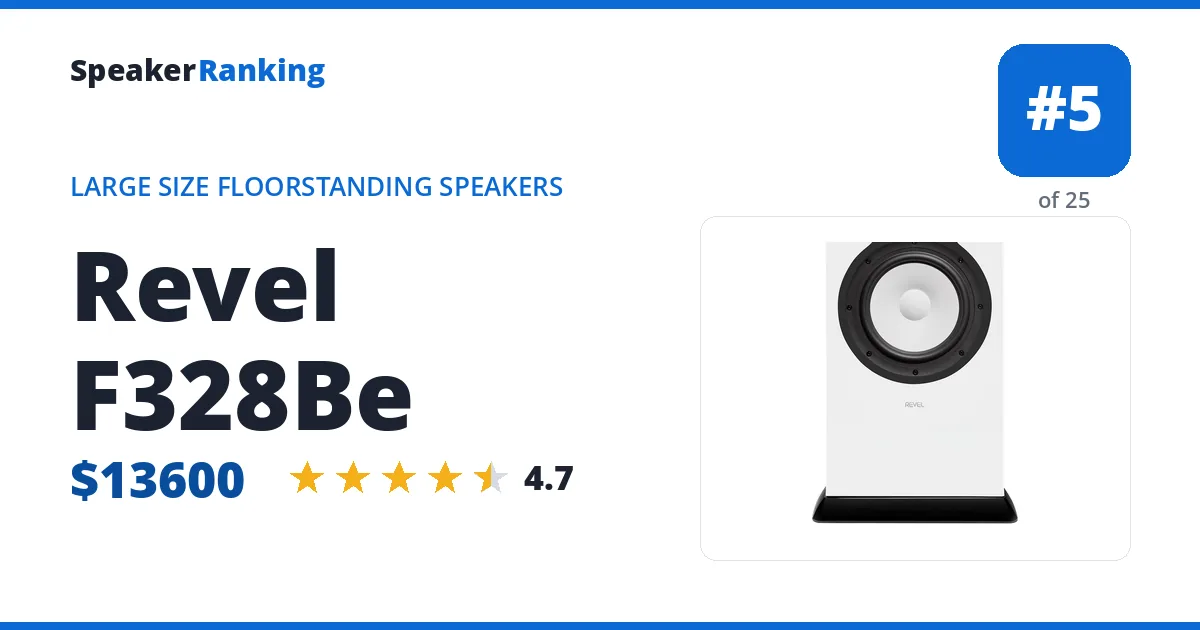
Pros: CEA2034 spinorama shows a quite flat on-axis response with superb directivity and efficiency above 90dB. Predicted in-room response is extremely accurate, with a smooth ~5dB downward slope from bass to treble that suits typical rooms without correction. Early reflections sum very nicely with the direct sound. Horizontal beamwidth of about ±70 degrees is wide and quite smooth. At 96dB SPL/1m distortion stays easily below the reviewer’s audibility threshold across nearly the whole range. Measured bass extension of 74Hz (-3dB), with a measured sensitivity of 91dB.
Cons: Vertical directivity is asymmetric: the reviewer recommends staying between -20 and +40 degrees relative to the tweeter axis, reflecting the driver layout of this three-way tower. Impedance dips to a minimum of 3 ohms with an additional resonance-driven phase swing, calling for an amplifier comfortable with a demanding load. Very expensive and very heavy (51 kg each).
Full Revel F328Be review and specifications →
| Bass Extension (-10dB) | 39Hz (measured, Audio Science Review) |
|---|---|
| Bass Extension (-3dB) | 74Hz (measured, Audio Science Review) |
| DIY Kit | No |
| Dimensions | 50.9”H x 13.5”W x 17.6”D (1292.9 x 342.9 x 447 mm) |
| Drivers | Three 8” (200mm) Deep Ceramic Composite aluminum cones, with cast frames woofer, 5-1/4” (130mm) Deep Ceramic Composite aluminum cone, with cast frame midrange, 1” (25mm) Beryllium dome, with acoustic lens waveguide tweeter |
| Impedance | 8 ohms nominal (3 ohms minimum, measured by Audio Science Review) |
| Sensitivity | 91dB (measured, Audio Science Review) |
| Spinorama Preference Score | 6.40 |
| Spinorama Preference Score with Perfect Sub | 7.81 |
| Weight | 112.4 lbs (51 kg) each |
| Woofer Cabinet | ported, rear |
- Links
- Reviews, Comparisons and Sound Samples
- Head-to-Head Comparisons
- Revel F328Be vs MoFi SourcePoint 888
- Revel F328Be vs Radiant Acoustics Clarity 66
- Revel F328Be vs MoFi SourcePoint V10 Master Edition
- Revel F328Be vs Ascend Acoustics ELX Ribbon Tower
- Revel F328Be vs KEF Blade Two Meta
- Revel F328Be vs GR-Research NX-Treme
- Revel F328Be vs KEF R5 Meta
- Revel F328Be vs Revel F226Be
- See all 40 comparisons
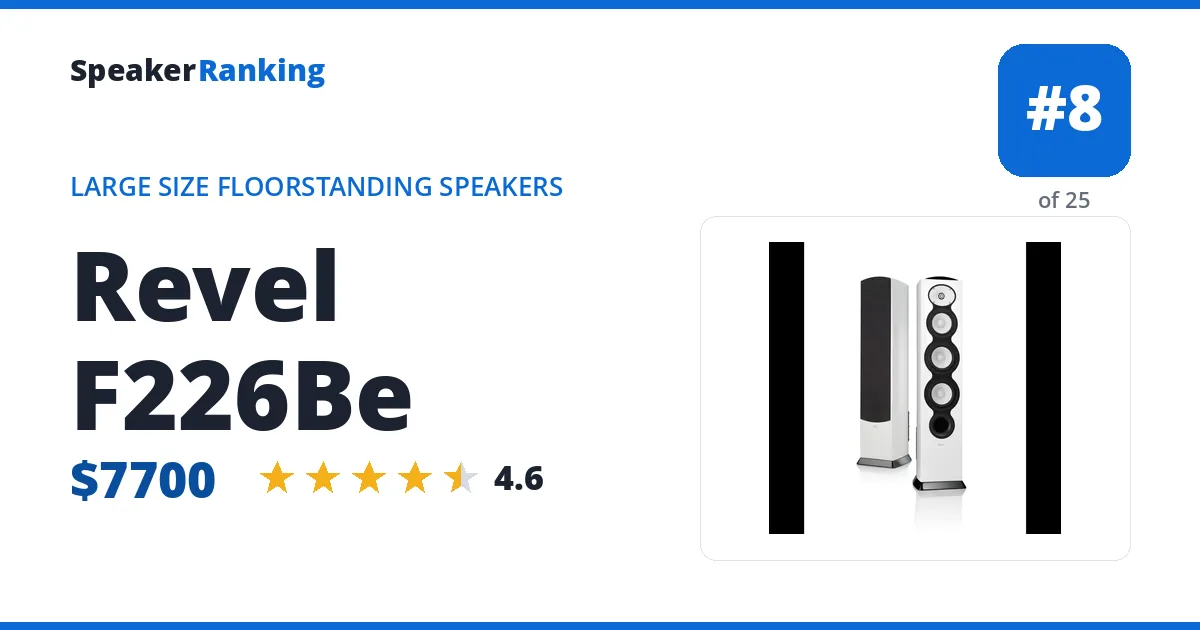
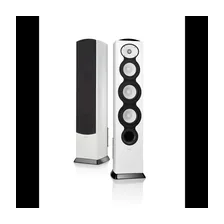 Ranked #10 of 74 in Large Size Floorstanding Speakers - Revel F226Be: $7700 per pair Crutchfield eBay
Older model: the Revel F206 (ranked lower, rated 4.5/5).
Pros: Compact three-way tower with a beryllium dome tweeter in an acoustic lens waveguide, a dedicated 5.25” mid-range, and dual 6.5” woofers (not a coaxial layout): all Deep Ceramic Composite aluminum cones engineered specifically to avoid breakup outside their crossover bands, and it measures that way: neither the woofers nor the mid-range show breakup spikes even well outside their intended pass bands, and even the front port measures unusually clean (only a mild ~3dB bump around 150Hz, well controlled versus the resonances the reviewer typically sees from ports). On-axis frequency response holds within about ±1.5dB above roughly 65Hz (excellent linearity) and off-axis behavior tracks it closely, with only mild, subdued peaking around 4-6kHz that doesn’t show up as real resonance in the spinorama data. Average sensitivity around 90dB (2.83V/1m), notably higher than some competing three-way designs and most bookshelf speakers, translating directly into better dynamic range at both low and high listening levels: one reviewer specifically praised its ability to deliver full transient impact (snare hits, kick drum) even at quiet, conversational volumes rather than needing to be cranked up to feel dynamic. Wide, consistent horizontal radiation of about ±60-70° at the -6dB point, landing right in the reviewer’s preferred range for an enveloping soundstage without excess diffusion, and exceptionally wide vertical dispersion: roughly ±80° up to 10kHz and still ±70° above that, which one reviewer called the widest vertical radiation pattern he had measured to date. Distortion stays under 3% even at 104dB SPL, and in real-world testing up to 105dB from 12-14 feet away, full-range with no crossover, the reviewer heard no audible mechanical noise, port chuffing, or compression at all. Flat enough on- and off-axis response that toeing the speaker 10-15° away from the listener preserves the same tonal balance rather than changing it, and the wide, well-controlled directivity lets sidewall reflections reinforce rather than smear the soundstage. Measured bass extension of 56Hz (-3dB), with a measured sensitivity of 89.7dB.
Cons: Minimum impedance dips to about 3.7-4 ohms below roughly 500Hz despite the 8-ohm nominal rating, so it wants a genuine 4-ohm-capable two-channel amplifier; budget AVRs rated only for 6 or 8 ohms may struggle. F3 of 56Hz and F10 of 36Hz mean it doesn’t extend nearly as low as some three-way rivals with larger woofers: a dedicated subwoofer (10-12”, or 15” for content below 30Hz) is recommended for home theater or bass-heavy music, even though the speaker itself can play surprisingly loud without one. Vertical directivity tolerance is tighter in the crossover handoff region than a true coaxial design would offer, since the tweeter, midrange, and woofers are physically separated: a mild directivity bump appears around 2-2.5kHz that’s typical of non-coaxial multi-way speakers, though not audibly problematic within about ±10° vertically. On-axis, the top end reads as a bit bright according to one reviewer’s subjective impression, generally benefiting from some toe-out. High-gloss cabinet finish can create distracting reflections if used behind a projector screen in a home theater setup. Front-ported, so it can technically sit close to a wall, but doing so makes the bass boomier.
Full Revel F226Be review and specifications →
| Bass Extension (-10dB) | 36Hz (measured, Erin’s Audio Corner) |
|---|---|
| Bass Extension (-3dB) | 56Hz (measured, Erin’s Audio Corner) |
| DIY Kit | No |
| Dimensions | 41.3”H x 9.8”W x 13.7”D (1049 x 248.9 x 348 mm) |
| Drivers | Two 6.5” (165mm) Deep Ceramic Composite aluminum cones, with cast frames woofer, 5-1/4” (130mm) Deep Ceramic Composite aluminum cone, with cast frame midrange, 1” (25mm) Beryllium dome, with acoustic lens waveguide tweeter |
| Impedance | 8 ohms nominal (3.7 ohms minimum, measured, Erin’s Audio Corner) |
| Sensitivity | 89.7dB (measured, Erin’s Audio Corner) |
| Spinorama Preference Score | 5.96 (spinorama.org) |
| Spinorama Preference Score with Perfect Sub | 8.15 (spinorama.org) |
| Weight | 58.2 lbs (26.4 kg) each |
| Woofer Cabinet | ported, front |
- Links
- Reviews, Comparisons and Sound Samples
- Erin’s Audio Corner: Revel PerformaBe F226Be Floorstanding Loudspeaker Review. I love this speaker. More from Erin’s Audio Corner →
- Erin’s Audio Corner: Should You Buy the Revel F226Be or the MoFi 888?
- Erin’s Audio Review Website Revel F226B
- Erin’s Audio Corner: My Top 5 Speakers at Any Price
- Erin’s Audio Corner Measurements (spinorama.org)
- Head-to-Head Comparisons
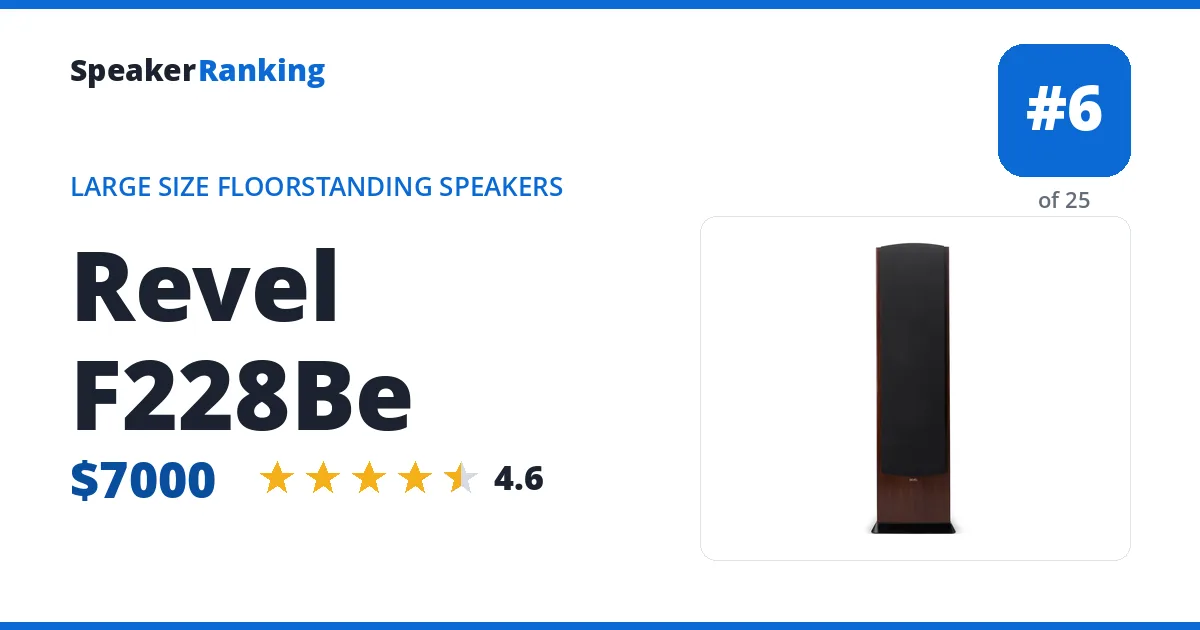
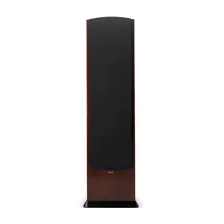 Ranked #17 of 74 in Large Size Floorstanding Speakers - Revel F228Be: $9,000 per pair Crutchfield eBay
Older model: the Revel F208 (ranked higher, rated 4.5/5).
Pros: CEA2034 spinorama shows an essentially flat on-axis response with very nice directivity. Predicted in-room response is nearly perfect, with a smooth slope down from bass to treble. Horizontal beamwidth of about ±70 degrees is wide and holds up well until narrowing above 8kHz. Vertical directivity offers more degrees of listening-height freedom than a typical bookshelf design, a benefit of this tower’s driver layout. Distortion is extremely low across the full audio range at 86dB SPL/1m and stays comfortable even at 96dB SPL/1m. Near-field measurements of the individual drivers show nice, well-integrated crossover behavior with only low-level resonances. Measured bass extension of 61Hz (-3dB), with a measured sensitivity of 89.3dB.
Cons: Minimum impedance dips to 3.4 ohms with a secondary rise around 2kHz, calling for an amplifier comfortable with a demanding load. Very expensive and very heavy (51 kg each).
Full Revel F228Be review and specifications →
| Bass Extension (-10dB) | 25Hz (measured, Audio Science Review) |
|---|---|
| Bass Extension (-3dB) | 61Hz (measured, Audio Science Review) |
| DIY Kit | No |
| Dimensions | 50.9”H x 13.5”W x 17.6”D (1292.9 x 342.9 x 447 mm) |
| Drivers | Dual 8” (200mm) Deep Ceramic Composite aluminum cones, with cast frames woofers, 5-1/4” (130mm) Deep Ceramic Composite aluminum cone, with cast frame midrange, 1” (25mm) Beryllium dome, with acoustic lens waveguide tweeter |
| Impedance | 8 ohms |
| Sensitivity | 89.3dB (300Hz-3kHz @ 2.83V/1m, measured by Audio Science Review; 90dB manufacturer specified) |
| Spinorama Preference Score | 6.01 |
| Spinorama Preference Score with Perfect Sub | 7.51 |
| Weight | 112.4 lbs (51 kg) each |
| Woofer Cabinet | ported, front |
- Links
- Reviews, Comparisons and Sound Samples
- Head-to-Head Comparisons
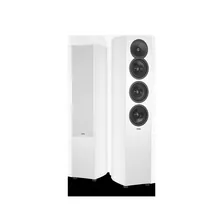 Ranked #19 of 74 in Large Size Floorstanding Speakers - Revel Concerta2 F35: $900 per pair Crutchfield eBay
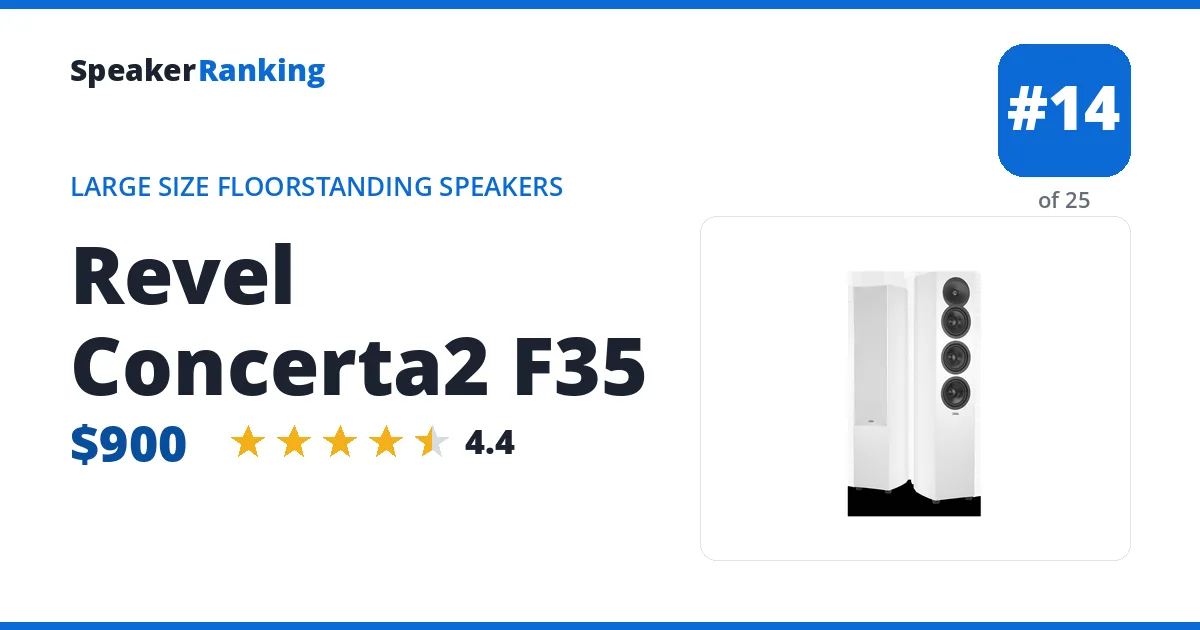
Pros: Two-and-a-half-way, four-driver design: a 1” aluminum dome tweeter on a waveguide, a 5.25” mid-range, and dual 5.25” mid-bass drivers in a rear-ported cabinet. Measured sensitivity of 89.4dB closely matches the 90dB spec, and distortion looks good at both 86dB and 96dB, holding up well even with a high-pass filter applied. At its sale price of $900/pair, down from full retail, the reviewer calls it a “no-brainer,” undercutting comparable budget floorstanders like the ELAC DF63. Frequency response and directivity mismatches are largely EQ-able, since most of what shows up in measurements traces to physical tweeter/mid-range separation rather than a fundamental flaw. Compression is fairly well controlled for the price: about 1dB of loss around 100Hz under long-term compression, described as “par for the course” at this cost. Measured bass extension of 70Hz (-3dB), with a measured sensitivity of 89.4dB.
Cons: F3 of 61Hz and F10 of 39Hz mean a subwoofer is needed for real bass extension. A dip in the lower midrange/2-3kHz region reduces attack and detail, and a peak around 5kHz adds some edge and sibilance in the lower treble. A peak in off-axis energy around 3kHz reflects off sidewalls at roughly 60-70° off-axis and arrives louder than the direct sound: this specific issue can’t be fixed with EQ (boosting the direct sound would boost the stronger reflection too) and would need acoustic absorption to properly address, though the reviewer considers it a minor, optional fix at this price. A couple of minor resonances appear in the impedance plot, including one around 300Hz that may partly explain a subtle sense of vocal warmth noticed in listening, though it’s more likely room-related. Minimum impedance around 3.8 ohms. Short-term compression testing shows some increased distortion in the tweeter and higher-frequency compression at loud output.
Full Revel Concerta2 F35 review and specifications →
| Bass Extension (-10dB) | 50Hz (measured, Erin’s Audio Corner) |
|---|---|
| Bass Extension (-3dB) | 70Hz (measured, Erin’s Audio Corner) |
| DIY Kit | No |
| Dimensions | 40.3”H x 8.4”W x 12.2”D (1023.6 x 213.4 x 309.9 mm) |
| Drivers | 3x 5.25” deep anodized aluminum cone woofers, 1” Aluminum Tweeter |
| Impedance | 6 ohms nominal (3.8 ohms minimum, measured by Erin’s Audio Corner) |
| Sensitivity | 89.4dB (measured, Erin’s Audio Corner; 90dB manufacturer specified) |
| Spinorama Preference Score | 5.35 |
| Spinorama Preference Score with Perfect Sub | 7.30 |
| Weight | 41 lbs (18.6 kg) each |
| Woofer Cabinet | ported, rear |
- Links
- Reviews, Comparisons and Sound Samples
- Audio Science Review Revel Concerta2 F35 More from Audio Science Review →
- Erin’s Audio Corner: Revel F35 Review: Great Sound, Lower Price! More from Erin’s Audio Corner →
- Erin’s Audio Review Website Revel Concerta2 F35
- Audio Science Review Measurements (spinorama.org)
- Erin’s Audio Corner: You’ve Never Seen a Review Like This. Revel F35 Review (Part 1).
- Head-to-Head Comparisons
- Revel Concerta2 F35 vs Revel F206
- Revel Concerta2 F35 vs Perlisten S7t
- Revel Concerta2 F35 vs Revel F228Be
- Revel Concerta2 F35 vs Revel F208
- Revel Concerta2 F35 vs KEF R5
- Revel Concerta2 F35 vs Focal Chora 816
- Revel Concerta2 F35 vs JBL HDI-3800
- Revel Concerta2 F35 vs KEF R11 Meta
- See all 57 comparisons
In-Wall & In-Ceiling Speakers
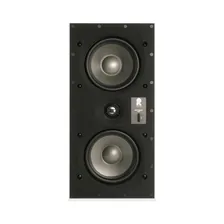 Ranked #2 of 18 in In-Wall & In-Ceiling Speakers - Revel W553L: $1,089.90 per pair Crutchfield eBay
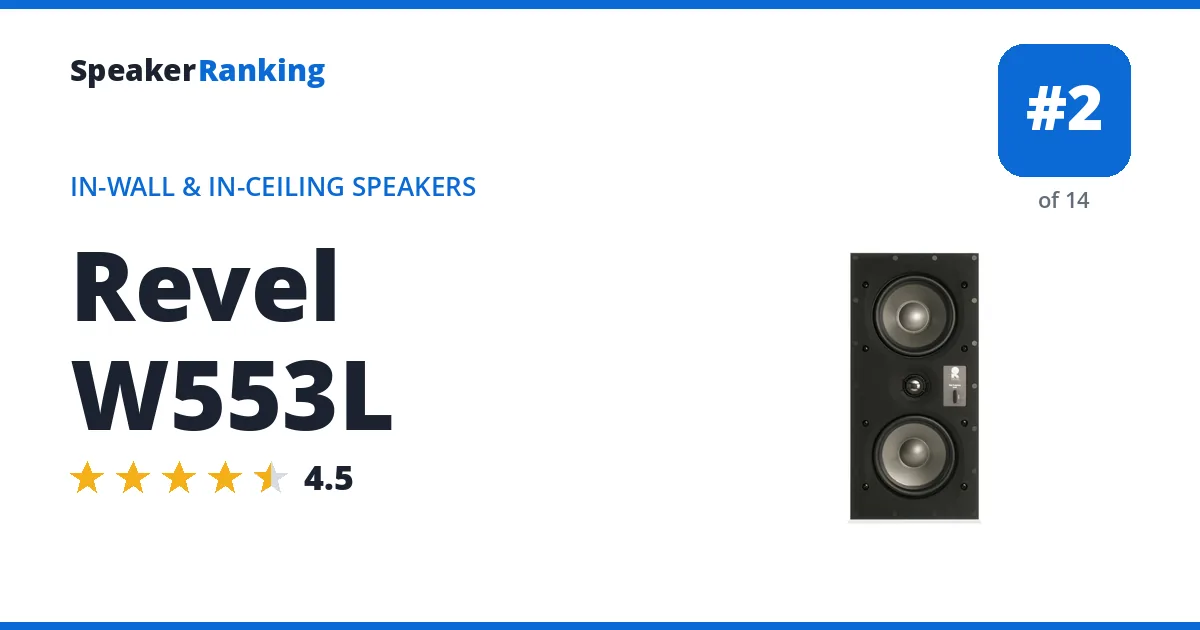
Pros: Erin’s Audio Corner’s Klippel measurement gives a preference score of 4.84, or 7.50 with a perfect subwoofer, a strong result for an in-wall speaker at this price. On-axis response is smooth (0.68 smoothness) and directivity is well controlled (SPDI deviation 2.35dB), so the sound off to the sides stays close to the sound you hear straight on. Bass measures to 64.5Hz at -3dB and 51.3Hz at -6dB. The 1” aluminum dome tweeter swivels toward the listening seat, a three-position switch trims treble to suit the room, and the cabinet mounts vertically or horizontally, so it works as a left, right or center channel. Measured bass extension of 64.5Hz (-3dB).
Cons: At $545 each a stereo pair costs twice that, and a separate amplifier is required. Bass ends early for a main speaker, with -3dB at 64.5Hz, so a subwoofer is needed for music and movies. Audio Science Review’s own measurement was less flattering (preference score 4.04, -3dB at 82Hz), so results differ between test benches. Two 5.25” woofers give less output headroom than the larger Revel in-wall models.
Full Revel W553L review and specifications →
| Bass Extension (-10dB) | 39.3Hz (measured, Erin’s Audio Corner) |
|---|---|
| Bass Extension (-3dB) | 64.5Hz (measured, Erin’s Audio Corner) |
| DIY Kit | No |
| Dimensions | 15.1”H x 7.4”W (384 x 188 mm) (74mm mounting depth) |
| Drivers | 2x 5.25” micro-ceramic composite (MCC) woofers, 1” swiveling aluminum dome tweeter with waveguide |
| Enclosure | In-wall, LCR (vertical or horizontal mounting) |
| Mounting Cutout | 163W x 359H mm |
| Power Handling | 10-150W recommended amplifier power |
| Sensitivity | 90dB |
| Spinorama Preference Score | 4.84 |
| Spinorama Preference Score with Perfect Sub | 7.50 |
| Warranty | Lifetime |
| Weight | 7.7 lbs (3.5 kg) |
- Links
- Reviews, Comparisons and Sound Samples
- Erin’s Audio Corner Website: Revel W553L More from Erin’s Audio Corner →
- Audio Science Review: Revel W553L Measurements (In-Wall Speaker) More from Audio Science Review →
- Erin’s Audio Corner Measurements (spinorama.org)
- Erin’s Audio Corner: HiFi In-Wall Speaker Shootout! The results will floor (wall?) you!!!
- Head-to-Head Comparisons
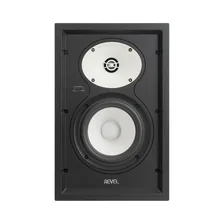 Ranked #3 of 18 in In-Wall & In-Ceiling Speakers - Revel W126Be: $3,849.90 per pair Crutchfield eBay
Pros: Revel’s own measurement, published on spinorama.org, gives a preference score of 5.39, or 7.97 with a perfect subwoofer, with a smooth predicted in-room response (0.85 smoothness). Directivity is tightly controlled (SPDI deviation 2.01dB) and on-axis deviation averages only 0.34dB. Bass measures to 62.6Hz at -6dB. It pairs a 1” beryllium dome tweeter and acoustic lens waveguide with a 6.5” aluminum cone woofer, rated at 89dB sensitivity and 105dB maximum output. Measured bass extension of 89.7Hz (-3dB).
Cons: The measurement comes from Revel, digitized from its published curves, and has no independent second test, so treat the figures as manufacturer supplied. Bass is limited, with -3dB at 89.7Hz, so a subwoofer is needed for full range sound. At $1925 each a stereo pair costs twice that, and the optional back box is sold separately. A single 6.5” woofer gives less output than the dual-woofer W226Be.
Full Revel W126Be review and specifications →
| Bass Extension (-10dB) | 42.5Hz (measured, Revel vendor data on spinorama.org) |
|---|---|
| Bass Extension (-3dB) | 89.7Hz (measured, Revel vendor data on spinorama.org) |
| Crossover Frequency | 2,100Hz |
| DIY Kit | No |
| Dimensions | 15.6”H x 10.2”W x 3.8”D (395 x 260 x 97 mm) (88.7mm mounting depth) |
| Drivers | 6.5” Deep Ceramic Composite (DCC) aluminum cone woofer, 1” beryllium dome tweeter with acoustic lens waveguide (2-way) |
| Enclosure | In-wall, 9-18L enclosure (optional W126BEBB back box sold separately) |
| Frequency Response | 55Hz-40kHz (-6dB, manufacturer) |
| Impedance | 6 ohms nominal (4 ohm minimum) |
| Maximum SPL | 105dB (manufacturer specified) |
| Mounting Cutout | 226W x 357H mm |
| Power Handling | 50-150W RMS at 4 ohms |
| Sensitivity | 89dB |
| Spinorama Preference Score | 5.39 |
| Spinorama Preference Score with Perfect Sub | 7.97 |
| Weight | 10.4 lbs (4.7 kg) |
- Links
- Reviews, Comparisons and Sound Samples
- Head-to-Head Comparisons
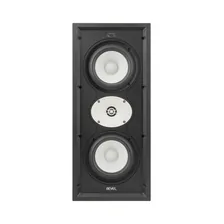 Ranked #4 of 18 in In-Wall & In-Ceiling Speakers - Revel W226Be: $4,949.90 per pair Crutchfield eBay
Pros: Revel’s own measurement, published on spinorama.org, gives a preference score of 5.51, or 7.60 with a perfect subwoofer. Bass measures to 48.1Hz at -3dB and 43.7Hz at -6dB, deeper than the single-woofer W126Be, and directivity is well controlled (SPDI deviation 1.95dB). Dual 6.5” aluminum cone woofers and a 1” beryllium dome tweeter behind an acoustic lens waveguide give 90dB sensitivity and a rated 110dB maximum output, and it accepts 50-200W of amplifier power. Measured bass extension of 48.1Hz (-3dB).
Cons: The measurement comes from Revel, digitized from its published curves, and has no independent second test, so treat the figures as manufacturer supplied. At $2475 each a stereo pair costs twice that, and the back box is not included and is sold separately. Predicted in-room smoothness (0.81) and on-axis deviation (0.33dB) are good but not ahead of the cheaper W126Be, so the extra cost buys bass and output rather than a cleaner midrange.
Full Revel W226Be review and specifications →
| Bass Extension (-10dB) | 36.4Hz (measured, Revel vendor data on spinorama.org) |
|---|---|
| Bass Extension (-3dB) | 48.1Hz (measured, Revel vendor data on spinorama.org) |
| Crossover Frequency | 2,000Hz |
| DIY Kit | No |
| Dimensions | 23”H x 10.2”W x 3.8”D (583 x 259 x 96 mm) (88mm mounting depth) |
| Drivers | 2x 6.5” Deep Ceramic Composite (DCC) aluminum cone woofers, 1” beryllium dome tweeter with acoustic lens waveguide (2-way) |
| Enclosure | In-wall, 18-36L enclosure (optional W226BEBB back box sold separately) |
| Frequency Response | 43Hz-40kHz (-6dB, manufacturer) |
| Impedance | 6 ohms nominal (4 ohm minimum) |
| Maximum SPL | 110dB (manufacturer specified) |
| Mounting Cutout | 226W x 549H mm |
| Power Handling | 50-200W RMS at 4 ohms |
| Sensitivity | 90dB |
| Spinorama Preference Score | 5.51 |
| Spinorama Preference Score with Perfect Sub | 7.60 |
| Weight | 15.7 lbs (7.1 kg) |
- Links
- Reviews, Comparisons and Sound Samples
- Head-to-Head Comparisons
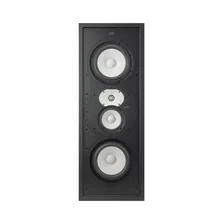 Ranked #5 of 18 in In-Wall & In-Ceiling Speakers - Revel W228Be: $7,699.90 per pair Crutchfield eBay
Pros: Revel’s own measurement, published on spinorama.org, gives a preference score of 6.79, or 8.33 with a perfect subwoofer. Bass measures to 43.4Hz at -3dB and 34.3Hz at -6dB, exceptional for an in-wall, and predicted in-room response is very smooth (0.91 smoothness) with tightly controlled directivity (SPDI deviation 1.89dB). Its three-way design uses dual 8” aluminum woofers, a 5.25” midrange and a 1” beryllium tweeter, rated for 115dB output, and the midrange and tweeter module rotates for vertical or horizontal mounting. Measured bass extension of 43.4Hz (-3dB).
Cons: Audio Science Review’s independent Klippel measurement was far weaker than Revel’s own (preference score 2.31, or 6.15 with a subwoofer, and -3dB at 108Hz), so real bass depends heavily on the installation and enclosure. The Revel figures are manufacturer supplied and digitized. At $3850 each a stereo pair costs twice that, and the speaker is about 939mm tall and 14.3kg with a 27 to 54 liter enclosure requirement, with the back box sold separately.
Full Revel W228Be review and specifications →
| Bass Extension (-10dB) | 26.9Hz (measured, Revel vendor data on spinorama.org) |
|---|---|
| Bass Extension (-3dB) | 43.4Hz (measured, Revel vendor data on spinorama.org) |
| Crossover Frequency | 220Hz, 2,500Hz |
| DIY Kit | No |
| Dimensions | 37”H x 13.9”W x 4.1”D (939 x 353 x 105 mm) (96mm mounting depth) |
| Drivers | 2x 8” DCC aluminum woofers, 5.25” DCC aluminum midrange, 1” beryllium dome tweeter with acoustic lens waveguide (3-way) |
| Enclosure | In-wall, 27-54L enclosure (optional W228BEBB back box sold separately) |
| Frequency Response | 35Hz-40kHz (-6dB, manufacturer) |
| Impedance | 6 ohms nominal (4 ohm minimum) |
| Maximum SPL | 115dB (manufacturer specified) |
| Mounting Cutout | 309W x 896H mm |
| Power Handling | 50-400W RMS at 4 ohms |
| Sensitivity | 90dB |
| Spinorama Preference Score | 6.79 |
| Spinorama Preference Score with Perfect Sub | 8.33 |
| Weight | 31.5 lbs (14.3 kg) |
- Links
- Reviews, Comparisons and Sound Samples
- Head-to-Head Comparisons
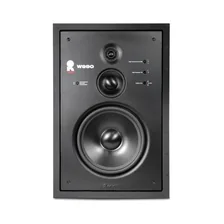 Ranked #15 of 18 in In-Wall & In-Ceiling Speakers - Revel W990: $4,239.90 per pair Crutchfield eBay
Pros: Audio Science Review’s Klippel measurement shows some of the deepest bass of any in-wall speaker, with -3dB at 32.2Hz and -6dB at 27.8Hz, so it can carry music without a subwoofer better than most. Directivity is well controlled (SPDI deviation 1.95dB). It is a three-way with a 9” woofer, a 3.5” midrange and a 1” aluminum dome tweeter, accepts 10-200W of amplifier power, and offers high frequency level, tilt, boundary compensation and listener axis controls to tune it to the room. Measured bass extension of 32.2Hz (-3dB), with a measured sensitivity of 85.9dB.
Cons: Its measured preference score is only 3.6, or 5.09 with a perfect subwoofer, because the midrange is uneven: on-axis deviation is high (0.86 normalized deviation on axis, 0.69 in the listening window) and on-axis smoothness is just 0.34. ASR’s computed sensitivity is about 85.9dB, so it needs more amplifier power than most speakers to play loud. At $2120 each a stereo pair costs twice that, which is a high price for the measured performance.
Full Revel W990 review and specifications →
| Bass Extension (-10dB) | 22.4Hz (measured, Audio Science Review) |
|---|---|
| Bass Extension (-3dB) | 32.2Hz (measured, Audio Science Review) |
| DIY Kit | No |
| Dimensions | 20.7”H x 13.9”W x 4.1”D (527 x 352 x 103 mm) (95mm mounting depth) |
| Drivers | 9” micro-ceramic composite (MCC) woofer, 3.5” midrange, 1” aluminum dome tweeter with waveguide (3-way) |
| Enclosure | In-wall, passive |
| Mounting Cutout | 318W x 486H mm |
| Power Handling | 10-200W RMS recommended amplifier power |
| Sensitivity | 85.9dB (measured, Audio Science Review) |
| Spinorama Preference Score | 3.60 |
| Spinorama Preference Score with Perfect Sub | 5.09 |
| Warranty | 5 years |
| Weight | 17 lbs (7.7 kg) |
- Links
- Reviews, Comparisons and Sound Samples
- Head-to-Head Comparisons
Discontinued Revel Models
Still ranked, and often still worth buying used, but no longer in production. Check availability before planning around one of these.
Medium Size Bookshelf Speakers
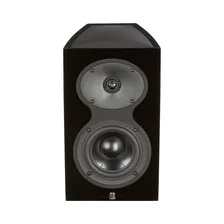 Ranked #13 of 90 in Medium Size Bookshelf Speakers - Revel M105: $1500 per pair Discontinued eBay
Pros: CEA2034 spinorama shows an essentially flat on-axis response with only a small 5kHz peak, a smooth listening window, and clean waterfall decay. Wide horizontal dispersion gives flexibility with toe-in. The reviewer called it reference-quality performance with minor EQ correction applied. Measured bass extension of 63Hz (-3dB), with a measured sensitivity of 85dB.
Cons: Low nominal impedance demands a capable amplifier that can handle low-impedance loads. Bass distortion runs high in the 80-250Hz range from woofer displacement, and maximum output is limited compared to larger designs. Discontinued.
Full Revel M105 review and specifications →
| Bass Extension (-10dB) | 49.8Hz (derived, log-interpolated between spinorama.org -9dB/-12dB points) |
|---|---|
| Bass Extension (-3dB) | 63Hz (measured, Audio Science Review) |
| DIY Kit | No |
| Dimensions | 14”H x 7.9”W x 9.8”D (355.6 x 200.7 x 248.9 mm) |
| Drivers | 5.25” aluminum cone woofer, 1” aluminum tweeter with acoustic lens waveguide |
| Frequency Response | 60Hz - 44kHz (+/-3dB) (Manufacturer specified) |
| Impedance | 8 ohms nominal, low minimum |
| Sensitivity | 85dB (2.83V/1m, measured, Audio Science Review) |
| Spinorama Preference Score | 5.76 |
| Spinorama Preference Score with Perfect Sub | 8.18 |
| Weight | 15.4 lbs (7 kg) each |
| Woofer Cabinet | ported, rear |
- Links
- Reviews, Comparisons and Sound Samples
- Head-to-Head Comparisons
Large Size Bookshelf Speakers
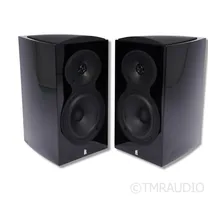 Ranked #9 of 134 in Large Size Bookshelf Speakers - Revel M106 Discontinued eBay
Newer model: the Revel M126Be, ranked lower, rated 4.3/5.
Pros: CEA2034 spinorama shows a fairly even on-axis response with no obvious resonances, and a listening window that sits comfortably above the on-axis curve. Predicted in-room response is called “near ideal” by the reviewer, with a smooth downward slope from bass to treble. Distortion at 96dB SPL/1m stays well controlled through the midrange and treble. Measured bass extension of 60Hz (-3dB), with a measured sensitivity of 86dB.
Cons: Some directivity error and response variation shows up in the crossover region. Horizontal beamwidth of about ±50 degrees is on the narrower side. Vertical directivity requires staying within about ±20 degrees of the reference axis for accurate tonal balance. Minimum impedance dips to 4.6 ohms with several peaks, a moderately demanding load for a compact bookshelf speaker. Discontinued.
Full Revel M106 review and specifications →
| Bass Extension (-10dB) | 43Hz (measured, Audio Science Review) |
|---|---|
| Bass Extension (-3dB) | 60Hz (measured, Audio Science Review) |
| DIY Kit | No |
| Dimensions | 15”H x 8.3”W x 11”D (381.0 x 210.8 x 279.4 mm) |
| Drivers | 6.5” (16.5 cm) Aluminum Cone, Cast-frame Woofer, 1” (2.5 cm) Aluminum Tweeter with Acoustic Lens Waveguide |
| Impedance | 4 ohms |
| Sensitivity | 86dB (measured, Audio Science Review) |
| Spinorama Preference Score | 5.62 |
| Spinorama Preference Score with Perfect Sub | 7.87 |
| Weight | 9.9 lbs (4.5 kg) |
| Woofer Cabinet | ported, rear |
- Links
- Reviews, Comparisons and Sound Samples
- Head-to-Head Comparisons
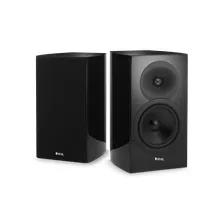 Ranked #51 of 134 in Large Size Bookshelf Speakers - Revel Concerta2 M16: $600 per pair used (about) Discontinued eBay
Pros: CEA2034 spinorama shows an on-axis response that’s essentially flat from 200Hz to 10kHz, with some bass boost around 100Hz. Predicted in-room response is very nice, with just extra bass and a bit of roll-off above 20kHz: the reviewer calls it “nice!” Distortion is well controlled through most of the range at both test levels. Measured bass extension of 60.1Hz (-3dB).
Cons: Harmonic distortion shows a notable peak around 80Hz and a sharp spike around 350Hz, plus the woofer appears to get a bit unhappy right before handing off to the tweeter. Cumulative spectral decay (waterfall) shows some lingering resonances in the 300Hz-1kHz region. The reviewer cautions not to over-cover the cabinet/grille area with thin fabric, as it can audibly affect the top-end response. Discontinued.
Full Revel Concerta2 M16 review and specifications →
| Bass Extension (-10dB) | 41.6Hz (measured, Audio Science Review) |
|---|---|
| Bass Extension (-3dB) | 60.1Hz (measured, Audio Science Review) |
| DIY Kit | No |
| Dimensions | 14.8”H x 8.6”W x 10.8”D (374.7 x 218.4 x 273.3 mm) |
| Drivers | 25mm tweeter + 165mm woofer |
| Impedance | 6 ohms |
| Sensitivity | 86dB |
| Spinorama Preference Score | 5.06 |
| Spinorama Preference Score with Perfect Sub | 7.28 |
| Weight | 32 lbs (14.5 kg) |
| Woofer Cabinet | ported, rear |
- Links
- Reviews, Comparisons and Sound Samples
- Head-to-Head Comparisons
- Revel Concerta2 M16 vs ELAC Uni-Fi Reference UBR62
- Revel Concerta2 M16 vs JBL HDI-1600
- Revel Concerta2 M16 vs ELAC DBR62
- Revel Concerta2 M16 vs Yamaha NS-800A
- Revel Concerta2 M16 vs Definitive Technology Demand D11
- Revel Concerta2 M16 vs ELAC Debut 3.0 DB63
- Revel Concerta2 M16 vs Technics SB-C700
- Revel Concerta2 M16 vs Emotiva Airmotiv XB2
- See all 27 comparisons
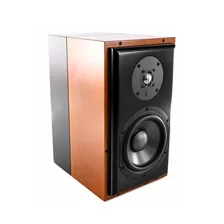 Ranked #98 of 134 in Large Size Bookshelf Speakers - Revel Performa M22: $600 per pair used (about) Discontinued eBay
Pros: Very flat frequency response from 200Hz to 10kHz. Distortion is well controlled through most of the range, with only a modest crossover-region bump around 2-4kHz. Measured bass extension of 46.9Hz (-3dB).
Cons: 3dB bass boost around 100Hz. On-axis response also droops below 150Hz and peaks above 4kHz, which the reviewer thought may sound a bit bright/light. Distortion rises substantially below 100Hz when driven hard. Discontinued.
Full Revel Performa M22 review and specifications →
| Bass Extension (-10dB) | 37.1Hz (derived, log-interpolated between spinorama.org -9dB/-12dB points) |
|---|---|
| Bass Extension (-3dB) | 46.9Hz (measured, Audio Science Review) |
| DIY Kit | No |
| Dimensions | 14.5”H x 8.6”W x 11.9”D (368.3 x 219.1 x 301.6 mm) |
| Drivers | 25mm tweeter + 200mm woofer |
| Impedance | 4 ohms |
| Sensitivity | 85dB |
| Spinorama Preference Score | 5.31 |
| Spinorama Preference Score with Perfect Sub | 7.26 |
| Weight | 41.7 lbs (18.9 kg) |
| Woofer Cabinet | ported, rear |
- Reviews, Comparisons and Sound Samples
- Head-to-Head Comparisons
- Revel Performa M22 vs Focal Aria 906
- Revel Performa M22 vs Polk Reserve R100
- Revel Performa M22 vs Polk R200
- Revel Performa M22 vs Sonus Faber Lumina II
- Revel Performa M22 vs Polk Monitor XT20
- Revel Performa M22 vs KEF Q3 Meta
- Revel Performa M22 vs JBL XPL-90
- Revel Performa M22 vs SVS Prime Bookshelf
- See all 29 comparisons
Large Size Floorstanding Speakers
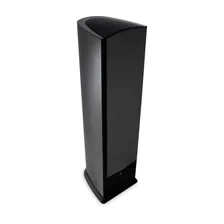 Ranked #16 of 74 in Large Size Floorstanding Speakers - Revel F208: $4,800 per pair used Discontinued eBay
Newer model: the Revel F228Be, ranked lower, rated 4.5/5.
Pros: CEA2034 spinorama shows a fairly even on-axis response with sensitivity matching spec at ~87-88dB. Predicted in-room response is a smooth, textbook-quality downward slope that should translate well to most rooms without correction. Early reflections sum so cleanly with the direct sound that side-wall absorption isn’t recommended: it would work against the speaker’s naturally well-integrated off-axis behavior. Distortion stays below 0.5% from 100Hz up at 96dB/1m, with all distortion components falling below audible threshold above 200Hz. Very wide horizontal directivity of about ±75 degrees. Measured performance was judged very close to Revel’s own flagship Salon2, and Revel’s speakers (including this one) are developed using Harman’s double-blind listening test methodology. Preference score of 7.4 (7.7 with a subwoofer added). Measured bass extension of 47Hz (-3dB), with a measured sensitivity of 88.2dB.
Cons: Some directivity error and tweeter-response ripple right at the 2.2kHz crossover point. A notable on-axis dip at about 4kHz, attributed to probable cabinet diffraction. Cumulative spectral decay (waterfall) shows an unexplained resonance around 4-5kHz that the reviewer couldn’t pin down a clear cause for. Vertical directivity shows narrowband interference nulls just above and below the tweeter axis (roughly 2-3kHz), typical of a non-coaxial tower with vertically separated drivers, so listening height matters more than it would with a coincident design. Minimum impedance dips to 3.4 ohms, calling for a robust, high-current amplifier. Distortion climbs substantially below about 80-100Hz (up to ~5% in the deep bass) when driven hard, an excursion-limited trade-off typical of towers at high output. Isolating the woofers alone shows their usable range ending around 500-700Hz at the crossover, with somewhat elevated (though still low in absolute terms) 2nd/3rd harmonic distortion in the 100-300Hz region. Discontinued.
Full Revel F208 review and specifications →
| Bass Extension (-10dB) | 24Hz (measured, Audio Science Review) |
|---|---|
| Bass Extension (-3dB) | 47Hz (measured, Audio Science Review) |
| DIY Kit | No |
| Dimensions | 46.6”H x 13.5”W x 14.8”D (1183.6 x 342.9 x 375.9 mm) |
| Drivers | Dual 8” (20 cm) Aluminum Cone, Cast-frame Woofers, 5.25” (13.3 cm) Aluminum Cone, Cast-frame Midrange, 1” (2.5 cm) Aluminum Tweeter with Acoustic Lens Waveguide |
| Impedance | 8 ohms nominal, 3.5 ohms minimum (measured, Audio Science Review) |
| Sensitivity | 88.2dB (measured by Audio Science Review; 88.5dB manufacturer specified) |
| Spinorama Preference Score | 6.35 |
| Spinorama Preference Score with Perfect Sub | 7.67 |
| Weight | 79.4 lbs (36 kg) each |
| Woofer Cabinet | ported, front |
- Links
- Reviews, Comparisons and Sound Samples
- Head-to-Head Comparisons
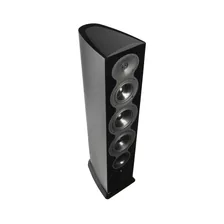 Ranked #18 of 74 in Large Size Floorstanding Speakers - Revel F206: $2000 per pair used Discontinued eBay
Newer model: the Revel F226Be, ranked higher, rated 4.6/5.
Pros: CEA2034 spinorama shows a pretty even on-axis response. Predicted in-room response is excellent, with a smooth downward slope. Horizontal beamwidth of about ±65 degrees is wide, if a bit uneven. Distortion is very nice at 86dB SPL/1m, falling below the frequency range where human hearing is most sensitive, and stays excellent even at 96dB SPL/1m. Near-field measurements of the individual drivers show nice suppression of port and woofer resonances. Really amazing value for the performance. Measured bass extension of 60Hz (-3dB), with a measured sensitivity of 87dB.
Cons: Some directivity error and a small peak around 4.5kHz show up alongside the directivity error around 3kHz. Vertical directivity means listening position needs to stay within the tweeter axis, though the reviewer notes there is some leeway. Minimum impedance dips to 3.3 ohms, calling for an amplifier comfortable with a demanding load. Discontinued.
Full Revel F206 review and specifications →
| Bass Extension (-10dB) | 34Hz (measured, Audio Science Review) |
|---|---|
| Bass Extension (-3dB) | 60Hz (measured, Audio Science Review) |
| DIY Kit | No |
| Dimensions | 40.3”H x 8.4”W x 12.2”D (1023.6 x 213.4 x 309.9 mm) |
| Drivers | Dual 6.5” (16.5 cm) Aluminum Cone, Cast-frame Woofers, 5.25” (13.3 cm) Aluminum Cone, Cast-frame Midrange, 1” (2.5 cm) Aluminum Tweeter with Acoustic Lens Waveguide |
| Impedance | 4 ohms nominal (3.3 ohms minimum, measured by Audio Science Review) |
| Sensitivity | 87dB (measured, Audio Science Review) |
| Spinorama Preference Score | 5.51 |
| Spinorama Preference Score with Perfect Sub | 7.52 |
| Weight | 57.3 lbs (26 kg) each |
| Woofer Cabinet | ported, front |
- Links
- Reviews, Comparisons and Sound Samples
- Head-to-Head Comparisons
Small Home Subwoofers (Under 30 lbs)
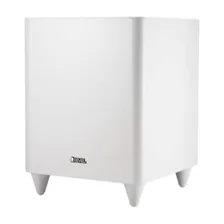 Ranked #13 of 48 in Small Home Subwoofers (Under 30 lbs) - Revel B8: $500 Discontinued eBay
Pros: Independent CEA-2010 testing records 54.7 dB at 20 Hz and 111.5 dB through 40-80 Hz. The sealed enclosure with 8” (203mm) driver is best suited to upper-bass support in a modest room.
Cons: Deep-bass output is limited relative to its midbass result, so it is not the right choice for the lowest movie effects. The 353.1H x 266.7W x 266.7D mm cabinet and 9.0 kg mass still need deliberate placement and calibration. Discontinued.
Full Revel B8 review and specifications →
| CEA-2010-A Average (40-80Hz) | 111.5 dB |
|---|---|
| Cabinet Color | black, white |
| Country | United States |
| Dimensions | 13.9”H x 10.5”W x 10.5”D (353.1 x 266.7 x 266.7 mm) |
| Drivers | 8” (203mm) driver |
| Enclosure | sealed |
| Measurement Source | Brent Butterworth |
| Output SPL at 20 Hz | 54.7 dB |
| Output SPL at 25 Hz | 72.7 dB |
| Output SPL at 31.5 Hz | 96.8 dB |
| Output SPL at 40 Hz | 105.3 dB |
| Output SPL at 50 Hz | 109.6 dB |
| Output SPL at 63 Hz | 115.1 dB |
| Output SPL at 80 Hz | 116.2 dB |
| Warranty | 5 |
| Weight | 19.8 lbs (9.0 kg) |
- Links
- Reviews, Comparisons and Sound Samples
- Independently measured by Brent Butterworth; the published figures above come from this ASR subwoofer measurement thread.
- Head-to-Head Comparisons