Short answer: the Wharfedale Diamond 12.1i, if you are buying new. The Wharfedale Diamond 12.1 ranks higher than the Micca RB42 (#32 vs #137 of 160 bookshelf speakers) but is discontinued; its replacement, the Wharfedale Diamond 12.1i, is rated 4.0/5 at $499 and is still sold new.
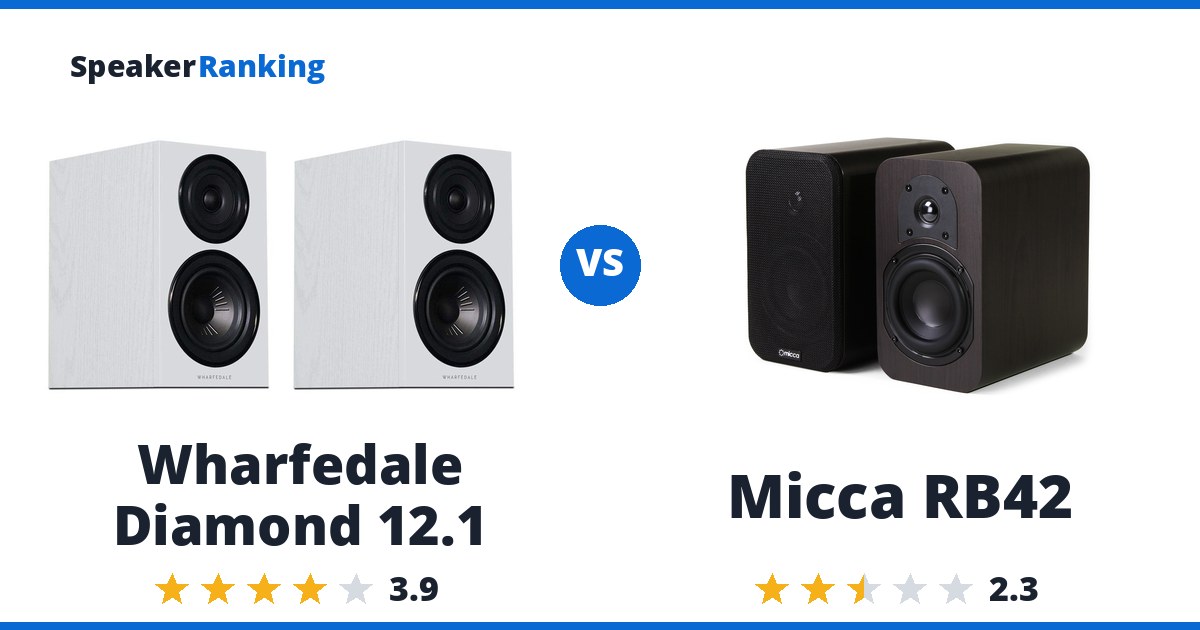
The Wharfedale Diamond 12.1 is the better-sounding, deeper-bass pick. A budget two-way bookshelf speaker (5” polypropylene woofer, 1” textile dome tweeter) that measures well for its price: harmonic distortion at 86dB stays under 1% THD down to about 60Hz, genuinely good for a 5” mid-woofer. Its bass reaches about 61Hz before falling 3dB, against 85Hz for the Micca RB42. Watch for: A dip of about 3dB in the 1-3kHz crossover region (on-axis, in the predicted in-room response, and even off-axis) gives the speaker a soft, “laid-back” character that noticeably saps attack and transient bite from drums, guitar and other percussive material: possibly an intentional BBC-style dip, but one the reviewer would still prefer tuned flat.
What the Micca RB42 does well: Curved cabinet fit and finish look closer to a speaker costing three times as much. The tradeoff: CEA2034 spinorama shows significant peaks and valleys in the on-axis and listening-window response starting a few kHz up, with excess high-frequency energy the reviewer found fatiguing over time despite an initial impression of “detail.”
Buy the Wharfedale Diamond 12.1i, the replacement for the discontinued Wharfedale Diamond 12.1; it is rated higher for sound quality than the Micca RB42.
Still deciding? The full Passive Home rankings cover every ranked option.
Specifications Side By Side
| Wharfedale Diamond 12.1 | Micca RB42 | |
|---|---|---|
| Price | $599 per pair Discontinued | $159.99 per pair |
| Ranked | #32 of 160 in Medium Size Bookshelf Speakers | #137 of 160 in Medium Size Bookshelf Speakers |
| Bass Extension (-10dB) | 46Hz (measured, Erin’s Audio Corner) | 62Hz (measured, Audio Science Review) - the reviewer noted an artificial boost around 100-300Hz, so true extension may be worse than this on-axis reading suggests |
| Bass Extension (-3dB) | 61Hz (measured, Erin’s Audio Corner) | 85Hz (measured, Audio Science Review) - the reviewer noted an artificial boost around 100-300Hz, so true extension may be worse than this on-axis reading suggests |
| Crossover Frequency | 2.6kHz | - |
| Dimensions | 12.2”H x 7”W x 10.9”D (310 x 178 x 277 mm) | 8.7H x 4.9W x 7.9D in |
| Impedance | 8 ohms nominal (3.9 ohms minimum above 80Hz, measured, Erin’s Audio Corner) | 4-8 ohms |
| Sensitivity | 84dB (measured by Erin’s Audio Corner; 87dB manufacturer specified) | 80dB (2.83V/1m, measured, Audio Science Review) |
| Drivers | 5” advanced polypropylene cone woofer, 1” textile dome tweeter | 4” coated paper woofer, 0.75” silk dome tweeter |
| Weight | 15 lbs (6.8 kg) each | 6 lbs (2.7 kg) each (per retailer listing) |
| Woofer Cabinet | ported | ported, front |
| Spinorama Preference Score | 5.01 | 4.59 |
| Spinorama Preference Score with Perfect Sub | 7.42 | 6.87 |
| DIY Kit | No | No |
| Frequency Response | - | 50Hz - 20kHz (Manufacturer specified, typical in-room) |
| Power Handling | - | 15-100W each |
Related Speaker Comparisons
More worthwhile head-to-heads for Wharfedale Diamond 12.1:
- Audio First Fidelia vs Wharfedale Diamond 12.1
- Ascend Sierra 1 v2 vs Wharfedale Diamond 12.1
- KEF LS50 Meta vs Wharfedale Diamond 12.1
- Arendal 1961 Monitor vs Wharfedale Diamond 12.1
- Wharfedale Diamond 12.1 vs Moondrop M4P MTM
Prices on this page were last checked October 7, 2026 at 9:25 PM UTC. Product prices and availability are accurate as of that date/time and are subject to change; the price and availability shown on Amazon at the time of purchase will apply to the purchase of this product.
As an eBay Partner, we may be compensated if you make a purchase.
The Two Speakers In Full
 Wharfedale Diamond 12.1: $599 per pair Discontinued eBay
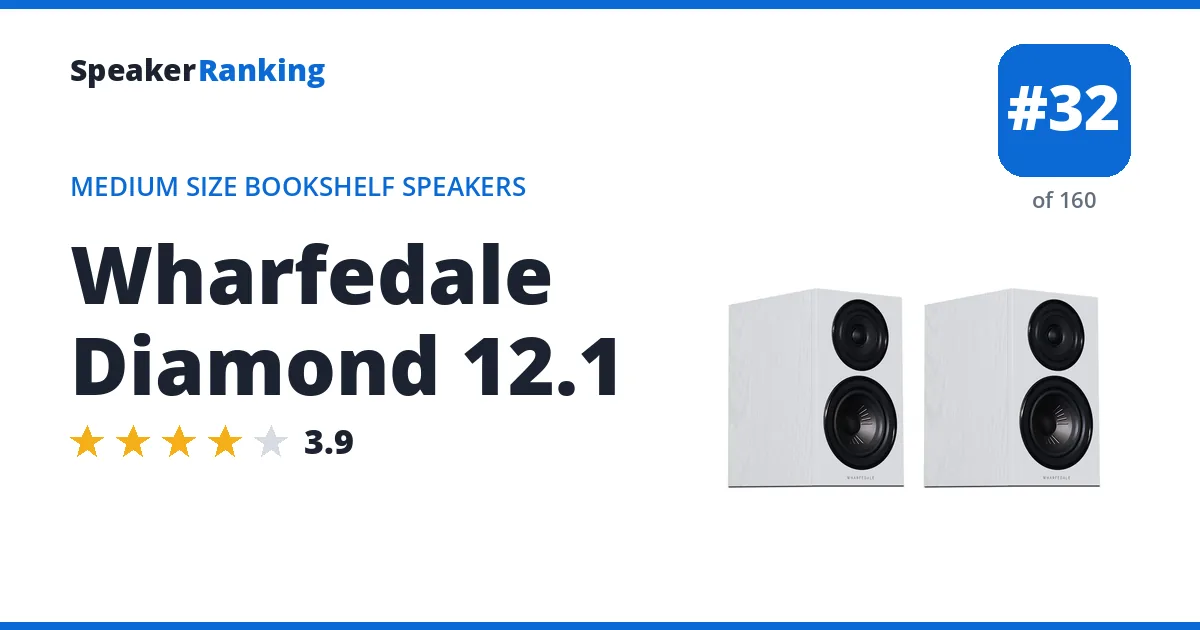
Newer model: the Wharfedale Diamond 12.1i, ranked higher, estimated 4/5.
Older model: the Wharfedale Diamond 9.1 (rated 2.8/5).
Same family: the Wharfedale Diamond 12.0 (smaller bookshelf, ranked lower, estimated 3.1/5), the Wharfedale Diamond 12.2 (larger bookshelf, estimated 4.1/5), the Wharfedale Diamond 12.3 (smaller floorstanding, estimated 3.9/5), the Wharfedale Diamond 12.4 (larger floorstanding, estimated 4.1/5), the Wharfedale Diamond 12.C (smaller center, estimated 3.5/5) and the Wharfedale Diamond 12.Ci (larger center, estimated 3.6/5).
Pros: A budget two-way bookshelf speaker (5” polypropylene woofer, 1” textile dome tweeter) that measures well for its price: harmonic distortion at 86dB stays under 1% THD down to about 60Hz, genuinely good for a 5” mid-woofer. Wide horizontal radiation of about ±60° up to roughly 5kHz before the tweeter starts to beam. Tonally smooth and easy to listen to at moderate volumes, with a pleasant, non-fatiguing character the reviewer said he’d happily recommend to someone who wants noticeably better fit, finish and looks than typical speakers in the $300-400 range. A high-pass crossover around 80Hz meaningfully cleans up midrange multitone distortion, so pairing it with a subwoofer helps more than usual for a speaker this size. Measured bass extension of 61Hz (-3dB), with a measured sensitivity of 84dB.
Cons: A dip of about 3dB in the 1-3kHz crossover region (on-axis, in the predicted in-room response, and even off-axis) gives the speaker a soft, “laid-back” character that noticeably saps attack and transient bite from drums, guitar and other percussive material: possibly an intentional BBC-style dip, but one the reviewer would still prefer tuned flat. Vertical directivity is unusually tight for this class of speaker, holding together only within about ±5° of the tweeter axis before a real hole opens up in the response, so seating height matters a lot more than on most bookshelf designs. Diffraction artifacts around 3kHz and 5kHz show up as differences between the listening-window and on-axis curves. Distortion climbs well past acceptable levels at higher output: harmonic distortion exceeds 3% around 150Hz at 96dB (versus under 1% at 86dB), multitone distortion tops 10% at 96dB/1m, and real compression sets in between 96-102dB (about 1.5dB of lost dynamic range around 300Hz at 102dB/1m, roughly equivalent to 92dB for a pair at 4m in a room). A genuine limitation on how loud or how far away this speaker can be pushed. Measured average sensitivity (84dB) runs a few dB below the 87dB spec. Only a 5” woofer, so a subwoofer is required for real bass. Discontinued.
Full Wharfedale Diamond 12.1 review and specifications →
| Bass Extension (-10dB) | 46Hz (measured, Erin’s Audio Corner) |
|---|---|
| Bass Extension (-3dB) | 61Hz (measured, Erin’s Audio Corner) |
| Crossover Frequency | 2.6kHz |
| DIY Kit | No |
| Dimensions | 12.2”H x 7”W x 10.9”D (310 x 178 x 277 mm) |
| Drivers | 5” advanced polypropylene cone woofer, 1” textile dome tweeter |
| Impedance | 8 ohms nominal (3.9 ohms minimum above 80Hz, measured, Erin’s Audio Corner) |
| Sensitivity | 84dB (measured by Erin’s Audio Corner; 87dB manufacturer specified) |
| Spinorama Preference Score | 5.01 |
| Spinorama Preference Score with Perfect Sub | 7.42 |
| Weight | 15 lbs (6.8 kg) each |
| Woofer Cabinet | ported |
- Links
- Reviews, Comparisons and Sound Samples
- Erin’s Audio Corner: Wharfedale 12.1 Budget Bookshelf Speaker with “Laid Back” sound but output limited. More from Erin’s Audio Corner →
- Audio Science Review Wharfedale Diamond 12.1 More from Audio Science Review →
- Erin’s Audio Corner Website: Wharfedale Diamond 12.1
- Audio Science Review Measurements (spinorama.org)
- Head-to-Head Comparisons
- Wharfedale Diamond 12.1 vs Carmody S2000
- Wharfedale Diamond 12.1 vs Wharfedale Super Denton
- Wharfedale Diamond 12.1 vs Klipsch RP-500M II
- Wharfedale Diamond 12.1 vs Radiant Acoustics Clarity 4.2
- Wharfedale Diamond 12.1 vs Monitor Audio Silver 50 7G
- Wharfedale Diamond 12.1 vs KEF Q150
- Wharfedale Diamond 12.1 vs Revel M105
- Wharfedale Diamond 12.1 vs Moondrop M4P MTM
- See all 37 comparisons
 Micca RB42: $159.99 per pair Amazon eBay
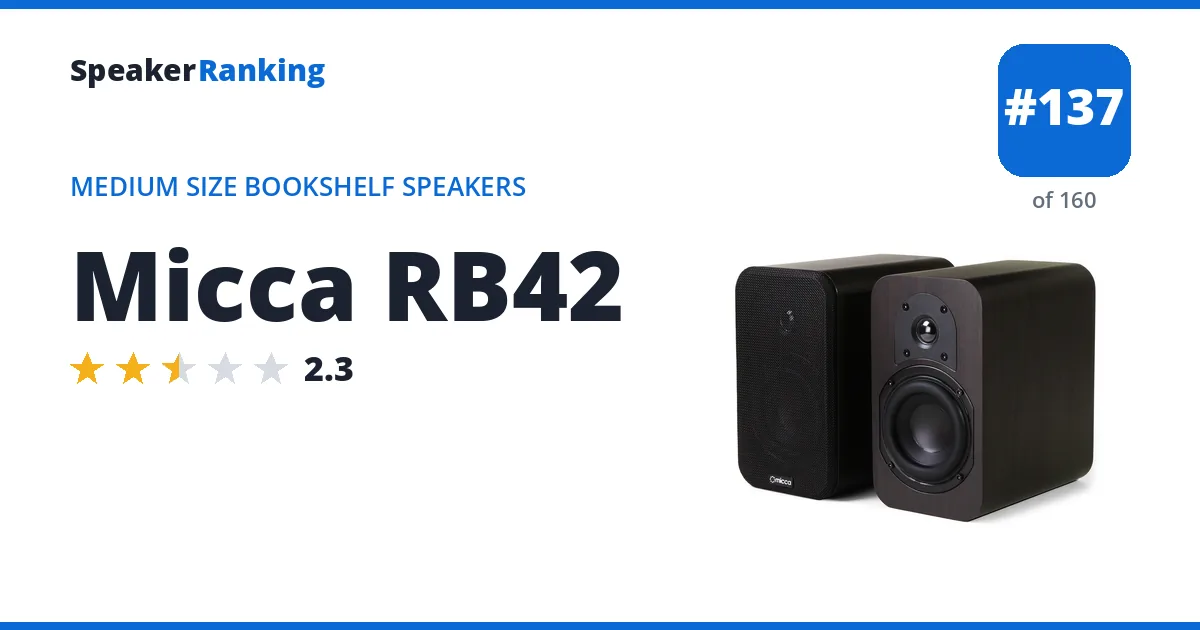
Same family: the Micca RB42-C (center, estimated 2.1/5).
Pros: Curved cabinet fit and finish look closer to a speaker costing three times as much. Rated for a wide 15-100W amplifier range with 4-8 ohm compatibility, giving flexibility with modest amplification. Measured bass extension of 85Hz (-3dB), with a measured sensitivity of 80dB.
Cons: CEA2034 spinorama shows significant peaks and valleys in the on-axis and listening-window response starting a few kHz up, with excess high-frequency energy the reviewer found fatiguing over time despite an initial impression of “detail.” Off-axis response diverges heavily from on-axis, meaning tonality shifts with room and listening position in ways EQ can’t correct. Distorts and the woofer visibly flaps under moderate volume; low 83dB sensitivity makes it a harder amplifier load than its size suggests.
Full Micca RB42 review and specifications →
| Bass Extension (-10dB) | 62Hz (measured, Audio Science Review) - the reviewer noted an artificial boost around 100-300Hz, so true extension may be worse than this on-axis reading suggests |
|---|---|
| Bass Extension (-3dB) | 85Hz (measured, Audio Science Review) - the reviewer noted an artificial boost around 100-300Hz, so true extension may be worse than this on-axis reading suggests |
| DIY Kit | No |
| Dimensions | 8.7H x 4.9W x 7.9D in |
| Drivers | 4” coated paper woofer, 0.75” silk dome tweeter |
| Frequency Response | 50Hz - 20kHz (Manufacturer specified, typical in-room) |
| Impedance | 4-8 ohms |
| Power Handling | 15-100W each |
| Sensitivity | 80dB (2.83V/1m, measured, Audio Science Review) |
| Spinorama Preference Score | 4.59 |
| Spinorama Preference Score with Perfect Sub | 6.87 |
| Weight | 6 lbs (2.7 kg) each (per retailer listing) |
| Woofer Cabinet | ported, front |
- Links
- Reviews, Comparisons and Sound Samples
- Head-to-Head Comparisons