Short answer: the Ascend Sierra 1 v2 for better sound quality, the Wharfedale Diamond 12.1 for the lower price. The Ascend Sierra 1 v2 ranks #3 of 34 bookshelf speakers at $1000. The Wharfedale Diamond 12.1 ranks #10 at $599, $401 cheaper.
What the Ascend Sierra 1 v2 offers: Formaldehyde-free layered bamboo ply cabinet with a 1” dome tweeter over a 5.25” midwoofer, mated by a 4th-order acoustic crossover rather than a stock textbook design. Watch for: F3 of 55Hz and F10 of 39Hz mean in-room extension tops out in the mid-40s Hz; the reviewer still recommends a subwoofer for full-range material.
What the Wharfedale Diamond 12.1 offers: A budget two-way bookshelf speaker (5” polypropylene woofer, 1” textile dome tweeter) that measures well for its price: harmonic distortion at 86dB stays under 1% THD down to about 60Hz, genuinely good for a 5” mid-woofer. Watch for: A dip of about 3dB in the 1-3kHz crossover region (on-axis, in the predicted in-room response, and even off-axis) gives the speaker a soft, “laid-back” character that noticeably saps attack and transient bite from drums, guitar…
Buy the Ascend Sierra 1 v2 if sound quality matters more than the price. Buy the Wharfedale Diamond 12.1 if the price matters more than sound quality.
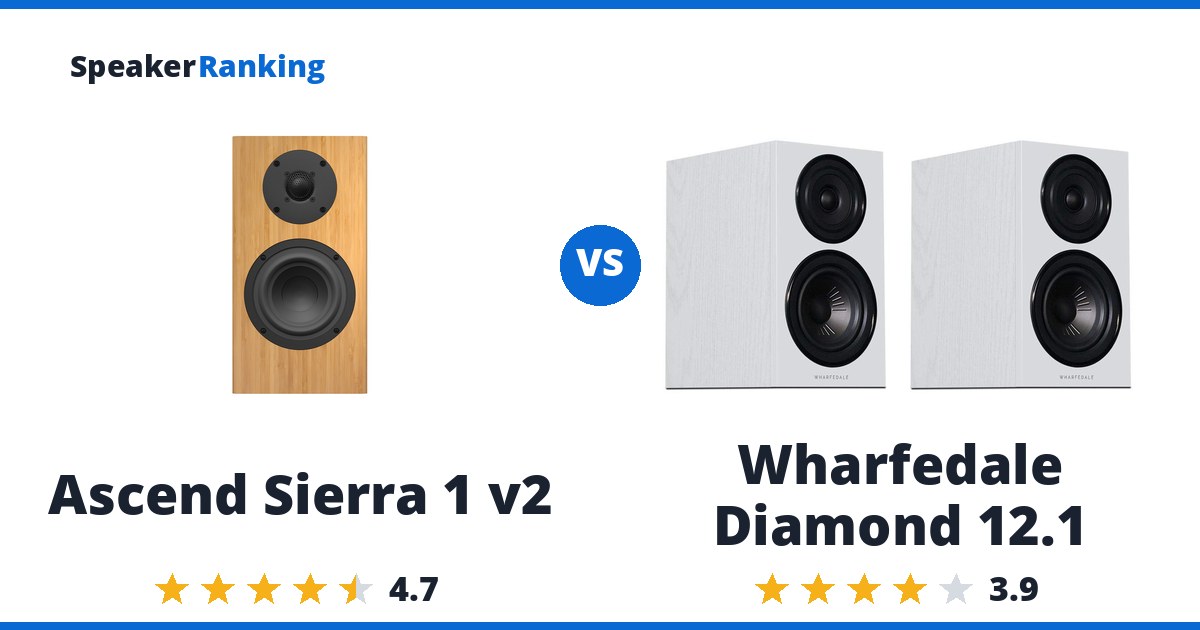
Specifications Side By Side
| Ascend Sierra 1 v2 | Wharfedale Diamond 12.1 | |
|---|---|---|
| Price | $1000 | $599 Discontinued |
| Ranked | #3 of 34 in Medium Size Bookshelf Speakers | #10 of 34 in Medium Size Bookshelf Speakers |
| Bass Extension (-10dB) | 39Hz (measured, Erin’s Audio Corner) | 46Hz (measured, Erin’s Audio Corner) |
| Bass Extension (-3dB) | 55Hz (measured, Erin’s Audio Corner) | 61Hz (measured, Erin’s Audio Corner) |
| Dimensions | 14.2"H x 7.5"W x 10.5"D (361.9 x 190.5 x 266.7 mm) | 12.2"H x 7"W x 10.9"D (310 x 178 x 277 mm) |
| Impedance | 8 ohms nominal, 7 ohms minimum (measured, Erin’s Audio Corner) | 8 ohms nominal (3.9 ohms minimum above 80Hz, measured, Erin’s Audio Corner) |
| Sensitivity | 81.5dB (measured, Erin’s Audio Corner) | 84dB (measured by Erin’s Audio Corner; 87dB manufacturer specified) |
| Drivers | 5.25" proprietary mineral-filled polypropylene cone with cast aluminum frame woofer, 26mm aluminum/magnesium alloy dome tweeter with titanium former (SEAS Titan) | 5" advanced polypropylene cone woofer, 1" textile dome tweeter |
| Weight | 18.5 lbs / 8.4 kg each | 15 lbs / 6.8 kg each |
| Woofer Cabinet | ported | ported |
| Crossover Frequency | - | 2.6kHz |
| Discontinued | - | Yes |
Related Speaker Comparisons
More useful head-to-heads from the same speaker class:
- Philharmonic Ceramic Mini vs Tekton Troubadour
- KEF LS50 Meta vs Zaph Audio ZA5.2 TM
- Arendal 1961 Monitor vs Philharmonic Ceramic Mini
- Ascend Sierra 1 v2 vs Totem Kin One
- Ascend Sierra 1 v2 vs Acoustic Energy AE100 Mk2
The Two Speakers In Full
 Ascend Sierra 1 v2: $1000 Ascendacoustics
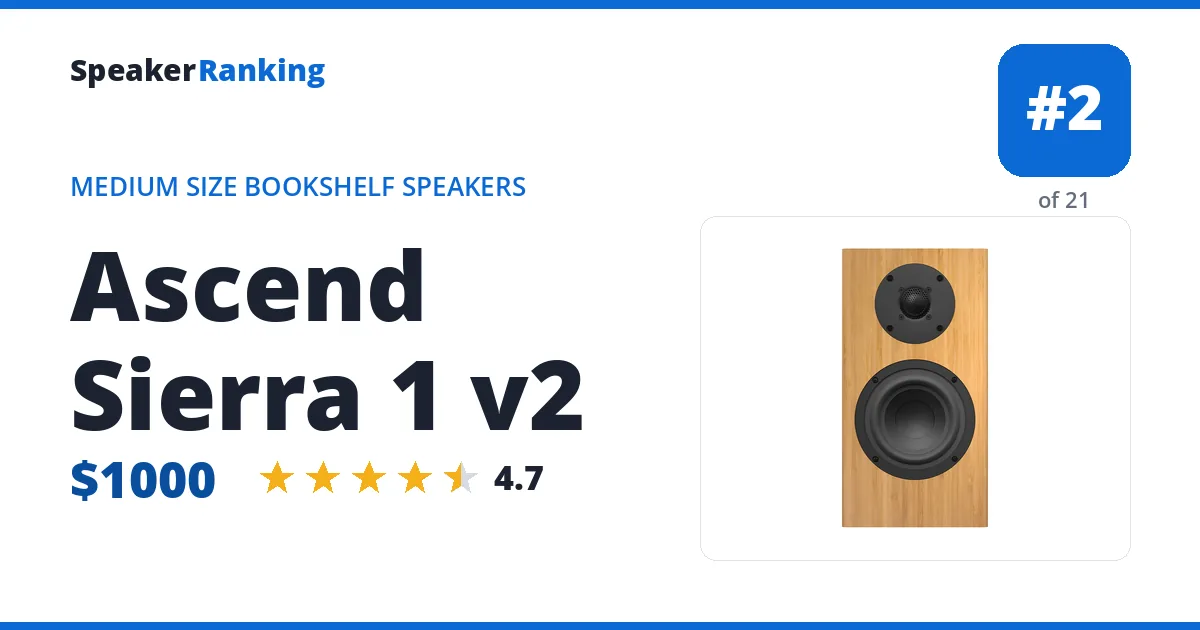
Pros: Formaldehyde-free layered bamboo ply cabinet with a 1” dome tweeter over a 5.25” midwoofer, mated by a 4th-order acoustic crossover rather than a stock textbook design. In-room response is extremely linear - the reviewer called it “textbook” - a clear step up from the earlier V1, which had boxiness around 700Hz-1kHz and sibilance around 4-6kHz. Preference score of 8.4 with a subwoofer (6.8 without), which the reviewer calls topnotch. Wide, even horizontal radiation of about ±70° up to 6kHz. Better vertical directivity than its tweeter-to-woofer spacing would suggest, thanks to the steep 4th-order crossover slopes. No mechanical noise, port chuffing, or woofer bottoming even driven to 96dB/1m. In a three-way comparison against the Dynaudio Emit 20 and a Revel bookshelf model (all around $1,000/pair), measured as the most linear of the three and was the reviewer’s personal pick over both, despite the Dynaudio’s deeper bass and higher output capability. Independent ASR Klippel measurements corroborate Erin’s findings: superb off-axis response with only slight on-axis variations, and an in-room response the reviewer called “incredibly smooth and accurate - amazing for a non-DSP speaker.” Distortion above 200Hz at 86dB/1m is very low for the class.
Cons: F3 of 55Hz and F10 of 39Hz mean in-room extension tops out in the mid-40s Hz; the reviewer still recommends a subwoofer for full-range material. Diffraction dips appear around 3kHz and 5-6kHz, and the 1” dome tweeter starts beaming above roughly 6.7kHz, narrowing the soundstage radiation in the top octave - a straightforward consequence of dome size rather than a design flaw. At 96dB/1m the 5.25” midwoofer shows increased distortion in the midrange, likely tied to motor topology; high-passing to a subwoofer around 80Hz largely clears it up. Moderate sensitivity (~81-82dB average) with a 7-ohm minimum impedance. ASR’s power-sweep testing found response holds steady up to 96dB SPL/1m, but pushing to 102dB causes midbass below 400Hz to sag with distortion “through the roof” - a harder output ceiling than the 96dB tests alone suggest. Vertical directivity also narrows above about 1kHz, so the reviewer recommends staying at tweeter-axis height for best results.
Full Ascend Sierra 1 v2 review and specifications →
| Bass Extension (-10dB) | 39Hz (measured, Erin's Audio Corner) |
|---|---|
| Bass Extension (-3dB) | 55Hz (measured, Erin's Audio Corner) |
| Dimensions | 14.2"H x 7.5"W x 10.5"D (361.9 x 190.5 x 266.7 mm) |
| Drivers | 5.25" proprietary mineral-filled polypropylene cone with cast aluminum frame woofer, 26mm aluminum/magnesium alloy dome tweeter with titanium former (SEAS Titan) |
| Impedance | 8 ohms nominal, 7 ohms minimum (measured, Erin's Audio Corner) |
| Sensitivity | 81.5dB (measured, Erin's Audio Corner) |
| Weight | 18.5 lbs / 8.4 kg each |
| Woofer Cabinet | ported |
As an eBay Partner, we may be compensated if you make a purchase.
- Links
- Reviews, Comparisons and Sound Samples
- Erin’s Audio Corner: NEW! Ascend Acoustics Sierra-1 V2 Review
- Erin’s Audio Corner Website Ascend Sierra 1 v2
- Audio Science Review Ascend Sierra 1 v2
- Erin’s Audio Corner: 5 AWESOME SPEAKERS Under $1000 You Won’t Regret
- Erin’s Audio Corner: I Tested 250 Speakers So You Don’t Have To!
- Erin’s Audio Corner: My Top Picks of 2023: Must-Haves Under $3000
- Reddit Search for Ascend Sierra 1 v2 Review
- Head-to-Head Comparisons
- Ascend Sierra 1 v2 vs KEF LS50 Meta
- Ascend Sierra 1 v2 vs Philharmonic Ceramic Mini
- Ascend Sierra 1 v2 vs Arendal 1961 Monitor
- Ascend Sierra 1 v2 vs Audiofirst Fidelia
- Ascend Sierra 1 v2 vs Moondrop M4P MTM
- Ascend Sierra 1 v2 vs Emotiva B1+
- Ascend Sierra 1 v2 vs Klipsch RP-500M II
- Ascend Sierra 1 v2 vs Wharfedale Super Denton
- See all 17 comparisons
 Wharfedale Diamond 12.1: $599 Discontinued
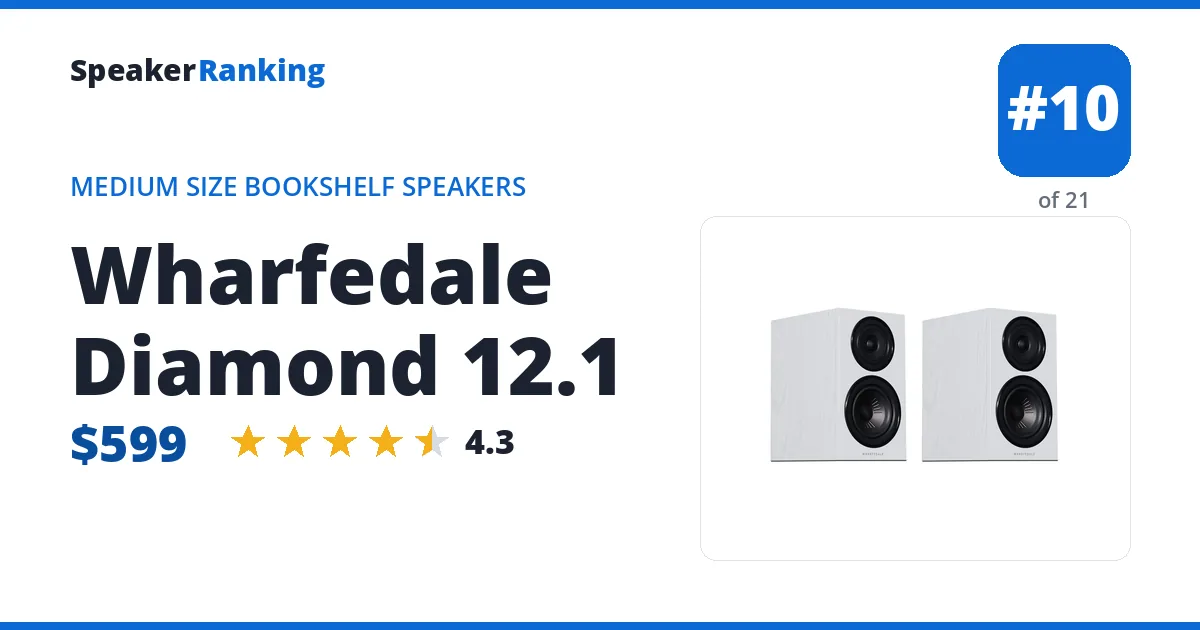
Pros: A budget two-way bookshelf speaker (5” polypropylene woofer, 1” textile dome tweeter) that measures well for its price: harmonic distortion at 86dB stays under 1% THD down to about 60Hz, genuinely good for a 5” mid-woofer. Wide horizontal radiation of about ±60° up to roughly 5kHz before the tweeter starts to beam. Tonally smooth and easy to listen to at moderate volumes, with a pleasant, non-fatiguing character the reviewer said he’d happily recommend to someone who wants noticeably better fit, finish and looks than typical speakers in the $300-400 range. A high-pass crossover around 80Hz meaningfully cleans up midrange multitone distortion, so pairing it with a subwoofer helps more than usual for a speaker this size.
Cons: A dip of about 3dB in the 1-3kHz crossover region (on-axis, in the predicted in-room response, and even off-axis) gives the speaker a soft, “laid-back” character that noticeably saps attack and transient bite from drums, guitar and other percussive material - possibly an intentional BBC-style dip, but one the reviewer would still prefer tuned flat. Vertical directivity is unusually tight for this class of speaker, holding together only within about ±5° of the tweeter axis before a real hole opens up in the response, so seating height matters a lot more than on most bookshelf designs. Diffraction artifacts around 3kHz and 5kHz show up as differences between the listening-window and on-axis curves. Distortion climbs well past acceptable levels at higher output - harmonic distortion exceeds 3% around 150Hz at 96dB (versus under 1% at 86dB), multitone distortion tops 10% at 96dB/1m, and real compression sets in between 96-102dB (about 1.5dB of lost dynamic range around 300Hz at 102dB/1m, roughly equivalent to 92dB for a pair at 4m in a room) - a genuine limitation on how loud or how far away this speaker can be pushed. Measured average sensitivity (84dB) runs a few dB below the 87dB spec. Only a 5” woofer, so a subwoofer is required for real bass. Discontinued.
Full Wharfedale Diamond 12.1 review and specifications →
| Bass Extension (-10dB) | 46Hz (measured, Erin's Audio Corner) |
|---|---|
| Bass Extension (-3dB) | 61Hz (measured, Erin's Audio Corner) |
| Crossover Frequency | 2.6kHz |
| Dimensions | 12.2"H x 7"W x 10.9"D (310 x 178 x 277 mm) |
| Discontinued | Yes |
| Drivers | 5" advanced polypropylene cone woofer, 1" textile dome tweeter |
| Impedance | 8 ohms nominal (3.9 ohms minimum above 80Hz, measured, Erin's Audio Corner) |
| Sensitivity | 84dB (measured by Erin's Audio Corner; 87dB manufacturer specified) |
| Weight | 15 lbs / 6.8 kg each |
| Woofer Cabinet | ported |
As an eBay Partner, we may be compensated if you make a purchase.
- Links
- Reviews, Comparisons and Sound Samples
- Head-to-Head Comparisons
- Wharfedale Diamond 12.1 vs Radiant Acoustics Clarity 4.2
- Wharfedale Diamond 12.1 vs Klipsch RP-500M II
- Wharfedale Diamond 12.1 vs KEF Q150
- Wharfedale Diamond 12.1 vs Arendal 1961 Monitor
- Wharfedale Diamond 12.1 vs KEF LS50 Meta
- Wharfedale Diamond 12.1 vs JBL Studio 530
- Wharfedale Diamond 12.1 vs Audiofirst Fidelia
- Wharfedale Diamond 12.1 vs Pioneer SP-BS22-LR (Philharmonic AAM Mod)
- See all 9 comparisons