Short answer: the Ascend Sierra 1 v2, unless the Moondrop M4P MTM’s layout suits your room. The M4P’s dual 4” carbon-cone woofers and 1” aluminum-magnesium dome are crossed at 1.8kHz, so vertical placement is very fussy and staying within about ±20° of the tweeter axis is essential. The Sierra 1 v2 gives up nothing in placement and reaches F3 of 55Hz and F10 of 39Hz, in-room extension in the mid-40s Hz.
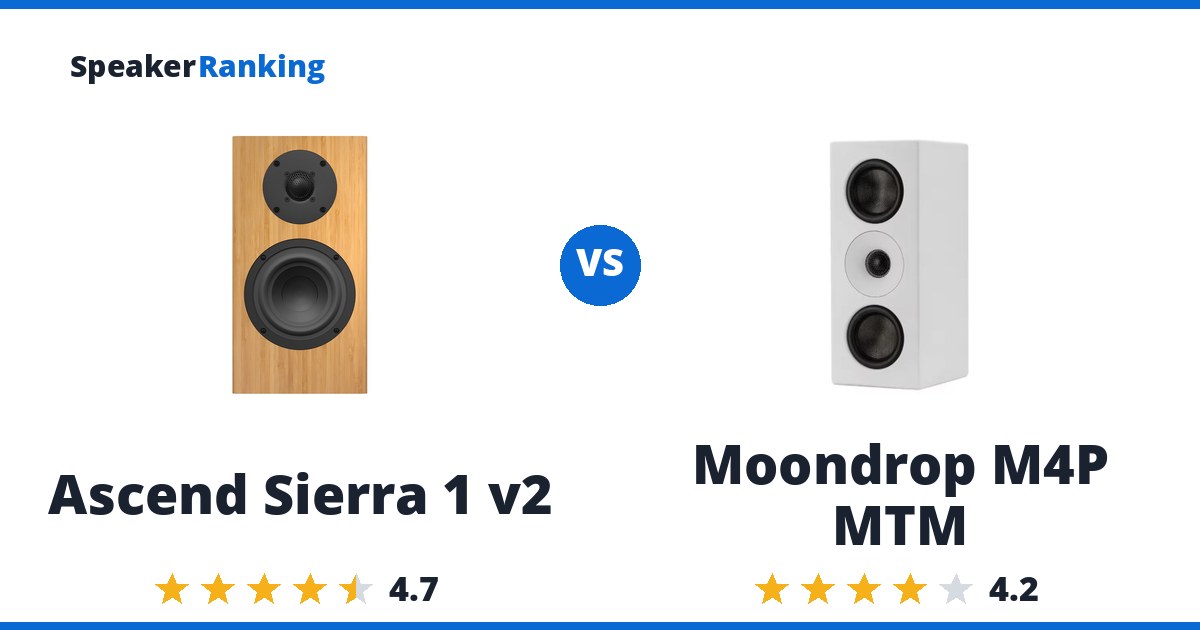
On the Ascend Sierra 1 v2 side: Formaldehyde-free layered bamboo ply cabinet with a 1” dome tweeter over a 5.25” midwoofer. Set against that: F3 of 55Hz and F10 of 39Hz mean in-room extension tops out in the mid-40s Hz.
The case for the Moondrop M4P MTM: MTM (mid-tweeter-mid) two-way layout with dual 4” carbon-cone woofers flanking a 1” aluminum-magnesium dome tweeter, crossed over at 1.8kHz. The tradeoff: Vertical placement is very fussy: staying within about ±20° of the tweeter axis is essential.
Buy the Ascend Sierra 1 v2. It ranks higher for sound quality, and the $80 saving on the Moondrop M4P MTM is not enough to make up the difference.
Want more options? Browse the full Passive Home rankings.
Specifications Side By Side
| Ascend Sierra 1 v2 | Moondrop M4P MTM | |
|---|---|---|
| Price | $1000 per pair | $920 per pair |
| Ranked | #3 of 88 in Medium Size Bookshelf Speakers | #12 of 88 in Medium Size Bookshelf Speakers |
| Bass Extension (-10dB) | 39Hz (measured, Erin's Audio Corner) | 46Hz (measured, Erin's Audio Corner) |
| Bass Extension (-3dB) | 55Hz (measured, Erin's Audio Corner) | 69Hz (measured, Erin's Audio Corner) |
| Dimensions | 14.2"H x 7.5"W x 10.5"D (361.9 x 190.5 x 266.7 mm) | 15"H x 6.1"W x 7.3"D (380 x 155 x 185 mm) |
| Impedance | 8 ohms nominal, 7 ohms minimum (measured, Erin's Audio Corner) | 4 ohms nominal, 3.7 ohms minimum (measured above 80Hz, Erin's Audio Corner) |
| Sensitivity | 81.5dB (measured, Erin's Audio Corner) | 85dB (measured average 300Hz-3kHz @ 2.83V/1m, Erin's Audio Corner) |
| Drivers | 5.25" proprietary mineral-filled polypropylene cone with cast aluminum frame woofer, 26mm aluminum/magnesium alloy dome tweeter with titanium former (SEAS Titan) | 2x 4" (87mm) carbon cone woofer, 1" (25mm) aluminum/magnesium dome tweeter |
| Weight | 18.5 lbs (8.4 kg) each | 13.7 lbs (6.2 kg) each |
| Woofer Cabinet | ported | ported |
| Spinorama Preference Score | 6.28 | 4.14 |
| Spinorama Preference Score with Perfect Sub | 8.24 | 6.69 |
| Crossover Frequency | - | 1800Hz |
| Power Handling | - | 75W rated / 150W max |
Related Speaker Comparisons
More worthwhile head-to-heads for Ascend Sierra 1 v2:
- Ascend Sierra 1 v2 vs Audio First Fidelia
- Ascend Sierra 1 v2 vs Philharmonic Ceramic Mini
- Ascend Sierra 1 v2 vs KEF LS50 Meta
- Ascend Sierra 1 v2 vs XMechanik Mechano23 DIY
- Ascend Sierra 1 v2 vs Ascend Acoustics HTM-200SE2
Prices on this page were last checked September 23, 2026 at 11:24 PM UTC. Product prices and availability are accurate as of that date/time and are subject to change; the price and availability shown on Amazon at the time of purchase will apply to the purchase of this product.
As an eBay Partner, we may be compensated if you make a purchase.
The Two Speakers In Full
 Ascend Sierra 1 v2: $1000 per pair Ascendacoustics eBay
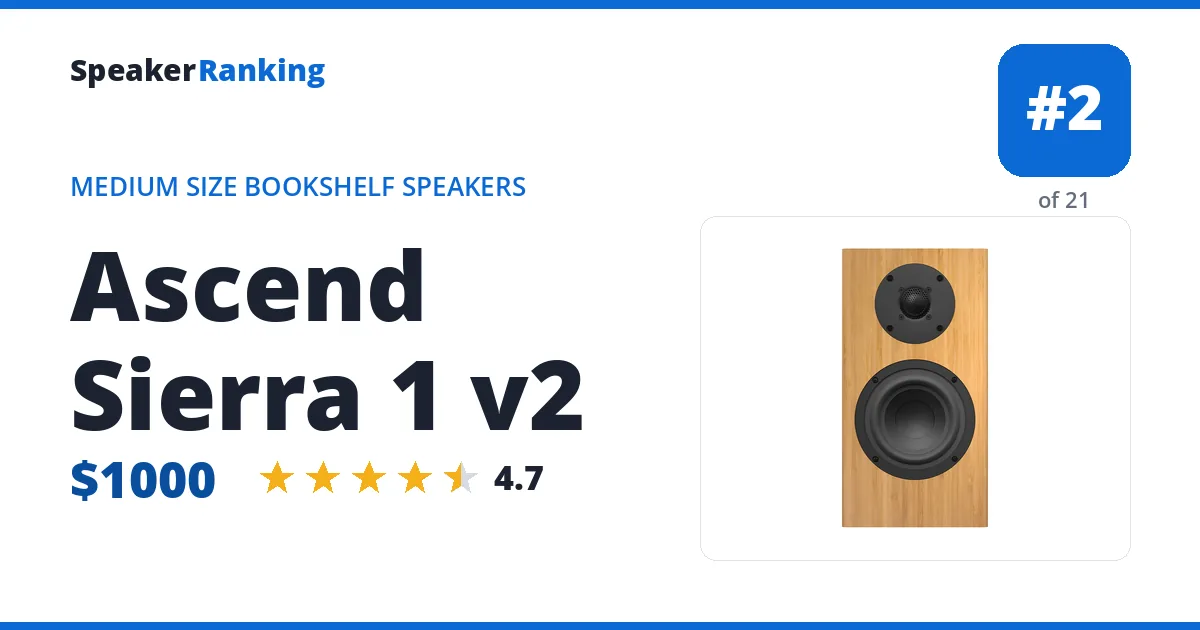
Pros: Formaldehyde-free layered bamboo ply cabinet with a 1” dome tweeter over a 5.25” midwoofer, mated by a 4th-order acoustic crossover rather than a stock textbook design. In-room response is extremely linear - the reviewer called it “textbook” - a clear step up from the earlier V1, which had boxiness around 700Hz-1kHz and sibilance around 4-6kHz. Preference score of 8.4 with a subwoofer (6.8 without), which the reviewer calls topnotch. Wide, even horizontal radiation of about ±70° up to 6kHz. Better vertical directivity than its tweeter-to-woofer spacing would suggest, thanks to the steep 4th-order crossover slopes. No mechanical noise, port chuffing, or woofer bottoming even driven to 96dB/1m. In a three-way comparison against the Dynaudio Emit 20 and a Revel bookshelf model (all around $1,000/pair), measured as the most linear of the three and was the reviewer’s personal pick over both, despite the Dynaudio’s deeper bass and higher output capability. Independent ASR Klippel measurements corroborate Erin’s findings: superb off-axis response with only slight on-axis variations, and an in-room response the reviewer called “incredibly smooth and accurate - amazing for a non-DSP speaker.” Distortion above 200Hz at 86dB/1m is very low for the class. Measured bass extension of 55Hz (-3dB), with a measured sensitivity of 81.5dB.
Cons: F3 of 55Hz and F10 of 39Hz mean in-room extension tops out in the mid-40s Hz; the reviewer still recommends a subwoofer for full-range material. Diffraction dips appear around 3kHz and 5-6kHz, and the 1” dome tweeter starts beaming above roughly 6.7kHz, narrowing the soundstage radiation in the top octave - a straightforward consequence of dome size rather than a design flaw. At 96dB/1m the 5.25” midwoofer shows increased distortion in the midrange, likely tied to motor topology; high-passing to a subwoofer around 80Hz largely clears it up. Moderate sensitivity (~81-82dB average) with a 7-ohm minimum impedance. ASR’s power-sweep testing found response holds steady up to 96dB SPL/1m, but pushing to 102dB causes midbass below 400Hz to sag with distortion “through the roof” - a harder output ceiling than the 96dB tests alone suggest. Vertical directivity also narrows above about 1kHz, so the reviewer recommends staying at tweeter-axis height for best results.
Full Ascend Sierra 1 v2 review and specifications →
| Bass Extension (-10dB) | 39Hz (measured, Erin's Audio Corner) |
|---|---|
| Bass Extension (-3dB) | 55Hz (measured, Erin's Audio Corner) |
| Dimensions | 14.2"H x 7.5"W x 10.5"D (361.9 x 190.5 x 266.7 mm) |
| Drivers | 5.25" proprietary mineral-filled polypropylene cone with cast aluminum frame woofer, 26mm aluminum/magnesium alloy dome tweeter with titanium former (SEAS Titan) |
| Impedance | 8 ohms nominal, 7 ohms minimum (measured, Erin's Audio Corner) |
| Sensitivity | 81.5dB (measured, Erin's Audio Corner) |
| Spinorama Preference Score | 6.28 |
| Spinorama Preference Score with Perfect Sub | 8.24 |
| Weight | 18.5 lbs (8.4 kg) each |
| Woofer Cabinet | ported |
- Links
- Reviews, Comparisons and Sound Samples
- Erin’s Audio Corner: NEW! Ascend Acoustics Sierra-1 V2 Review More from Erin’s Audio Corner →
- Erin’s Audio Corner Website Ascend Sierra 1 v2
- Audio Science Review Ascend Sierra 1 v2 More from Audio Science Review →
- Erin’s Audio Corner: 5 AWESOME SPEAKERS Under $1000 You Won’t Regret
- Erin’s Audio Corner: I Tested 250 Speakers So You Don’t Have To!
- Erin’s Audio Corner: My Top Picks of 2023: Must-Haves Under $3000
- Manufacturer Measurements (spinorama.org)
- Head-to-Head Comparisons
- Ascend Sierra 1 v2 vs KEF LS50 Meta
- Ascend Sierra 1 v2 vs Philharmonic Ceramic Mini
- Ascend Sierra 1 v2 vs Audio First Fidelia
- Ascend Sierra 1 v2 vs XMechanik Mechano23 DIY
- Ascend Sierra 1 v2 vs Ascend Acoustics HTM-200SE2
- Ascend Sierra 1 v2 vs Arendal 1961 Monitor
- Ascend Sierra 1 v2 vs Ascend Acoustics Luna V2 Mini-Monitor Titan
- Ascend Sierra 1 v2 vs Aalto Speakers Aalto 1 EVO
- See all 49 comparisons
 Moondrop M4P MTM: $920 per pair Shenzhenaudio eBay
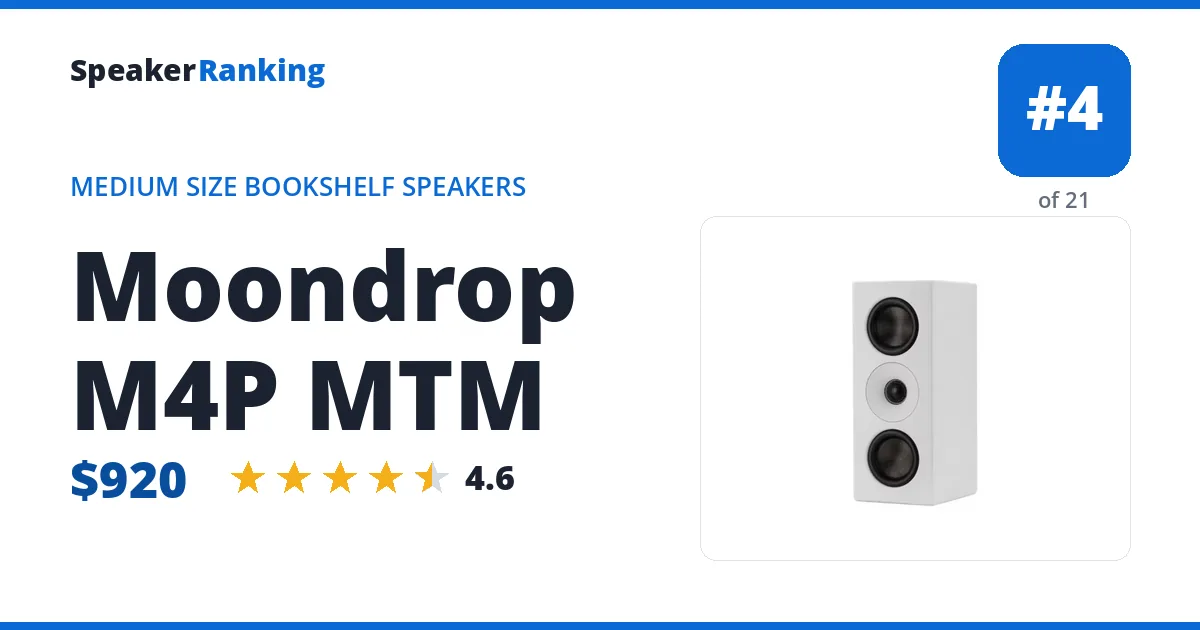
Pros: MTM (mid-tweeter-mid) two-way layout with dual 4” carbon-cone woofers flanking a 1” aluminum-magnesium dome tweeter, crossed over at 1.8kHz. Wide horizontal radiation of about ±60° through the midrange and still around ±50° near the tweeter, giving an expansive, enveloping soundstage on well-recorded stereo material. Noticeable mid-bass “thump” around 100-160Hz that adds a sense of punch and kick-drum impact, more pronounced than the reviewer’s Audiofirst Fidelia reference. Rolled-off, laid-back treble (roughly 1-2dB below linear) rather than the 2-5dB high-frequency boost common on speakers marketed as “detailed” - a plus for listeners who find brighter speakers fatiguing. Tonal balance stays consistent whether pointed straight on or toed out about 30°, so side-to-side seating position doesn’t change the sound much. At $920/pair in a compact monitor cabinet (13-14 lbs), reasonably priced for the format. Measured bass extension of 69Hz (-3dB), with a measured sensitivity of 85dB.
Cons: Vertical placement is very fussy: staying within about ±20° of the tweeter axis is essential, because the two woofers cancel each other through the crossover region (classic MTM lobing) - sit above or below that window and the upper midrange loses clarity and detail. SPL-limited: noticeable compression showed up both subjectively (thinner-sounding transients at 80-85dB/10 feet) and in measurements, with roughly 1.5dB of dynamic-range loss and about 3dB of added distortion under instantaneous compression testing. Harmonic distortion jumps substantially at 96dB versus 86dB (mostly second-order, so less audible than it looks on paper), and multitone distortion rides right at the reviewer’s 3% threshold at full output. Low impedance (3.7-ohm minimum, 1.7-ohm minimum EPDR) means a Class AB amp may run hot over longer sessions; a Class D amp is recommended for better thermal headroom. Designed primarily for nearfield use (about 1 meter); farfield listening is more of a gamble since dynamic range drops off noticeably at distance. Slight sibilance and a mild upper-midrange dip give a touch of a recessed, warm character alongside the bass emphasis. Bass reaches only about 50-60Hz in-room, and not with much volume before running into the SPL limits noted above.
Full Moondrop M4P MTM review and specifications →
| Bass Extension (-10dB) | 46Hz (measured, Erin's Audio Corner) |
|---|---|
| Bass Extension (-3dB) | 69Hz (measured, Erin's Audio Corner) |
| Crossover Frequency | 1800Hz |
| Dimensions | 15"H x 6.1"W x 7.3"D (380 x 155 x 185 mm) |
| Drivers | 2x 4" (87mm) carbon cone woofer, 1" (25mm) aluminum/magnesium dome tweeter |
| Impedance | 4 ohms nominal, 3.7 ohms minimum (measured above 80Hz, Erin's Audio Corner) |
| Power Handling | 75W rated / 150W max |
| Sensitivity | 85dB (measured average 300Hz-3kHz @ 2.83V/1m, Erin's Audio Corner) |
| Spinorama Preference Score | 4.14 |
| Spinorama Preference Score with Perfect Sub | 6.69 |
| Weight | 13.7 lbs (6.2 kg) each |
| Woofer Cabinet | ported |
- Links
- Reviews, Comparisons and Sound Samples
- Head-to-Head Comparisons
- Moondrop M4P MTM vs Ascend Acoustics Luna V2 Mini-Monitor Titan
- Moondrop M4P MTM vs Arendal 1961 Monitor
- Moondrop M4P MTM vs Klipsch RP-500M II
- Moondrop M4P MTM vs KEF LS50 Meta
- Moondrop M4P MTM vs Wharfedale Diamond 12.1
- Moondrop M4P MTM vs Radiant Acoustics Clarity 4.2
- Moondrop M4P MTM vs KEF Q150
- Moondrop M4P MTM vs JBL Studio 530
- See all 10 comparisons