Short answer: the Philharmonic Ceramic Mini. It ranks #2 of 88 bookshelf speakers by sound quality, rated 4.7/5, at $900; the Tekton Troubadour ranks #24, rated 3.8/5, and costs $1,000, so there is not much of a tradeoff to weigh.
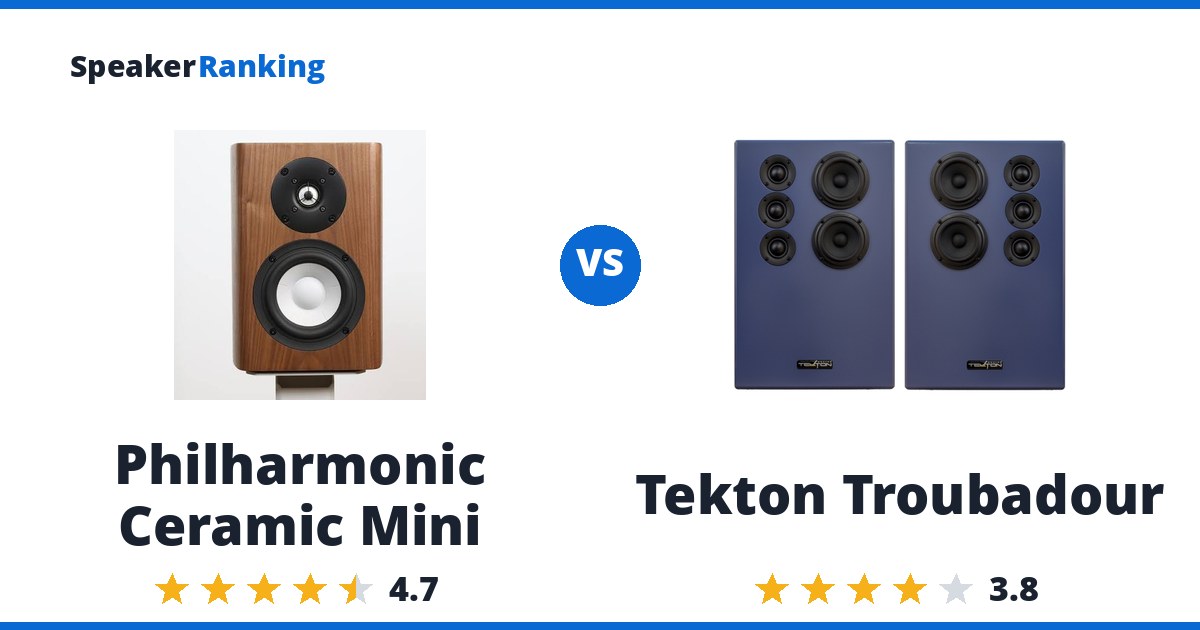
Why pick the Philharmonic Ceramic Mini: Gorgeous looks and finish options for the price. The catch: Somewhat limited output capability for its size: audible woofer compression (“flopping”) around 95dB at 3 meters for a stereo pair, so keep to moderate levels or pair with a subwoofer for home theater use.
What the Tekton Troubadour does well: Offset in-phase array of 2x 5.25” mid-woofers and 3x 1” dome tweeters gives good on-axis linearity (within about ±2.5 dB) and a wide vertical listening window (about ±20°), so seating height isn’t fussy. The tradeoff: Forward, elevated upper-midrange presentation from increased off-axis energy in the 2-8 kHz range, centered around 4 kHz, that can read as hot or aggressive depending on the room and listener; a couple bands of EQ can tame it.
One note: the Tekton Troubadour is no longer sold new, but at #24 of 88 bookshelf speakers by sound quality it still outranks most current models, so used is worth considering.
Buy the Philharmonic Ceramic Mini. It is rated higher for sound quality than the Tekton Troubadour and costs less, so it is the default pick unless a specific strength of the other one matters more to you.
Still deciding? The full Passive Home rankings cover every ranked option.
Specifications Side By Side
| Philharmonic Ceramic Mini | Tekton Troubadour | |
|---|---|---|
| Price | $900 per pair | $1,000 per pair Discontinued |
| Ranked | #2 of 88 in Medium Size Bookshelf Speakers | #24 of 88 in Medium Size Bookshelf Speakers |
| Bass Extension (-3dB) | 51Hz (measured, Erin’s Audio Corner) | 51Hz (measured, Erin’s Audio Corner) |
| Bass Extension (-10dB) | 36Hz (measured, Erin’s Audio Corner) | 39Hz (measured, Erin’s Audio Corner) |
| Dimensions | 12” x 8.5” x 11.3” (305 x 216 x 286 mm) | 21” x 13.5” x 9” (533 x 343 x 229 mm) |
| Impedance | 4 ohms nominal (3.2 ohms min, 15 ohms max) (measured, Erin’s Audio Corner) | 4 ohms nominal, 3.6 ohms minimum (measured above 80Hz, Erin’s Audio Corner) |
| Drivers | 5.25” ceramic woofer, 1” ceramic dome tweeter | 2x 5.25” mid-woofers, 3x 1” dome tweeters (offset in-phase array) |
| Sensitivity | 82dB (2.83V/1m, measured by Erin’s Audio Corner) | 88dB (measured average 300Hz-3kHz @ 2.83V/1m, Erin’s Audio Corner) |
| Weight | 17 lbs (7.7 kg) | 32 lbs (14.5 kg) each |
| Frequency Response | 55Hz - 20kHz (+1.5/-3dB, Manufacturer specified, ported) | - |
| Crossover Frequency | 2kHz (Linkwitz-Riley 4th order) | - |
| Woofer Cabinet | ported, rear | - |
| Country | USA (Vienna, Virginia) | USA |
| Spinorama Preference Score | 5.77 | 5.50 |
| Spinorama Preference Score with Perfect Sub | 7.78 | 7.52 |
| DIY Kit | No | No |
Related Speaker Comparisons
More top alternatives to Philharmonic Ceramic Mini:
- Philharmonic Ceramic Mini vs Audio First Fidelia
- Ascend Sierra 1 v2 vs Philharmonic Ceramic Mini
- KEF LS50 Meta vs Philharmonic Ceramic Mini
- XMechanik Mechano23 DIY vs Philharmonic Ceramic Mini
- Ascend Acoustics HTM-200SE2 vs Philharmonic Ceramic Mini
Prices on this page were last checked September 30, 2026 at 2:57 PM UTC. Product prices and availability are accurate as of that date/time and are subject to change; the price and availability shown on Amazon at the time of purchase will apply to the purchase of this product.
As an eBay Partner, we may be compensated if you make a purchase.
The Two Speakers In Full
 Philharmonic Ceramic Mini: $900 per pair Philharmonic Audio eBay
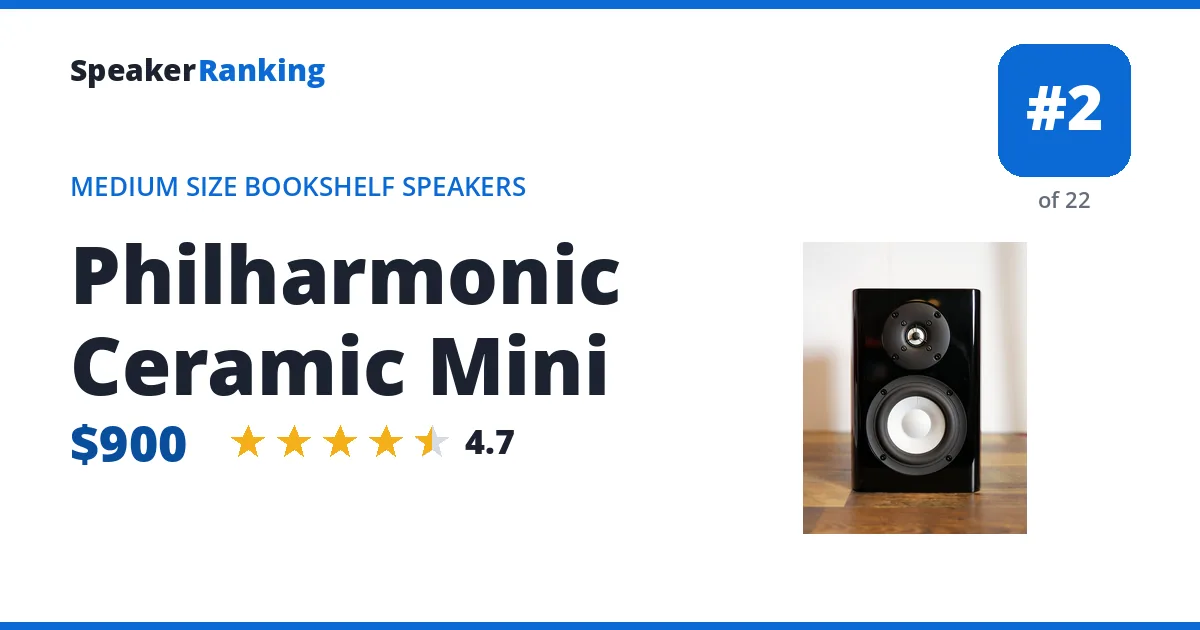
Pros: Gorgeous looks and finish options for the price. Very low midrange distortion for the size, well under 1% above about 400-500Hz. Excellent on-axis linearity. Mild, pleasant bass bump around 100Hz that adds welcome warmth without being excessive. Wide soundstage and dispersion (~70-80 degrees horizontally). Clean cabinet and port with no measured resonances. A great value combination of looks and performance at this price. Measured bass extension of 51Hz (-3dB), with a measured sensitivity of 82dB.
Cons: Somewhat limited output capability for its size: audible woofer compression (“flopping”) around 95dB at 3 meters for a stereo pair, so keep to moderate levels or pair with a subwoofer for home theater use. A mild diffraction-related dip around 4-6kHz can cause occasional sibilance on some vocal tracks. Measured sensitivity (82.2dB average) runs a bit below the manufacturer’s claimed 84dB, so it needs more amp power than the spec alone suggests. Needs a subwoofer for real bass authority below about 40Hz.
Full Philharmonic Ceramic Mini review and specifications →
| Bass Extension (-10dB) | 36Hz (measured, Erin’s Audio Corner) |
|---|---|
| Bass Extension (-3dB) | 51Hz (measured, Erin’s Audio Corner) |
| Country | USA (Vienna, Virginia) |
| Crossover Frequency | 2kHz (Linkwitz-Riley 4th order) |
| DIY Kit | No |
| Dimensions | 12” x 8.5” x 11.3” (305 x 216 x 286 mm) |
| Drivers | 5.25” ceramic woofer, 1” ceramic dome tweeter |
| Frequency Response | 55Hz - 20kHz (+1.5/-3dB, Manufacturer specified, ported) |
| Impedance | 4 ohms nominal (3.2 ohms min, 15 ohms max) (measured, Erin’s Audio Corner) |
| Sensitivity | 82dB (2.83V/1m, measured by Erin’s Audio Corner) |
| Spinorama Preference Score | 5.77 |
| Spinorama Preference Score with Perfect Sub | 7.78 |
| Weight | 17 lbs (7.7 kg) |
| Woofer Cabinet | ported, rear |
- Links
- Reviews, Comparisons and Sound Samples
- Head-to-Head Comparisons
- Philharmonic Ceramic Mini vs Ascend Sierra 1 v2
- Philharmonic Ceramic Mini vs Audio First Fidelia
- Philharmonic Ceramic Mini vs KEF LS50 Meta
- Philharmonic Ceramic Mini vs XMechanik Mechano23 DIY
- Philharmonic Ceramic Mini vs Ascend Acoustics HTM-200SE2
- Philharmonic Ceramic Mini vs Arendal 1961 Monitor
- Philharmonic Ceramic Mini vs Ascend Acoustics Luna V2 Mini-Monitor Titan
- Philharmonic Ceramic Mini vs Aalto Speakers Aalto 1 EVO
- See all 23 comparisons
 Tekton Troubadour: $1,000 per pair Discontinued eBay
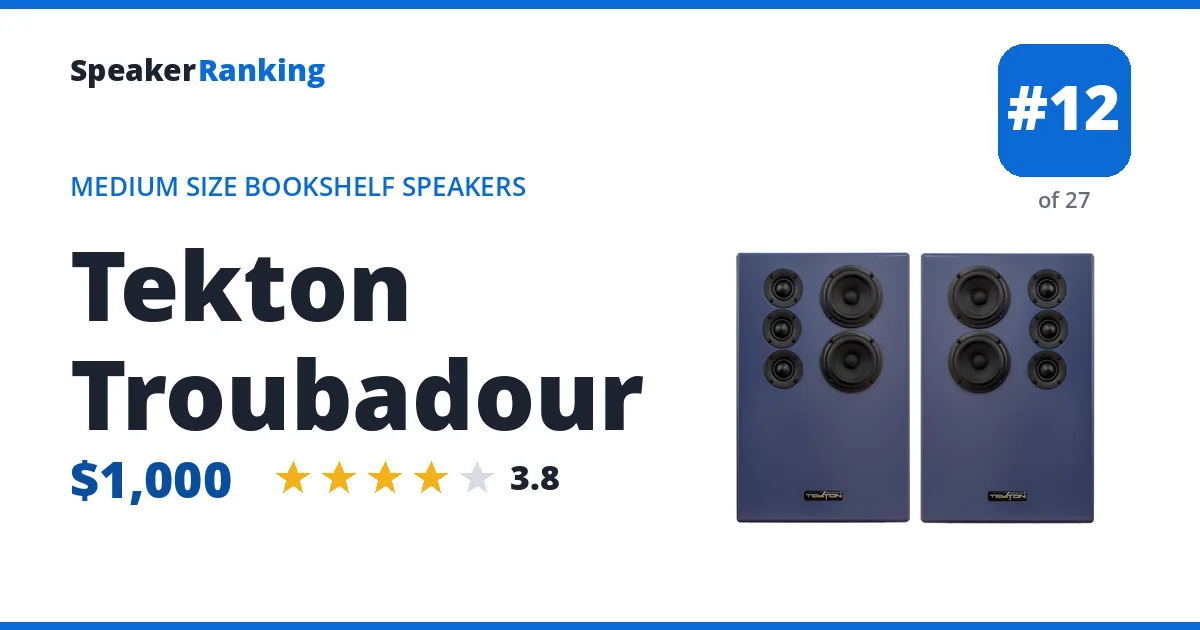
Pros: Offset in-phase array of 2x 5.25” mid-woofers and 3x 1” dome tweeters gives good on-axis linearity (within about ±2.5 dB) and a wide vertical listening window (about ±20°), so seating height isn’t fussy. Bass extension is solid for a stand-mount this size: F3 around 51 Hz, F10 around 39 Hz, with distortion staying below 3% THD down to about 40 Hz at 96 dB. Made in the USA. Asymmetrical tweeter/mid-woofer placement broadens horizontal dispersion versus a conventional symmetric layout. Measured bass extension of 51Hz (-3dB), with a measured sensitivity of 88dB.
Cons: Forward, elevated upper-midrange presentation from increased off-axis energy in the 2-8 kHz range, centered around 4 kHz, that can read as hot or aggressive depending on the room and listener; a couple bands of EQ can tame it. Multitone distortion climbs to about 10% around 1 kHz at higher output, attributed to the 4-inch mid-range drivers. Because the driver layout is offset rather than mirror-imaged, left/right placement and toe-in matter more than with a standard symmetric bookshelf design. Discontinued.
Full Tekton Troubadour review and specifications →
| Bass Extension (-10dB) | 39Hz (measured, Erin’s Audio Corner) |
|---|---|
| Bass Extension (-3dB) | 51Hz (measured, Erin’s Audio Corner) |
| Country | USA |
| DIY Kit | No |
| Dimensions | 21” x 13.5” x 9” (533 x 343 x 229 mm) |
| Drivers | 2x 5.25” mid-woofers, 3x 1” dome tweeters (offset in-phase array) |
| Impedance | 4 ohms nominal, 3.6 ohms minimum (measured above 80Hz, Erin’s Audio Corner) |
| Sensitivity | 88dB (measured average 300Hz-3kHz @ 2.83V/1m, Erin’s Audio Corner) |
| Spinorama Preference Score | 5.50 |
| Spinorama Preference Score with Perfect Sub | 7.52 |
| Weight | 32 lbs (14.5 kg) each |
- Reviews, Comparisons and Sound Samples
- Head-to-Head Comparisons