Short answer: the Klipsch RP-500M II. It ranks #18 of 88 bookshelf speakers by sound quality, rated 4.0/5, at $389.99; the Wharfedale Diamond 12.1 ranks #21, rated 3.9/5, and costs $599, so there is little reason to consider the other one.
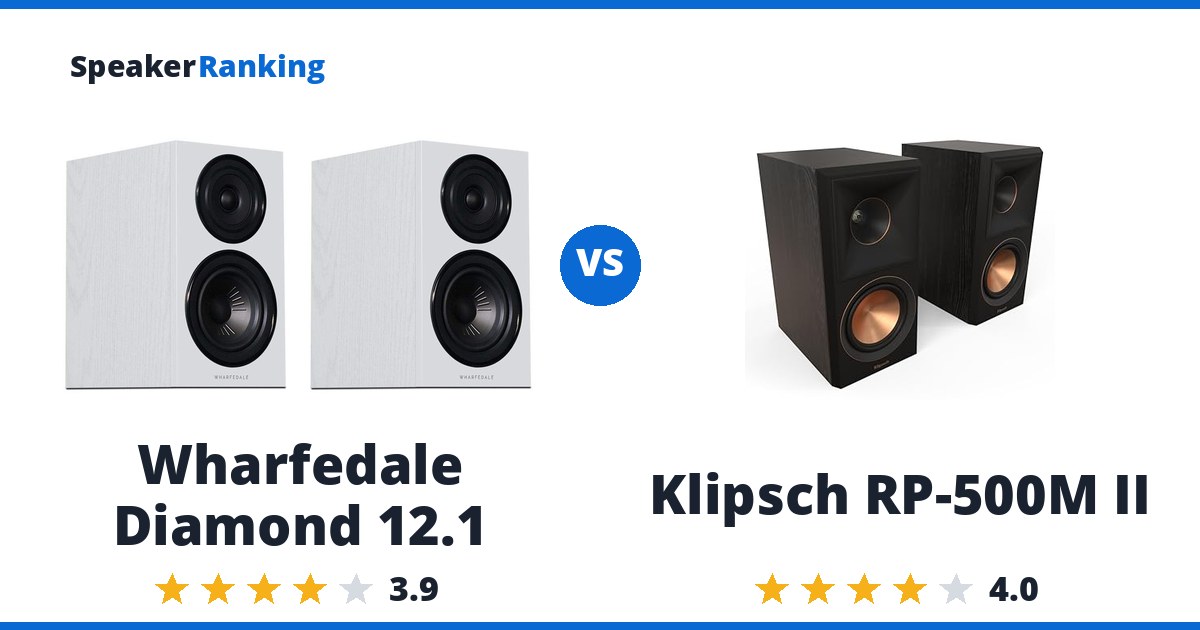
What the Wharfedale Diamond 12.1 does well: A budget two-way bookshelf speaker (5” polypropylene woofer, 1” textile dome tweeter) that measures well for its price: harmonic distortion at 86dB stays under 1% THD down to about 60Hz, genuinely good for a 5” mid-woofer. Watch for: A dip of about 3dB in the 1-3kHz crossover region (on-axis, in the predicted in-room response, and even off-axis) gives the speaker a soft, “laid-back” character that noticeably saps attack and transient bite from drums, guitar and other percussive material: possibly an intentional BBC-style dip, but one the reviewer would still prefer tuned flat.
Why pick the Klipsch RP-500M II: Major mid-range clarity improvement over the original RP-500M: about a 5dB fill-in between 1-3kHz in the estimated in-room response, giving a noticeably more resolved, detailed midrange. The tradeoff: Klipsch’s quoted sensitivity (around 92-93dB) uses an unconventional in-room-based rating rather than the standard anechoic measurement; on an anechoic basis it measures closer to about 85dB, in line with typical bookshelf speakers this size, so it isn’t the outlier in efficiency the spec sheet implies.
One note: the Wharfedale Diamond 12.1 is no longer sold new, but at #21 of 88 bookshelf speakers by sound quality it still outranks most current models, so used is worth considering.
Buy the Klipsch RP-500M II. It is rated higher for sound quality than the Wharfedale Diamond 12.1 and costs less, so only choose the other one for a particular feature it does better.
Want more options? Browse the full Passive Home rankings.
Specifications Side By Side
| Wharfedale Diamond 12.1 | Klipsch RP-500M II | |
|---|---|---|
| Price | $599 per pair Discontinued | $389.99 per pair |
| Ranked | #21 of 88 in Medium Size Bookshelf Speakers | #18 of 88 in Medium Size Bookshelf Speakers |
| Bass Extension (-10dB) | 46Hz (measured, Erin’s Audio Corner) | 53Hz (measured, Erin’s Audio Corner) |
| Bass Extension (-3dB) | 61Hz (measured, Erin’s Audio Corner) | 67Hz (measured, Erin’s Audio Corner) |
| Crossover Frequency | 2.6kHz | 1530Hz |
| Dimensions | 12.2”H x 7”W x 10.9”D (310 x 178 x 277 mm) | 13.6”H x 6.8”W x 10.6”D (344.4 x 173 x 270.5 mm) |
| Impedance | 8 ohms nominal (3.9 ohms minimum above 80Hz, measured, Erin’s Audio Corner) | 8 ohms nominal, 3.3 ohms minimum (measured, Erin’s Audio Corner) |
| Sensitivity | 84dB (measured by Erin’s Audio Corner; 87dB manufacturer specified) | 85dB (measured, Erin’s Audio Corner) |
| Drivers | 5” advanced polypropylene cone woofer, 1” textile dome tweeter | 5.25” Cerametallic™ cone woofer with Faraday rings, 1” LTS Titanium diaphragm tweeter with Hybrid Cross-Section Expanded Tractrix® horn |
| Weight | 15 lbs (6.8 kg) each | 13 lbs (5.9 kg) each |
| Woofer Cabinet | ported | ported, rear |
| Spinorama Preference Score | 5.01 | 5.22 |
| Spinorama Preference Score with Perfect Sub | 7.42 | 7.84 |
| DIY Kit | No | No |
Related Speaker Comparisons
More top alternatives to Klipsch RP-500M II:
- Klipsch RP-500M II vs Audio First Fidelia
- Ascend Sierra 1 v2 vs Klipsch RP-500M II
- KEF LS50 Meta vs Klipsch RP-500M II
- Arendal 1961 Monitor vs Klipsch RP-500M II
- Klipsch RP-500M II vs Moondrop M4P MTM
Prices on this page were last checked September 29, 2026 at 3:43 PM UTC. Product prices and availability are accurate as of that date/time and are subject to change; the price and availability shown on Amazon at the time of purchase will apply to the purchase of this product.
As an eBay Partner, we may be compensated if you make a purchase.
The Two Speakers In Full
 Wharfedale Diamond 12.1: $599 per pair Discontinued eBay
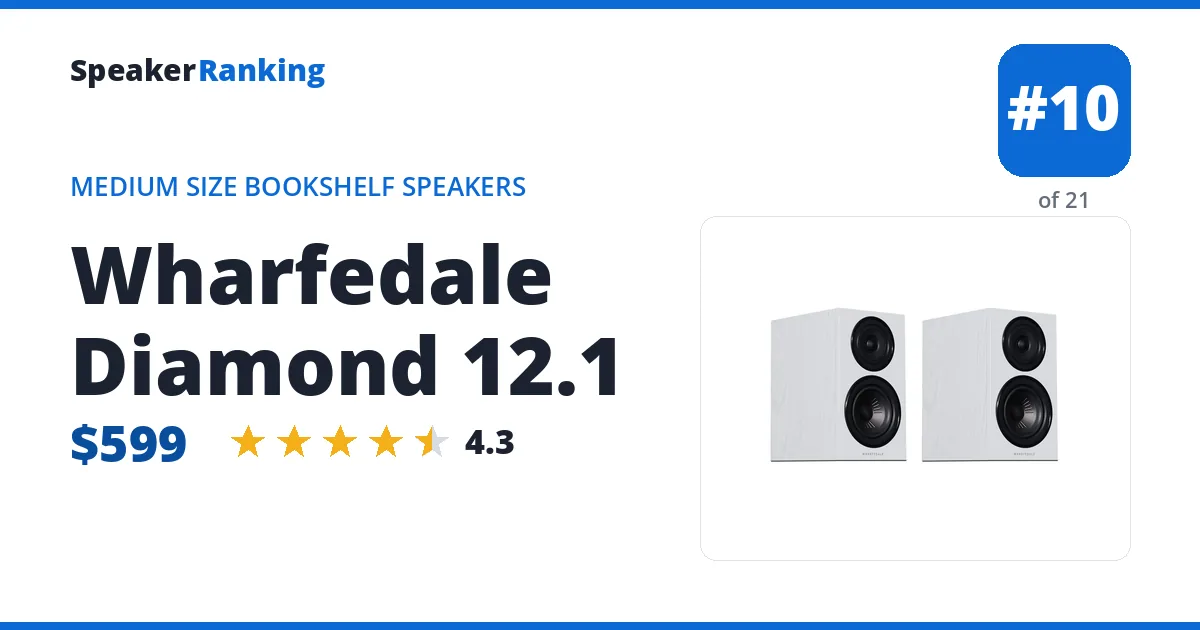
Newer model: the Wharfedale Diamond 12.1i. It’s likely to perform similarly, though we don’t have measurements to confirm that yet.
Pros: A budget two-way bookshelf speaker (5” polypropylene woofer, 1” textile dome tweeter) that measures well for its price: harmonic distortion at 86dB stays under 1% THD down to about 60Hz, genuinely good for a 5” mid-woofer. Wide horizontal radiation of about ±60° up to roughly 5kHz before the tweeter starts to beam. Tonally smooth and easy to listen to at moderate volumes, with a pleasant, non-fatiguing character the reviewer said he’d happily recommend to someone who wants noticeably better fit, finish and looks than typical speakers in the $300-400 range. A high-pass crossover around 80Hz meaningfully cleans up midrange multitone distortion, so pairing it with a subwoofer helps more than usual for a speaker this size. Measured bass extension of 61Hz (-3dB), with a measured sensitivity of 84dB.
Cons: A dip of about 3dB in the 1-3kHz crossover region (on-axis, in the predicted in-room response, and even off-axis) gives the speaker a soft, “laid-back” character that noticeably saps attack and transient bite from drums, guitar and other percussive material: possibly an intentional BBC-style dip, but one the reviewer would still prefer tuned flat. Vertical directivity is unusually tight for this class of speaker, holding together only within about ±5° of the tweeter axis before a real hole opens up in the response, so seating height matters a lot more than on most bookshelf designs. Diffraction artifacts around 3kHz and 5kHz show up as differences between the listening-window and on-axis curves. Distortion climbs well past acceptable levels at higher output: harmonic distortion exceeds 3% around 150Hz at 96dB (versus under 1% at 86dB), multitone distortion tops 10% at 96dB/1m, and real compression sets in between 96-102dB (about 1.5dB of lost dynamic range around 300Hz at 102dB/1m, roughly equivalent to 92dB for a pair at 4m in a room). A genuine limitation on how loud or how far away this speaker can be pushed. Measured average sensitivity (84dB) runs a few dB below the 87dB spec. Only a 5” woofer, so a subwoofer is required for real bass. Discontinued.
Full Wharfedale Diamond 12.1 review and specifications →
| Bass Extension (-10dB) | 46Hz (measured, Erin’s Audio Corner) |
|---|---|
| Bass Extension (-3dB) | 61Hz (measured, Erin’s Audio Corner) |
| Crossover Frequency | 2.6kHz |
| DIY Kit | No |
| Dimensions | 12.2”H x 7”W x 10.9”D (310 x 178 x 277 mm) |
| Drivers | 5” advanced polypropylene cone woofer, 1” textile dome tweeter |
| Impedance | 8 ohms nominal (3.9 ohms minimum above 80Hz, measured, Erin’s Audio Corner) |
| Sensitivity | 84dB (measured by Erin’s Audio Corner; 87dB manufacturer specified) |
| Spinorama Preference Score | 5.01 |
| Spinorama Preference Score with Perfect Sub | 7.42 |
| Weight | 15 lbs (6.8 kg) each |
| Woofer Cabinet | ported |
- Links
- Reviews, Comparisons and Sound Samples
- Erin’s Audio Corner: Wharfedale 12.1 Budget Bookshelf Speaker with “Laid Back” sound but output limited. More from Erin’s Audio Corner →
- Audio Science Review Wharfedale Diamond 12.1 More from Audio Science Review →
- Erin’s Audio Corner Website: Wharfedale Diamond 12.1
- Audio Science Review Measurements (spinorama.org)
- Head-to-Head Comparisons
- Wharfedale Diamond 12.1 vs Carmody S2000
- Wharfedale Diamond 12.1 vs Radiant Acoustics Clarity 4.2
- Wharfedale Diamond 12.1 vs Wharfedale Super Denton
- Wharfedale Diamond 12.1 vs KEF Q150
- Wharfedale Diamond 12.1 vs Wharfedale Diamond 220
- Wharfedale Diamond 12.1 vs Monitor Audio Silver 50 7G
- Wharfedale Diamond 12.1 vs Revel M105
- Wharfedale Diamond 12.1 vs Polk Audio XT15
- See all 38 comparisons
 Klipsch RP-500M II: $389.99 per pair Amazon eBay
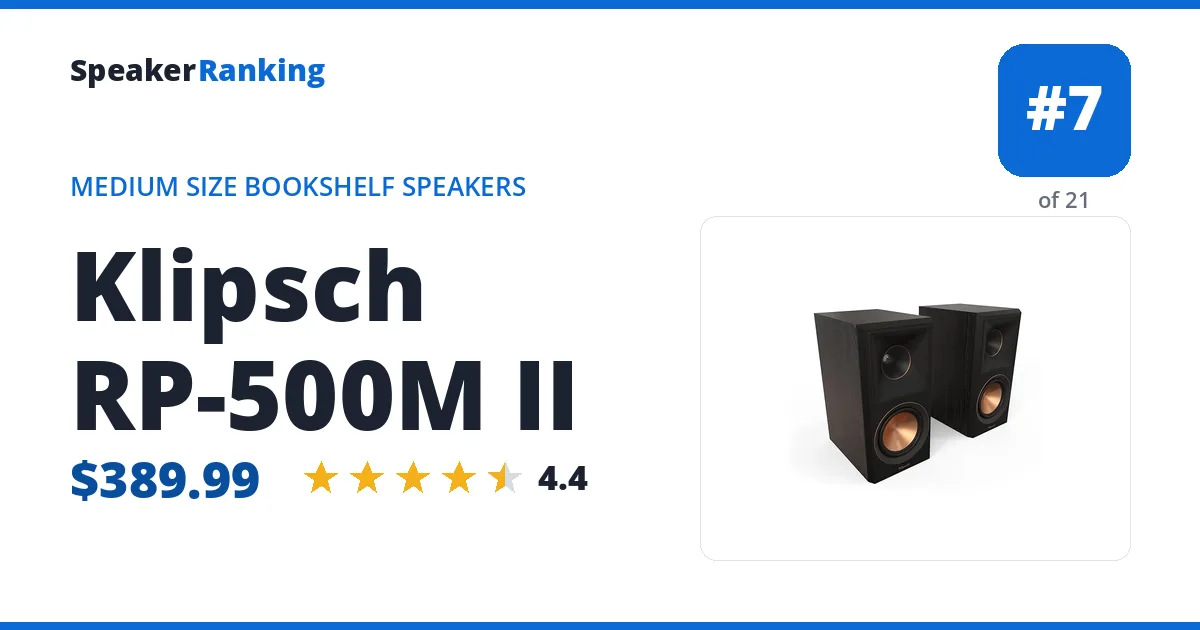
Older model: the Klipsch RP-500M (ranked lower, rated 3.4/5).
Pros: Major mid-range clarity improvement over the original RP-500M: about a 5dB fill-in between 1-3kHz in the estimated in-room response, giving a noticeably more resolved, detailed midrange. More neutral and linear overall than its sibling RP-600M II, which carries about 2-3dB more high-frequency energy and a touch more bass but less overall balance. Very precise soundstage imaging and instrument placement. Distortion through the midrange is cleaner than the previous generation. Measured bass extension of 67Hz (-3dB), with a measured sensitivity of 85dB.
Cons: Klipsch’s quoted sensitivity (around 92-93dB) uses an unconventional in-room-based rating rather than the standard anechoic measurement; on an anechoic basis it measures closer to about 85dB, in line with typical bookshelf speakers this size, so it isn’t the outlier in efficiency the spec sheet implies. Horizontal dispersion of about ±40-50° is narrower and more directive than the reviewer’s preference for a wider, more enveloping soundstage. Toeing the speaker out to widen the soundstage or soften on-axis brightness comes at some cost to imaging precision. Slightly less clean in the tweeter region than the midrange, likely tied to crossover placement, though not considered a dealbreaker. Low-frequency output is limited: measured around 95dB at 4 meters for the pair before the woofers started to unload, so a subwoofer is recommended for anyone wanting real bass rather than stepping up to a larger model.
Full Klipsch RP-500M II review and specifications →
| Bass Extension (-10dB) | 53Hz (measured, Erin’s Audio Corner) |
|---|---|
| Bass Extension (-3dB) | 67Hz (measured, Erin’s Audio Corner) |
| Crossover Frequency | 1530Hz |
| DIY Kit | No |
| Dimensions | 13.6”H x 6.8”W x 10.6”D (344.4 x 173 x 270.5 mm) |
| Drivers | 5.25” Cerametallic™ cone woofer with Faraday rings, 1” LTS Titanium diaphragm tweeter with Hybrid Cross-Section Expanded Tractrix® horn |
| Impedance | 8 ohms nominal, 3.3 ohms minimum (measured, Erin’s Audio Corner) |
| Sensitivity | 85dB (measured, Erin’s Audio Corner) |
| Spinorama Preference Score | 5.22 |
| Spinorama Preference Score with Perfect Sub | 7.84 |
| Weight | 13 lbs (5.9 kg) each |
| Woofer Cabinet | ported, rear |
- Links
- Reviews, Comparisons and Sound Samples
- Head-to-Head Comparisons
- Klipsch RP-500M II vs Wharfedale Super Denton
- Klipsch RP-500M II vs Monitor Audio Silver 50 7G
- Klipsch RP-500M II vs Radiant Acoustics Clarity 4.2
- Klipsch RP-500M II vs Revel M105
- Klipsch RP-500M II vs Moondrop M4P MTM
- Klipsch RP-500M II vs KEF Q150
- Klipsch RP-500M II vs Arendal 1961 Monitor
- Klipsch RP-500M II vs Wharfedale Diamond 220
- See all 39 comparisons