Short answer: the Polk Audio XT60. Both are rated 3.5/5 for sound quality (#177 and #179 of 226 floorstanding speakers), and the Polk Audio XT60 costs $370 against $1,300 for the Magnepan LRS+, and with sound quality even, the cheaper one is the better buy.
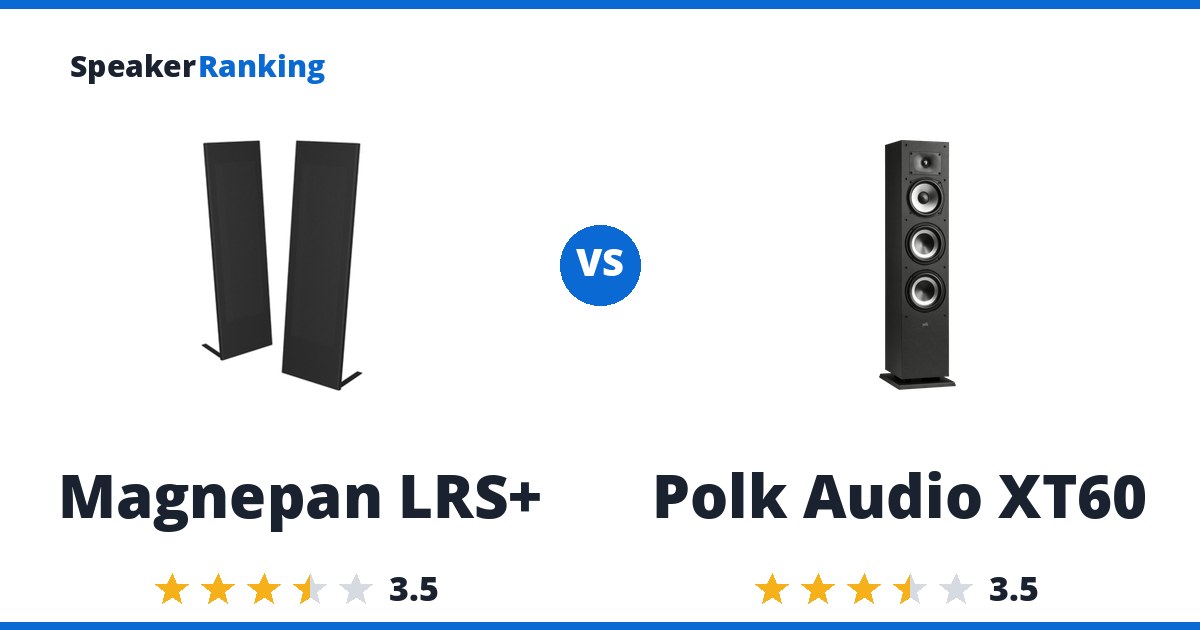
The case for the Magnepan LRS+: Thin, two-way planar-magnetic open-baffle/dipole panel design (about 48” tall, just 1” deep). Watch for: Extremely current-hungry and power-hungry: even a pair of 600W Macintosh monoblock amplifiers only averaged about 90dB output.
The Polk Audio XT60 is the more accurate, deeper-bass pick. Passive-radiator-loaded design (6.5” woofer plus two 6.5” passive radiators) gives deeper bass than the driver size alone would suggest: 43.9Hz at -3dB / 38.1Hz at -10dB, genuinely competitive extension for a budget tower. Its measured preference score, a predictor of how neutral it sounds, is 5.19 against 1.27 for the Magnepan LRS+. Its bass reaches about 43.9Hz before falling 3dB, against 74Hz for the Magnepan LRS+. The tradeoff: Bass alignment Q (lfq 0.96) is the highest, least-controlled figure in this entire batch, consistent with owner reports of a slightly loose, boomy low end at higher volumes.
Buy the Polk Audio XT60. Both are rated the same for sound quality, and it costs $930 less than the Magnepan LRS+.
Want more options? Browse the full Passive Home rankings.
Specifications Side By Side
| Magnepan LRS+ | Polk Audio XT60 | |
|---|---|---|
| Price | $1300 per pair | $370 per pair |
| Ranked | #179 of 226 in Large Size Floorstanding Speakers | #177 of 226 in Large Size Floorstanding Speakers |
| Bass Extension (-10dB) | 67Hz (measured, Erin’s Audio Corner) | 38.1Hz (measured, spinorama.org) |
| Bass Extension (-3dB) | 74Hz (measured, Erin’s Audio Corner) | 43.9Hz (measured, spinorama.org) |
| Sensitivity | 85.1dB (measured, Erin’s Audio Corner) | 86dB (1W/1m) |
| Drivers | Full-range planar magnetic dipole panel (48” tall x 13.5” wide); quasi-ribbon design, two-way with separate mid/bass and tweeter ribbon sections | 1” Terylene dome tweeter, 6.5” bilaminate polypropylene woofer, 2x 6.5” passive radiators |
| Weight | 30 lbs (13.6 kg) | 20 lbs (9.07 kg) each |
| Woofer Cabinet | open baffle | Passive radiator-loaded |
| Impedance | 4 ohms nominal, 3 ohms minimum (measured, Erin’s Audio Corner) | 4/8-ohm compatible |
| Dimensions | 48”H x 13.5”W x 1”D (1219.2 x 342.9 x 25.4 mm) | 19.05 x 92.5 x 23.09cm (7.5 x 36.4 x 9.09 in) each |
| Spinorama Preference Score | 1.27 | 5.19 |
| Spinorama Preference Score with Perfect Sub | 4.32 | 7.13 |
| DIY Kit | No | No |
Related Speaker Comparisons
More top alternatives to Polk Audio XT60:
- Polk Audio XT60 vs KEF Blade Two Meta
- MoFi SourcePoint V10 Master Edition vs Polk Audio XT60
- Polk Audio XT60 vs MoFi SourcePoint 888
- Polk Audio XT60 vs Revel F328Be
- Radiant Acoustics Clarity 66 vs Polk Audio XT60
Prices on this page were last checked October 9, 2026 at 8:01 AM UTC. Product prices and availability are accurate as of that date/time and are subject to change; the price and availability shown on Amazon at the time of purchase will apply to the purchase of this product.
As an eBay Partner, we may be compensated if you make a purchase.
The Two Speakers In Full
 Magnepan LRS+: $1300 per pair Magnepan eBay
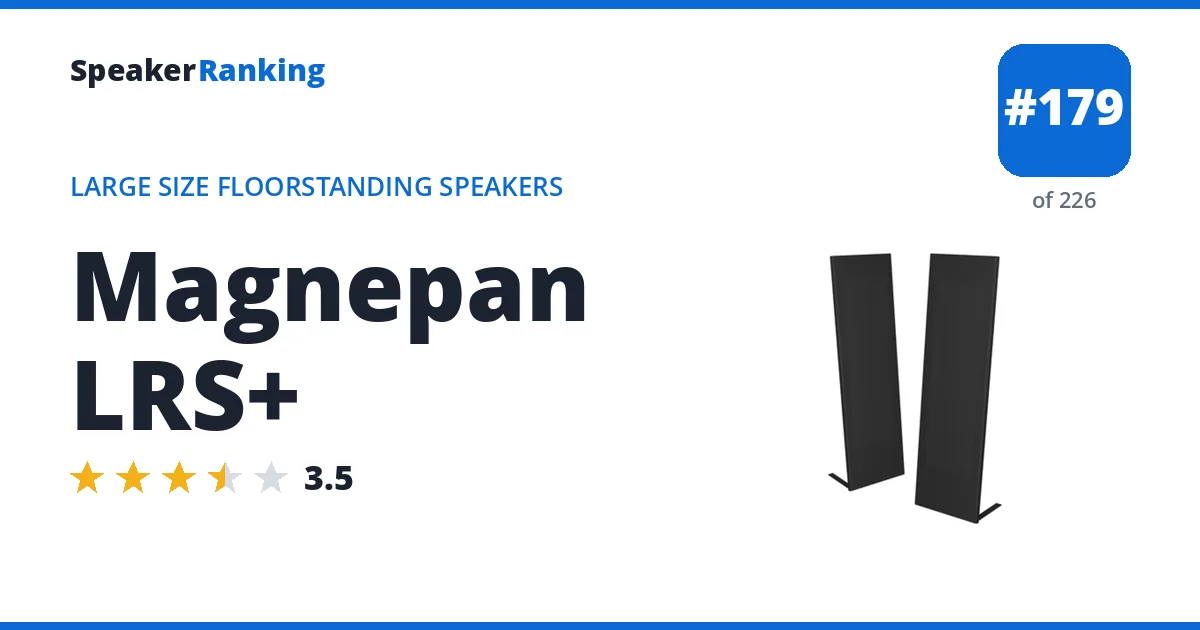
Pros: Thin, two-way planar-magnetic open-baffle/dipole panel design (about 48” tall, just 1” deep). Delivers a uniquely dramatic and enveloping soundstage with genuinely three-dimensional depth effects that work across all music genres, not just classical or orchestral material as commonly assumed. Extremely tight, locked-in center-phantom imaging when set up correctly. Open-baffle design avoids the “boxy” enclosure coloration of conventional cabinet speakers. Multitone distortion is remarkably consistent from low to high frequency, a characteristic the reviewer hasn’t observed in conventional cone-and-dome speakers. Compression at high output stays modest (about 0.5-1dB) through the midrange and treble, giving roughly 20-26dB of usable dynamic range in that region. At its price, a strong contender for a dedicated secondary listening room, even if not a main-system replacement. Measured bass extension of 74Hz (-3dB), with a measured sensitivity of 85.1dB.
Cons: Extremely current-hungry and power-hungry: even a pair of 600W Macintosh monoblock amplifiers only averaged about 90dB output. A robust, high-power amplifier is essentially mandatory, and budget amps won’t cut it. Bass rolls off very quickly (F3 74Hz, F10 67Hz, described as falling off “like a rock”), making a subwoofer an absolute requirement for any low-end content. A roughly 3dB dip in the mid-bass (100-300Hz) region thins out vocal body and fullness compared to a conventional bookshelf speaker. A resonance/bump around 400Hz adds a mild boxy quality, though it responds well to about 2dB of EQ correction. Extraordinarily fussy about exact positioning: both seating height (must align with the acoustic reference point between the panel’s lower tie-down points) and horizontal aiming are unusually critical; moving just a couple of inches can cause treble content above roughly 500-600Hz to nearly vanish. Distinct off-axis cancellation zones exist directly to the sides of the panel, where very little sound is audible at all. Fails badly under extreme dynamic-transient testing in the bass, and the reviewer blew fuses pushing the speaker during testing: not built for high-volume or highly dynamic playback. A genuinely different category from conventional hi-fi speakers, requiring more setup patience and experimentation than a typical monopole design.
Full Magnepan LRS+ review and specifications →
| Bass Extension (-10dB) | 67Hz (measured, Erin’s Audio Corner) |
|---|---|
| Bass Extension (-3dB) | 74Hz (measured, Erin’s Audio Corner) |
| DIY Kit | No |
| Dimensions | 48”H x 13.5”W x 1”D (1219.2 x 342.9 x 25.4 mm) |
| Drivers | Full-range planar magnetic dipole panel (48” tall x 13.5” wide); quasi-ribbon design, two-way with separate mid/bass and tweeter ribbon sections |
| Impedance | 4 ohms nominal, 3 ohms minimum (measured, Erin’s Audio Corner) |
| Sensitivity | 85.1dB (measured, Erin’s Audio Corner) |
| Spinorama Preference Score | 1.27 |
| Spinorama Preference Score with Perfect Sub | 4.32 |
| Weight | 30 lbs (13.6 kg) |
| Woofer Cabinet | open baffle |
- Links
- Reviews, Comparisons and Sound Samples
- Head-to-Head Comparisons
- Magnepan LRS+ vs Infinity Reference 253
- Magnepan LRS+ vs JBL Stage 2 280F
- Magnepan LRS+ vs Focal Aria Evo X N°2
- Magnepan LRS+ vs Polk T50
- Magnepan LRS+ vs Definitive Technology BP-9020
- Magnepan LRS+ vs Sony SS-CS3
- Magnepan LRS+ vs JBL Studio 590
- Magnepan LRS+ vs Triangle Esprit Antal Ez
- See all 38 comparisons
 Polk Audio XT60: $370 per pair Amazon B&H Photo Video Crutchfield eBay
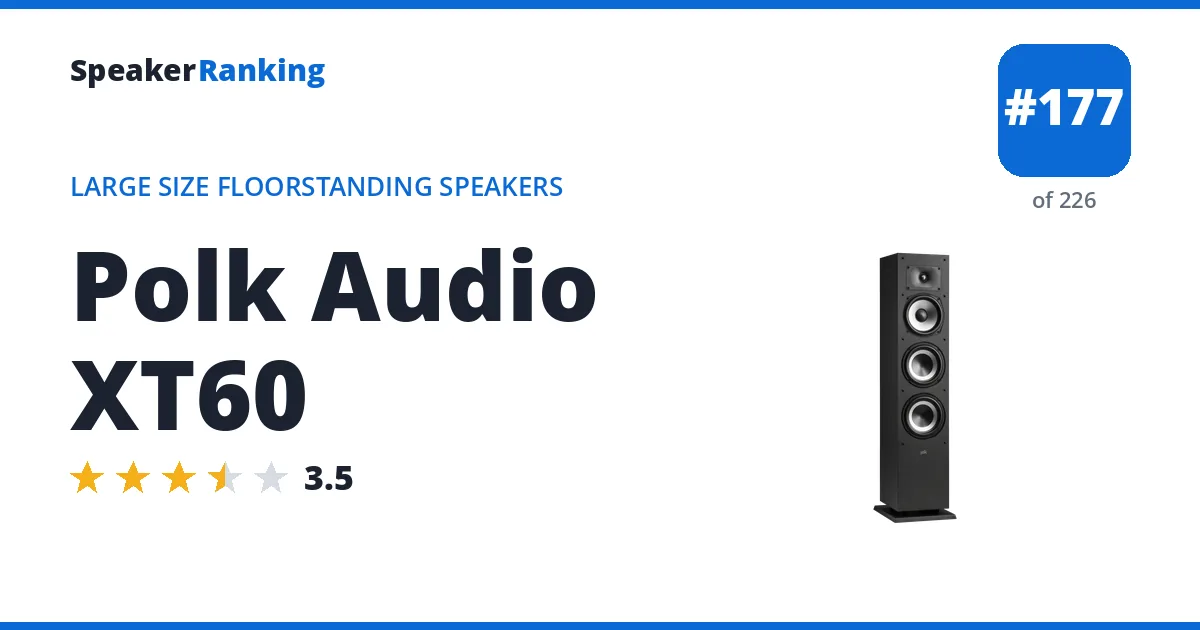
Same family: the Polk Audio XT15 (smaller bookshelf, rated 3.7/5), the Polk Monitor XT20 (larger bookshelf, rated 3.4/5), the Polk Audio XT70 (larger floorstanding, ranked higher, rated 3.6/5), the Polk Audio XT30 (smaller center, rated 3.6/5), the Polk Audio XT35 (larger center, rated 4.1/5), the Polk Audio Monitor XT10 (smaller subwoofer, estimated 3.1/5) and the Polk Audio Monitor XT12 (larger subwoofer, estimated 3.3/5).
Pros: Passive-radiator-loaded design (6.5” woofer plus two 6.5” passive radiators) gives deeper bass than the driver size alone would suggest: 43.9Hz at -3dB / 38.1Hz at -10dB, genuinely competitive extension for a budget tower. Hi-Res Audio certified, Dolby Atmos/DTS:X compatible, and works with either 4- or 8-ohm amplifier outputs. Measured bass extension of 43.9Hz (-3dB).
Cons: Bass alignment Q (lfq 0.96) is the highest, least-controlled figure in this entire batch, consistent with owner reports of a slightly loose, boomy low end at higher volumes. On-axis response is also relatively uneven, with narrow-band deviation of about 0.51dB. The vinyl-wrapped (not wood veneer) cabinet reads as budget up close per owner reviews, and at least one owner reported blowing a driver under sustained heavy bass: some caution is warranted with bass-heavy source material at volume.
Full Polk Audio XT60 review and specifications →
| Bass Extension (-10dB) | 38.1Hz (measured, spinorama.org) |
|---|---|
| Bass Extension (-3dB) | 43.9Hz (measured, spinorama.org) |
| DIY Kit | No |
| Dimensions | 19.05 x 92.5 x 23.09cm (7.5 x 36.4 x 9.09 in) each |
| Drivers | 1” Terylene dome tweeter, 6.5” bilaminate polypropylene woofer, 2x 6.5” passive radiators |
| Impedance | 4/8-ohm compatible |
| Sensitivity | 86dB (1W/1m) |
| Spinorama Preference Score | 5.19 |
| Spinorama Preference Score with Perfect Sub | 7.13 |
| Weight | 20 lbs (9.07 kg) each |
| Woofer Cabinet | Passive radiator-loaded |
- Links
- Reviews, Comparisons and Sound Samples
- Head-to-Head Comparisons
- Polk Audio XT60 vs Polk Audio XT70
- Polk Audio XT60 vs Polk Signature Elite ES60
- Polk Audio XT60 vs JBL Stage 2 280F
- Polk Audio XT60 vs Focal Aria Evo X N°2
- Polk Audio XT60 vs Polk T50
- Polk Audio XT60 vs Definitive Technology BP-9020
- Polk Audio XT60 vs Klipsch RP-6000F II
- Polk Audio XT60 vs Dynaudio Emit 30
- See all 39 comparisons