Short answer: the SunAudio Purified 4. It ranks #9 of 168 bookshelf speakers by sound quality (rated 4.3/5) at $3,650 and is still sold new; the KEF Q150 ranks #48 (rated 3.7/5) and is discontinued, so it is only an option used. The KEF Q150’s replacement, the KEF Q1 Meta, is rated 3.6/5.
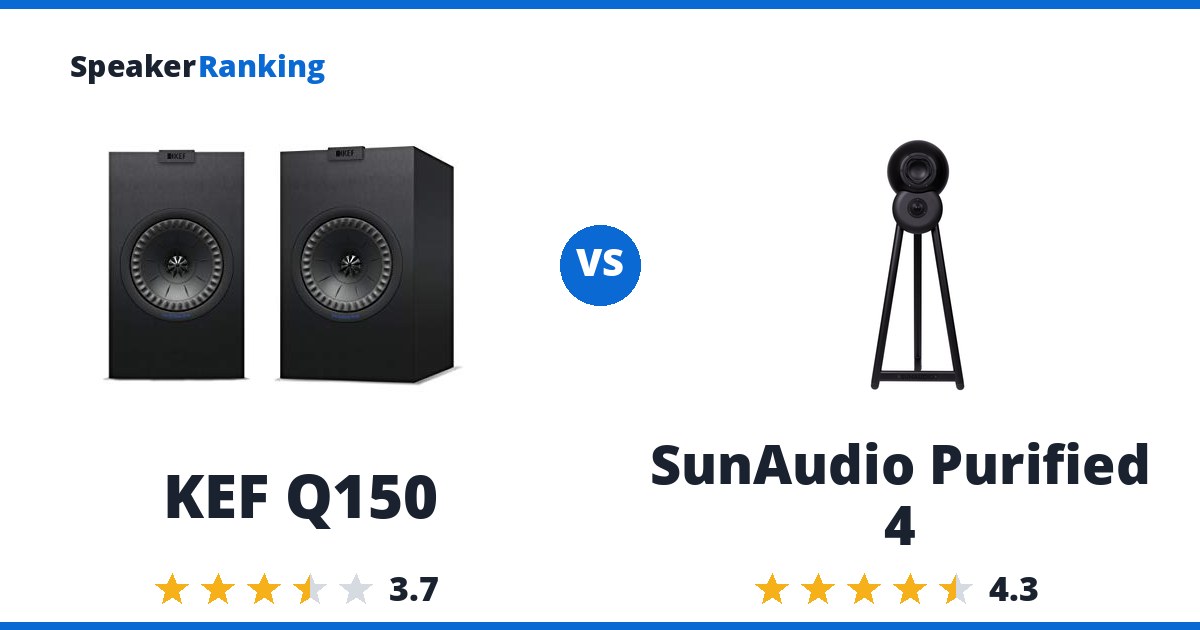
The KEF Q150 is the deeper-bass option. Two-way coaxial (Uni-Q) design with a 1” dome tweeter and 5.25” mid-range time-aligned in a single driver assembly, available in ported or sealed configuration. Its bass reaches about 51Hz before falling 3dB, against 71Hz for the SunAudio Purified 4. The tradeoff: A high-frequency lift in the estimated in-room response makes it sound noticeably brighter in an untreated room than in a heavily acoustically-treated one: a real preference factor depending on your room’s furnishings.
The SunAudio Purified 4 is the more accurate pick. On-axis response is essentially dead flat from 100Hz to 20kHz, staying within about ±1dB through most of the band and widening only to a gentle +1.5dB rise in the top octave. Its measured preference score, a predictor of how neutral it sounds, is 6.73 against 4.86 for the KEF Q150. Watch for: A 4-inch woofer means real bass extension is limited (-3dB around 71Hz and -10dB around 53Hz) so a subwoofer is needed for anything below the low-100s.
Buy the SunAudio Purified 4. It is rated higher for sound quality; the KEF Q150 is no longer sold new.
Want more options? Browse the full Passive Home rankings.
Specifications Side By Side
| KEF Q150 | SunAudio Purified 4 | |
|---|---|---|
| Price | $350 per pair Discontinued | $3,650 per pair as tested; modular kit, pricing varies by driver/finish configuration |
| Ranked | #48 of 168 in Medium Size Bookshelf Speakers | #9 of 168 in Medium Size Bookshelf Speakers |
| Bass Extension (-10dB) | 44Hz (measured, Erin’s Audio Corner) | 53Hz (measured, manufacturer spinorama data) |
| Bass Extension (-3dB) | 51Hz (measured, Erin’s Audio Corner) | 71Hz (measured, manufacturer spinorama data) |
| Dimensions | 11.9”H x 7.1”W x 10.9”D (303 x 180 x 278 mm) | 34.6” x 12.2” x 11” (880 x 310 x 280 mm) |
| Impedance | 8 ohms nominal, about 4.7 ohms minimum (measured, Erin’s Audio Corner) | 4 ohms |
| Sensitivity | ~85dB (300Hz-3kHz on-axis, measured, Erin’s Audio Corner) | 84.4dB (2.83V/1m, measured, manufacturer spinorama data) |
| Drivers | 130mm (5.25”) aluminium Uni-Q woofer, 25mm (1”) vented aluminium dome tweeter | BlieSMa T25A beryllium-dome tweeter (own CNC aluminum enclosure), Purifi 4” Ultra Low Distortion Extended woofer (PP-coated paper/fiber cone) |
| Weight | 12.3 lbs (5.6 kg) each | - |
| Woofer Cabinet | ported, rear | sealed, separate spherical driver modules on tripod stand |
| Spinorama Preference Score | 4.86 | 6.73 (manufacturer spinorama data) |
| Spinorama Preference Score with Perfect Sub | 7.06 | 9.44 (manufacturer spinorama data) |
| DIY Kit | No | No |
| Power Handling | - | 200W long-term max (woofer) |
Related Speaker Comparisons
More top alternatives to SunAudio Purified 4:
- KEF LS50 Meta vs SunAudio Purified 4
- SunAudio Purified 4 vs Arendal 1961 Monitor
- KEF Q150 vs Rogers LS3/5A Classic
- KEF Q150 vs Radiant Acoustics Clarity 4.2
- KEF Q150 vs Vandersteen VLR Wood
Prices on this page were last checked October 9, 2026 at 8:01 AM UTC. Product prices and availability are accurate as of that date/time and are subject to change; the price and availability shown on Amazon at the time of purchase will apply to the purchase of this product.
As an eBay Partner, we may be compensated if you make a purchase.
The Two Speakers In Full
 KEF Q150: $350 per pair Discontinued Amazon eBay
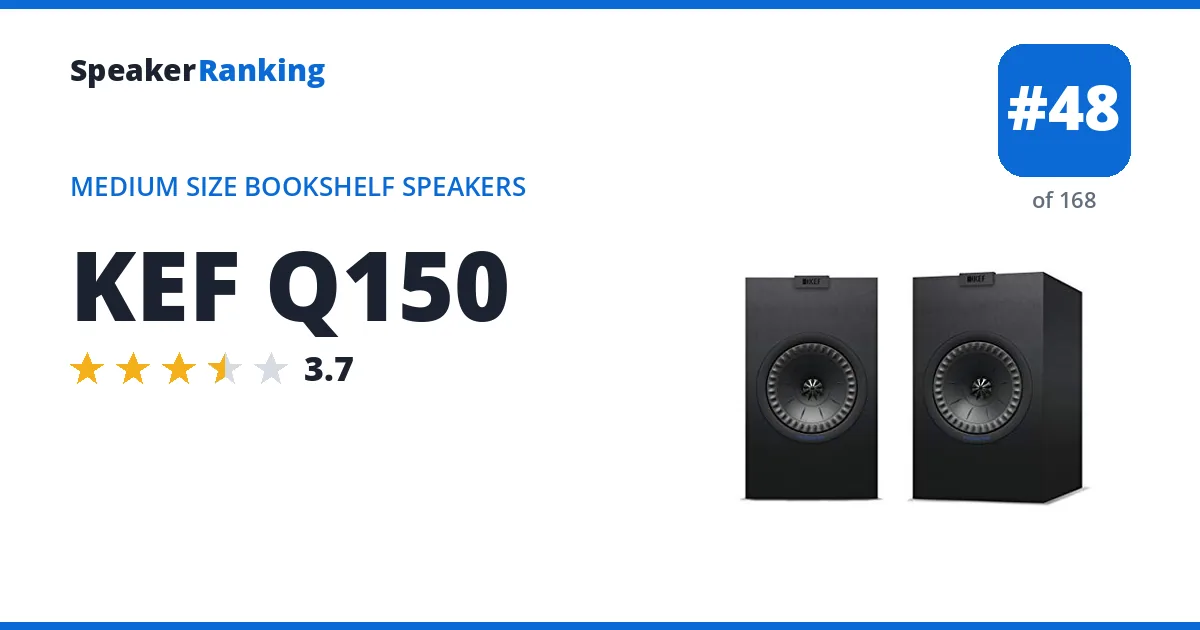
Newer model: the KEF Q1 Meta, ranked lower, rated 3.6/5.
Older model: the KEF Q100 (ranked lower, rated 2.4/5). See every KEF Q Series generation.
Same family: the KEF Q350 (larger bookshelf, rated 3/5), the KEF Q250c (smaller center, rated 3.9/5) and the KEF Q650c (larger center, rated 3.7/5).
Pros: Two-way coaxial (Uni-Q) design with a 1” dome tweeter and 5.25” mid-range time-aligned in a single driver assembly, available in ported or sealed configuration. Exceptional soundstage depth, a hallmark of KEF’s coaxial designs that the reviewer says few other speakers match. Bass extension reaches into kick-drum territory, respectable for a compact bookshelf speaker. Resonances present in measurements are consistent across on- and off-axis readings, meaning they can be effectively corrected with EQ. Distortion profile is essentially the same whether run sealed or ported, since a subwoofer crossover point sits above where the differences would matter anyway. At its sale price (around $300, sometimes seen at $400), the reviewer considers it a clear step up from his previous budget favorite in this range, the Emotiva B1+, mainly due to the superior soundstage depth. Measured bass extension of 51Hz (-3dB), with a measured sensitivity of 85dB.
Cons: A high-frequency lift in the estimated in-room response makes it sound noticeably brighter in an untreated room than in a heavily acoustically-treated one: a real preference factor depending on your room’s furnishings. A mild dip in the 1-2kHz region reduces vocal fullness somewhat. Unexplained resonances appear in measurements and persist in both sealed and ported configurations, pointing to enclosure or panel vibration rather than the port. Horizontal radiation is narrower than the reviewer generally prefers from KEF’s lineup, with directivity that widens somewhat around 1.2kHz (near a resonance) and again above about 5kHz. Compression testing at high output (102dB) shows significant nonlinearity, especially at lower frequencies: noticeably worse than a comparable Arendal bookshelf speaker costing over twice as much, which held up better until 80Hz. Not intended for loud listening without a subwoofer: the woofer will over-exert itself without a high-pass filter, and the reviewer recommends crossing over at 80-120Hz. At full retail price (around $600/pair), the value proposition is far less certain than at sale pricing. Discontinued.
Full KEF Q150 review and specifications →
| Bass Extension (-10dB) | 44Hz (measured, Erin’s Audio Corner) |
|---|---|
| Bass Extension (-3dB) | 51Hz (measured, Erin’s Audio Corner) |
| DIY Kit | No |
| Dimensions | 11.9”H x 7.1”W x 10.9”D (303 x 180 x 278 mm) |
| Drivers | 130mm (5.25”) aluminium Uni-Q woofer, 25mm (1”) vented aluminium dome tweeter |
| Impedance | 8 ohms nominal, about 4.7 ohms minimum (measured, Erin’s Audio Corner) |
| Sensitivity | ~85dB (300Hz-3kHz on-axis, measured, Erin’s Audio Corner) |
| Spinorama Preference Score | 4.86 |
| Spinorama Preference Score with Perfect Sub | 7.06 |
| Weight | 12.3 lbs (5.6 kg) each |
| Woofer Cabinet | ported, rear |
- Links
- Reviews, Comparisons and Sound Samples
- Erin’s Audio Corner: Kef’s Cheapest Bookshelf. Is the Q150 worth your money? More from Erin’s Audio Corner →
- Erin’s Audio Corner Website KEF Q150
- GR-Research: KEF Q150… can it get any BETTER? More from GR-Research →
- Erin’s Audio Corner: 5 AWESOME SPEAKERS Under $1000 You Won’t Regret
- Erin’s Audio Corner: Budget Stereo Systems You Will Love
- Erin’s Audio Corner Measurements (spinorama.org)
- Head-to-Head Comparisons
 SunAudio Purified 4: $3,650 per pair as tested; modular kit, pricing varies by driver/finish configuration SunAudio eBay
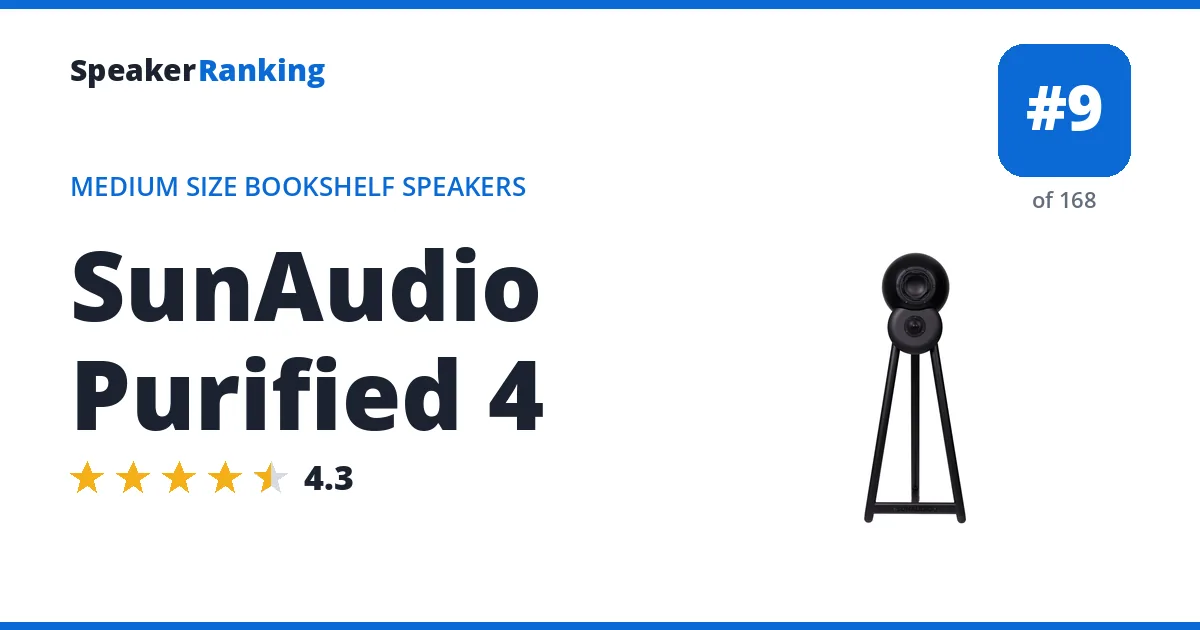
Same family: the SunAudio Purified 4 4XA25A Alu+Alu (larger bookshelf, ranked lower, rated 4.2/5), the SunAudio Purified 4 4XA25A Fiber+Alu (larger bookshelf, ranked lower, rated 4.2/5), the SunAudio Purified 4 4XA25A tw35mm (larger bookshelf, ranked lower, rated 4.1/5) and the SunAudio Purified 4 4XA25B Alu+Beryllium (larger bookshelf, ranked lower, rated 4.3/5).
Pros: On-axis response is essentially dead flat from 100Hz to 20kHz, staying within about ±1dB through most of the band and widening only to a gentle +1.5dB rise in the top octave. The listening window curve tracks on-axis almost exactly, meaning off-axis output stays consistent rather than diverging. Both directivity index curves rise smoothly and monotonically from the bass straight through to 20kHz with no bumps, dips, or discontinuities: a sign of very well-integrated driver-to-driver handoff from the beryllium-dome tweeter. Early reflections and sound power both decline smoothly with frequency, with no resonant peaks anywhere in the response. The manufacturer’s own preference-score modeling comes out to 6.65 unequalized (rising to 9.36 with an ideal subwoofer) with a frequency deviation of just 0.8dB across 300Hz-5kHz: genuinely flagship-tier numbers for a 4-inch woofer design. Distinctive modular build: separate CNC-machined aluminum enclosures for the Purifi 4” woofer and BlieSMa T25A beryllium-dome tweeter, mounted on their own tripod stand, with cone-material and finish options. Measured sensitivity of 84.4dB.
Cons: A 4-inch woofer means real bass extension is limited (-3dB around 71Hz and -10dB around 53Hz) so a subwoofer is needed for anything below the low-100s. Measured sensitivity of 84.4dB is on the low side, meaning it needs more amplifier power than more efficient designs to reach the same volume. This is manufacturer self-measured data with no independent third-party review, so there’s no outside verification of distortion, unit-to-unit consistency, or how the reference crossover performs outside SunAudio’s own lab. The modular two-sphere design and tripod stand is unconventional, and pricing is steep for such a small woofer given the niche, boutique nature of the brand.
Full SunAudio Purified 4 review and specifications →
| Bass Extension (-10dB) | 53Hz (measured, manufacturer spinorama data) |
|---|---|
| Bass Extension (-3dB) | 71Hz (measured, manufacturer spinorama data) |
| DIY Kit | No |
| Dimensions | 34.6” x 12.2” x 11” (880 x 310 x 280 mm) |
| Drivers | BlieSMa T25A beryllium-dome tweeter (own CNC aluminum enclosure), Purifi 4” Ultra Low Distortion Extended woofer (PP-coated paper/fiber cone) |
| Impedance | 4 ohms |
| Power Handling | 200W long-term max (woofer) |
| Sensitivity | 84.4dB (2.83V/1m, measured, manufacturer spinorama data) |
| Spinorama Preference Score | 6.73 (manufacturer spinorama data) |
| Spinorama Preference Score with Perfect Sub | 9.44 (manufacturer spinorama data) |
| Woofer Cabinet | sealed, separate spherical driver modules on tripod stand |
- Links
- Reviews, Comparisons and Sound Samples
- Head-to-Head Comparisons