Short answer: both are discontinued, so this only matters if you are buying used. Used, the Wharfedale Diamond 220 is the better pick: it ranks #51 of 160 bookshelf speakers by sound quality (rated 3.7/5), against #143 (rated 2.1/5) for the JBL Stage A130. If you want one new, the Wharfedale Diamond 12.1i replaces the Wharfedale Diamond 220 and is rated 4.0/5 at $499.
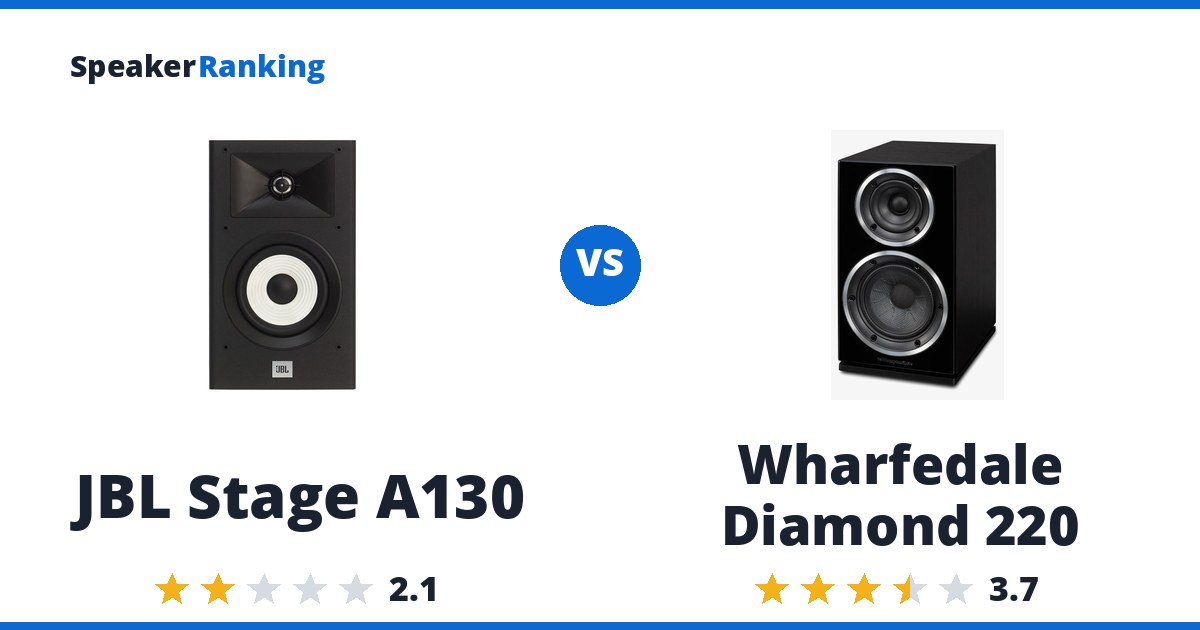
The JBL Stage A130 is the more accurate, deeper-bass option. More constant, better-behaved directivity than the smaller A120 once past the tweeter crossover point, giving a more consistent radiation pattern that likely explains some of its positive reception among other reviewers. Its measured preference score, a predictor of how neutral it sounds, is 4.04 against 3.40 for the Wharfedale Diamond 220. Its bass reaches about 66Hz before falling 3dB, against 117.2Hz for the Wharfedale Diamond 220. Watch for: Still shows the same underlying “Batman”-shaped response pattern as the A120: a bass bump, a midrange dip, a cabinet-resonance peak around 800Hz-1.7kHz (confirmed via accelerometer testing on the cabinet panels), and roughly a 5dB treble bump around 10kHz.
The Wharfedale Diamond 220 is the better-sounding pick. Amir found the on-axis response smooth once the grille is removed, calling grille removal “a huge improvement” since the stock grille caused unusually strong comb filtering around 5kHz. The tradeoff: Response rolls off below 200Hz, so a subwoofer is recommended for full-range use.
Buy the Wharfedale Diamond 220 only if you find one used in good condition; both are discontinued, and it is the better rated of the two. For a new speaker, buy the Wharfedale Diamond 12.1i, which replaces the Wharfedale Diamond 220.
Want more options? Browse the full Passive Home rankings.
Specifications Side By Side
| JBL Stage A130 | Wharfedale Diamond 220 | |
|---|---|---|
| Price | $399 per pair Discontinued | $299 per pair Discontinued |
| Ranked | #143 of 160 in Medium Size Bookshelf Speakers | #51 of 160 in Medium Size Bookshelf Speakers |
| Crossover Frequency | 3.2kHz | - |
| Dimensions | 12.6”H x 7.5”W x 9.1”D (321 x 190 x 230 mm) | 12.4”H x 6.9”W x 8.9”D (315 x 174 x 227 mm) |
| Impedance | 6 ohms nominal, about 4.3 ohms minimum (measured, Erin’s Audio Corner) | 8 ohms |
| Sensitivity | 85.2dB (measured, Erin’s Audio Corner) | 86.9dB (2.83V/1m, measured, Audio Science Review; 86dB manufacturer specified) |
| Drivers | 5.25” (133mm) polycellulose woofer, 1” (25mm) aluminum dome tweeter | 5” (130mm) woven Kevlar woofer, 1” (25mm) tweeter |
| Weight | 12 lbs (5.45 kg) each | 11.7 lbs (5.3 kg) each |
| Woofer Cabinet | ported | ported, bottom-firing into secondary enclosure |
| Bass Extension (-3dB) | 66Hz (measured, Erin’s Audio Corner) | 117.2Hz (measured, Audio Science Review) |
| Bass Extension (-10dB) | 50Hz (measured, Erin’s Audio Corner) | 58.0Hz (measured, Audio Science Review) |
| Spinorama Preference Score | 4.04 | 3.40 |
| Spinorama Preference Score with Perfect Sub | 6.51 | 6.64 |
| DIY Kit | No | No |
Related Speaker Comparisons
More worthwhile head-to-heads for Wharfedale Diamond 220:
- Ascend Sierra 1 v2 vs Wharfedale Diamond 220
- KEF LS50 Meta vs Wharfedale Diamond 220
- Arendal 1961 Monitor vs Wharfedale Diamond 220
- Revel M105 vs Wharfedale Diamond 220
- Monitor Audio Silver 50 7G vs Wharfedale Diamond 220
Prices on this page were last checked October 7, 2026 at 9:25 PM UTC. Product prices and availability are accurate as of that date/time and are subject to change; the price and availability shown on Amazon at the time of purchase will apply to the purchase of this product.
As an eBay Partner, we may be compensated if you make a purchase.
The Two Speakers In Full
 JBL Stage A130: $399 per pair Discontinued eBay
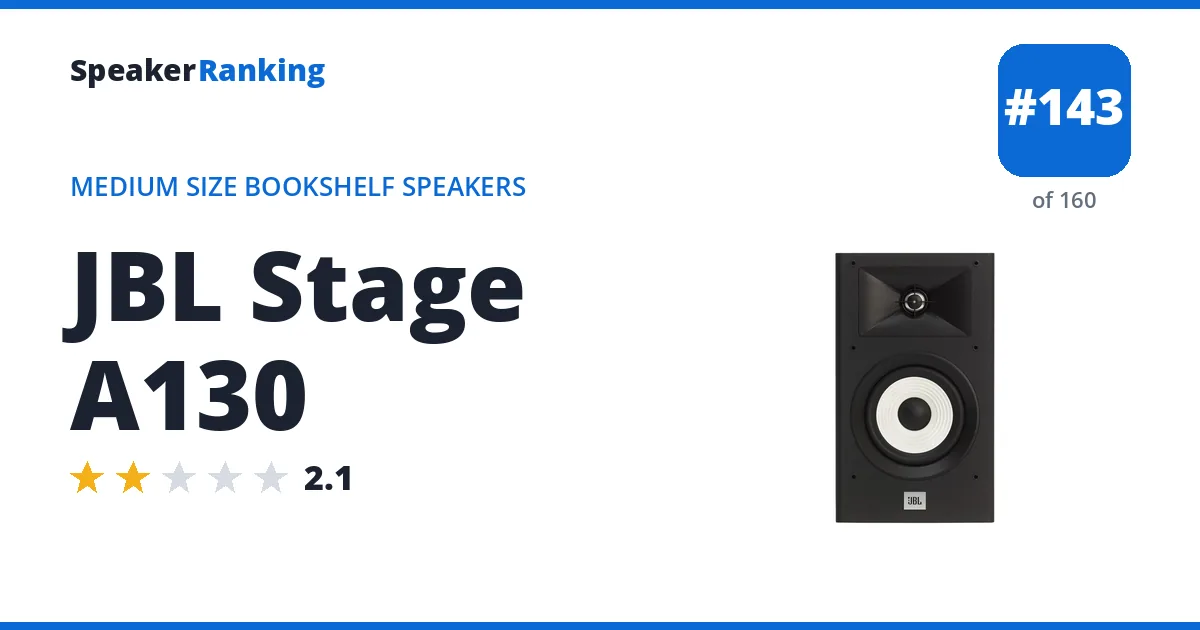
Newer model: the JBL Stage 250B, ranked higher, rated 3.2/5.
Older model: the JBL Arena 120 (ranked higher, rated 3.8/5).
Same family: the JBL Stage A120 (smaller bookshelf, ranked higher, rated 2.5/5), the JBL Stage A180 (floorstanding, rated 3.8/5), the JBL Stage A125C (smaller center, rated 3.4/5) and the JBL Stage A135C (larger center, rated 2.9/5).
Pros: More constant, better-behaved directivity than the smaller A120 once past the tweeter crossover point, giving a more consistent radiation pattern that likely explains some of its positive reception among other reviewers. Distortion at 96dB measures slightly better than a direct competitor (Emotiva Airmotiv B1+) in the low end, though slightly worse at high frequencies. The tweeter itself sounded decent to the reviewer, who considers it a reasonable value at its price point despite other reservations. Wide, well-filled horizontal radiation through the midrange. Measured bass extension of 66Hz (-3dB), with a measured sensitivity of 85.2dB.
Cons: Still shows the same underlying “Batman”-shaped response pattern as the A120: a bass bump, a midrange dip, a cabinet-resonance peak around 800Hz-1.7kHz (confirmed via accelerometer testing on the cabinet panels), and roughly a 5dB treble bump around 10kHz. Does not include a port bung, so sealed-cabinet listening requires DIY stuffing rather than a proper factory solution. The reviewer’s own measurements notably diverge from another well-known publication’s results on this same model, possibly reflecting a running production change, though this couldn’t be confirmed. Overall sound quality struck the reviewer as not a good-sounding speaker despite the more favorable measurements relative to the A120. Output-limited at extreme volumes (102dB), similar to its smaller sibling. Loses to the similarly-priced Emotiva Airmotiv B1+ in overall linearity and neutrality, according to the reviewer’s direct comparison. Discontinued.
Full JBL Stage A130 review and specifications →
| Bass Extension (-10dB) | 50Hz (measured, Erin’s Audio Corner) |
|---|---|
| Bass Extension (-3dB) | 66Hz (measured, Erin’s Audio Corner) |
| Crossover Frequency | 3.2kHz |
| DIY Kit | No |
| Dimensions | 12.6”H x 7.5”W x 9.1”D (321 x 190 x 230 mm) |
| Drivers | 5.25” (133mm) polycellulose woofer, 1” (25mm) aluminum dome tweeter |
| Impedance | 6 ohms nominal, about 4.3 ohms minimum (measured, Erin’s Audio Corner) |
| Sensitivity | 85.2dB (measured, Erin’s Audio Corner) |
| Spinorama Preference Score | 4.04 |
| Spinorama Preference Score with Perfect Sub | 6.51 |
| Weight | 12 lbs (5.45 kg) each |
| Woofer Cabinet | ported |
- Links
- Reviews, Comparisons and Sound Samples
- Head-to-Head Comparisons
- JBL Stage A130 vs Fluance Signature HFS
- JBL Stage A130 vs JBL Control 1 Pro
- JBL Stage A130 vs Q Acoustics 5020
- JBL Stage A130 vs Polk T15
- JBL Stage A130 vs Micca RB42
- JBL Stage A130 vs Definitive Technology ProMonitor 1000
- JBL Stage A130 vs Pioneer Elite SP-EBS73-LR
- JBL Stage A130 vs Q Acoustics 3020i
- See all 35 comparisons
 Wharfedale Diamond 220: $299 per pair Discontinued eBay
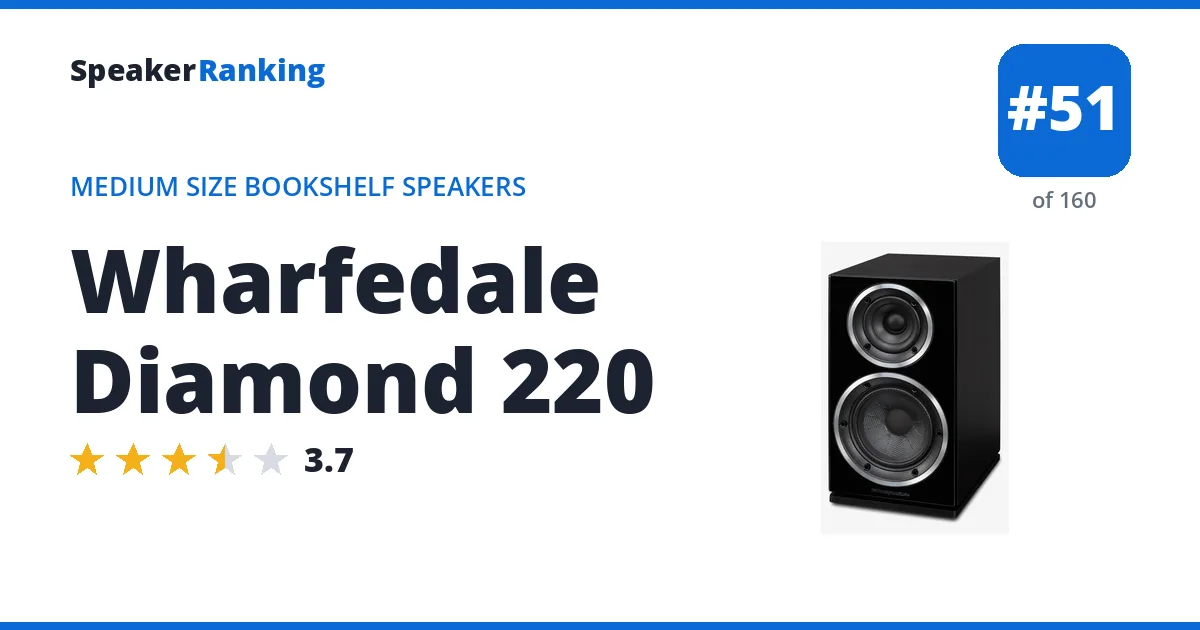
Newer model: the Wharfedale Diamond 12.1i, ranked higher, estimated 4/5.
Pros: Amir found the on-axis response smooth once the grille is removed, calling grille removal “a huge improvement” since the stock grille caused unusually strong comb filtering around 5kHz. Good horizontal dispersion from the waveguide-loaded tweeter and controlled distortion. After some EQ (a room mode filter and treble shelf), the reviewer called it “a truly hifi speaker” where “every audiophile track..sounded very good,” and said he was “happy to recommend” it for the budget class. Measured bass extension of 117.2Hz (-3dB), with a measured sensitivity of 86.9dB.
Cons: Response rolls off below 200Hz, so a subwoofer is recommended for full-range use. Some port rattling was noted at high volumes, traced to vibration rather than the woofer itself. Best performance requires removing the grille and applying the reviewer’s EQ filters. Discontinued, with only limited remaining stock available direct from Wharfedale.
Full Wharfedale Diamond 220 review and specifications →
| Bass Extension (-10dB) | 58.0Hz (measured, Audio Science Review) |
|---|---|
| Bass Extension (-3dB) | 117.2Hz (measured, Audio Science Review) |
| DIY Kit | No |
| Dimensions | 12.4”H x 6.9”W x 8.9”D (315 x 174 x 227 mm) |
| Drivers | 5” (130mm) woven Kevlar woofer, 1” (25mm) tweeter |
| Impedance | 8 ohms |
| Sensitivity | 86.9dB (2.83V/1m, measured, Audio Science Review; 86dB manufacturer specified) |
| Spinorama Preference Score | 3.40 |
| Spinorama Preference Score with Perfect Sub | 6.64 |
| Weight | 11.7 lbs (5.3 kg) each |
| Woofer Cabinet | ported, bottom-firing into secondary enclosure |
- Links
- Reviews, Comparisons and Sound Samples
- Head-to-Head Comparisons
- Wharfedale Diamond 220 vs Polk Audio XT15
- Wharfedale Diamond 220 vs KEF Q150
- Wharfedale Diamond 220 vs Boston Acoustics A25
- Wharfedale Diamond 220 vs Wharfedale Diamond 12.1
- Wharfedale Diamond 220 vs Wharfedale Super Denton
- Wharfedale Diamond 220 vs Klipsch RP-500M II
- Wharfedale Diamond 220 vs JBL Studio 530
- Wharfedale Diamond 220 vs ELAC Debut 2.0 B5.2
- See all 32 comparisons