These sit in different size classes, so this is not a straight ranking comparison. The Monolith Encore T6 ranks #127 of 226 floorstanding speakers by sound quality; the Monolith Encore B6 ranks #99 of 214 bookshelf speakers by sound quality.
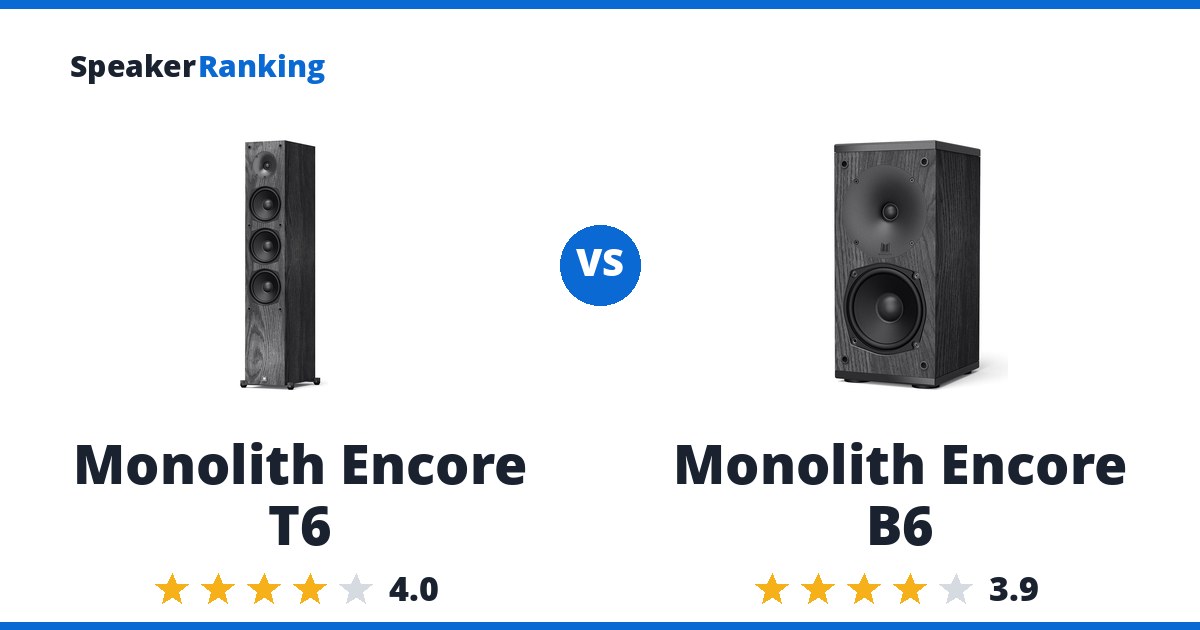
Why pick the Monolith Encore T6: Three 6.5-inch pulp-cone drivers provide more displacement and cleaner cinema output than the B6, with good compression behavior at normal levels. The catch: Despite its size, Erin measured F3 around 68Hz, so the tower does not eliminate the need for a subwoofer.
What the Monolith Encore B6 does well: For its budget price, the B6 delivers useful midbass punch and a long reflex tail: Erin measured F3 at 68Hz and F10 near 37Hz. Watch for: Erin measured 85.3dB sensitivity and a 3.4-ohm minimum, so this is not an easy load despite its modest output ceiling.
One note: the Monolith Encore T6 is discontinued and no longer widely available new.
Buy the Monolith Encore T6 for a floorstanding speaker; the Monolith Encore B6 suits a bookshelf speaker instead.
Want more options? Browse the full Passive Home rankings.
Specifications Side By Side
| Monolith Encore T6 | Monolith Encore B6 | |
|---|---|---|
| Price | Discontinued | Discontinued |
| Ranked | #127 of 226 in Large Size Floorstanding Speakers | #99 of 214 in Large Size Bookshelf Speakers |
| Bass Extension (-3dB) | ~68Hz (measured, Erin’s Audio Corner) | 68Hz (measured, Erin’s Audio Corner) |
| Bass Extension (-10dB) | 31.1Hz (measured, Erin’s Audio Corner) | 37Hz (measured, Erin’s Audio Corner) |
| Sensitivity | 87.8dB/2.83V/1m (manufacturer) | 85.3dB/2.83V/1m (measured, Erin’s Audio Corner) |
| Impedance | 4 ohms nominal | 4 ohms nominal; 3.4 ohms minimum (measured, Erin’s Audio Corner) |
| Drivers | Three 6.5-inch pulp woofers; 25mm waveguided silk dome | 6.5-inch pulp woofer; 25mm waveguided silk dome |
| Dimensions | 40H x 7.9W x 13.8D inches | 15.7H x 7.9W x 9.9D inches |
| Weight | 49.2 lbs (22.3 kg) each | 15.4 lbs (7.0 kg) each |
| Spinorama Preference Score | 4.57 | 4.67 |
| Spinorama Preference Score with Perfect Sub | 6.45 | 6.93 |
| DIY Kit | No | No |
Frequency Response Compared
Both speakers’ spinorama measurements, overlaid. A flatter line is more neutral: peaks sound forward or harsh, dips sound recessed. Each curve is shifted so its average from 300 Hz to 3 kHz sits at 0 dB, so loudness differences between the two are removed and only the shape is compared.
Measurement data: Monolith Encore T6 (measured by Erin’s Audio Corner) and Monolith Encore B6 (measured by Erin’s Audio Corner), via spinorama.org.
Watch Them Compared
Videos and reviews that test both speakers side by side.
Related Speaker Comparisons
More worthwhile head-to-heads for Monolith Encore B6:
- KEF R3 Meta vs Monolith Encore B6
- KEF Q Concerto Meta vs Monolith Encore B6
- KEF R3 vs Monolith Encore B6
- Emotiva Airmotiv XB2 vs Monolith Encore B6
- ELAC Debut 3.0 DB63 vs Monolith Encore B6
Prices on this page were last checked October 10, 2026 at 5:37 PM UTC. Product prices and availability are accurate as of that date/time and are subject to change; the price and availability shown on Amazon at the time of purchase will apply to the purchase of this product.
As an eBay Partner, we may be compensated if you make a purchase.
The Two Speakers In Full
 Monolith Encore T6 Discontinued eBay
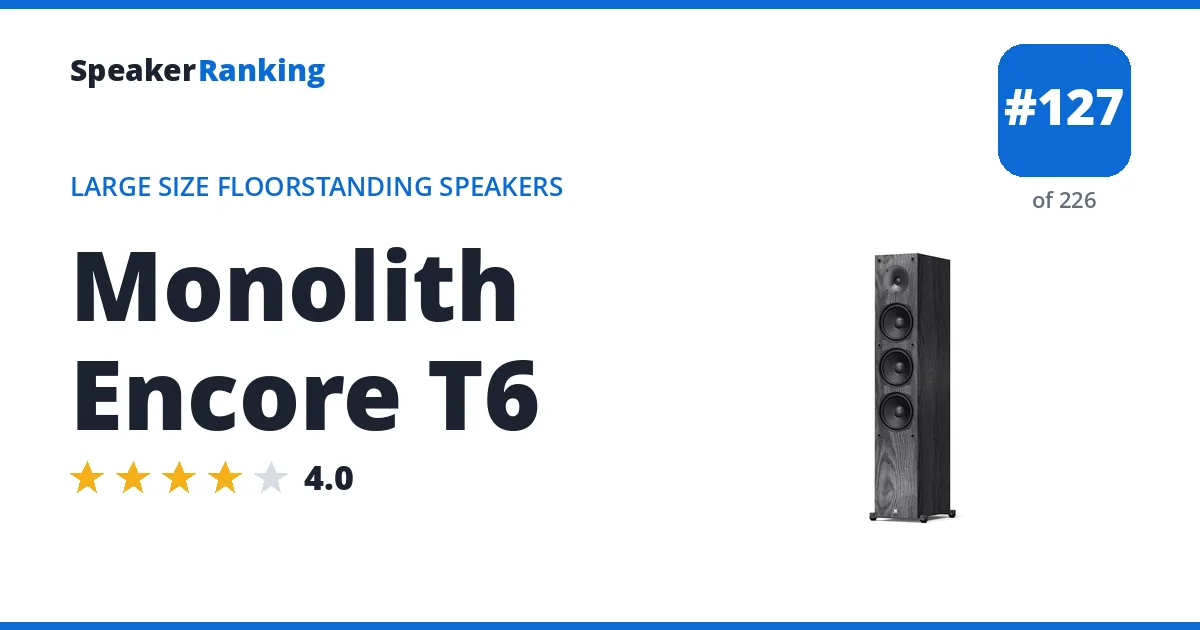
Same family: the Monolith Encore B6 (bookshelf, rated 3.9/5) and the Monolith Encore C6 (center, rated 3.7/5).
Pros: Three 6.5-inch pulp-cone drivers provide more displacement and cleaner cinema output than the B6, with good compression behavior at normal levels. Erin found the revised waveguided tweeter’s horizontal radiation consistent enough for predictable EQ, while the gloss-capped, heavily braced 49lb cabinet feels far above its price. The tower can produce useful midbass impact when crossed to a subwoofer. Measured bass extension of ~68Hz (-3dB).
Cons: Despite its size, Erin measured F3 around 68Hz, so the tower does not eliminate the need for a subwoofer. The native response needs equalization: crossover-region unevenness and excess top-octave energy prevent a fully neutral presentation. The four-ohm load and low-frequency phase angle warrant a robust amplifier, and the tall multi-driver array creates a narrower vertical listening window than a compact two-way. Discontinued.
Full Monolith Encore T6 review and specifications →
| Released | Nov 2021 (4 years ago) |
|---|---|
| Bass Extension (-10dB) | 31.1Hz (measured, Erin’s Audio Corner) |
| Bass Extension (-3dB) | ~68Hz (measured, Erin’s Audio Corner) |
| DIY Kit | No |
| Dimensions | 40H x 7.9W x 13.8D inches |
| Drivers | Three 6.5-inch pulp woofers; 25mm waveguided silk dome |
| Impedance | 4 ohms nominal |
| Sensitivity | 87.8dB/2.83V/1m (manufacturer) |
| Spinorama Preference Score | 4.57 |
| Spinorama Preference Score with Perfect Sub | 6.45 |
| Weight | 49.2 lbs (22.3 kg) each |
- Links
- Reviews, Comparisons and Sound Samples
- Head-to-Head Comparisons
 Monolith Encore B6 Discontinued eBay
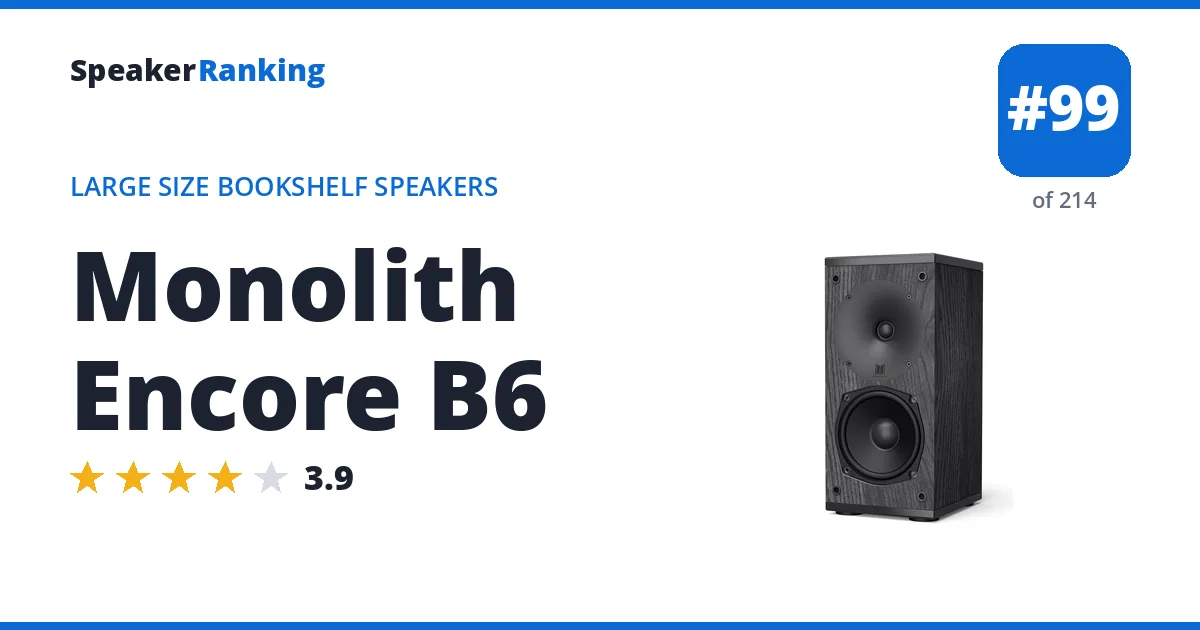
Same family: the Monolith Encore T6 (floorstanding, rated 4/5) and the Monolith Encore C6 (center, rated 3.7/5).
Pros: For its budget price, the B6 delivers useful midbass punch and a long reflex tail: Erin measured F3 at 68Hz and F10 near 37Hz. The revised tweeter assembly yields broadly smooth horizontal directivity and an early-reflections trend that accepts EQ well. At sane levels, its 6.5-inch pulp woofer provides satisfying attack, and gloss top/bottom panels plus a braced MDF cabinet are unusually substantial for the class. Measured bass extension of 68Hz (-3dB), with a measured sensitivity of 85.3dB.
Cons: Erin measured 85.3dB sensitivity and a 3.4-ohm minimum, so this is not an easy load despite its modest output ceiling. Low-frequency compression reaches about 2dB and distortion rises rapidly when driven full-range; use an 80Hz subwoofer crossover. Response variation is roughly +2.7/-3.7dB, with residual crossover/treble irregularities that keep it from true neutrality without EQ. The listening window tightens vertically, so ear height matters. Discontinued.
Full Monolith Encore B6 review and specifications →
| Released | Nov 2021 (4 years ago) |
|---|---|
| Bass Extension (-10dB) | 37Hz (measured, Erin’s Audio Corner) |
| Bass Extension (-3dB) | 68Hz (measured, Erin’s Audio Corner) |
| DIY Kit | No |
| Dimensions | 15.7H x 7.9W x 9.9D inches |
| Drivers | 6.5-inch pulp woofer; 25mm waveguided silk dome |
| Impedance | 4 ohms nominal; 3.4 ohms minimum (measured, Erin’s Audio Corner) |
| Sensitivity | 85.3dB/2.83V/1m (measured, Erin’s Audio Corner) |
| Spinorama Preference Score | 4.67 |
| Spinorama Preference Score with Perfect Sub | 6.93 |
| Weight | 15.4 lbs (7.0 kg) each |
- Links
- Reviews, Comparisons and Sound Samples
- Head-to-Head Comparisons
- Monolith Encore B6 vs Klipsch RP-600M II
- Monolith Encore B6 vs StarkSound Beta 5
- Monolith Encore B6 vs Parts Express Samba MT
- Monolith Encore B6 vs ELAC Debut 3.0 DB63
- Monolith Encore B6 vs Emotiva Airmotiv XB2
- Monolith Encore B6 vs KEF R3
- Monolith Encore B6 vs KEF Q Concerto Meta
- Monolith Encore B6 vs KEF R3 Meta