Short answer: the KEF R3 if sound quality matters most, the Monolith Encore B6 if price matters most. The KEF R3 ranks #15 of 131 bookshelf speakers, rated 4.5/5, at $2,200. The Monolith Encore B6 ranks #63, rated 3.9/5, at $360, $1,840 cheaper.
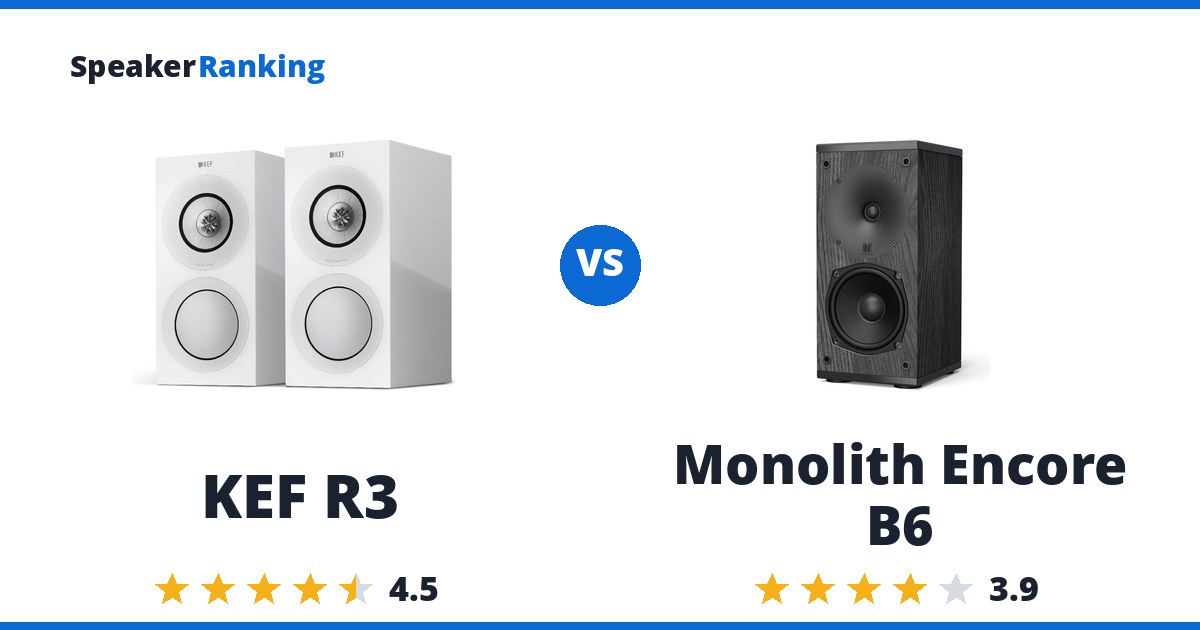
What the KEF R3 does well: True three-way stand-mount with a 6.5-inch woofer below KEF’s 5-inch Uni-Q midrange/1-inch tweeter. The catch: The low-frequency alignment rolls gradually rather than delivering high-output sub-bass; KEF specifies 58Hz +/-3dB and Erin’s high-level data supports using an 80Hz subwoofer crossover.
Why pick the Monolith Encore B6: For its budget price, the B6 delivers useful midbass punch and a long reflex tail: Erin measured F3 at 68Hz and F10 near 37Hz. The catch: Erin measured 85.3dB sensitivity and a 3.4-ohm minimum, so this is not an easy load despite its modest output ceiling.
Buy the KEF R3 if sound quality is the priority over the price, or the Monolith Encore B6 if the price is the priority over sound quality.
Looking for alternatives? See the complete Passive Home rankings.
Specifications Side By Side
| KEF R3 | Monolith Encore B6 | |
|---|---|---|
| Price | $2,200 per pair | $360 per pair |
| Ranked | #15 of 131 in Large Size Bookshelf Speakers | #63 of 131 in Large Size Bookshelf Speakers |
| Bass Extension (-3dB) | Approximately 58Hz (manufacturer specified; consistent with Erin’s measured roll-off) | 68Hz (measured, Erin’s Audio Corner) |
| Bass Extension (-10dB) | 35.2Hz (measured, Audio Science Review) | 37Hz (measured, Erin’s Audio Corner) |
| Sensitivity | Approximately 86-87dB/2.83V/1m (measured, Erin’s Audio Corner) | 85.3dB/2.83V/1m (measured, Erin’s Audio Corner) |
| Impedance | 8 ohms nominal; suitable for Erin’s 4/8-ohm-rated amplifier | 4 ohms nominal; 3.4 ohms minimum (measured, Erin’s Audio Corner) |
| Drivers | 1” tweeter coaxial with 5” midrange; 6.5” woofer | 6.5-inch pulp woofer; 25mm waveguided silk dome |
| Dimensions | 16.6”H x 7.9”W x 13.2”D | 15.7H x 7.9W x 9.9D inches |
| Woofer Cabinet | ported, rear Flexible Port | - |
| Weight | 29.9 lbs (13.55 kg) each | 15.4 lbs (7.0 kg) each |
| Spinorama Preference Score | 6.2 (spinorama.org) | 4.67 |
| Spinorama Preference Score with Perfect Sub | 7.97 (spinorama.org) | 6.93 |
| DIY Kit | No | No |
Related Speaker Comparisons
How KEF R3 compares with other leading options:
- TAD Compact Reference One (CR1TX) vs KEF R3
- KEF R3 vs Perlisten S4b
- KEF Reference 1 Meta vs KEF R3
- KEF R3 vs GR-Research NX-Studio
- March Audio Sointuva AWG vs KEF R3
Prices on this page were last checked September 30, 2026 at 2:57 PM UTC. Product prices and availability are accurate as of that date/time and are subject to change; the price and availability shown on Amazon at the time of purchase will apply to the purchase of this product.
As an eBay Partner, we may be compensated if you make a purchase.
The Two Speakers In Full
 KEF R3: $2,200 per pair Amazon eBay
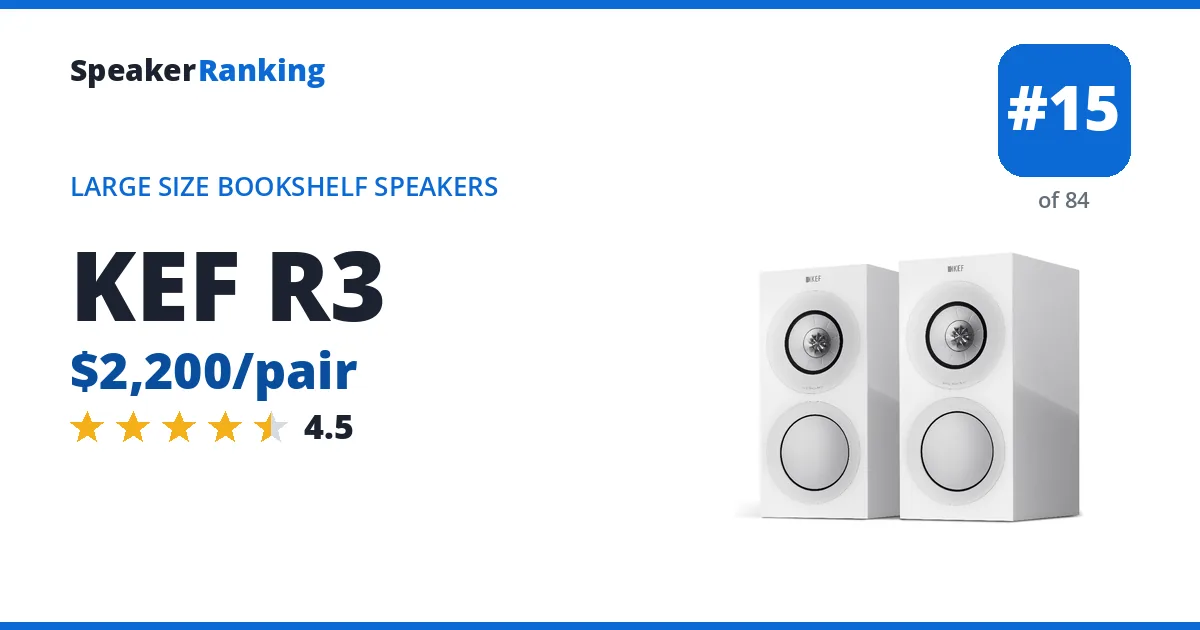
Pros: True three-way stand-mount with a 6.5-inch woofer below KEF’s 5-inch Uni-Q midrange/1-inch tweeter. Erin measured approximately 86-87dB/2.83V/1m sensitivity, exceptionally low sub-1% distortion at 86dB and orderly directivity in both planes. The coaxial geometry maintains image stability across seats, while Flexible Port Technology avoids the strong midrange port resonance common to rear-vented competitors. A 110W Parasound drove it successfully in Erin’s listening. Measured bass extension of 35.2Hz (-10dB), with a measured sensitivity of 87dB.
Cons: The low-frequency alignment rolls gradually rather than delivering high-output sub-bass; KEF specifies 58Hz +/-3dB and Erin’s high-level data supports using an 80Hz subwoofer crossover. Narrow high-frequency features and natural Uni-Q narrowing toward the top octave make toe angle audible, although off-axis tracking remains smooth. Sensitivity is moderate, the cabinet weighs almost 30 lb, and this original R3 lacks the Meta successor’s MAT absorber.
Full KEF R3 review and specifications →
| Bass Extension (-10dB) | 35.2Hz (measured, Audio Science Review) |
|---|---|
| Bass Extension (-3dB) | Approximately 58Hz (manufacturer specified; consistent with Erin’s measured roll-off) |
| DIY Kit | No |
| Dimensions | 16.6”H x 7.9”W x 13.2”D |
| Drivers | 1” tweeter coaxial with 5” midrange; 6.5” woofer |
| Impedance | 8 ohms nominal; suitable for Erin’s 4/8-ohm-rated amplifier |
| Sensitivity | Approximately 86-87dB/2.83V/1m (measured, Erin’s Audio Corner) |
| Spinorama Preference Score | 6.2 (spinorama.org) |
| Spinorama Preference Score with Perfect Sub | 7.97 (spinorama.org) |
| Weight | 29.9 lbs (13.55 kg) each |
| Woofer Cabinet | ported, rear Flexible Port |
- Links
- Reviews, Comparisons and Sound Samples
- Head-to-Head Comparisons
 Monolith Encore B6: $360 per pair Amazon Monoprice eBay
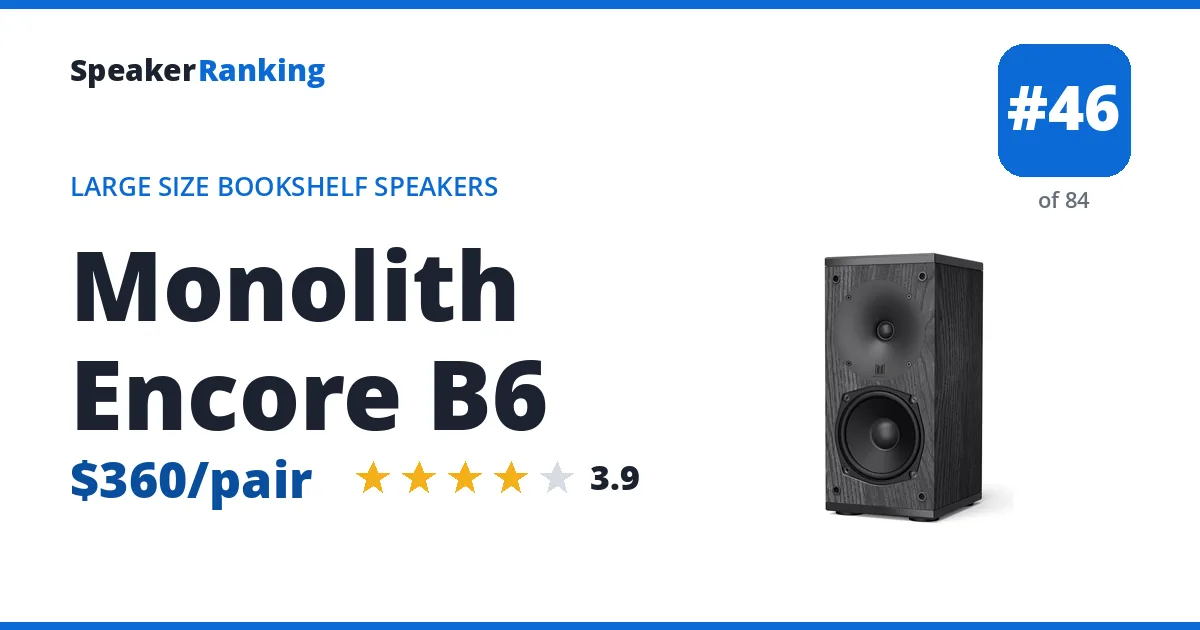
Pros: For its budget price, the B6 delivers useful midbass punch and a long reflex tail: Erin measured F3 at 68Hz and F10 near 37Hz. The revised tweeter assembly yields broadly smooth horizontal directivity and an early-reflections trend that accepts EQ well. At sane levels, its 6.5-inch pulp woofer provides satisfying attack, and gloss top/bottom panels plus a braced MDF cabinet are unusually substantial for the class. Measured bass extension of 68Hz (-3dB), with a measured sensitivity of 85.3dB.
Cons: Erin measured 85.3dB sensitivity and a 3.4-ohm minimum, so this is not an easy load despite its modest output ceiling. Low-frequency compression reaches about 2dB and distortion rises rapidly when driven full-range; use an 80Hz subwoofer crossover. Response variation is roughly +2.7/-3.7dB, with residual crossover/treble irregularities that keep it from true neutrality without EQ. The listening window tightens vertically, so ear height matters.
Full Monolith Encore B6 review and specifications →
| Bass Extension (-10dB) | 37Hz (measured, Erin’s Audio Corner) |
|---|---|
| Bass Extension (-3dB) | 68Hz (measured, Erin’s Audio Corner) |
| DIY Kit | No |
| Dimensions | 15.7H x 7.9W x 9.9D inches |
| Drivers | 6.5-inch pulp woofer; 25mm waveguided silk dome |
| Impedance | 4 ohms nominal; 3.4 ohms minimum (measured, Erin’s Audio Corner) |
| Sensitivity | 85.3dB/2.83V/1m (measured, Erin’s Audio Corner) |
| Spinorama Preference Score | 4.67 |
| Spinorama Preference Score with Perfect Sub | 6.93 |
| Weight | 15.4 lbs (7.0 kg) each |
- Links
- Reviews, Comparisons and Sound Samples
- Head-to-Head Comparisons