Short answer: the March Audio Sointuva AWG. It ranks #5 of 131 bookshelf speakers by sound quality, rated 4.7/5, at $4,150. The KEF R3 ranks #15, rated 4.5/5, at $2,200, $1,950 cheaper, a saving that is not big enough to make up the sound-quality gap.
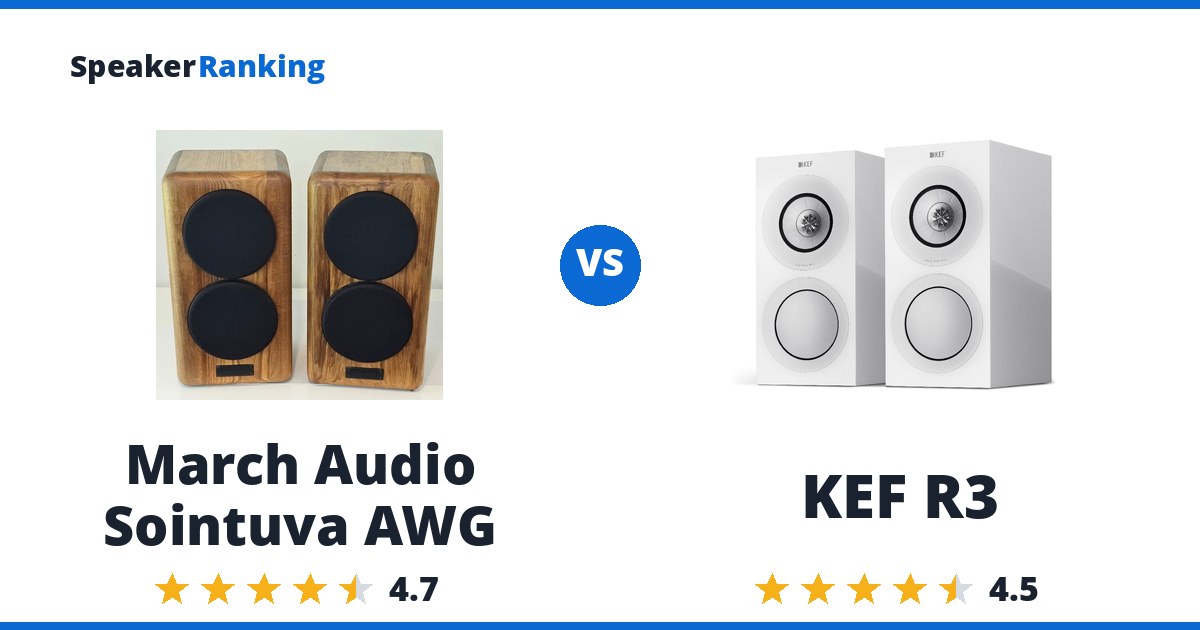
Why pick the March Audio Sointuva AWG: Purifi drivers deliver exceptionally low midrange distortion (the reviewer calls them “world class”) paired with bass extension unusually deep for a bookshelf (F3 40Hz, F10 30Hz), reaching down to about 30Hz in-room with some boundary reinforcement. The catch: Correct listening axis sits about 7° above the tweeter line, which means shorter stands (around 24”) than typical bookshelf stands are sold at: get the height wrong and the sound scoops out in the mid/high frequencies.
The case for the KEF R3: True three-way stand-mount with a 6.5-inch woofer below KEF’s 5-inch Uni-Q midrange/1-inch tweeter. The catch: The low-frequency alignment rolls gradually rather than delivering high-output sub-bass; KEF specifies 58Hz +/-3dB and Erin’s high-level data supports using an 80Hz subwoofer crossover.
Buy the March Audio Sointuva AWG. It is rated higher for sound quality, and the $1,950 saving on the KEF R3 is not enough to make up the difference.
Still deciding? The full Passive Home rankings cover every ranked option.
Specifications Side By Side
| March Audio Sointuva AWG | KEF R3 | |
|---|---|---|
| Price | $4150 per pair | $2,200 per pair |
| Ranked | #5 of 131 in Large Size Bookshelf Speakers | #15 of 131 in Large Size Bookshelf Speakers |
| Bass Extension (-10dB) | 30Hz (measured, Erin’s Audio Corner) | 35.2Hz (measured, Audio Science Review) |
| Bass Extension (-3dB) | 40Hz (measured, Erin’s Audio Corner) | Approximately 58Hz (manufacturer specified; consistent with Erin’s measured roll-off) |
| Dimensions | 17.7”H x 9.4”W x 8.7”D (449.6 x 238.8 x 221 mm) | 16.6”H x 7.9”W x 13.2”D |
| Impedance | 6 ohms | 8 ohms nominal; suitable for Erin’s 4/8-ohm-rated amplifier |
| Sensitivity | 82.4dB (measured, Erin’s Audio Corner) | Approximately 86-87dB/2.83V/1m (measured, Erin’s Audio Corner) |
| Drivers | 6.5” Purifi PTT-OEM Midwoofer, Satori TW29BNWG-4 Beryllium Dome Tweeter with Waveguide | 1” tweeter coaxial with 5” midrange; 6.5” woofer |
| Woofer Cabinet | passive radiator | ported, rear Flexible Port |
| Weight | 11 lbs (5 kg) | 29.9 lbs (13.55 kg) each |
| Spinorama Preference Score | 6.95 | 6.2 (spinorama.org) |
| Spinorama Preference Score with Perfect Sub | 8.45 | 7.97 (spinorama.org) |
| DIY Kit | No | No |
Related Speaker Comparisons
More worthwhile head-to-heads for March Audio Sointuva AWG:
- KEF Reference 1 Meta vs March Audio Sointuva AWG
- GR-Research NX-Studio vs March Audio Sointuva AWG
- AsciLab C6B vs March Audio Sointuva AWG
- KEF R3 Meta vs March Audio Sointuva AWG
- KEF Q Concerto Meta vs March Audio Sointuva AWG
Prices on this page were last checked September 30, 2026 at 2:57 PM UTC. Product prices and availability are accurate as of that date/time and are subject to change; the price and availability shown on Amazon at the time of purchase will apply to the purchase of this product.
As an eBay Partner, we may be compensated if you make a purchase.
The Two Speakers In Full
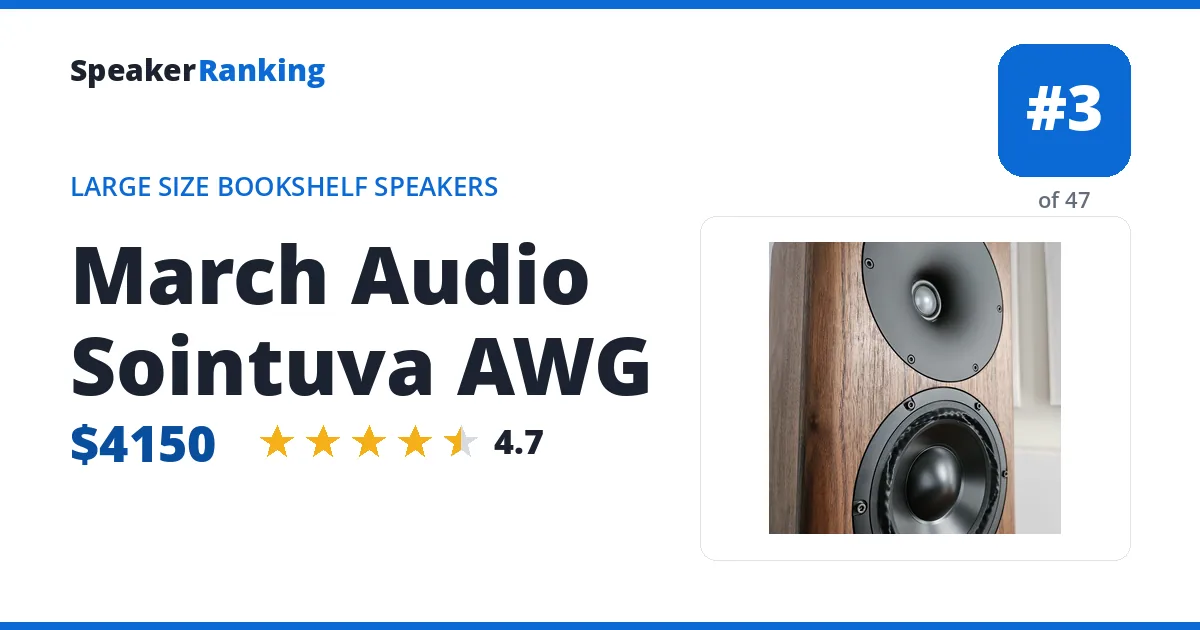
 March Audio Sointuva AWG: $4150 per pair March Audio eBay
Older model: the March Audio Sointuva (ranked lower, rated 4.6/5).
Pros: Purifi drivers deliver exceptionally low midrange distortion (the reviewer calls them “world class”) paired with bass extension unusually deep for a bookshelf (F3 40Hz, F10 30Hz), reaching down to about 30Hz in-room with some boundary reinforcement. Sensitivity tolerance band measured extremely tight at 1.6-1.73dB, indicating excellent build consistency. Estimated in-room response is exceptionally smooth and neutral: one of the flattest the reviewer has measured, with none of the usual coloration descriptors (bright, boomy, nasal, shouty) needed to describe it. Distortion stays so low even at loud volumes that there’s no audible warning cue before you’re playing dangerously loud: a backhanded compliment to how clean it sounds. At $4150/pair, ranked among the reviewer’s top three bookshelf speakers in that price range. Measured bass extension of 40Hz (-3dB), with a measured sensitivity of 82.4dB.
Cons: Correct listening axis sits about 7° above the tweeter line, which means shorter stands (around 24”) than typical bookshelf stands are sold at: get the height wrong and the sound scoops out in the mid/high frequencies. Moderate-low sensitivity (~82dB) is roughly 3dB below a typical bookshelf speaker, meaning close to double the amplifier power is needed for the same output; low impedance also calls for a 4-ohm capable amp. Horizontal radiation holds a wide ±60° only up to about 3kHz before narrowing: tighter top-end dispersion than the reviewer’s preferred ±60-70° through the treble, and the reason he left the previous generation off his all-time top-five list. Multitone distortion rises above the reviewer’s personal 3% threshold in the 1-2kHz region, though it wasn’t audible in his listening. Not intended to be crossed over with a subwoofer at 80Hz: designed to play full-range down to 40-50Hz, so pairing it with a sub and cutting it off early wastes its bass capability. Best positioned about 3 feet from the rear wall, requiring more floor space than many bookshelf speakers.
Full March Audio Sointuva AWG review and specifications →
| Bass Extension (-10dB) | 30Hz (measured, Erin’s Audio Corner) |
|---|---|
| Bass Extension (-3dB) | 40Hz (measured, Erin’s Audio Corner) |
| DIY Kit | No |
| Dimensions | 17.7”H x 9.4”W x 8.7”D (449.6 x 238.8 x 221 mm) |
| Drivers | 6.5” Purifi PTT-OEM Midwoofer, Satori TW29BNWG-4 Beryllium Dome Tweeter with Waveguide |
| Impedance | 6 ohms |
| Sensitivity | 82.4dB (measured, Erin’s Audio Corner) |
| Spinorama Preference Score | 6.95 |
| Spinorama Preference Score with Perfect Sub | 8.45 |
| Weight | 11 lbs (5 kg) |
| Woofer Cabinet | passive radiator |
- Links
- Reviews, Comparisons and Sound Samples
- Head-to-Head Comparisons
- March Audio Sointuva AWG vs AsciLab C6B
- March Audio Sointuva AWG vs GR-Research NX-Studio
- March Audio Sointuva AWG vs KEF Reference 1 Meta
- March Audio Sointuva AWG vs KEF R3 Meta
- March Audio Sointuva AWG vs KEF Q Concerto Meta
- March Audio Sointuva AWG vs Wharfedale Aura 2
- March Audio Sointuva AWG vs MoFi SourcePoint 8
- March Audio Sointuva AWG vs GR-Research NX-Bravo
- See all 11 comparisons
 KEF R3: $2,200 per pair Amazon eBay
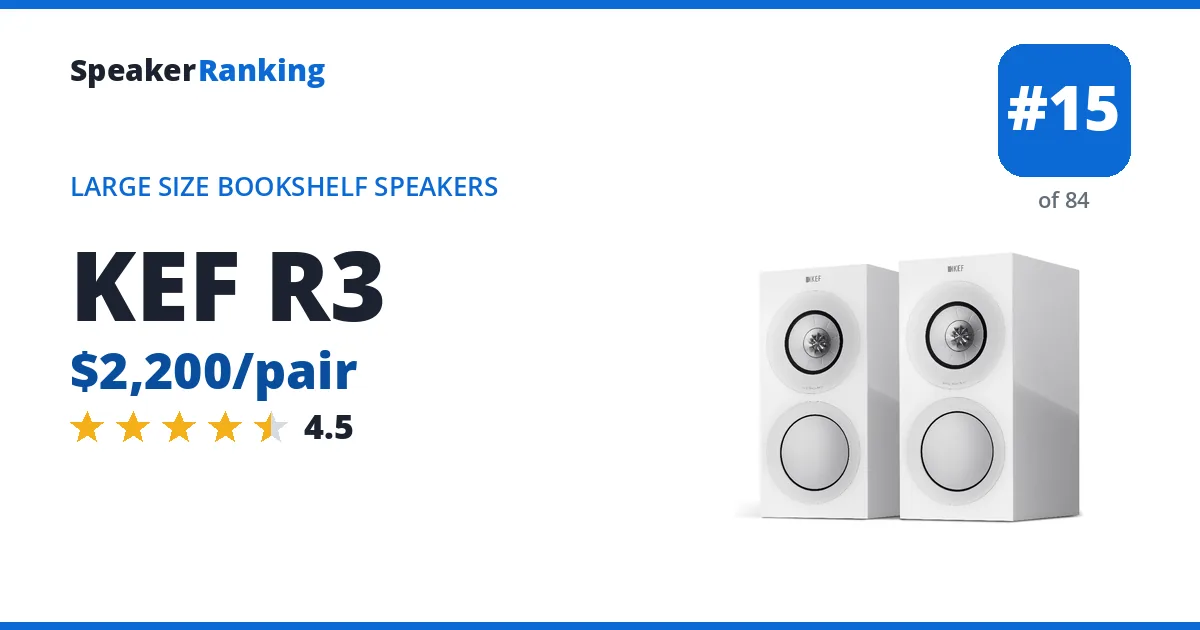
Pros: True three-way stand-mount with a 6.5-inch woofer below KEF’s 5-inch Uni-Q midrange/1-inch tweeter. Erin measured approximately 86-87dB/2.83V/1m sensitivity, exceptionally low sub-1% distortion at 86dB and orderly directivity in both planes. The coaxial geometry maintains image stability across seats, while Flexible Port Technology avoids the strong midrange port resonance common to rear-vented competitors. A 110W Parasound drove it successfully in Erin’s listening. Measured bass extension of 35.2Hz (-10dB), with a measured sensitivity of 87dB.
Cons: The low-frequency alignment rolls gradually rather than delivering high-output sub-bass; KEF specifies 58Hz +/-3dB and Erin’s high-level data supports using an 80Hz subwoofer crossover. Narrow high-frequency features and natural Uni-Q narrowing toward the top octave make toe angle audible, although off-axis tracking remains smooth. Sensitivity is moderate, the cabinet weighs almost 30 lb, and this original R3 lacks the Meta successor’s MAT absorber.
Full KEF R3 review and specifications →
| Bass Extension (-10dB) | 35.2Hz (measured, Audio Science Review) |
|---|---|
| Bass Extension (-3dB) | Approximately 58Hz (manufacturer specified; consistent with Erin’s measured roll-off) |
| DIY Kit | No |
| Dimensions | 16.6”H x 7.9”W x 13.2”D |
| Drivers | 1” tweeter coaxial with 5” midrange; 6.5” woofer |
| Impedance | 8 ohms nominal; suitable for Erin’s 4/8-ohm-rated amplifier |
| Sensitivity | Approximately 86-87dB/2.83V/1m (measured, Erin’s Audio Corner) |
| Spinorama Preference Score | 6.2 (spinorama.org) |
| Spinorama Preference Score with Perfect Sub | 7.97 (spinorama.org) |
| Weight | 29.9 lbs (13.55 kg) each |
| Woofer Cabinet | ported, rear Flexible Port |
- Links
- Reviews, Comparisons and Sound Samples
- Head-to-Head Comparisons