Short answer: the Dynaudio Special Forty. It ranks #135 of 203 bookshelf speakers by sound quality (rated 3.5/5) at $3,600 and is still sold new; the Klipsch RP-600M ranks #175 (rated 2.9/5) and is discontinued, so it is only an option used. The Klipsch RP-600M’s replacement, the Klipsch RP-600M II, is rated 3.7/5.
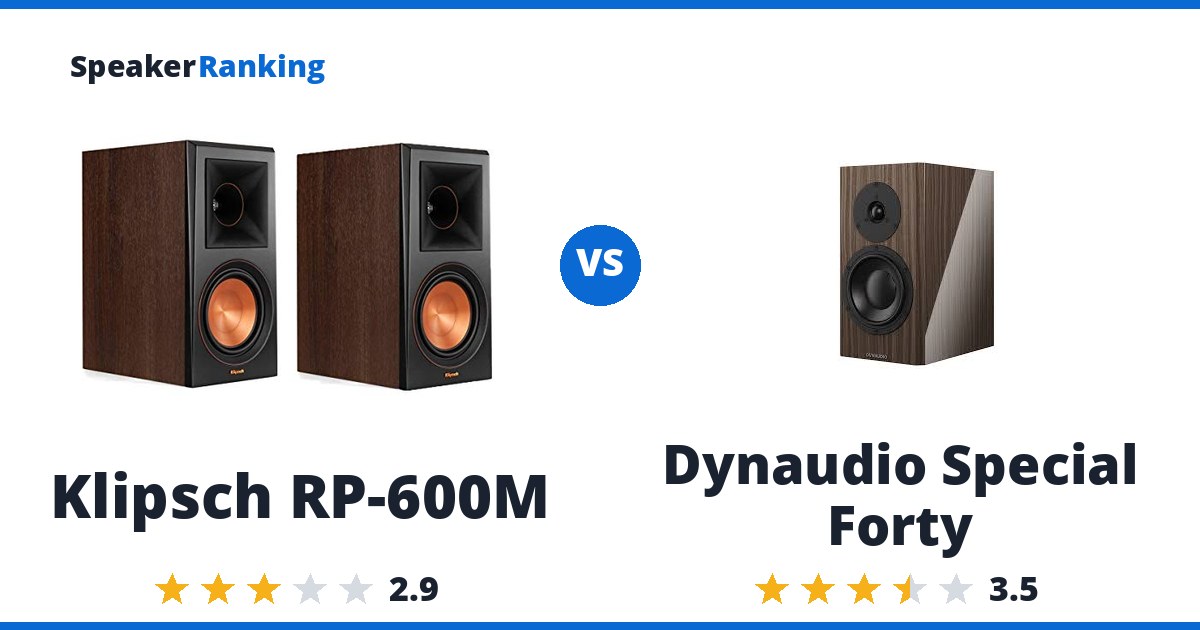
The case for the Klipsch RP-600M: More linear horizontal dispersion than the updated Klipsch RP-600M II: as you move side-to-side, the tonal character changes less, a genuine advantage for off-axis listening consistency. The catch: A strong, annoying resonance in the lower vocal range around 300Hz stands out clearly (though it can be EQ’d out).
The Dynaudio Special Forty is the more accurate, deeper-bass option. Smooth, “buttery” overall tonal character consistent with Dynaudio’s house sound. Its measured preference score, a predictor of how neutral it sounds, is 4.73 against 3.66 for the Klipsch RP-600M. Its bass reaches about 54Hz before falling 3dB, against 73Hz for the Klipsch RP-600M. Watch for: A glaring, sometimes sibilant quality around 3-4kHz was the most noticeable issue in listening, the one thing the reviewer would want notched out with EQ.
Buy the Dynaudio Special Forty. It is rated higher for sound quality and still sold new, while the Klipsch RP-600M is discontinued.
Still deciding? The full Passive Home rankings cover every ranked option.
Specifications Side By Side
| Klipsch RP-600M | Dynaudio Special Forty | |
|---|---|---|
| Price | $239.97 per pair Discontinued | $3600 per pair |
| Ranked | #175 of 203 in Large Size Bookshelf Speakers | #135 of 203 in Large Size Bookshelf Speakers |
| Bass Extension (-10dB) | 40Hz (measured, Erin’s Audio Corner) | 39Hz (measured, Erin’s Audio Corner) |
| Bass Extension (-3dB) | 73Hz (measured, Erin’s Audio Corner) | 54Hz (measured, Erin’s Audio Corner) |
| Dimensions | 15.7”H x 8”W x 11.9”D (398.8 x 203.2 x 302.3 mm) | 14.1”H x 7.7”W x 12.1”D (358.1 x 195.6 x 307.3 mm) |
| Impedance | 8 ohms nominal, 3.5 ohms minimum (measured, Erin’s Audio Corner) | 6 ohms nominal (4.9 ohms minimum above 80Hz, measured, Erin’s Audio Corner) |
| Sensitivity | 85.2dB (measured, Erin’s Audio Corner) | 83.5dB (measured, Erin’s Audio Corner; 86dB manufacturer specified) |
| Drivers | 6.5” Cerametallic cone woofer, 1” titanium LTS vented tweeter with Tractrix horn | 5.9” MSP (Magnesium Silicate Polymer) cone woofer, 1” Esotar soft dome tweeter |
| Weight | 16.1 lbs (7.3 kg) each | 17.9 lbs (8.1 kg) each |
| Woofer Cabinet | ported | ported |
| Spinorama Preference Score | 3.66 | 4.73 |
| Spinorama Preference Score with Perfect Sub | 5.61 | 6.74 |
| DIY Kit | No | No |
Related Speaker Comparisons
More top alternatives to Dynaudio Special Forty:
- Dynaudio Special Forty vs Perlisten S4b
- Dynaudio Special Forty vs KEF Reference 1 Meta
- Dynaudio Special Forty vs GR-Research NX-Studio
- AsciLab C6B vs Dynaudio Special Forty
- Audio First Cadentia 3 vs Dynaudio Special Forty
Prices on this page were last checked October 9, 2026 at 8:01 AM UTC. Product prices and availability are accurate as of that date/time and are subject to change; the price and availability shown on Amazon at the time of purchase will apply to the purchase of this product.
As an eBay Partner, we may be compensated if you make a purchase.
The Two Speakers In Full
 Klipsch RP-600M: $239.97 per pair Discontinued Amazon eBay
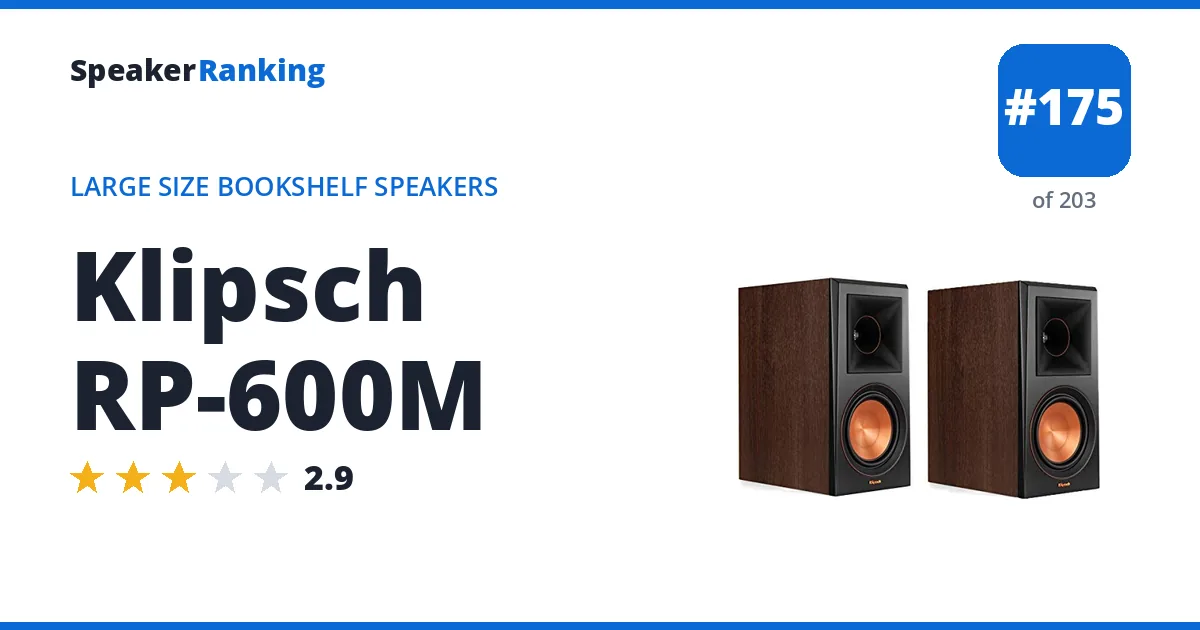
Newer model: the Klipsch RP-600M II, ranked higher, rated 3.7/5.
Same family: the Klipsch RP-500M (smaller bookshelf, rated 3.4/5).
Pros: More linear horizontal dispersion than the updated Klipsch RP-600M II: as you move side-to-side, the tonal character changes less, a genuine advantage for off-axis listening consistency. Takes exceptionally well to EQ correction (miniDSP or similar), letting a knowledgeable owner fix its tonal shortcomings without needing to upgrade. Standard 6.5” woofer/horn-tweeter two-way design with reasonably gradual bass rolloff (F3 ~70Hz, F10 ~40Hz) rather than a steep vented-enclosure cutoff. Measured bass extension of 73Hz (-3dB), with a measured sensitivity of 85.2dB.
Cons: A strong, annoying resonance in the lower vocal range around 300Hz stands out clearly (though it can be EQ’d out). Overall tonal balance is notably less neutral than the newer Klipsch RP-600M II, with a roughly 3-4dB suckout in the estimated in-room response. The waveguide doesn’t extend flush to the baffle edge, increasing diffraction compared to the redesigned version. Klipsch’s marketed sensitivity spec (about 96dB) is a half-space, in-room-style rating roughly 9dB above the true anechoic figure (closer to 85-86dB), which can mislead buyers comparing spec sheets. Elevated treble on-axis, similar to its successor, benefits from toe-out or careful placement. Vertical listening tolerance is limited to about ±10° from the tweeter axis. Still needs a subwoofer for real bass weight; a boost around 120Hz gives kick drums their “tambour” without the underlying “meat.”. Discontinued.
Full Klipsch RP-600M review and specifications →
| Bass Extension (-10dB) | 40Hz (measured, Erin’s Audio Corner) |
|---|---|
| Bass Extension (-3dB) | 73Hz (measured, Erin’s Audio Corner) |
| DIY Kit | No |
| Dimensions | 15.7”H x 8”W x 11.9”D (398.8 x 203.2 x 302.3 mm) |
| Drivers | 6.5” Cerametallic cone woofer, 1” titanium LTS vented tweeter with Tractrix horn |
| Impedance | 8 ohms nominal, 3.5 ohms minimum (measured, Erin’s Audio Corner) |
| Sensitivity | 85.2dB (measured, Erin’s Audio Corner) |
| Spinorama Preference Score | 3.66 |
| Spinorama Preference Score with Perfect Sub | 5.61 |
| Weight | 16.1 lbs (7.3 kg) each |
| Woofer Cabinet | ported |
- Links
- Reviews, Comparisons and Sound Samples
- Erin’s Audio Corner: The Truth about Klipsch’s “NEW” Sound. RP-600M Update. More from Erin’s Audio Corner →
- Erin’s Audio Corner Website Klipsch RP-600M
- GR-Research: We Bought The "NEW" RP-600M II Is KLIPSCH Listening?! More from GR-Research →
- Audio Science Review Measurements More from Audio Science Review →
- Audio Science Review Measurements (spinorama.org)
- Head-to-Head Comparisons
- Klipsch RP-600M vs Sonus Faber Lumina II Amator
- Klipsch RP-600M vs Wharfedale Diamond 9.1
- Klipsch RP-600M vs Triangle Borea BR03
- Klipsch RP-600M vs KEF Q350
- Klipsch RP-600M vs B&W 805S
- Klipsch RP-600M vs Emotiva Airmotiv B2+
- Klipsch RP-600M vs Sonus Faber Sonetto II G2
- Klipsch RP-600M vs Aperion Audio Verus V8B
- See all 38 comparisons
 Dynaudio Special Forty: $3600 per pair Safe and Sound HQ eBay
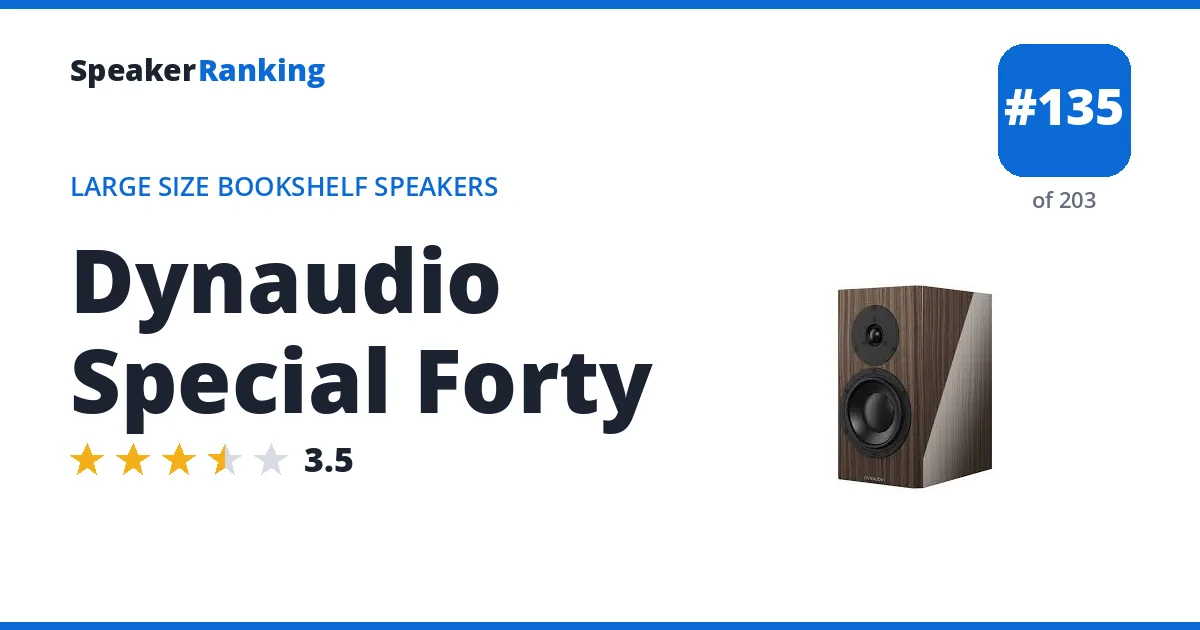
Pros: Smooth, “buttery” overall tonal character consistent with Dynaudio’s house sound. Surprisingly precise, focused imaging despite wide horizontal radiation (about ±70°): atypical, since wide-radiating speakers usually sacrifice some image precision in reflective rooms. Strong output capability: reached 100-101dB average at 3.5 meters with no audible distortion or woofer distress, and compression testing at 102dB shows the cabinet holding up mechanically well at extreme output. Bass reaches a genuine 50Hz (potentially 40Hz) in most rooms from a rear-ported design. Distortion stays below 1% at 86dB and doesn’t cross 3% THD until about 50Hz even at 96dB. Extra weight and impact on snares and percussion around 700-800Hz that the reviewer found appealing on many tracks. Measured bass extension of 54Hz (-3dB), with a measured sensitivity of 83.5dB.
Cons: A glaring, sometimes sibilant quality around 3-4kHz was the most noticeable issue in listening, the one thing the reviewer would want notched out with EQ. Multiple enclosure resonances appear between 500Hz-1kHz across on-axis, listening window, early-reflections, and sound-power measurements, corroborated by independent third-party CSD data showing similar 500-800Hz cabinet resonances. A dip around 1.2kHz traces to a cone-edge-to-surround compliance mismatch in the driver itself (confirmed by testing the bare driver’s impedance): a known artifact common to many similarly-sized drivers across several manufacturers, contributing to elevated second-order distortion in that region. A somewhat laid-back, recessed 1-2kHz character (sometimes described as a “BBC dip”) gives an overall subdued quality that isn’t overtly problematic but shapes the tonal balance. Impedance drops below 3 ohms in the 100-200Hz region, requiring a genuinely 4-ohm-stable amplifier rather than an AVR. Rear port means it can’t be placed directly against a wall.
Full Dynaudio Special Forty review and specifications →
| Bass Extension (-10dB) | 39Hz (measured, Erin’s Audio Corner) |
|---|---|
| Bass Extension (-3dB) | 54Hz (measured, Erin’s Audio Corner) |
| DIY Kit | No |
| Dimensions | 14.1”H x 7.7”W x 12.1”D (358.1 x 195.6 x 307.3 mm) |
| Drivers | 5.9” MSP (Magnesium Silicate Polymer) cone woofer, 1” Esotar soft dome tweeter |
| Impedance | 6 ohms nominal (4.9 ohms minimum above 80Hz, measured, Erin’s Audio Corner) |
| Sensitivity | 83.5dB (measured, Erin’s Audio Corner; 86dB manufacturer specified) |
| Spinorama Preference Score | 4.73 |
| Spinorama Preference Score with Perfect Sub | 6.74 |
| Weight | 17.9 lbs (8.1 kg) each |
| Woofer Cabinet | ported |
- Links
- Reviews, Comparisons and Sound Samples
- Head-to-Head Comparisons
- Dynaudio Special Forty vs ELAC Debut 2.0 B6.2
- Dynaudio Special Forty vs Infinity IL10
- Dynaudio Special Forty vs SVS Prime Bookshelf
- Dynaudio Special Forty vs GR-Research X-LS Encore
- Dynaudio Special Forty vs KEF Q3 Meta
- Dynaudio Special Forty vs Polk Monitor XT20
- Dynaudio Special Forty vs Sonus Faber Lumina II
- Dynaudio Special Forty vs Mission LX-3 MKII
- See all 55 comparisons