Short answer: the Klipsch RP-600M for off-axis consistency, the Sonetto II G2 for build. The Klipsch has more linear horizontal dispersion than the updated RP-600M II, so tonal character changes less side to side, though a strong, annoying resonance around 300Hz stands out and may need EQ. The Sonetto II G2 pairs its concrete and aluminum base with a notably bright on-axis sound.
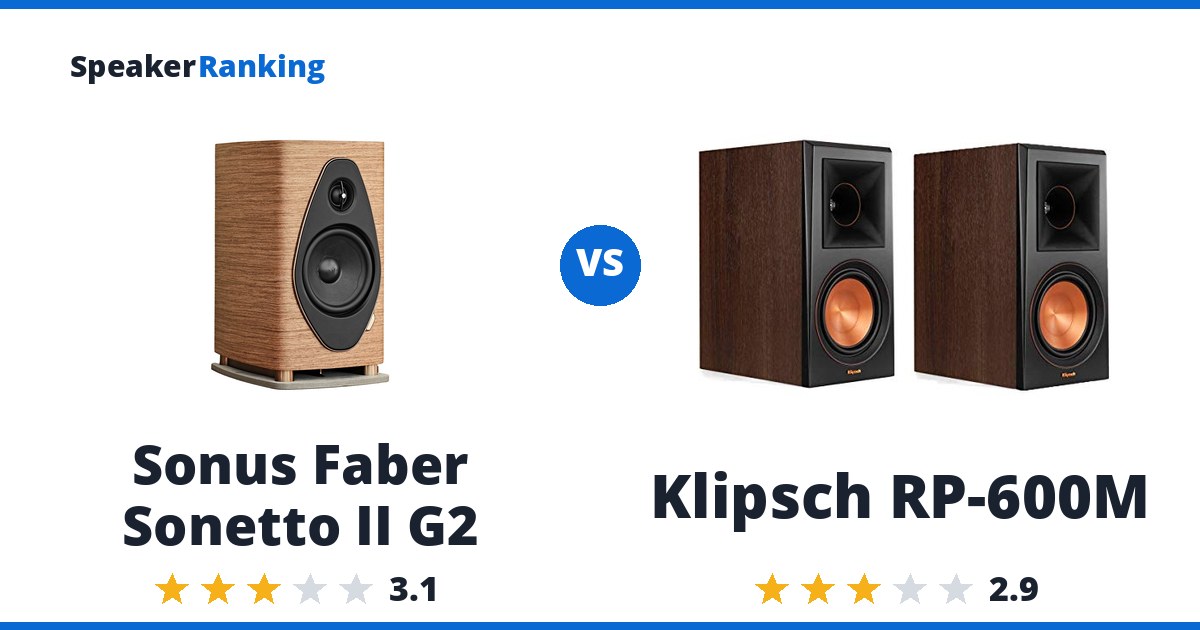
Buy the Sonus Faber Sonetto II G2. It is rated higher for sound quality, and the Klipsch RP-600M is discontinued, so it is only available used.
Still deciding? The full Passive Home rankings cover every ranked option.
Specifications Side By Side
| Sonus Faber Sonetto II G2 | Klipsch RP-600M | |
|---|---|---|
| Price | $3500 per pair | $377.99 per pair Discontinued |
| Ranked | #106 of 134 in Large Size Bookshelf Speakers | #111 of 134 in Large Size Bookshelf Speakers |
| Bass Extension (-10dB) | 38Hz (measured, Erin’s Audio Corner) | 40Hz (measured, Erin’s Audio Corner) |
| Bass Extension (-3dB) | 62Hz (measured, Erin’s Audio Corner) | 73Hz (measured, Erin’s Audio Corner) |
| Impedance | 4 ohms nominal (4.2 ohms minimum, measured by Erin’s Audio Corner) | 8 ohms nominal, 3.5 ohms minimum (measured, Erin’s Audio Corner) |
| Sensitivity | 87dB (measured, Erin’s Audio Corner) | 85.2dB (measured, Erin’s Audio Corner) |
| Drivers | 1x 6.5” mid-woofer (paper cone), 1x 1.1” (28mm) DAD soft dome tweeter | 6.5” Cerametallic cone woofer, 1” titanium LTS vented tweeter with Tractrix horn |
| Weight | 38.4 lbs (17.4 kg) | 16.1 lbs (7.3 kg) each |
| Dimensions | 16.3”H x 8.9”W x 14”D (414.3 x 227.0 x 355.6 mm) | 15.7”H x 8”W x 11.9”D (398.8 x 203.2 x 302.3 mm) |
| Woofer Cabinet | ported, front | ported |
| Spinorama Preference Score | 4.25 | 3.66 |
| Spinorama Preference Score with Perfect Sub | 6.54 | 5.61 |
| DIY Kit | No | No |
Related Speaker Comparisons
More top alternatives to Sonus Faber Sonetto II G2:
- Sonus Faber Sonetto II G2 vs Perlisten S4b
- Sonus Faber Sonetto II G2 vs KEF Reference 1 Meta
- Sonus Faber Sonetto II G2 vs GR-Research NX-Studio
- Sonus Faber Sonetto II G2 vs AsciLab C6B
- Audio First Cadentia 3 vs Sonus Faber Sonetto II G2
Prices on this page were last checked October 3, 2026 at 10:26 PM UTC. Product prices and availability are accurate as of that date/time and are subject to change; the price and availability shown on Amazon at the time of purchase will apply to the purchase of this product.
As an eBay Partner, we may be compensated if you make a purchase.
The Two Speakers In Full
 Sonus Faber Sonetto II G2: $3500 per pair Crutchfield eBay
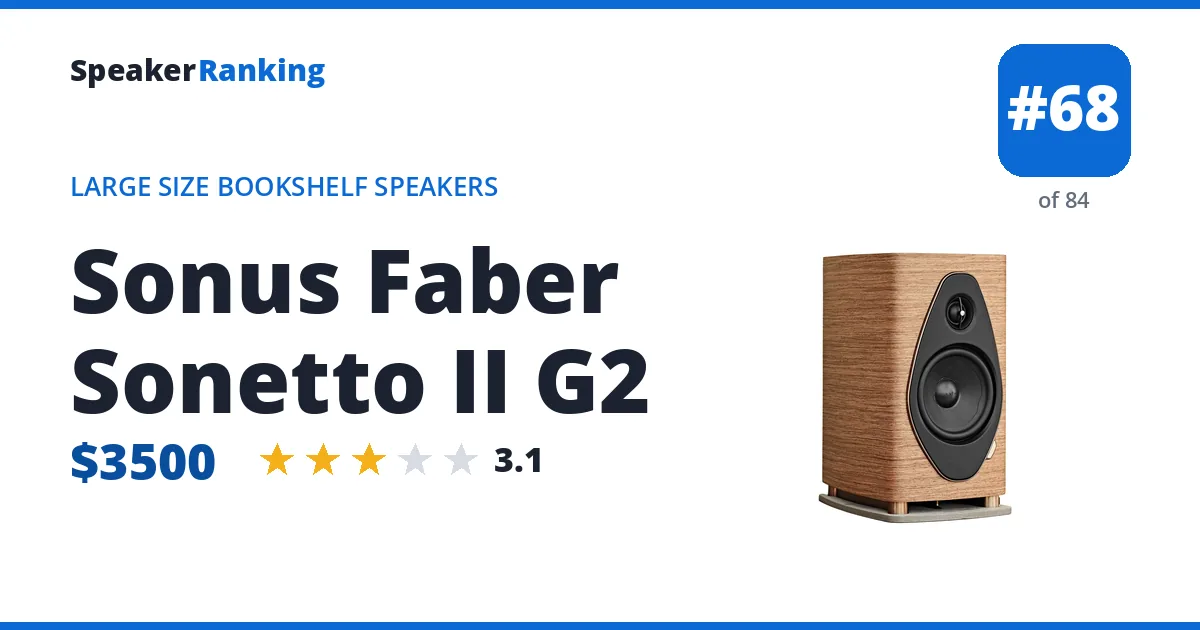
Pros: Two-way design with a 1.125” damped Apex Dome silk tweeter and 6.5” cone woofer, using a base of concrete, aluminum, and steel with under-cabinet venting. Notably more neutral than Sonus Faber’s own Lumina 2, which runs 2-5dB hotter in the treble. Horizontal directivity narrows at a fairly constant, well-behaved rate rather than narrowing-then-widening-then-narrowing like some rivals (including the Lumina 2), meaning sidewall reflections match the direct sound well enough that the reviewer doesn’t recommend sidewall absorption for this speaker. The tweeter-to-woofer crossover handoff around 3kHz looks clean, suggesting a higher-order crossover than typical for the size/price class. Good dynamic range: the low end loses only about 2dB from 76dB to 96dB, otherwise holding up well. Not a difficult amplifier load (about 4.2 ohms minimum impedance). Bass extension reaches a genuine 50Hz in-room, fuller than the Lumina 2. Measured bass extension of 62Hz (-3dB), with a measured sensitivity of 87dB.
Cons: Sounds notably bright pointed directly on-axis; toeing the speaker out about 30° reduces treble energy and sibilance meaningfully. A resonance around 700Hz gives vocals a slightly nasal, hollow quality. A dip in the upper midrange (roughly 1-2kHz) reduces perceived detail and attack, while the elevated treble can read as “analytical” or “detailed” to some listeners despite being a coloration rather than true resolution. Needs more clearance from the rear wall than some rivals (about 1.5-2 feet in an ideal room, more or less depending on your specific room modes) or the 80-120Hz region can become boomy. Vertical listening window is limited to about ±10-15° from the tweeter axis. Some unexplained directivity irregularities appear around 1.2kHz and 1.6kHz, possibly port-related, along with a longer decay in the 800Hz-1600Hz range in burst-decay measurements. Multitone distortion approaches the reviewer’s 3% threshold through the midrange, though likely not obviously audible without direct A/B comparison. A resonance in the cabinet appears around 400Hz in impedance measurements.
Full Sonus Faber Sonetto II G2 review and specifications →
| Bass Extension (-10dB) | 38Hz (measured, Erin’s Audio Corner) |
|---|---|
| Bass Extension (-3dB) | 62Hz (measured, Erin’s Audio Corner) |
| DIY Kit | No |
| Dimensions | 16.3”H x 8.9”W x 14”D (414.3 x 227.0 x 355.6 mm) |
| Drivers | 1x 6.5” mid-woofer (paper cone), 1x 1.1” (28mm) DAD soft dome tweeter |
| Impedance | 4 ohms nominal (4.2 ohms minimum, measured by Erin’s Audio Corner) |
| Sensitivity | 87dB (measured, Erin’s Audio Corner) |
| Spinorama Preference Score | 4.25 |
| Spinorama Preference Score with Perfect Sub | 6.54 |
| Weight | 38.4 lbs (17.4 kg) |
| Woofer Cabinet | ported, front |
- Links
- Reviews, Comparisons and Sound Samples
- Head-to-Head Comparisons
- Sonus Faber Sonetto II G2 vs Audio Craftsmen Victoria
- Sonus Faber Sonetto II G2 vs Emotiva Airmotiv B2+
- Sonus Faber Sonetto II G2 vs Pylon Jasper Monitor 18
- Sonus Faber Sonetto II G2 vs JBL XPL-90
- Sonus Faber Sonetto II G2 vs KEF Q350
- Sonus Faber Sonetto II G2 vs Sonus Faber Lumina II Amator
- Sonus Faber Sonetto II G2 vs Polk R200
- Sonus Faber Sonetto II G2 vs Wharfedale Diamond 9.1
- See all 59 comparisons
 Klipsch RP-600M: $377.99 per pair Discontinued Amazon eBay
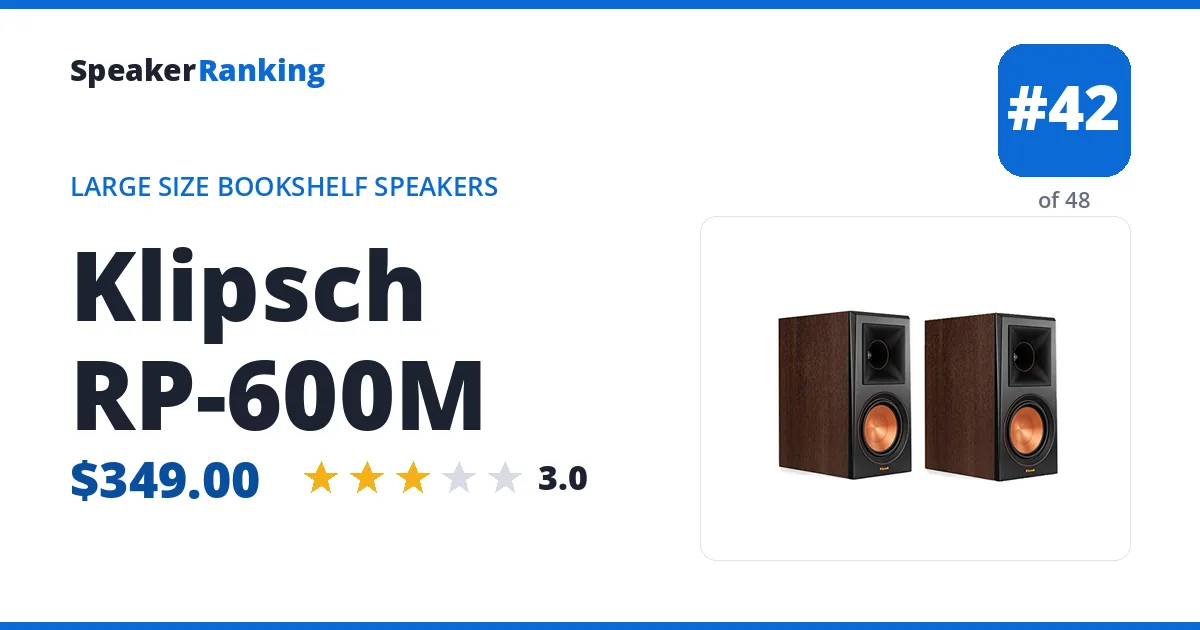
Newer model: the Klipsch RP-600M II, ranked higher, rated 3.7/5.
Pros: More linear horizontal dispersion than the updated RP-600M II: as you move side-to-side, the tonal character changes less, a genuine advantage for off-axis listening consistency. Takes exceptionally well to EQ correction (miniDSP or similar), letting a knowledgeable owner fix its tonal shortcomings without needing to upgrade. Standard 6.5” woofer/horn-tweeter two-way design with reasonably gradual bass rolloff (F3 ~70Hz, F10 ~40Hz) rather than a steep vented-enclosure cutoff. Measured bass extension of 73Hz (-3dB), with a measured sensitivity of 85.2dB.
Cons: A strong, annoying resonance in the lower vocal range around 300Hz stands out clearly (though it can be EQ’d out). Overall tonal balance is notably less neutral than the newer RP-600M II, with a roughly 3-4dB suckout in the estimated in-room response. The waveguide doesn’t extend flush to the baffle edge, increasing diffraction compared to the redesigned version. Klipsch’s marketed sensitivity spec (about 96dB) is a half-space, in-room-style rating roughly 9dB above the true anechoic figure (closer to 85-86dB), which can mislead buyers comparing spec sheets. Elevated treble on-axis, similar to its successor, benefits from toe-out or careful placement. Vertical listening tolerance is limited to about ±10° from the tweeter axis. Still needs a subwoofer for real bass weight; a boost around 120Hz gives kick drums their “tambour” without the underlying “meat.”. Discontinued.
Full Klipsch RP-600M review and specifications →
| Bass Extension (-10dB) | 40Hz (measured, Erin’s Audio Corner) |
|---|---|
| Bass Extension (-3dB) | 73Hz (measured, Erin’s Audio Corner) |
| DIY Kit | No |
| Dimensions | 15.7”H x 8”W x 11.9”D (398.8 x 203.2 x 302.3 mm) |
| Drivers | 6.5” Cerametallic cone woofer, 1” titanium LTS vented tweeter with Tractrix horn |
| Impedance | 8 ohms nominal, 3.5 ohms minimum (measured, Erin’s Audio Corner) |
| Sensitivity | 85.2dB (measured, Erin’s Audio Corner) |
| Spinorama Preference Score | 3.66 |
| Spinorama Preference Score with Perfect Sub | 5.61 |
| Weight | 16.1 lbs (7.3 kg) each |
| Woofer Cabinet | ported |
- Links
- Reviews, Comparisons and Sound Samples
- Erin’s Audio Corner: The Truth about Klipsch’s “NEW” Sound. RP-600M Update. More from Erin’s Audio Corner →
- Erin’s Audio Corner Website Klipsch RP-600M
- GR-Research: We Bought The "NEW" RP-600M II Is KLIPSCH Listening?! More from GR-Research →
- Audio Science Review Measurements More from Audio Science Review →
- Audio Science Review Measurements (spinorama.org)
- Head-to-Head Comparisons
- Klipsch RP-600M vs Sonus Faber Lumina II Amator
- Klipsch RP-600M vs Wharfedale Diamond 9.1
- Klipsch RP-600M vs Triangle Borea BR03
- Klipsch RP-600M vs KEF Q350
- Klipsch RP-600M vs B&W 805S
- Klipsch RP-600M vs Emotiva Airmotiv B2+
- Klipsch RP-600M vs Aperion Audio Verus V8B
- Klipsch RP-600M vs JBL XPL-90
- See all 30 comparisons