Short answer: the JBL 306P MKII. It ranks #69 of 118 powered bookshelf speakers by sound quality, rated 4.1/5, at $238; the KRK Rokit 7 G4 ranks #98, rated 3.9/5, and costs $334, so there is little reason to consider the other one.
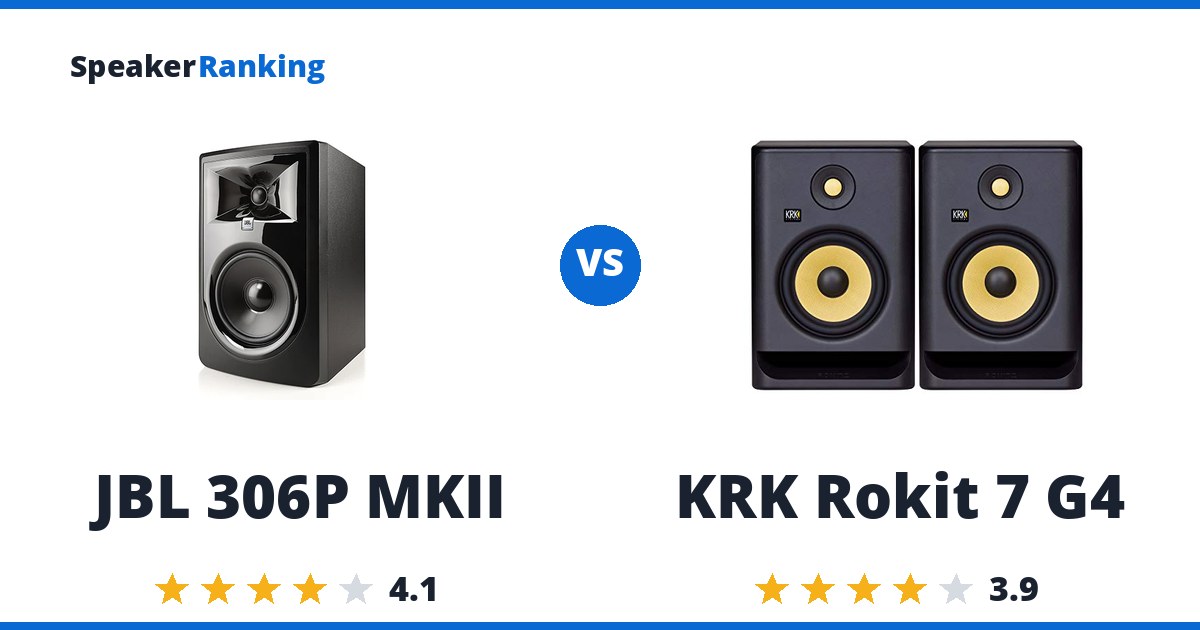
What the JBL 306P MKII does well: A 6.94 ideal-subwoofer score and 46.9Hz measured -3dB extension make this a useful affordable nearfield monitor. Watch for: The 3.4dB response span from 300Hz to 5kHz is less even than the JBL 308P MKII’s, with midrange resonances affecting neutrality.
Why pick the KRK Rokit 7 G4: The 7-inch format offers a middle ground between compact monitors and larger 8-inch cabinets. It has an adjustable EQ, which the JBL 306P MKII lacks. The tradeoff: Its balanced studio inputs need a suitable source connection rather than offering built-in consumer streaming.
Buy the JBL 306P MKII. It is rated higher for sound quality than the KRK Rokit 7 G4 and costs less, so only choose the other one for a particular feature it does better.
Want more options? Browse the full Powered Home rankings.
Specifications Side By Side
| JBL 306P MKII | KRK Rokit 7 G4 | |
|---|---|---|
| Price | $238 per pair | $334.00 per pair |
| Ranked | #69 of 118 in Large Size Powered Bookshelf Speakers | #98 of 118 in Large Size Powered Bookshelf Speakers |
| Bass Extension (-3dB) | 46.9Hz (measured, Audio Science Review) | - |
| Bass Extension (-10dB) | 38.6Hz (derived, log-interpolated between spinorama.org -9dB/-12dB points) | - |
| Dimensions | 16.1”H x 11.2”W x 12.9”D (408 x 285 x 328 mm) | 13.4”H x 8.9”W x 11.2”D (340.4 x 226.1 x 284.5 mm) |
| Frequency Response | 39Hz - 24kHz (-10dB) (Manufacturer specified) | 42Hz - 40kHz (Manufacturer specified) |
| Weight | 13.4 lbs (6.1 kg) each | 16.8 lbs (7.6 kg) |
| Drivers | 6.5” woofer, 1” neodymium tweeter | 7” (178mm) woofer |
| App | No | No |
| EQ | No | Yes (Room adjustment) |
| DSP | No | No |
| Amplifier Power | 112W total | 145w Per Speaker |
| Spinorama Preference Score | 5.06 | - |
| Spinorama Preference Score with Perfect Sub | 6.94 | - |
| Inputs | XLR, 1/4” TRS | TRS, XLR |
| XLR Input | Yes | Yes |
| RCA Input | No | No |
| TRS Input | Yes | Yes |
| Optical Input | No | No |
| Coaxial Input | No | No |
| USB Input | No | No |
| HDMI Input | No | No |
| AES Input | No | No |
| Aux Input | No | No |
| Bluetooth | No | No |
Watch Them Compared
Videos and reviews that test both speakers side by side.
Related Speaker Comparisons
More top alternatives to JBL 306P MKII:
- Genelec 8361A vs JBL 306P MKII
- JBL 306P MKII vs Genelec 8341A
- JBL 306P MKII vs ADAM Audio S2V
- Neumann KH 310 A vs JBL 306P MKII
- JBL 308P MKII vs JBL 306P MKII
Prices on this page were last checked October 10, 2026 at 5:37 PM UTC. Product prices and availability are accurate as of that date/time and are subject to change; the price and availability shown on Amazon at the time of purchase will apply to the purchase of this product.
As an eBay Partner, we may be compensated if you make a purchase.
The Two Speakers In Full
 JBL 306P MKII: $238 per pair Amazon B&H Photo Video eBay
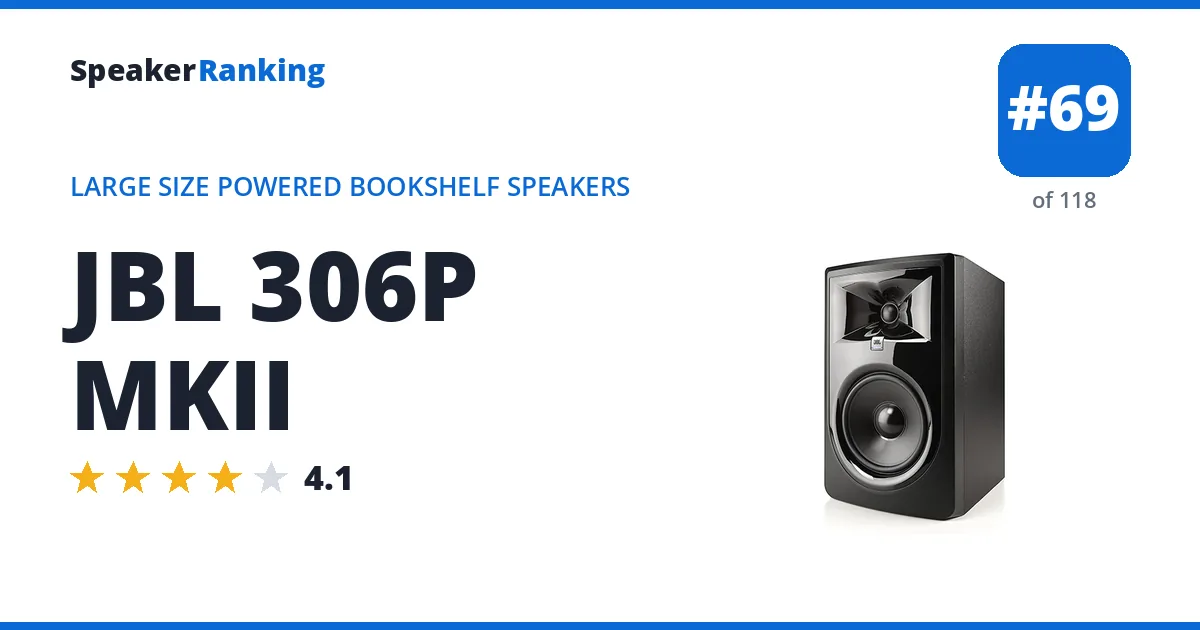
Same family: the JBL 305P MKII (smaller bookshelf, rated 4.3/5) and the JBL 308P MKII (larger bookshelf, ranked higher, rated 4.4/5). See every JBL 3 Series generation.
Pros: A 6.94 ideal-subwoofer score and 46.9Hz measured -3dB extension make this a useful affordable nearfield monitor. The waveguide supports broad horizontal listening coverage, and basic boundary controls help with setup. Measured bass extension of 46.9Hz (-3dB).
Cons: The 3.4dB response span from 300Hz to 5kHz is less even than the JBL 308P MKII’s, with midrange resonances affecting neutrality. Hiss can matter at a quiet desk, while bass distortion limits demanding playback. A subwoofer improves bandwidth but does not remove the midrange irregularities. A narrow dip around 1.6kHz shows in the on-axis and listening-window curves.
Full JBL 306P MKII review and specifications →
| Released | Aug 2018 (8 years ago) |
|---|---|
| AES Input | No |
| Amplifier Power | 112W total |
| App | No |
| Aux Input | No |
| Bass Extension (-10dB) | 38.6Hz (derived, log-interpolated between spinorama.org -9dB/-12dB points) |
| Bass Extension (-3dB) | 46.9Hz (measured, Audio Science Review) |
| Bluetooth | No |
| Coaxial Input | No |
| DSP | No |
| Dimensions | 16.1”H x 11.2”W x 12.9”D (408 x 285 x 328 mm) |
| Drivers | 6.5” woofer, 1” neodymium tweeter |
| EQ | No |
| Frequency Response | 39Hz - 24kHz (-10dB) (Manufacturer specified) |
| HDMI Input | No |
| Inputs | XLR, 1/4” TRS |
| Optical Input | No |
| RCA Input | No |
| Spinorama Preference Score | 5.06 |
| Spinorama Preference Score with Perfect Sub | 6.94 |
| TRS Input | Yes |
| USB Input | No |
| Weight | 13.4 lbs (6.1 kg) each |
| XLR Input | Yes |
- Links
- Reviews, Comparisons and Sound Samples
- Audio Science Review Measurements More from Audio Science Review →
- Audio Science Review Measurements (spinorama.org)
- DSAUDIO.review: Adam Audio T7V vs JBL 306P MKII Sound & Frequency Response Comparison More from DSAUDIOreview →
- DSAUDIO.review: KRK Rokit 7 RP7G4 vs JBL 306P MKII Sound & Frequency Response Comparison
- DSAUDIO.review: Kali Audio LP-8 vs JBL 306P MKII Sound & Frequency Response Comparison
- Head-to-Head Comparisons
 KRK Rokit 7 G4: $334.00 per pair Amazon eBay
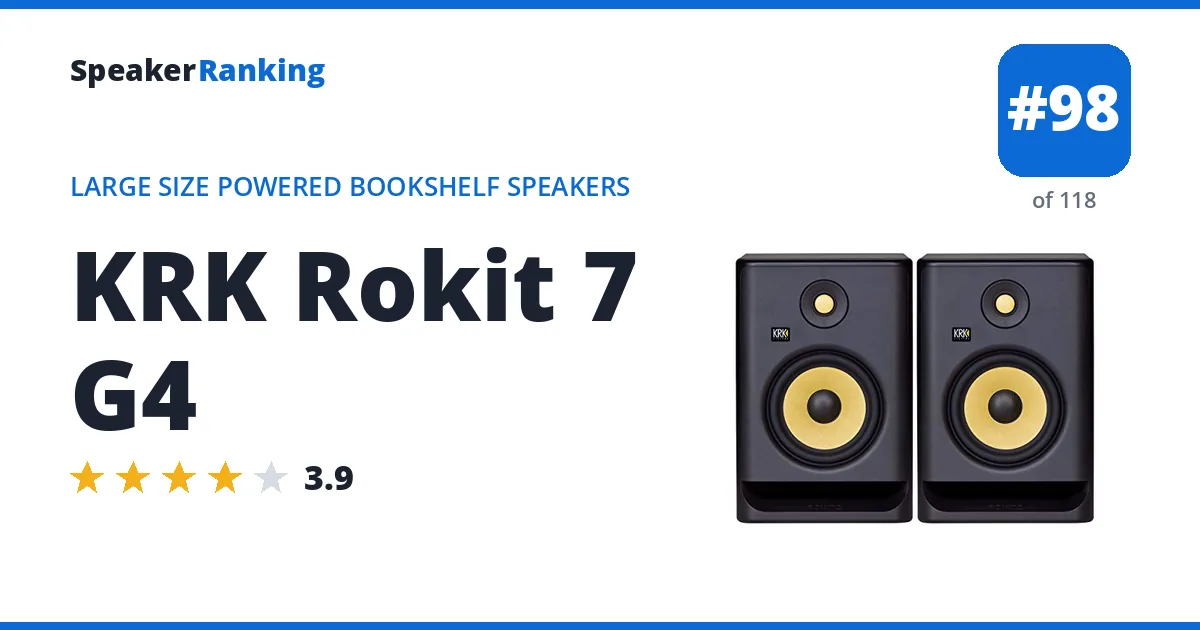
Newer model: the KRK Rokit 7 G5, ranked higher, estimated 4/5, released Mar 2024. See every KRK Rokit generation.
Same family: the KRK Rokit 5 G4 (smaller bookshelf, rated 3.7/5) and the KRK Rokit 8 G4 (larger bookshelf, ranked higher, rated 3.9/5).
Pros: The 7-inch format offers a middle ground between compact monitors and larger 8-inch cabinets. Balanced inputs and room-adjustment controls make it practical for a simple studio installation.
Cons: Its balanced studio inputs need a suitable source connection rather than offering built-in consumer streaming. The cabinet still occupies appreciably more desk space than a compact monitor.
Full KRK Rokit 7 G4 review and specifications →
| Released | Apr 2019 (7 years ago) |
|---|---|
| AES Input | No |
| Amplifier Power | 145w Per Speaker |
| App | No |
| Aux Input | No |
| Bluetooth | No |
| Coaxial Input | No |
| DSP | No |
| Dimensions | 13.4”H x 8.9”W x 11.2”D (340.4 x 226.1 x 284.5 mm) |
| Drivers | 7” (178mm) woofer |
| EQ | Yes (Room adjustment) |
| Frequency Response | 42Hz - 40kHz (Manufacturer specified) |
| HDMI Input | No |
| Inputs | TRS, XLR |
| Optical Input | No |
| RCA Input | No |
| TRS Input | Yes |
| USB Input | No |
| Weight | 16.8 lbs (7.6 kg) |
| XLR Input | Yes |
- Links
- Reviews, Comparisons and Sound Samples
- DSAUDIO.review: KRK Rokit 7 G4 RP7G4 vs Adam Audio T7V Sound & Frequency Response Comparison More from DSAUDIOreview →
- DSAUDIO.review: KRK Rokit 7 G4 RP7G4 vs Yamaha HS7 Sound & Frequency Response Comparison
- DSAUDIO.review: KRK Rokit 5 RP5G4 vs KRK Rokit 7 RP7G4 Sound & Frequency Comparison
- DSAUDIO.review: KRK Rokit 7 RP7G4 vs JBL 306P MKII Sound & Frequency Response Comparison
- Head-to-Head Comparisons