Short answer: the Klipsch The Nines, narrowly, because the JBL’s 1.6kHz dip is the one blemish. The 306P MKII at $398 against $999.99 has a nice, smooth on-axis response with very good directivity control for a compact 6.5” monitor, though a narrow but noticeable dip around 1.6kHz appears on-axis and in the listening window. The Nines are Erin’s favorite Klipsch speaker he has heard, needing only a -2dB tweeter trim.
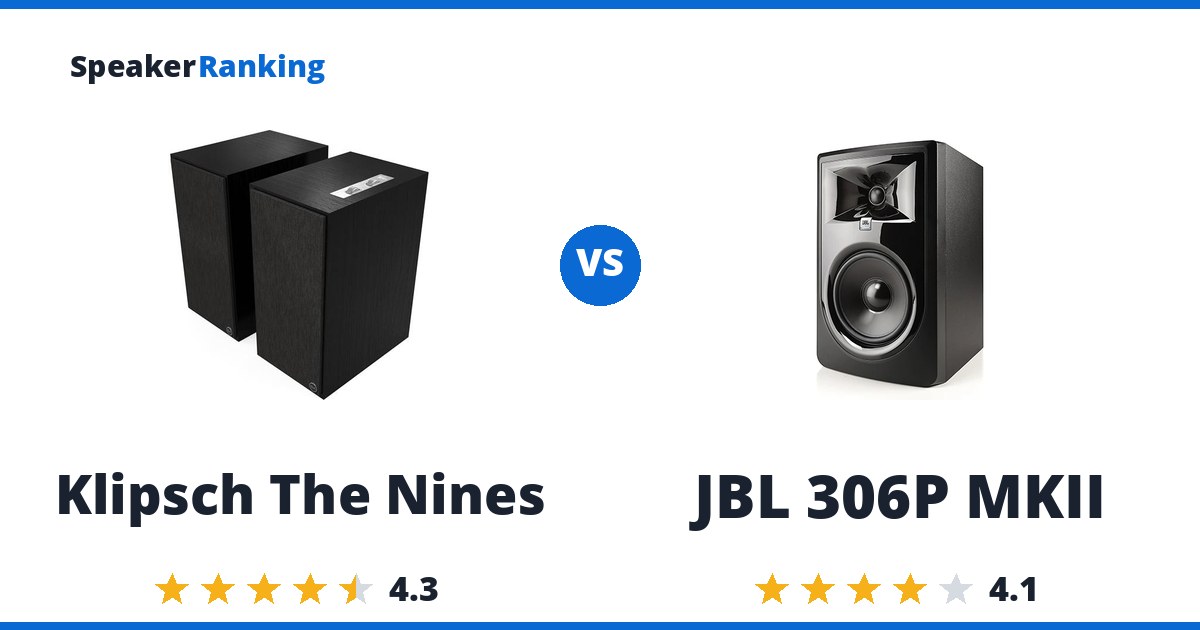
Buy the Klipsch The Nines if sound quality is the priority over the price, or the JBL 306P MKII if the price is the priority over sound quality.
Want more options? Browse the full Powered Home rankings.
Specifications Side By Side
| Klipsch The Nines | JBL 306P MKII | |
|---|---|---|
| Price | $999.99 per pair | $398 per pair |
| Ranked | #40 of 68 in Large Size Powered Bookshelf Speakers | #41 of 68 in Large Size Powered Bookshelf Speakers |
| Drivers | 8” high-excursion fiber-composite woofer, 1” titanium LTS vented tweeter with Tractrix horn | 6.5” woofer, 1” neodymium tweeter |
| Amplifier Power | 240W total (480W peak; 100W LF + 20W HF per powered speaker) | 112W total |
| Inputs | HDMI ARC, Bluetooth 5.0, phono/line RCA, 3.5mm, USB, optical | XLR, 1/4” TRS |
| Bluetooth Codecs | SBC, AAC, aptX, aptX HD | - |
| Dimensions | 19.13”H x 9.5”W x 13.38”D | 16.1”H x 11.2”W x 12.9”D (408 x 285 x 328 mm) |
| Weight | 28.4 lbs (12.9 kg) primary, 26.9 lbs (12.2 kg) secondary | 13.4 lbs (6.1 kg) each |
| Sensitivity | 82.5dB (measured at 0.30V/1m, Erin’s Audio Corner) | - |
| Bass Extension (-3dB) | 42.5Hz (measured, Erin’s Audio Corner) | 46.9Hz (measured, Audio Science Review) |
| Bass Extension (-10dB) | 31Hz (measured, Erin’s Audio Corner) | 38.6Hz (derived, log-interpolated between spinorama.org -9dB/-12dB points) |
| Frequency Response | 34Hz - 25kHz +/-3dB (manufacturer specified) | 39Hz - 24kHz (-10dB) (Manufacturer specified) |
| App | Klipsch Connect (bass/mid/treble EQ) | No |
| Woofer Cabinet | rear-ported bass reflex | - |
| Maximum SPL | 115dB at 1m (stereo pair, manufacturer specified) | - |
| Spinorama Preference Score | 5.32 | 5.06 |
| Spinorama Preference Score with Perfect Sub | 6.90 | 6.94 |
| Subwoofer Output | Yes | - |
| Outputs | Subwoofer | - |
| XLR Input | No | Yes |
| RCA Input | Yes | No |
| TRS Input | No | Yes |
| Optical Input | Yes | No |
| Coaxial Input | No | No |
| USB Input | Yes | No |
| HDMI Input | Yes | No |
| AES Input | No | No |
| Aux Input | Yes | No |
| Bluetooth | Yes, 5.0 | No |
| EQ | - | No |
| DSP | - | No |
Related Speaker Comparisons
More worthwhile head-to-heads for Klipsch The Nines:
- Klipsch The Nines vs Genelec 8351B
- Klipsch The Nines vs Neumann KH420
- Klipsch The Nines vs Genelec 8361A
- Klipsch The Nines vs Genelec 8341A
- Klipsch The Nines vs Neumann KH 150
Prices on this page were last checked October 2, 2026 at 10:18 PM UTC. Product prices and availability are accurate as of that date/time and are subject to change; the price and availability shown on Amazon at the time of purchase will apply to the purchase of this product.
As an eBay Partner, we may be compensated if you make a purchase.
The Two Speakers In Full
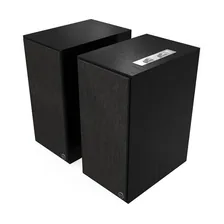 Klipsch The Nines: $999.99 per pair Crutchfield eBay
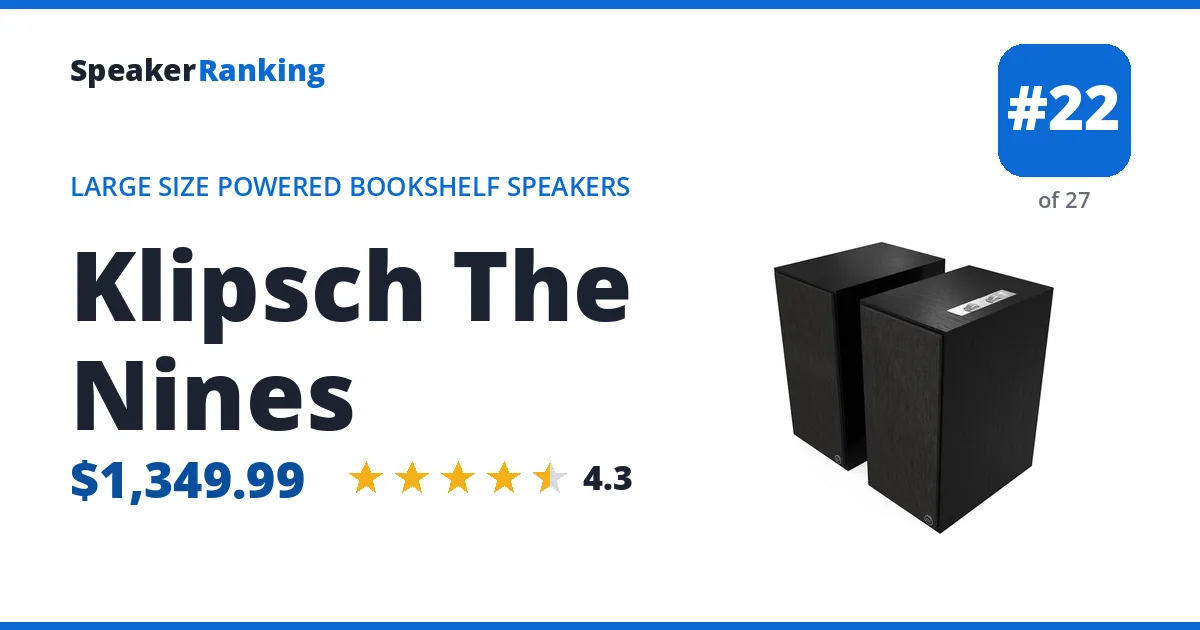
Pros: The 1.7dB response span from 300Hz to 5kHz supports even mids, and measured -3dB extension is 42.5Hz. Extensive consumer connections and app adjustment make it convenient for TV and music, while the horn provides a focused listening presentation. Erin called it his favorite Klipsch speaker. Measured bass extension of 42.5Hz (-3dB), with a measured sensitivity of 82.5dB.
Cons: The 6.90 ideal-subwoofer score reflects limitations beyond the narrow midband span. Horizontal coverage is relatively focused, so placement matters for multiple seats. The reviewer preferred reduced treble, and bass limiting at higher playback levels means the large woofer is not a guarantee of unlimited output. The app’s flat setting leaves treble elevated; Erin preferred a -2dB tweeter trim.
Full Klipsch The Nines review and specifications →
| AES Input | No |
|---|---|
| Amplifier Power | 240W total (480W peak; 100W LF + 20W HF per powered speaker) |
| App | Klipsch Connect (bass/mid/treble EQ) |
| Aux Input | Yes |
| Bass Extension (-10dB) | 31Hz (measured, Erin’s Audio Corner) |
| Bass Extension (-3dB) | 42.5Hz (measured, Erin’s Audio Corner) |
| Bluetooth | Yes, 5.0 |
| Bluetooth Codecs | SBC, AAC, aptX, aptX HD |
| Coaxial Input | No |
| Dimensions | 19.13”H x 9.5”W x 13.38”D |
| Drivers | 8” high-excursion fiber-composite woofer, 1” titanium LTS vented tweeter with Tractrix horn |
| Frequency Response | 34Hz - 25kHz +/-3dB (manufacturer specified) |
| HDMI Input | Yes |
| Inputs | HDMI ARC, Bluetooth 5.0, phono/line RCA, 3.5mm, USB, optical |
| Maximum SPL | 115dB at 1m (stereo pair, manufacturer specified) |
| Optical Input | Yes |
| Outputs | Subwoofer |
| RCA Input | Yes |
| Sensitivity | 82.5dB (measured at 0.30V/1m, Erin’s Audio Corner) |
| Spinorama Preference Score | 5.32 |
| Spinorama Preference Score with Perfect Sub | 6.90 |
| Subwoofer Output | Yes |
| TRS Input | No |
| USB Input | Yes |
| Weight | 28.4 lbs (12.9 kg) primary, 26.9 lbs (12.2 kg) secondary |
| Woofer Cabinet | rear-ported bass reflex |
| XLR Input | No |
- Links
- Reviews, Comparisons and Sound Samples
- Head-to-Head Comparisons
- Klipsch The Nines vs JBL 708P
- Klipsch The Nines vs JBL 4329P
- Klipsch The Nines vs JBL M2 Master Reference Monitor
- Klipsch The Nines vs APS Klasik 2020
- Klipsch The Nines vs Genelec 8040B
- Klipsch The Nines vs Kali Audio LP-6
- Klipsch The Nines vs Emotiva Airmotiv 6s
- Klipsch The Nines vs Focal Solo6 ST6
- See all 33 comparisons
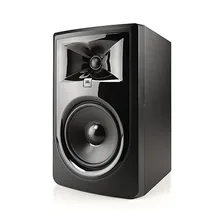 JBL 306P MKII: $398 per pair B&H Photo Video eBay
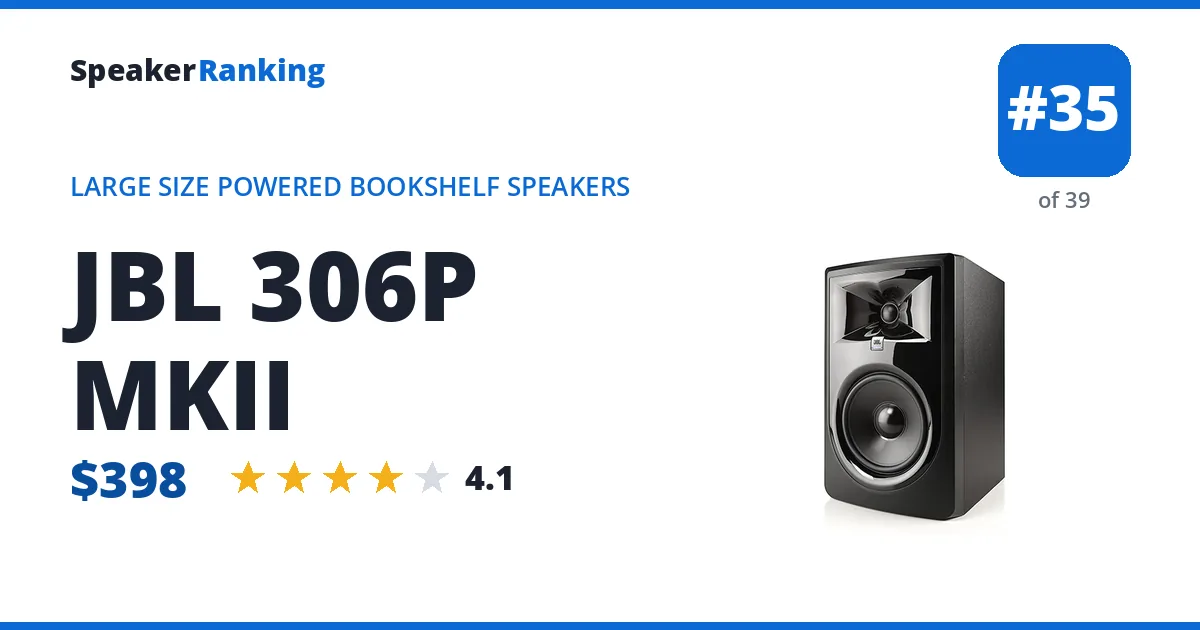
Pros: A 6.94 ideal-subwoofer score and 46.9Hz measured -3dB extension make this a useful affordable nearfield monitor. The waveguide supports broad horizontal listening coverage, and basic boundary controls help with setup. Measured bass extension of 46.9Hz (-3dB).
Cons: The 3.4dB response span from 300Hz to 5kHz is less even than the 308P MKII’s, with midrange resonances affecting neutrality. Hiss can matter at a quiet desk, while bass distortion limits demanding playback. A subwoofer improves bandwidth but does not remove the midrange irregularities. A narrow dip around 1.6kHz shows in the on-axis and listening-window curves.
Full JBL 306P MKII review and specifications →
| AES Input | No |
|---|---|
| Amplifier Power | 112W total |
| App | No |
| Aux Input | No |
| Bass Extension (-10dB) | 38.6Hz (derived, log-interpolated between spinorama.org -9dB/-12dB points) |
| Bass Extension (-3dB) | 46.9Hz (measured, Audio Science Review) |
| Bluetooth | No |
| Coaxial Input | No |
| DSP | No |
| Dimensions | 16.1”H x 11.2”W x 12.9”D (408 x 285 x 328 mm) |
| Drivers | 6.5” woofer, 1” neodymium tweeter |
| EQ | No |
| Frequency Response | 39Hz - 24kHz (-10dB) (Manufacturer specified) |
| HDMI Input | No |
| Inputs | XLR, 1/4” TRS |
| Optical Input | No |
| RCA Input | No |
| Spinorama Preference Score | 5.06 |
| Spinorama Preference Score with Perfect Sub | 6.94 |
| TRS Input | Yes |
| USB Input | No |
| Weight | 13.4 lbs (6.1 kg) each |
| XLR Input | Yes |
- Links
- Reviews, Comparisons and Sound Samples
- Head-to-Head Comparisons